



.
.
photo by Rhonda R. Dorsett

.
.
Dear Readers:
…..Good morning from Glacier Bay, Alaska, a stop along my extended vacation north.
…..I am writing to report very sad news. I was recently informed that the poet Michael L. Newell, whose poetry I have published on Jerry Jazz Musician since 2015, passed away on July 31 at the age of 80.
…..Michael was one of the first poets I published on a consistent basis, and over the years he and I corresponded via email countless times. (He called me “Jefe”). Consequently, I have read hundreds of his poems. His work often sensitively combined the miracles of nature and music, and his lifelong travels brought insight, humor, gratitude, and sophistication to virtually every poem. He was an incredibly talented and dedicated poet whose work frequently enabled me to see beauty in the world in ways that I hadn’t previously considered.
…..In the summer of 2019, I had the privilege of meeting Michael in Reedsport, Oregon, where he lived at the time. I had just begun retirement and was facing serious concerns about the future of the website, causing me to consider shuttering it. Over lunch along the Umpqua River, Michael listened patiently to my concerns, eventually getting me to recognize how my own talent for editing could, in its own way, help contribute favorably to contemporary American culture. He told me that I was in the process of “building something very special.” Those words sat with me for a time, and eventually helped me make the decision to continue publishing Jerry Jazz Musician, which has been at the center of how I’ve lived my life since.
…..A couple of years ago I began hearing less from Michael than usual, and I reached out to see if he was doing okay. Without elaborating on his condition, he told me he was facing a serious health crisis, and had little time left. Soon after, his poetry submissions became more frequent and deeply personal and introspective. It was obvious he wanted to share his voice and heart with others via his art.
…..Sometime in the spring of 2025, I asked him if he’d like to share some of his poems written during this era of his life with readers. He said that he would, and we set out to put a collection together, culminating in the June, 2025 publication of “What is this Path.” You can read it by clicking here.
…..I have written in the past that the most rewarding part of editing and publishing this website over the years is that it has given me the opportunity to meet so many wonderfully creative writers, but more importantly, really good people.
Michael was one of them. And I miss him deeply.
Joe Maita
Editor/Publisher
Jerry Jazz Musician
.
.
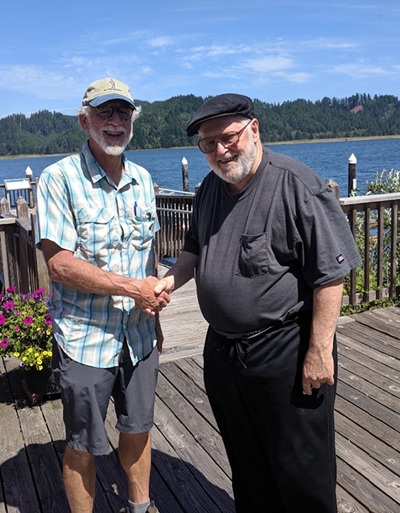
Michael L. Newell (right), with Joe Maita. Reedsport, Oregon. August 12, 2019
.
.
___
.
.
These are the last poems Michael sent to his friends on July 27. They may have been his final poems.
.
Three Miniatures
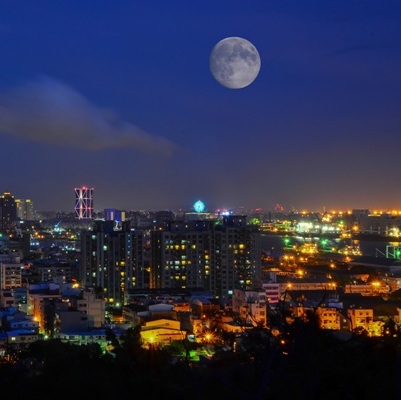
sliver of moon floats in puddles
stitched by rain
on soaked midnight streets
*****
broken shards of midnight moon
ghosts lost in roiling creek
wind sings with abandon
*****
borne upon ocean waves
wild psalm of infinite praise
as sun rises
.
.
Click here to read the first poems of Michael’s published on Jerry Jazz Musician/November, 2015
Click here to read Michael’s June 2025 Jerry Jazz Musician collection “What is this Path”
Click here to have access to all of Michael’s poems published on Jerry Jazz Musician
Click here to read “Pax Vobiscum,” the final poem published on Jerry Jazz Musician (July 28, 2026)
.
.
___
.
.
Michael Lee Newell
10/31/1945 – 07/31/2026
(eulogy written by Michael’s brother Patrick)
.
Michael was born a rambling man. Son of career Navy sailor, he was born on a Navy base in Jacksonville Florida. He grew up traveling from city to city, across the nation and even spending almost two years in Japan. There he played baseball with the locals, among his fondest early memories, ultimately inspiring one of his most loved poems, “Leaving Yokohama”.
He spent years in a Seminary, studying for the priesthood, loving catholicism and basketball. The former love faded, but his passion for basketball endured lifelong. Turning 18, he joined the U.S. Air Force, signing for a four year term which began a week after Kennedy was assassinated. Getting a place in the world away from home was the main motivation. He served in various bases in the U.S., and, as the Vietnam war heated up, in both the Philippines and Thailand, mostly the former. In those days apparently the North Vietnamese pilots still used Morse code. He was trained to be an adept eavesdropper, listening in and recording the sequences of dots and dashes.
After four years service, and with an honorable discharge, he returned to Los Angeles, living first with our parents, later with various roommates. He earned B.S. and M.S. degrees in theatre from CalState Northridge, a school with a reputation for launching acting careers. Here he met the great love of his life — quite possibly the only love of his life — Carol. The two aspiring thespians spent years together, traveling the circuit of regional theaters, dinner theaters, anywhere roles were offered. Some gigs, like the Oregon Shakespeare Theatre, were prestigious, but the pay was rarely enough.
Eventually it became apparent that acting was never going to take off as hoped (inspiring the poem “Thursday Day I gave up Acting”). A new direction was needed. Carol wanted a marriage, children, a home, a white picket fence. Michael wanted to travel the world all the days of his life, forever a stranger seeing new sights. Both got what they wanted. Michael never forgot Carol, decades later writing “Recidivist” about how his thoughts would wind back to her.
For the next several decades Michael earned his living as a teacher. He taught English and Drama among other subjects, and not infrequently coached basketball. He typically lasted no more than a year or two anywhere before finding reasons to move on. He proudly spoke of living in 22 different countries. Some of those that pop to mind include Saudi Arabia, Kuwait, United Arab Emirates and Jordan; Mexico and Bolivia, and Uzbekistan. As he aged his choices narrowed, since the potential health care liabilities discourage hiring beyond a certain age. His last three years teaching were spent in Rwanda, where he contracted several diseases including malaria.
Out of eight siblings, Michael alone never married. Possibly this is why he remained closest to our parents, spending summers on the Oregon coast, in Reedsport where they enjoyed their own lengthy retirement. The more he aged the more he appreciated his folks. Our father especially was the subject of “The Hand That Was Never Withdrawn”, and “Yankee Trader”.
By age 68, Michael no longer felt physically or mentally up to the rigors of his profession. Always unworldly, Michael wrote that “life felt like a dance where I never learned the steps.” With some sibling help Michael retired, taking residence first in Reedsport. Unfortunately when his landlord died, the new owner demanded twice the rent he had been paying. Our mother, then near death, was very worried about Michael becoming homeless. Michael said his gut twisted at the prospect. Brotherly promises were given that that would never happen. Brothers kept their promises.
For the last seven years of his life, Michael lived in Stuart, Florida, three hours drive from his birthplace. It is the longest time in one place he spent anywhere in his 80 years. Michael continued to publish poems in various magazines, and numerous chapbook collections all the days of his life. He continued communicating with poetry friends around the world until the end.
Shortly before passing, he received the devastating diagnosis of Lewy Body Dementia. On his final day alive he was pressing me for details from the neurologist. I asked him what specifically he was after. All he wanted to know was “Will I still be able to write poetry?”
The final words Michael heard on Earth were from Wendy, after giving him his nightly pills. “You are safe here, Michael.” He died in his sleep a few hours later.
It pleases me to think that the Stranger to the Land and his beloved restless parents are together again.
.
.
___
.
.
.

Jerry Jazz Musician…human produced since 1999
.
.
.









I didn’t just enjoy Michael J. Newell’s poetry. I appreciated him as a human being and how welcoming, supportive and respectful he was toward other poets who contribute their work to Jerry Jazz Musician.
He will be missed.
I loved Mr. Newell.
He was such a cool person and spoke very highly of you and the magazine and was always in awe that you wanted to publish his poems.