
“The Pianoless Tradition in Modern Jazz” – a playlist by Bob Hecht

May 3rd, 2024

.

.

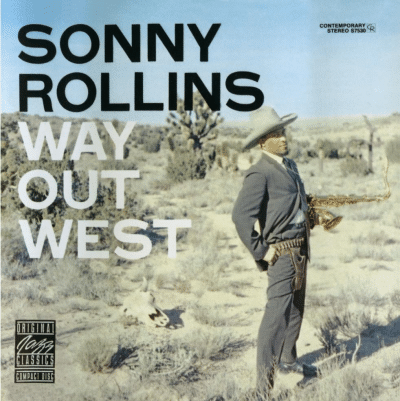
Sonny Rollins’ 1957 album  Way Out West  (Contemporary Records) features the trio of himself on saxophone, bassist Ray Brown, and drummer Shelly Manne.  Music from it is included in an extensive playlist Bob Hecht built around examples of prominent pianoless modern jazz.

.

.

___

.

.


…..The ‘tradition’ of pianoless modern jazz extends back more than seventy years, to the early fifties and Gerry Mulligan’s quartets with Chet Baker. Mulligan sought more harmonic freedom, eschewing the piano in favor of a more dominant role for the bass, and thereby enabling the soloists a greater feeling of openness or space for their own musical concepts.

…..Since those early experiments, the pianoless format (meaning here, more precisely, the absence of a chordal instrument, whether piano, guitar, or vibes) has been utilized extensively by an impressive array of notable, creative jazz musicians. These include a number of both ‘mainstream’ and ‘free’ jazz artists, such as: Sonny Rollins, Ornette Coleman, Lee Konitz, Dave Holland, Joe Henderson, John Coltrane, Steve Lacy, Avishai Cohen, Kirk Knuffke, Max Roach, Branford Marsalis, Joshua Redman, Jack DeJohnette, Warne Marsh, Kenny Garrett, Charles Mingus, Joe Lovano, Tom Harrell, Dave Liebman, Dave Douglas, Mark Turner, Elvin Jones, John Ellis, Ray Anderson, and others.

…..Mulligan once described his rationale behind his pioneering choice of cutting out the piano from so many of his bands:

…..“I consider the string bass to be the basis of the sound of the group, the foundation on which the soloist builds his line, the main thread around which the two horns weave their contrapuntal interplay … When a piano is used in a group it necessarily plays the dominant role; the horns and bass must tune to it as it cannot tune to them, making it the dominant tonality. The piano’s accepted function of constantly stating the chords of the progression, making the solo horn a slave to the whims of the piano player.”

…..Sonny Rollins explained the attraction for him of the pianoless format:

…..“I was kind of disappointed with piano accompaniment. I was obliged to play with it … but I couldn’t seem to find a guy who could contribute. They got in the way. They played too much. Their chords interrupted my train of thought. I ended up getting bugged at all piano players. And got this idea that I didn’t need piano. I feel it’s worked out much more successfully without a piano player.”

…..Ornette Coleman said this about the freedom attained without the chording instrument:

…..“… if you put a conventional chord under my note, you limit the number of choices I have for my next note; if you do not, my melody may move freely in a far greater choice of directions.”

…..It’s generally recognized that for the pianoless format to work musically, it requires not only a strong horn soloist (or soloists), but a bassist and drummer who can lock in together and stay rhythmically involved with the soloist. In capable, creative hands, the openness of the format allows for a great deal of interaction between the musicians, and a transparency that can enable the discerning listener to participate in those interactions. It can, in short, produce a liberating feeling in both the musicians and the listener.

…..Writer Peter Watrous described the phenomenon in a New York Times article in 1997, this way:

..“…groups that perform pianoless often become more flexible; they open up. Without the pianist dictating the background, improvisers can look into the back alleyways of a tune without fear of playing clashing notes.”

…..In essence, it’s quite an adventurous choice for a band, akin to playing jazz ‘without a parachute,’ as another writer has described it. Such groups tend to sound less confined, even more expansive.

…..The following long-form Spotify playlist presents some of the most outstanding examples of the pianoless approach, and includes many of the artists mentioned in this introduction.  Enjoy!

.

.

.

___

.

.

 

This playlist was assembled by Bob Hecht, who frequently contributes his essays, photographs, interviews, playlists and personal stories to Jerry Jazz Musician. He has a long history of producing and hosting jazz radio programs; his former podcast series, The Joys of Jazz,  was the 2019 Silver Medal winner in the New York Festivals Radio Awards. In addition, he is a widely published fine art photographer, whose work has appeared multiple times in The Sun, LensWork, Black & White Magazine, Zyzzyva and other periodicals, as well as in the book, Dream of Venice in Black & White, published by Bella Figuera Publications. He lives with his wife in Portland, Oregon. His photo website is roberthecht.com.

.

.

In addition to putting together great playlists, Bob has conducted several fine interviews for Jerry Jazz MusicianClick here to read his interview with Pepper Adams biographer Gary Carner.  Click here to read “Life in E Flat” – a conversation about Phil Woods – with pianist Bill Charlap and jazz journalist Ted Panken, and click here to read his interview with Alyn Shipton, author of The Gerry Mulligan 1950’s Quartets.

Click here to view all playlists published on Jerry Jazz Musician


.

.

___

.

.

Click here to read The Sunday Poem

Click here to read “A Collection of Jazz Poetry – Summer, 2023 Edition”

Click here to read “Ballad,” Lúcia Leão’s winning story in the 65th Jerry Jazz Musician Short Fiction Contest

Click here for information about how to submit your poetry or short fiction

Click here to subscribe to the (free) Jerry Jazz Musician quarterly newsletter

Click here to help support the ongoing publication of Jerry Jazz Musician, and to keep it ad and commercial-free (thank you!)

.

___

.

.

Jerry Jazz Musician…human produced (and AI-free) since 1999

.

.

.

Share this:

Comment on this article:

Your email address will not be published. Required fields are marked *

Site Archive

Your Support is Appreciated

Jerry Jazz Musician has been commercial-free since its inception in 1999. Your generous donation helps it remain that way. Thanks very much for your kind consideration.

Click here to read about plans for the future of Jerry Jazz Musician.

In this Issue

Announcing the publication of Volume II of Kinds of Cool: An Interactive Collection of Jazz Poetry...The second edition of Kinds of Cool, an Interactive Collection of Jazz Poetry has just been published, and is now available for sale on Amazon.com. This edition is dedicated to publishing women poets from all over the world who share their personal passion for and relationship with jazz music, and the culture it interacts with. With a foreword by Allison Miller, one of the world’s most eminent jazz drummers, and photography and design by Rhonda R. Dorsett

Poetry

photo by William Gottlieb/adapted by Rhonda R. Dorsett
21 jazz poems on the 21st of April, 2026...An ongoing series designed to share the quality of jazz poetry continuously submitted to Jerry Jazz Musician. In this edition…Mix in poems on the blues with some Coltrane, Monk, Bix, Mingus, Miles, Art Farmer, King Oliver, Desmond, and Brubeck, and you have one hell-of-a lively and entertaining collection to take in. Enjoy!

Community

A collection of poetic responses to the events of 2025...Forty poets describe their experiences with the tumultuous events of 2025, resulting in a remarkable collection of work made up of writers who may differ on what inspired them to participate, but who universally share a desire for their voice to be heard amid a changing America.

The Sunday Poem

photo via Pixabay

The Sunday Poem: “Shivers” by Howard Osborne

The Sunday Poem is published weekly, and strives to include the poet reading their work...

Howard Osborne reads his poem at its conclusion.


Click here to read previous editions of The Sunday Poem

Short Fiction

Photo by Johannes Schröter, via Pexels
Short Fiction Contest-winning story #71 – “Where the Music Wasn’t Allowed,” by Jane McCarthy....The award-winning story is about a young immigrant growing up in Southern California to the sound of music seeping into his family’s home from an upstairs neighbor’s piano, shaping the boy’s understanding of memory, family, belonging, and the improvisational ethics of music.

Interview

photo by Warren Fowler
Interview with John Gennari, author of The Jazz Barn: Music Inn, the Berkshires, and the Place of Jazz in American Life...The author discusses how in the 1950s the Berkshires – historic home to the likes of Hawthorne, Melville, Wharton, Rockwell, and Tanglewood – became a crucial space for the performance, study, and mainstreaming of jazz, and eventually an epicenter of the genre’s avant-garde.

Poetry

photo by Tsutumu Takasu/via Flicker/CC BY 2.0
“Cajun Glory” – a prose poem by Robert Alan Felt

Community

Ricky Esquivel/Pexels.com
Community Bookshelf #6...“Community Bookshelf” is a twice-yearly space where writers who have been published on Jerry Jazz Musician can share news about their recently authored books and/or recordings. This edition includes information about books published within the last six months or so (September, 2025 – March, 2026)

Poetry

Six poets write eight poems (in the midst of our times)...Poets within this community of writers are feeling this moment in time, and writing about it. This collection is another example.

Feature

photo by Laura Stanley via Pexels.com.
Trading Fours, with Douglas Cole, No. 28: “Little Samba”...Trading Fours with Douglas Cole is an occasional series of the writer’s poetic interpretations of jazz recordings and film. This edition is based largely on a documentary – They Shot the Piano Player – about Tenório Junior, a Latin jazz musician who only produced one album (1964) before he “disappeared” in 1976.

Short Fiction

photo J. & L. Caswall Smith
“Bitty’s Last Request” – a short story by Jill Bronfman...In the story – a finalist in the recently concluded 71st Short Fiction Contest – a very old dancer visits her young relative with stories to tell about the old days in the clubs.

Poetry

art by Marsha Hammel
“Learning the Alphabet of the Blues” – a poem by Mary K O’Melveny...A poem from Kinds of Cool: An Interactive Collection of Jazz Poetry, Vol. II

Short Fiction

Alejandro Aznar/via Pexels.com
“Down at the Crossroads” – a short story by David Rudd...In this story – a finalist in the recently concluded 71st Jerry Jazz Musician Short Fiction Contest – a jazz composer hears a lone fiddler play a tune that enters his head and won’t leave it, like a virulent earworm, wrecking his playing, his friendships, and indeed, his life, until he finally finds a way to remove it.

Feature

photo via Wikimedia Commons
Memorable Quotes: Two, by Edward R. Murrow…

Feature

photo via Wikipedia
“Two Famous Johns” – a true jazz story by Bob Hecht...The writer remembers an evening in New York’s Half Note in 1964 when he witnessed a John Coltrane performance that was also attended by the pop singer Johnny Mathis

Poetry

Haiku: Musings – by Connie Johnson...Exploring segments of the world of jazz – in three suites of vivid haiku poetry…

Jazz History Quiz

photo of "Hot Lips" Page by William Gottlieb
Jazz History Quiz #187...This trumpeter began his career in California, where he organized a big band that had a residency in China in 1934, and, during a trip through Kansas City in 1936, was invited to join Count Basie’s orchestra, replacing “Hot Lips” Page (pictured). Who is he?

Feature

“Bohemian Spirit” – A Remembrance of 1970’s Venice Beach, by Daniel Miltz...The writer recalls 1970’s Venice Beach, where creatives chased a kind of freedom that didn’t fit inside four walls…

Poetry

Linnaea Mallette/publicdomainpictures.net
A 2026 jazz poetry calendar...12 individual poets contribute a jazz-themed poem dedicated to a particular month, resulting in a 2026 calendar of jazz poetry that winds through the year with a variety of poetic styles and voices who share their journeys with the music, tying it into the month they were tasked to interpret. Along the way you will encounter the likes of Sonny Stitt, Charles Mingus, Jaco Pastorius, Wynton Kelly, John Coltrane, and Nina Simone.

Feature

Boris Yaro, CC BY 4.0, via Wikimedia Commons
“The Bowie Summer” – a personal memory, and how art can fundamentally reshape identity, by G.D. Newton-Wade

Short Fiction

photo by Iryna Olar/pexels.com 
“The Fading” – a short story by Noah Wilson...The story – a finalist in the recently concluded 70th Short Fiction Contest – examines the impact of genetic illness on a family of musicians and artists.

Poetry

Poems on Charlie “Bird” Parker (inspired by a painting by Al Summ) – an ekphrastic poetry collection...A collection of 25 poems inspired by the painting of Charlie Parker by the artist Al Summ.

Feature

Albert Ayler’s Spiritual Unity – A Classic of Our Time, and for All Time – an essay by Peter Valente...On the essence of Albert Ayler’s now classic 1964 album…

Poetry

Laura Manchinu (aka La Manchù), CC BY 2.0 , via Wikimedia Commons
“Ron Carter Apple Sauce” – a prose poem by Martin Durkin

A Letter from the Publisher

The gate at Buchenwald. Photo by Rhonda R Dorsett
War. Remembrance. Walls.
The High Price of Authoritarianism– by editor/publisher Joe Maita
...An essay inspired by my recent experiences witnessing the ceremonies commemorating the 80th anniversary of liberation of several World War II concentration camps in Germany.

Playlist

photo by Robert Hecht
“Spring is Here!” – a playlist by Bob Hecht...With perhaps Lorenz Hart’s most sardonic lyric — which is saying something! — this song remains one of the greats, and has been interpreted in many ways, from the plaintive and melancholy to the upbeat and hard swinging, such as John Coltrane’s version. Check out this bouquet of ten tracks to celebrate this great season!

Poetry

Wikimedia Commons
“Dorothy Parker, an Icon of the Jazz Age” – a poem by Jane McCarthy

Community

Nominations for the Pushcart Prize L (50)...Announcing the six writers nominated for the Pushcart Prize v. L (50), whose work appeared on the web pages of Jerry Jazz Musician or within print anthologies I edited during 2025.

Interview

Interview with Tad Richards, author of Listening to Prestige: Chronicling its Classic Jazz Recordings, 1949 – 1972...Richards discusses his book – a long overdue history of Prestige Records that draws readers into stories involving its visionary founder Bob Weinstock, the classic recording sessions he assembled, and the brilliant jazz musicians whose work on Prestige helped shape the direction of post-war music.

Contributing Writers

Click the image to view the writers, poets and artists whose work has been published on Jerry Jazz Musician, and find links to their work

Coming Soon

An interview with Paul Alexander, author of Bitter Crop: The Heartache and Triumph of Billie Holiday's Last Year; New poetry collections, Jazz History Quiz, and lots of short fiction; poetry; photography; interviews; playlists; and much more in the works...

Interview Archive

Ella Fitzgerald/IISG, CC BY-SA 2.0 , via Wikimedia Commons
Click to view the complete 25-year archive of Jerry Jazz Musician interviews, including those recently published with Judith Tick on Ella Fitzgerald (pictured),; Laura Flam and Emily Sieu Liebowitz on the Girl Groups of the 60's; Tad Richards on Small Group Swing; Stephanie Stein Crease on Chick Webb; Brent Hayes Edwards on Henry Threadgill; Richard Koloda on Albert Ayler; Glenn Mott on Stanley Crouch; Richard Carlin and Ken Bloom on Eubie Blake; Richard Brent Turner on jazz and Islam; Alyn Shipton on the art of jazz; Shawn Levy on the original queens of standup comedy; Travis Atria on the expatriate trumpeter Arthur Briggs; Kitt Shapiro on her life with her mother, Eartha Kitt; Will Friedwald on Nat King Cole; Wayne Enstice on the drummer Dottie Dodgion; the drummer Joe La Barbera on Bill Evans; Philip Clark on Dave Brubeck; Nicholas Buccola on James Baldwin and William F. Buckley; Ricky Riccardi on Louis Armstrong; Dan Morgenstern and Christian Sands on Erroll Garner; Maria Golia on Ornette Coleman.