
.
.
“An Evening at the Genesee” was a finalist in our recently concluded 65th Short Fiction Contest, and is published with the consent of the author.
.
.
___
.
.
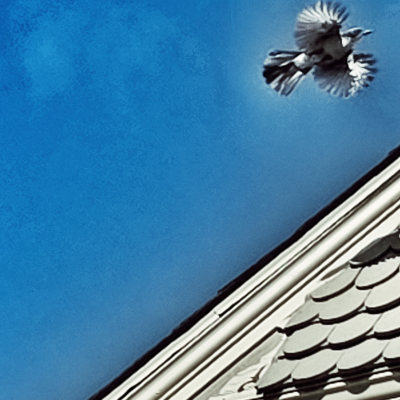
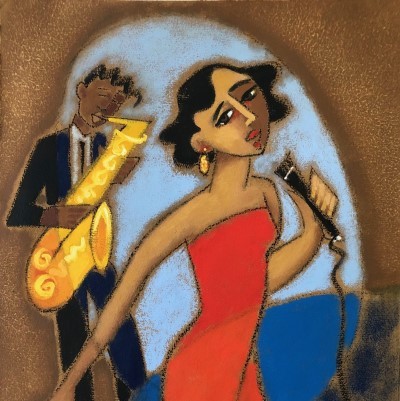
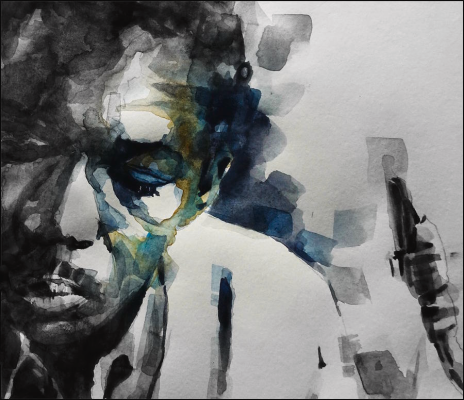
“Lush Life,” by Paul Lovering
.
An Evening At The Genesee
by Salvatore Difalco
.
…..Gents went in the hazily lit front entrance and ladies and escorts slipped in through a steel side door—a vestige of less liberal times. Pat Pirisi and Vince Crea walked me to the front, both as if costumed for a 1970’s discotheque. They held my arms strongly. I didn’t want to be there. I had fallen into a terrible depression after my wife of ten years left me and had walled myself off from the world—that is to say, I had wallowed myself off from the world. Luckily, I had friends who cared about my wellbeing. And this is when good friends should come through, when they can help you keep your head above water, when they’ll stand by your side and assist you as you stagger along—that said, they’ll not want to hear about the marriage or the ex or the impending divorce. They don’t think you’re special or particularly worthy of shoulder-rubbing in that regard. Separation and divorce are commonplace, almost the norm these days and not the exception. The whole sad thing is nothing earth shattering to all but the afflicted parties and then not always. So you just shut your mouth about that and go along with whatever.
…..The boys pulled me up to the glass and brass doors with a hammered green tin sign that read Genesse Tavern. The formidable doorman, with the name “Jimmy” stitched in gold on his black golf shirt, stood there stone-faced with his massive tattooed arms crossed. I wondered if he was married and having problems at home. Domestic harmony doesn’t engender angry men—but was he angry?. He looked like he could make guys shit their pants by punching them in certain areas of the abdomen. He had no nose and no neck. But was he angry?
…..“We’re here to fix up our friend,” Pat said.
…..“Yeah,” Vince said, “he’s all fucked up.”
…..The doorman bared his clenched teeth and said something that sounded like growling. Pat nodded as though he understood what he was saying. The boys pulled me inside. As I passed him, the doorman looked inside my skull with his dead black eyes. Maybe he grasped the depth of my malaise—but being constituted as he was, felt little sympathy. Or maybe tumbleweeds were blowing across the charred desert of his mind and I did not signify at all to him.
…..“Guys,” I said, “I’m not into this.”
…..Pat wrenched my wrist and told me to shut up. “We’re saving your life,” he said. “You should be thanking us.”
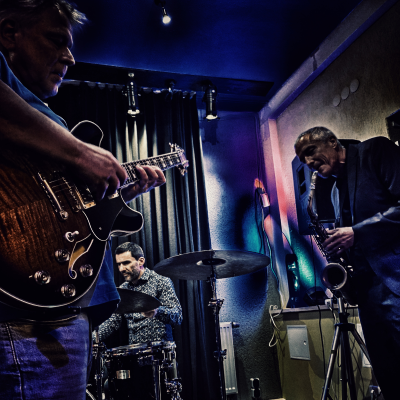
…..The joint smelled like musk oil, urine and stale beer. Someone in a dark corner blew a tenor saxophone accompanied by whispering drums and a softly thrumming bass. I had no idea the place featured a jazz trio. I would have likely come long ago, being a jazz enthusiast. Were they any good? They weren’t bad. But I don’t think anyone else paid them any heed. Drunkards lined the main bar, many with their heads bowed, mute and desolate. We continued into the side section, where men and women hunched in dimly-lit booths sipping cocktails and chatting, the women painted and perfumed, the men freshly-shaven and Old-Spiced. We sat in a booth with me on the inside, Pat blocking my escape.
…..“Why we sitting in the ladies section?” Vince wanted to know, as did I.
…..“So’s we can have a little parley here, see,” Pat said.
…..“Are we negotiating something?” I asked. “And why didn’t you tell me about the band? Who the hell likes jazz in these parts?”
…..“What’s the big deal?” Pat said. “People like it just fine. You like it, no?”
…..“That’s jazz?” Vince said, knitting his brows.
…..Pat elbowed me. He was taking liberties for some reason. The temptation to punch him in the face bubbled inside me, but I also wanted to see where this was going because as is so often the case, I can never anticipate what become eventualities. That is to say, events become eventualities for me only retrospectively. Such as my wife leaving. How did I not anticipate the move? All the signs were there, presumably. The signs are always there. You have to train yourself to see them—or rather steel yourself—and to feel them. But perhaps none of this makes sense to an outsider. Sometimes words can be enemies of understanding, I know. At the end of the day, we try our best and hope that our efforts satisfy the client.
…..“What the fuck are you doing?” Pat asked me.
…..“I’m taking notes,” I said.
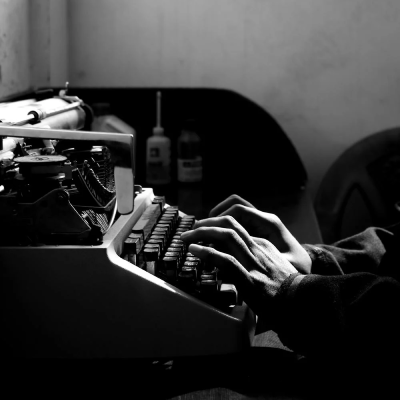
…..Indeed, I’d brought along my trusty notepad and pen. On the advice of my therapist, Dr. Emily Boccaccio, I’d begun journaling, in private and in public. She told me not to hesitate putting pen to paper when I felt so inclined. Would it draw attention, or suspicion? Perhaps, but most people had their eyes glued to their phones and scarcely paid attention to others unless they were doing something offensive, and writing in a notepad could not be thus construed except by an analphabet or a maniac. But I’m stretching the truth a little, aren’t I?
…..“He’s taking notes,” Pat said to Vince, who shrugged. “I said he’s taking notes, you fucking hump.”
…..“So what, he’s taking notes,” Vince said. “Who cares? Maybe he needs to do it. Let’s order a pitcher of beer, I’m dying of thirst.”
…..Pat wanted to know what I was writing.
…..“Details,” I said, “observations, little this and that’s.” He wanted to know for what purpose. “My therapist, Pat,” I said. “I’m writing things down on the advice of my therapist. She thinks the journaling will help me work things out, you know.”
…..Pat shook his head and sneered. “He’s writing stories about us, Vince,” he said.
…..Vince smiled. “That’s good, no?” he said.
…..“That’s not good!” Pat shouted.
…..The band broke into a tune that sounded familiar. “They’re playing Coltrane,” I said. I couldn’t believe it. They were doing a slowed down version of “In A Sentimental Mood.” Pat and Vince looked at me blankly. “You have no idea who Coltrane is, right?” When neither responded, I jotted this down in my notes.
…..“What did you just write?” Pat asked, pointing at my notepad. “Are you making criticisms of us? Are you mocking us? So what if we don’t know who this Coleman dude is. Do you think anyone else in here knows?”
…..“I never heard of him,” Vince said, “and this music is depressing.”
…..“You’re depressing,” I said.
…..“You gonna write that down, too?” Pat said.
…..Why was I with these two characters? Perhaps, lacking flesh and blood friends, I had conjured them up like djinns in order to play out my psychodrama, and having summoned them, I felt an obligation not only to understand them, but to use them well. Did we go way back? From a socio-historical perspective, no, though in some psychological sense we did. But categorically, no. We were all but strangers. And I was as strange to them as they were to me. That is something to admit at this point of the narration.
…..A passing waiter with a Van Dyke beard paused and frowned at Pat who sat there glaring at him. “Be with you in a minute,” the waiter said.
…..I rubbed my eyes and stifled a yawn. I was tired. “I’m tired, guys,” I said. Pat pointed out that we hadn’t even had our first pitcher yet and that my note-taking was getting under his skin. “This isn’t fun or feasible for me unless I can journal,” I said, “no matter how much beer we drink.” It had become my safety blanket.
…..Pat thought about it for a minute. “Okay,” he said, “take your fucking notes.”
…..The waiter came for our order. He glared at Pat. It was okay if he didn’t like Pat. He could be hard to like—just one of those guys. The band sprang into “Blue Train”—a tune that had one time made me realize how meaningless my life was—and Vince bobbed his head. I felt no urge to bob my head. Pat didn’t like the music, so he didn’t bob his head, indeed, if it could be imagined, he did what amounted to the opposite of bobbing his head.
…..My mood swelled, soared, and sank with that wailing saxophone. I tried to catch a glimpse of the band, but even though smoking had long been prohibited, it seemed as though a haze enveloped them, their faces and instruments obscured. The pitcher arrived and I paid and gave the waiter a healthy tip. I wondered if he liked jazz. He locked eyes with me and nodded. He was cool with me. I was cool with him. I filled my glass and drank Pat and Vince followed suit.
…..“Can I ask you a few questions?” I said. “I need details to, like, flesh you out.”
…..Vince looked at me as though I were citing phrases from the Koran in Arabic.
…..“Flesh us out?” Pat said. “The fuck does that mean?”
…..How could I explain? The density of people could not be overestimated. But was this exercise necessary? Would Dr. Boccaccio approve of my approach? Did it matter? The health of my mind had a direct correlation to the state of my heart. And I don’t mean the muscle pumping blood through my veins. I mean my metaphoric heart, the one that had been shredded by my ex. Of course, I blame myself completely for the break up. I should have been more attentive, more loving, more giving, more sensitive, less brutish, less vulgar, less detached, and less of whatever I amounted to in total that repulsed her.
…..“I’m a Leo,” Vince said apropos of nothing. “And I like long walks on the beach,” he added. “And I’m big into Van Halen.”
…..I blinked, then jotted it all down. “What else?” I said.
…..“Blondes, I like blondes,” he said. “Big bosoms, I also like, if I’m being honest. Turn offs are, like, cankles and Brussel’s sprouts, ew.”
…..“I love Brussel’s sprouts,” Pat said.
…..“They smell like garbage,” Vince said.
…..“You smell like garbage.”
…..“Enough,” I said. “This is unnecessary and unhelpful.”
…..The two fell silent, ogling each other with scarcely contained provocation. Okay, I thought, I was getting a more complete picture of this Vince guy at least—nothing out of the ordinary, clearly. Almost a stock minor character, who gets in a line or an action or two, but mainly acts as a balancing third wheel, or almost like animated furniture. Pat, on the other hand, was far more driven and complex, and far darker. A preexisting tension existed between us; I wondered about its nature.
…..“So, Pat,” I said, “let’s dive in, shall we?” And it was funny, I knew next to nothing about him—his ethnicity, his religion, his height, weight, family situation, whether he worked or not, what he had in mind by bringing me to the Genesee.
…..The band struck up “Cousin Mary,” which gave me pause as my ex was named Mary. Mary, Mary, what have you done to me, Mary? Thinking of her gave me stomach discomfort. More than that. If I let myself fall into the Mary rabbit hole, I could very well suffer another nervous breakdown or a psychological implosion. As it was I was terribly close to a complete collapse.
…..“You okay?” Vince asked. “You look, I don’t know—funny.”
…..“I’m fine, man. Just a little indigestion.”
…..“You know what’ll fix that?” Vince said. “A couple of pickled eggs.”
…..“They have pickled eggs here?” Pat said, looking toward the bar.
…..“They used to, back in the day,” Vince said.
…..“I don’t see any jars on the bar,” Pat said.
…..“Will you guys shut up about the pickled fucking eggs!” I cried, unable to suffer their badinage further.
…..“Relax, man” Pat said. “You’re making this even more difficult than it has to be.”
…..“Is that right? Tell me about yourself, Pat. I know fuck all about you, bro. You act like we’ve been friends forever, but you know that’s not true. I doubt you have any memories of me beyond this evening.”
…..Breathing steadily through his open mouth, Pat said nothing.
…..A puzzled Vince sniffed and stared at the back of his hands as if they might provide him with a roadmap to understanding.
…..“So spill it,” I said.
…..“This all you need to know,” he said. “I’m of Sardinian descent—”
…..“You’re Sardinian?” Vince said, his mouth agape.
…..“I am,” Pat said. “My father hailed from Sardinia, okay. It’s not that bizarre. And I’m Roman Catholic, er lapsed. My father died a few years back and I live with my mother. My brother Joey passed away last year in a motorcycle accident. I am currently unemployed and have few marketable skills. The reason why we came here remains obscure to me, to be perfectly frank. That jazz music jangles my nerves. And I know you have suffered recent emotional devastation, but the details are scant and perhaps so they should be. But if I am here to help you in some way, I don’t think I am equipped to do so. So why are we here, at the Genesee? Whenever I try to think of the reason, I encounter a great blankness in my mind the kind of which I’ve never experienced as far as I can remember.”
…..“You guys are giving me a headache,” Vince said. “Let’s have some fun. I feel like dancing. Do you guys feel like dancing?”
…..The band began “After the Rain,” and as much as I liked it, it made me feel heavy.
…..“Maybe we should switch venues,” Pat said.
…..“Where do you wanna go?” Vince asked.
…..Pat looked at Vince blankly. Vince was about to say something, but reconsidered. The two seemed to shrink a little.
…..I wrote all this down as quickly as I could and when my pen suddenly ran out of ink, I summoned the waiter again, hoping he had a pen on his person that he could spare. He checked his apron and produced a blue Bic.
…..“Thanks, man,” I said. “Listen, let me ask you something.”
…..“Shoot.”
…..“Do you know who John Coltrane is?”
…..“Of course I do. The band’s been covering his tunes all night.”
…..“What’s the band’s name?”
…..“Chasin’ the Trane.”
…..His answer filled me with inexpressible joy. I wanted to kiss the man on both cheeks and ask him to give me his telephone number so I could call him some time and chat. I glanced at Pat and Vince, who stood there with their hands in their pockets and their mouths open. But by now they had become unnecessary ciphers.
.
.
___
.
.

Sicilian/Canadian writer Salvatore Difalco currently lives in Toronto, Canada. His new book of poems Off Course scheduled for release in 2025.
.
.
___
.
.
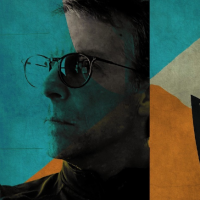
Paul Lovering was born in Devon and now lives in the Scottish Borders. After years of working in watercolors, he now uses mixed media (acrylic, watercolor and digital). From large canvases to an extensive range of blended photography, his art combines the past with the modern.
You can view all his art on Fine Art America and Saatchi Art websites.
.
.
.
Listen to the 1957 recording of John Coltrane performing his composition “Blue Train,” with Coltrane (tenor saxophone); Lee Morgan (trumpet); Curtis Fuller (trombone); Kenny Drew (piano); Paul Chambers (bass); and Philly Joe Jones (drums). [Universal Music Group]
.
___
.
.
Click here to help support the continuing publication of Jerry Jazz Musician, and to keep it ad and commercial-free (thank you!)
.
Click here to read “Ballad,” Lúcia Leão’s winning story in the 65th Jerry Jazz Musician Short Fiction Contest
Click here to read more short fiction published on Jerry Jazz Musician
Click here to read The Sunday Poem
Click here for information about how to submit your poetry or short fiction
Click here for details about the upcoming 67th Jerry Jazz Musician Short Fiction Contest
Click here to subscribe to the Jerry Jazz Musician quarterly newsletter (it’s free)
.
.
.
___
.
.

Jerry Jazz Musician…human produced (and AI-free) since 1999
.
.
.