



.
.
New Short Fiction Award
Three times a year, we award a writer who submits, in our opinion, the best original, previously unpublished work.
Lúcia Leão, a resident of South Florida, is the winner of the 65th Jerry Jazz Musician New Short Fiction Award, announced and published for the first time on April 24, 2024.
.
.
___
.
.
 .
.
.
Ballad
By Lúcia Leão
.
…..My father was a loyal human being who raised his children with the same passion he showed in other areas of his life. He was a very quiet man who didn’t seem really present in his body and in his own life the way other fathers did. Yet, nobody will ever convince me that this was some kind of disease, and if anybody tries to tell me that having him as a father explains why I am who I am, I will tell them that the world needs less of their type of science and more of some other truths.
…..I am in my third marriage.
…..This time I met her at the subway. We were both standing and there was a boy, a teenager with a big watch showing me in glaring numbers that it was 6:00 (p.m.). She could also see the watch, so it would be embarrassing to continue with my initial plan and ask her the silly question about the hours and the minutes. I wouldn’t ask her about the seconds, but I could feel them escaping the whole time. The digital watch didn’t bother to show them, maybe to make us forget about how fast we can be taken far away from who or where we are at any exact point in our life.
…..Her face had that indefinable winter color and lips that could become warm at any moment. The whole picture of her made me think that I had seen her before and was meeting her again after many years. I laughed at myself for being 43 years old and allowing such a juvenile thought to surface. She saw me smiling and smiled back. She seemed amused.
…..That was a good beginning. Grace and I will always have good memories of our first encounter, the two of us vulnerable, standing there at the subway, strangers among strangers, the warmth of the coats and the boots and the socks, the heavy scent of otherness all over the car masked by our sudden intimacy and laughter. This feeling set the tone for our relationship from then on.
…..We are getting married next week. Grace is taking care of the details of the party, and I am getting used to the idea of being a married man one more time.
…..I was in the subway again this morning, with the newspaper on my lap, reading about a guitar player who had suddenly died of a heart attack. A boy was standing in front of me and on his face he had a half smile.
…..I put down the paper and stared at him. The eyelids were dark, the blue from his eyes cast shadows on the skin, and his neck seemed to be stretching more than necessary as if the head felt stuck and was trying to go somewhere.
…..We were going south, downtown. The meeting with my client was scheduled for nine, but I wanted to get to the office early and make a few phone calls while the place was quiet.
…..The image of the boy’s fingers distractedly touching his dark hair and the slow motion of the train composed a hypnotic language to me this morning. The language spoke of the past and of so many other lives I had lived and would still live. The dark shadow of the boy’s blue eyes sucked me within it and darkened everything around us. In this tunnel, in the deep spiral of memories, the language became my voice, a strong voice telling me that the world would always be vast, maybe too vast for me—or not enough.
.
* * *
.
…..“Victor!” she cried. “Victor!” she cried again.
…..I didn’t answer.
…..“How many times do I need to tell you to stop it?”
…..My mother’s desperation was a genuine form of love, and she tried to save me from myself since I was little. But I was very much like my father, and she didn’t have enough energy to fight two strong opponents at the same time.
…..I shared my bedroom with my brother, who was three years older than I. We almost never talked because he loved sports and outdoor activities and I was usually inside the house with friends or with my father, when he was at home.
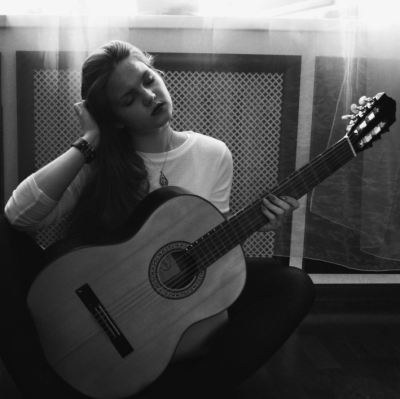
…..After dinner, my father would usually go to his room and play for one hour or two. We would hear the sound of his guitar coming softly through the door and getting mixed with the other sounds of our routine. My mother would enter the room one or two times and would come out with a preoccupied look on her face. One would think she considered his interest in music as some type of obsession, an illness. Or maybe she was afraid she could lose him.
…..On rare occasions, my father would keep the door open, and we would see him sitting on the bed, alone, playing his music to a non-existent audience.
…..I was the first to be allowed to get in as often as I wished. Later, he invited my brother too, but he got bored and disappeared from the concert room. One hour was a long time, and one night I took some sheets of paper with me and started to draw while he played. It wasn’t comfortable to draw on my parents’ bed, but I thought this kind was the kind of privilege most kids did not have. Their fathers were not like mine.
…..He was the one who invented the game. I had to draw a story for each song he played. We started with short pieces, and it took me a while to understand what he meant when he told me, “You have to imagine what you feel and feel what you hear.”
…..How would I connect that complicated sentence to my drawings? At that time, I liked to draw cars and burned trees struck by lightning. These were the drawings I was getting good at. Going from there to feelings seemed to me a task beyond my capability.
…..My father was sure I could do it. He started with short pieces and not even looked at me while he played. I thought he had forgotten about me, but after playing he would stop briefly and ask, “Show me.”
…..It would be a sign of disrespect to his music not to draw anything. So, that is how I started. I was drawing all kinds of shapes and body parts, arms, hands, and eyes. At first, the body seemed to me the best thing to investigate. Then I went to leaves, roots, and trunks, back to my initial motivation. Nature was a great subject, but what interested me was nature distorted, wounded by some kind of powerful yet invisible event that would quickly change the landscape.
…..I mixed my first interest with the others that surfaced throughout the nights. My mother still had a concerned look on her face sometimes, whereas I thought she should be happy instead, for seeing us together in that dialogue with no words.
…..This first stage lasted a few weeks. I collected all the papers and they all had, on top, the name of the song my father had played. He started to compare different versions of my drawings for the same song, and he would say things like “You are better with fast songs.” Or “Here you could have put an orchid instead of a rose, this was a light song.”
…..It went on like that for some time and when I decided to put the drawings on the walls of the room I shared with my brother, my mother said softly, though firmly, a very direct “no.” Then she looked at my face holding the drawings and the hammer and the nails and she understood that there was no point in fighting nature. I would be the person I was becoming.
…..The night my father saw the drawings hanging in my room he gave me a hug that imprinted in my bones some kind of strength, some kind of freedom within silence. He was not exactly proud of me, as some fathers would be of their children. It was something bigger than this whole business of pride. I was deeply in touch with him, closer than any other human being would ever be to him, I thought. It was a connection that allowed us to share unspoken secrets that didn’t even belong to us. It was the thing he looked for so often in his music with his placid, yet impatient eyes, I thought.
…..The room became crowded fast. My drawings bothered my brother, but he had to accept them the way I accepted the pictures of football players populating the walls on “his” side.
…..I got carried away; it wasn’t my father’s fault. And when my mother saw me fixing one more drawing as if it were the first, she decided the time had come for her to put an end to that.
…..“Victor,” she said, after touching my hand that was holding the hammer. “It is time to stop.”
…..She was really worried about me, I could sense it. But I was a kid, and I couldn’t simply not do what I wanted to do.
…..That same night, my father called me into his bedroom and looked at me very seriously.
…..“It is time for you to choose an instrument to play,” he said. He lightly touched my back with one hand and with the other he held the guitar. “You had enough fun with the drawings already.”
…..I told him the truth. That it wasn’t finished yet and that I wanted to keep covering the walls until it was over, that I wanted to keep listening to him, to keep drawing, to keep going.
…..“I want to find the end,” I suddenly said, not sure of what I had just explained.
…..At this point, my father let go of the guitar and put his two hands on my shoulders. It wasn’t a gesture of punishment, of fear, of loss. He had really listened to what I had revealed to him and to myself.
…..“It never ends,” he spoke clearly, in an adult-like manner.
…..He hugged me for a long time, caressing my hair but not moving.
…..“What would you like me to play for you tonight?” he finally asked.
…..I sat there amazed at what I could feel when I was that close to him. I could feel his heartbeat. And mine, in the background.
…..I never ended up playing an instrument. I became great with words and, later, great with women. There was nothing easier for me than to have women gravitate around me. They surrounded me, a melody playing by itself, circles, and a vague idea of who I could really be.
.
* * *
.
…..The boy standing in front of me had a watch but with a red hand for the seconds this time. The train was slow, very slow, approaching the station. He would get off there, I supposed, from the way his body had acquired a palpable uneasiness. I went back to my newspaper and read more about the guitar player.
…..He had been found by his bed… the guitar on a chair… on his hand a piece of paper, a ripped-up paper with doodles all around.
…..I could see his hands and a small flower. A child’s hands? It was a message coming from far away—nature, sweetness, and fear. The endless night, what death can mean.
…..Grace would like the story about the man. I knew that for a long time, she would love to listen to me, avidly. She would listen to me. She would. For a while. She would place me in her heart. And I would never stop banging my hands against the walls, piercing them, in my quest. I would play drums like this, with my fists, trying to make the noise explode, the night explode, and I would never stop. I would never stop.
.
.
___
.
.

Lúcia Leão is a translator, interpreter, and writer from Rio de Janeiro. Her work has been published in SWWIM Everyday, South Florida Poetry Journal and Ekphrastic Review, among others. She lives in South Florida.
.
.
___
.
.
Click here to read “The Old Casino,” J.B. Marlow’s winning story in the 64th Jerry Jazz Musician Short Fiction Contest
Click here to read more short fiction published on Jerry Jazz Musician
Click here to read The Sunday Poem
Click here for information about how to submit your poetry or short fiction
Click here for details about the upcoming 66th Jerry Jazz Musician Short Fiction Contest
Click here to subscribe to the Jerry Jazz Musician quarterly newsletter (it’s free)
Click here to help support the continuing publication of Jerry Jazz Musician, and to keep it ad and commercial-free (thank you!)
.
.
___
.
.

Jerry Jazz Musician…human produced (and AI-free) since 1999
.
.
.




What a beautiful and creatively crafted story.
only a mind glittering with wonder and awe Could have crafted this psychologically layered tale and melded the surreal with the real So expertly. Read it often to get the full effect. Soooo good!