
“Sittin’ In: Jazz Clubs of the 1940s and 1950s” Vol. 2 — Birdland

June 1st, 2021


.


.

…..Jeff Gold’s book Sittin’ In: Jazz Clubs of the 1940s and 1950s is a visual history of many of the country’s most influential night clubs and ballrooms during jazz music’s golden era.

…..The book is centered around a collection of memorabilia Mr. Gold discovered, and features photographs of club patrons taken by in-house photographers, as well as postcards, handbills, menus, matchbooks, and posters.

…..In cooperation with Mr. Gold, Jerry Jazz Musician will occasionally publish a noteworthy excerpt from the book.   In this edition, Gold writes about New York’s Midtown Manhattan club Birdland, and shares photographs and memorabilia from his collection.

.

.

___

.

.


Birdland

1678 Broadway, Just North of West Fifty-Second Street

.

.
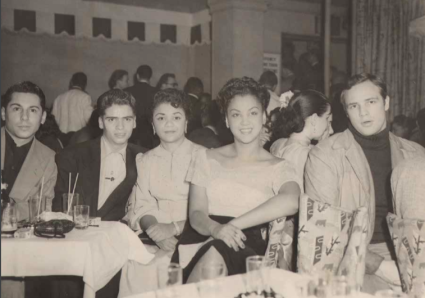


Birdland souvenir photograph with frequent patron Marlon Brando (right) posing with clubgoers, date unknown

.

___

.


…..

…..On December 15, 1949, former [midtown Manhattan jazz club] Royal Roost partner Morris Levy opened Birdland with his brother Irving, manager Oscar Goodstein, and six other partners.  The three-hundred-seat basement club, named in honor of bebop giant Charlie “Bird” Parker, opened with A Journey thru Jazz 1920-1950, showcasing the history of jazz as played by some of those who had created it:  trumpeters Max Kaminsky and Hot Lips Page, up-and-comers Stan Getz and Lennie Tristano, Lester Young, Harry Belafonte, and Parker.

…..Birdland historian Leo T. Sullivan wrote, “Many jazz clubs opened and closed over the many years, but never has there been a venue showcasing such incredible jazz greats on a nightly basis as the ‘Jazz Corner of the World,’ Birdland.”

…..The club featured a long bar on one side, booths on the other, and tables running down in the middle.  Above the booths were portraits of jazz stars painted by Diana Dale, the club’s hatcheck girl.  For those too young to drink or who came only to listen, there was the “bullpen” or “peanut gallery,” a section to the right of the bar separated from the rest of the club by a barrier.  When the club first opened, there were birdcages with live finches hanging from the ceiling; unfortunately, the noise and smoke proved too much for the birds, who lasted only about a month.

…..Birdland didn’t have a dance floor, and the stage was small enough that on occasion, if a large group was playing, the piano was placed on the floor.  Nearby was a radio booth where Symphony Sid broadcast nightly to listeners on the East Coast, from midnight until six o’clock in the morning.  Pee Wee Marquette, standing three feet, nine inches tall, was the clubs notorious emcee, most famous for intentionally mispronouncing the name of any performer who refused to tip him.

…..Birdland booked top acts for six-night runs, with Mondays reserved for jam sessions.  As one of the main bebop venues, the club played host to Parker as well as Bud Powell, Thelonious Monk, Dizzy Gillespie, and Miles Davis.  Count Basie, a favorite of Morris Levy’s, made Birdland his New York base of operations and signed to Levy’s record label, Roulette, in the late 1950s.  The club did well with women vocalists, booking Billie Holiday, Nina Simone, Ella Fitzgerald, and Dinah Washington.  Other musicians who appeared included Clifford Brown, Sonny Rollins, Art Tatum, Duke Ellington, Lester Young, Stan Getz, and Dave Brubeck.  George Shearing wrote the standard “Lullaby of Birdland” after Levy asked him to compose a theme song for Symphony Sid’s broadcasts.

…..As the club’s popularity grew, it became a draw for celebrities; patrons included Marilyn Monroe, Marlene Dietrich, Frank Sinatra, Ava Gardner, Judy Garland, Sugar Ray Robinson, and even classical music icon Igor Stravinsky.  Eventually the Birdland name gained enough cachet that the club was able to sponsor national – and, in at least one case, international – concert tours during the mid-to late 1950s.
…..While Levy was committed to integration and Birdland an oasis of sorts from racism, things could be different just outside the door. On August 15, 1959, Miles Davis, who was performing with his quintet at the club, stepped outside to take a break.  In his autobiography, Davis recalled: “I had just walked this pretty white girl named Judy out to get a cab.  She got in the cab, and I’m standing there in front of Birdland wringing wet because it’s a hot, steaming, muggy night in August.  This white policeman comes up to me and tells me to move on…’Move on, for what?  I’m working downstairs.  That’s my name up there, Miles Davis,’ and I pointed my name on the marquee all up in lights.  He said, ‘I don’t care where you work, I said move on!  If you don’t move on I’m going to arrest you.’  I just looked at his face real straight and hard, and I didn’t move.  Then he said, ‘You’re under arrest!’

…..A fight ensued, with Davis badly beaten by three officers before being hauled off to jail, charged with disorderly conduct and the assault of a police officer.  The story was widely reported, with photographs of a bloodied Davis, and eventually the charges were dropped, but Davis never forgot the incident.  “[It] changed my whole life and my whole attitude again, made me bitter and cynical again when I was really starting to feel good about the things that had changed in this country.”

…..Many legendary live albums were recorded at the club, including Art Blakey’s two-volume A Night at Birdland (1954), Count Basie’s Basie at Birdland (1961), and most of John Coltrane’s Live at Birdland (1964).  But as rents in the area rose, running a profitable jazz club became increasingly difficult, and in June 1964, Birdland filed for Chapter 11 bankruptcy, closing for good the next year.

…..The club’s legacy was boosted in 1977 by Josef Zawinul’s song “Birdland,” featured on his band Weather Report’s bestselling album Heavy Weather.  In 1980, the Manhattan Transfer’s version of the song won a Grammy Award, and in 1991, Quincy Jones’s version won two more.  In 1986, a new club with the Birdland name opened in the midtown theater district.

.

.

___

.

.
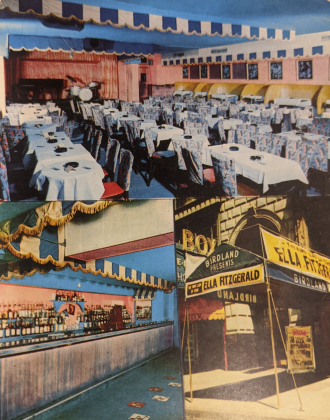
Birdland postcard, 1950s

.

.
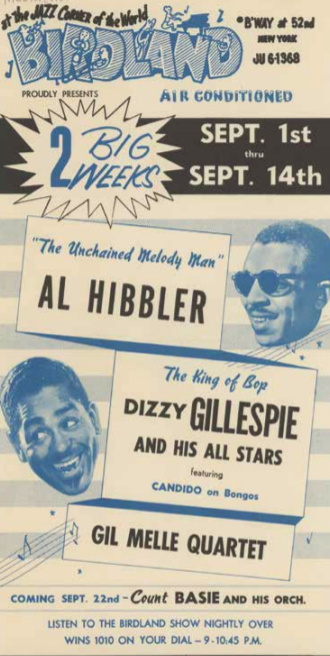
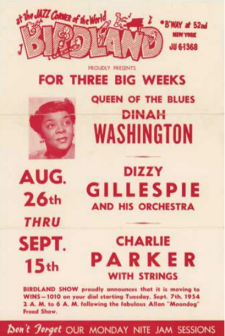
Birdland handbill for a 1955 engagement with Al Hibbler, Dizzy Gillespie, and Gil Melle

.

.
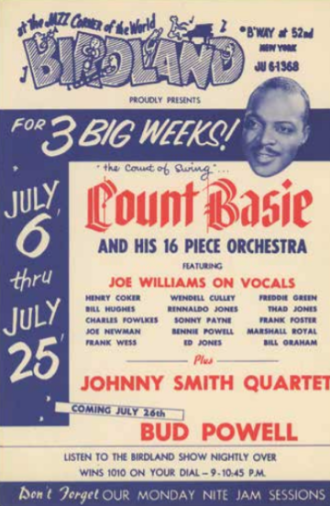
Handbill advertising 1956 Birdland shows with Count Basie, Johnny Smith and Bud Powell

.

.
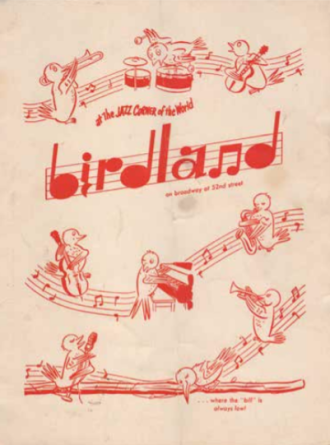
Birdland menu, date unknown

.

.
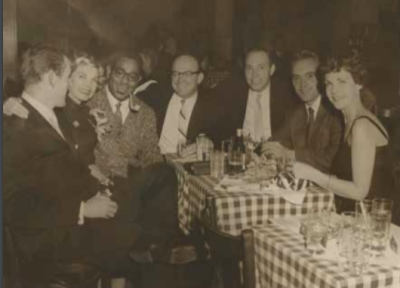
Birdland souvenir photograph with Dizzy Gillespie posing with fans, date unknown

.

.
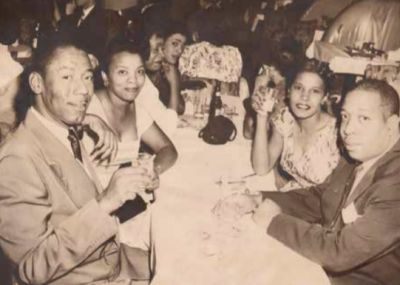
Birdland souvenir photograph, date unknown

.

.
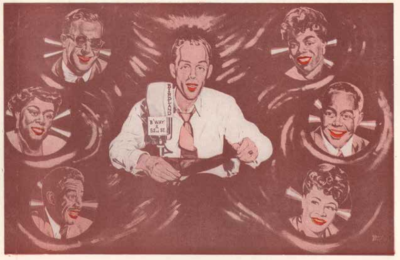
Jazz DJ Symphony Sid pictured on the inside of a Birdland photo folder along with other notable jazz figures.

.

.
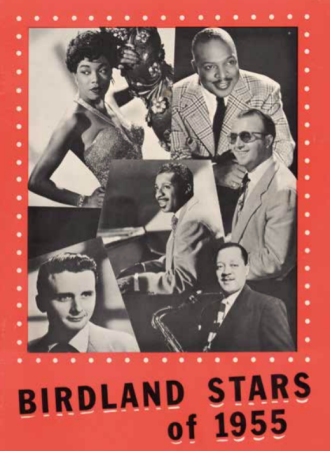
 

Concert tour program, 1955

.

.
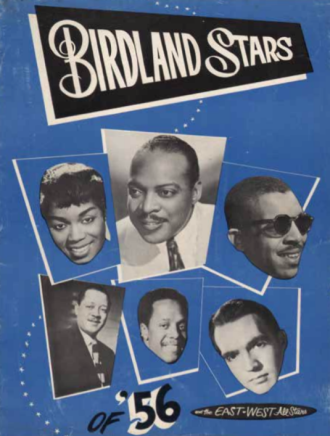
Concert tour program, 1956

.

.
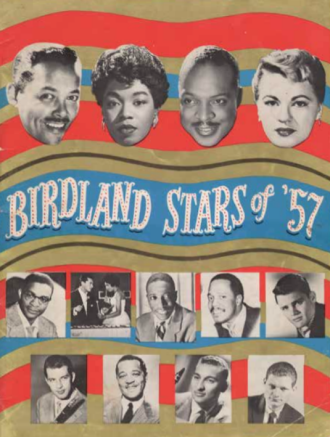
 

Concert tour program, 1957

.

.
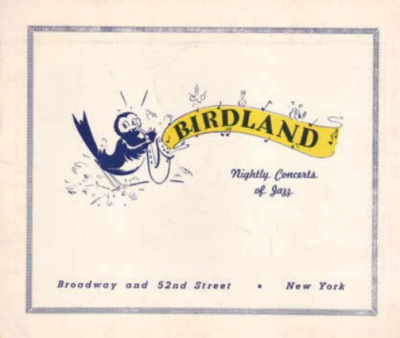
Birdland photo folder, date unknown

.

.


___

.

.


Listen to a 1954 recording of Sarah Vaughan (with Clifford Brown on trumpet) singing George Shearing’s composition “Lullaby Of Birdland.”   

.

.

Listen to the 1977 recording of Weather Report playing Josef Zawinul’s composition “Birdland”

.

.

___

.

.

Click here to read Vol 1, on the Savoy Ballroom

Click here to read Vol 2, on Birdland

Click here to read Vol 3, on Club Ubangi

Click here to read Vol 4, Four Harlem Nightspots

Click here to read Vol 5, on Connie’s Inn and Smalls’ Paradise

.

Click here to read our interview with Jeff Gold

.

.

___

.

.

photo courtesy Jeff Gold
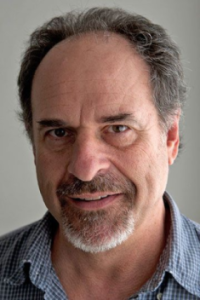
Jeff Gold is a Grammy Award-winning music historian, archivist, author, and executive.  Profiled by Rolling Stone as one of five “top collectors of high-end music memorabilia,” he is an internationally recognized expert who has consulted for the Rock & Roll Hall of Fame, Museum of Pop Culture, and various record labels and cultural institutions.  He has also appeared as a music memorabilia expert on PBS’s History Detectives and VH1’s Rock Collectors.  His other books include 101 Essential Rock Records: The Golden Age of Vinyl from the Beatles to the Sex Pistols and Total Chaos: The Story of the Stooges/As Told by Iggy Pop.  He own the music memorabilia website Recordmecca.com and writes about topics of interest to collectors on its blog. 

Follow Jeff on Twitter at @recordmecca or on Instagram at @recordmecca.


.

.

___

.

.


All text and images — unless otherwise noted — © Jeff Gold.  Excerpted from Sittin’ In:  Jazz Clubs of the 1940s and 1950s (Harper Design).  Published by permission of Jeff Gold.

.

.

.


Share this:

Comment on this article:

Your email address will not be published. Required fields are marked *

Site Archive

Your Support is Appreciated

Jerry Jazz Musician has been commercial-free since its inception in 1999. Your generous donation helps it remain that way. Thanks very much for your kind consideration.

Click here to read about plans for the future of Jerry Jazz Musician.

In this Issue

Announcing the publication of Volume II of Kinds of Cool: An Interactive Collection of Jazz Poetry...The second edition of Kinds of Cool, an Interactive Collection of Jazz Poetry has just been published, and is now available for sale on Amazon.com. This edition is dedicated to publishing women poets from all over the world who share their personal passion for and relationship with jazz music, and the culture it interacts with. With a foreword by Allison Miller, one of the world’s most eminent jazz drummers, and photography and design by Rhonda R. Dorsett

Poetry

photo by William Gottlieb/adapted by Rhonda R. Dorsett
21 jazz poems on the 21st of April, 2026...An ongoing series designed to share the quality of jazz poetry continuously submitted to Jerry Jazz Musician. In this edition…Mix in poems on the blues with some Coltrane, Monk, Bix, Mingus, Miles, Art Farmer, King Oliver, Desmond, and Brubeck, and you have one hell-of-a lively and entertaining collection to take in. Enjoy!

Community

A collection of poetic responses to the events of 2025...Forty poets describe their experiences with the tumultuous events of 2025, resulting in a remarkable collection of work made up of writers who may differ on what inspired them to participate, but who universally share a desire for their voice to be heard amid a changing America.

The Sunday Poem

photo by Duncan Light/via Pexels

The Sunday Poem: Three poems on Mother’s Day

The Sunday Poem is published weekly, and strives to include the poet reading their work...

Readings of the poems by Daniel Warren Brown, Erren Kelly, and Michael L. Newell can be heard at their conclusion.


Click here to read previous editions of The Sunday Poem

Short Fiction

Photo by Johannes Schröter, via Pexels
Short Fiction Contest-winning story #71 – “Where the Music Wasn’t Allowed,” by Jane McCarthy....The award-winning story is about a young immigrant growing up in Southern California to the sound of music seeping into his family’s home from an upstairs neighbor’s piano, shaping the boy’s understanding of memory, family, belonging, and the improvisational ethics of music.

Interview

photo by Warren Fowler
Interview with John Gennari, author of The Jazz Barn: Music Inn, the Berkshires, and the Place of Jazz in American Life...The author discusses how in the 1950s the Berkshires – historic home to the likes of Hawthorne, Melville, Wharton, Rockwell, and Tanglewood – became a crucial space for the performance, study, and mainstreaming of jazz, and eventually an epicenter of the genre’s avant-garde.

Poetry

photo by Tsutumu Takasu/via Flicker/CC BY 2.0
“Cajun Glory” – a prose poem by Robert Alan Felt

Community

Ricky Esquivel/Pexels.com
Community Bookshelf #6...“Community Bookshelf” is a twice-yearly space where writers who have been published on Jerry Jazz Musician can share news about their recently authored books and/or recordings. This edition includes information about books published within the last six months or so (September, 2025 – March, 2026)

Poetry

Six poets write eight poems (in the midst of our times)...Poets within this community of writers are feeling this moment in time, and writing about it. This collection is another example.

Feature

photo by Laura Stanley via Pexels.com.
Trading Fours, with Douglas Cole, No. 28: “Little Samba”...Trading Fours with Douglas Cole is an occasional series of the writer’s poetic interpretations of jazz recordings and film. This edition is based largely on a documentary – They Shot the Piano Player – about Tenório Junior, a Latin jazz musician who only produced one album (1964) before he “disappeared” in 1976.

Short Fiction

photo J. & L. Caswall Smith
“Bitty’s Last Request” – a short story by Jill Bronfman...In the story – a finalist in the recently concluded 71st Short Fiction Contest – a very old dancer visits her young relative with stories to tell about the old days in the clubs.

Poetry

art by Marsha Hammel
“Learning the Alphabet of the Blues” – a poem by Mary K O’Melveny...A poem from Kinds of Cool: An Interactive Collection of Jazz Poetry, Vol. II

Feature

photo via Wikimedia Commons
Memorable Quotes: Two, by Edward R. Murrow…

Feature

photo via Wikipedia
“Two Famous Johns” – a true jazz story by Bob Hecht...The writer remembers an evening in New York’s Half Note in 1964 when he witnessed a John Coltrane performance that was also attended by the pop singer Johnny Mathis

Poetry

Haiku: Musings – by Connie Johnson...Exploring segments of the world of jazz – in three suites of vivid haiku poetry…

Jazz History Quiz

photo of "Hot Lips" Page by William Gottlieb
Jazz History Quiz #187...This trumpeter began his career in California, where he organized a big band that had a residency in China in 1934, and, during a trip through Kansas City in 1936, was invited to join Count Basie’s orchestra, replacing “Hot Lips” Page (pictured). Who is he?

Feature

“Bohemian Spirit” – A Remembrance of 1970’s Venice Beach, by Daniel Miltz...The writer recalls 1970’s Venice Beach, where creatives chased a kind of freedom that didn’t fit inside four walls…

Poetry

Linnaea Mallette/publicdomainpictures.net
A 2026 jazz poetry calendar...12 individual poets contribute a jazz-themed poem dedicated to a particular month, resulting in a 2026 calendar of jazz poetry that winds through the year with a variety of poetic styles and voices who share their journeys with the music, tying it into the month they were tasked to interpret. Along the way you will encounter the likes of Sonny Stitt, Charles Mingus, Jaco Pastorius, Wynton Kelly, John Coltrane, and Nina Simone.

Feature

Boris Yaro, CC BY 4.0, via Wikimedia Commons
“The Bowie Summer” – a personal memory, and how art can fundamentally reshape identity, by G.D. Newton-Wade

Short Fiction

photo by Iryna Olar/pexels.com 
“The Fading” – a short story by Noah Wilson...The story – a finalist in the recently concluded 70th Short Fiction Contest – examines the impact of genetic illness on a family of musicians and artists.

Poetry

Poems on Charlie “Bird” Parker (inspired by a painting by Al Summ) – an ekphrastic poetry collection...A collection of 25 poems inspired by the painting of Charlie Parker by the artist Al Summ.

Short Fiction

Los Angeles Daily News, CC BY 4.0 , via Wikimedia Commons
“The Pet Shop” – a short story by Sherry Shahan...The story – a finalist in the recently concluded 70th Short Fiction Contest, – is about an octogenarian couple who accept a part-time caretaker position at Crazy Goose Burlesque when the theater is temporarily shuttered due to archaic public indecency laws.

Feature

Albert Ayler’s Spiritual Unity – A Classic of Our Time, and for All Time – an essay by Peter Valente...On the essence of Albert Ayler’s now classic 1964 album…

Poetry

Laura Manchinu (aka La Manchù), CC BY 2.0 , via Wikimedia Commons
“Ron Carter Apple Sauce” – a prose poem by Martin Durkin

A Letter from the Publisher

The gate at Buchenwald. Photo by Rhonda R Dorsett
War. Remembrance. Walls.
The High Price of Authoritarianism– by editor/publisher Joe Maita
...An essay inspired by my recent experiences witnessing the ceremonies commemorating the 80th anniversary of liberation of several World War II concentration camps in Germany.

Playlist

photo by Robert Hecht
“Spring is Here!” – a playlist by Bob Hecht...With perhaps Lorenz Hart’s most sardonic lyric — which is saying something! — this song remains one of the greats, and has been interpreted in many ways, from the plaintive and melancholy to the upbeat and hard swinging, such as John Coltrane’s version. Check out this bouquet of ten tracks to celebrate this great season!

Poetry

Wikimedia Commons
“Dorothy Parker, an Icon of the Jazz Age” – a poem by Jane McCarthy

Community

Nominations for the Pushcart Prize L (50)...Announcing the six writers nominated for the Pushcart Prize v. L (50), whose work appeared on the web pages of Jerry Jazz Musician or within print anthologies I edited during 2025.

Interview

Interview with Tad Richards, author of Listening to Prestige: Chronicling its Classic Jazz Recordings, 1949 – 1972...Richards discusses his book – a long overdue history of Prestige Records that draws readers into stories involving its visionary founder Bob Weinstock, the classic recording sessions he assembled, and the brilliant jazz musicians whose work on Prestige helped shape the direction of post-war music.

Contributing Writers

Click the image to view the writers, poets and artists whose work has been published on Jerry Jazz Musician, and find links to their work

Coming Soon

An interview with Paul Alexander, author of Bitter Crop: The Heartache and Triumph of Billie Holiday's Last Year; New poetry collections, Jazz History Quiz, and lots of short fiction; poetry; photography; interviews; playlists; and much more in the works...

Interview Archive

Ella Fitzgerald/IISG, CC BY-SA 2.0 , via Wikimedia Commons
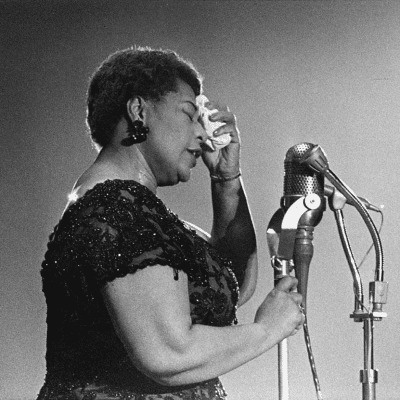
Click to view the complete 25-year archive of Jerry Jazz Musician interviews, including those recently published with Judith Tick on Ella Fitzgerald (pictured),; Laura Flam and Emily Sieu Liebowitz on the Girl Groups of the 60's; Tad Richards on Small Group Swing; Stephanie Stein Crease on Chick Webb; Brent Hayes Edwards on Henry Threadgill; Richard Koloda on Albert Ayler; Glenn Mott on Stanley Crouch; Richard Carlin and Ken Bloom on Eubie Blake; Richard Brent Turner on jazz and Islam; Alyn Shipton on the art of jazz; Shawn Levy on the original queens of standup comedy; Travis Atria on the expatriate trumpeter Arthur Briggs; Kitt Shapiro on her life with her mother, Eartha Kitt; Will Friedwald on Nat King Cole; Wayne Enstice on the drummer Dottie Dodgion; the drummer Joe La Barbera on Bill Evans; Philip Clark on Dave Brubeck; Nicholas Buccola on James Baldwin and William F. Buckley; Ricky Riccardi on Louis Armstrong; Dan Morgenstern and Christian Sands on Erroll Garner; Maria Golia on Ornette Coleman.