
.
.
For over twenty years, publishing quality jazz-themed fiction has been a mission of Jerry Jazz Musician. Hundreds of short stories have appeared on the pages of this website, most all of which can be accessed by clicking here.
A substantial number of novels and stories with jazz music as a component of the story have been published over the years, and the scholar David J. Rife has written short essay/reviews of them, which he has compiled in two valuable resources, Jazz Fiction: A History and Comprehensive Reader’s Guide (2008), and a recently published sequel, Jazz Fiction: Take Two. (Several of the stories published on Jerry Jazz Musician are reviewed).
Rife’s work is impressive and worth sharing with Jerry Jazz Musician readers. With his cooperation, essay/review excerpts from Take Two will be published on a regular basis.
.
In this edition, Rife writes about the “quest” theme in contemporary jazz fiction, where long-lost instruments and rumored recordings take the place of more dramatic artifacts like the Holy Grail.
.
.
___
.
.
.
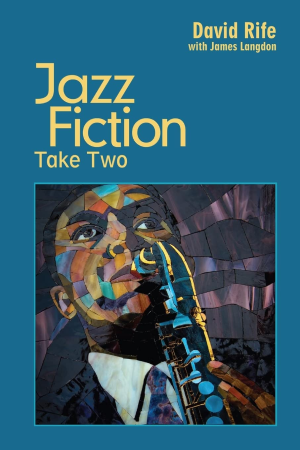
…..Jazz Fiction: Take Two is the sequel to Jazz Fiction: A History and Comprehensive Reader’s Guide (2008). The earlier work filled a pressing need in jazz studies by identifying and discussing 700 works of fiction with a jazz component.
…..This work picks up where that one left off, around the turn of the 21st century, and surveys over 500 works of jazz-inflected fiction that have appeared since. None of these works, to my knowledge, have been discussed in this context.
…..The essay-reviews at the center of the book are designed to give readers a sense of the plots of the works in question and to characterize their debt to jazz. The entries were written with both the general reader and the scholar in mind and are intended to entertain as well as inform. This alone should qualify Jazz Fiction: Take Two as an unusual and useful reference resource.
.
-David J. Rife
.
.
___
.
.
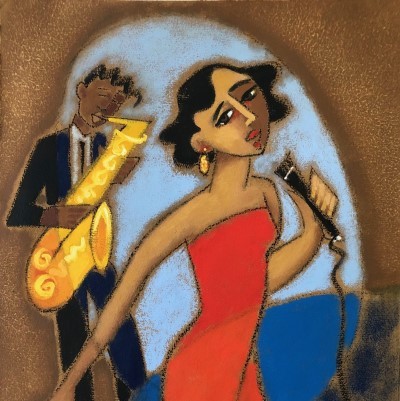
“Transfiguration,” by Martel Chapman

.
Quest
.
…..The quest theme, it seems, has always been with us. Remember Odysseus, after the war, burning to return home to his wife and kingdom but being hampered at every turn by cannibals, monsters, and angry gods. And remember, too, how King Arthur’s Knights (except one!) were denied the Holy Grail, and thus salvation, by the corrosiveness of their sins. Much closer to our time is the example of Indiana Jones who risked everything to search for the Lost Ark of the Covenant. Thus, the archetype of the quest: a larger-than-life hero with an obsessive desire to accomplish a lofty objective who must journey to overcome a series of obstacles to prove his/her worthiness. To provide a well-known counter example, think of the Fat Man and his cronies devoting their lives to acquiring the Maltese Falcon—a pure manifestation of their demonically impure quest for “the root of all evil.”
…..This final example brings us closer to the quest theme in contemporary jazz fiction, where long-lost instruments and rumored recordings take the place of more dramatic artifacts like the Holy Grail. The works in the list below contain shards of heroic objectives but no actual heroes or Arks. For those, we must segue from the constructed world back to the so-called real one, where artists like Sonny Rollins and John Coltrane sought transcendence—a love supreme—through their sacred instruments.
.
.
___
.
..
..…
…..This is the second of two novels in a series featuring the never-named Vinyl Detective (VD, hereafter) that focus on jazz, primarily rare recordings. VD and his girlfriend Nevada are by now a detective duo (superficially after the fashion of Nick and Nora in Hammett’s “Thin Man” series). They are assisted by VD’s annoying chum Stinkler and their taxi driver, a striking young woman called Clean Head. The story is set in motion when VD and Nevada are commissioned by an elderly soigné woman to locate and buy at any cost every recording they can find by the long defunct Flare Path Orchestra, a group that was formed by British air force personnel during WW2. It was in fact considered the finest band in the land and ranked with Glenn Miller’s American military orchestra.
…..Because the records, on the Victory label, had been recorded on shellac instead of vinyl, they were exceedingly fragile. Inevitably, almost all of them had been destroyed during delivery. There is considerable question half a century later whether any had survived. But our detectives know their business and soon are able to achieve more success than they had anticipated. Along the way of their quest, they find themselves enmired in a web of historical intrigue including espionage, cryptography, Save-the-Badger activism, and neo-Nazism.
…..It’s a thrilling, well-plotted ride with quirky Dickensian characters, a nicely balanced amalgam of humor and violence, and a very satisfactory denouement. A record, “Curated” by the author of the VD novels, has recently appeared. It contains an original composition, “The Vinyl Detective Theme,” as well as other jazz works mentioned in the novels. The writer has also provided liner notes—and a warning that we’ll need a proper turntable to play the record on. There’s a rumor about plans for a TV series. But don’t waste your time looking for Flare Path records. You’d have better luck locating a dodo.
…..The books in the series are much fun and generally stop short of silliness. One exception to this is that both VD and Stinkler feel and behave like middle aged men (they don’t work and appear to be confirmed bachelors) and turn out to be chick magnets. In The Vinyl Detective: Written in Dead Wax, VD attracts—and sleeps with—two world-class young women; in this book, the peculiar Stinkler also attracts (and has affairs with) two striking beauties, one of whom is 18. Maybe the author wants to give hope to the nerdy.
.
.
_____
.
.
…..At first the two alternating stories of this narrative seem to be unrelated, as if the writer needed to splice together independent novellas in order to produce a book length commodity. But before long we come to realize that they are connected in a satisfyingly organic way. One strand involves the iconic Charles “Buddy” Bolden and the origins of jazz in New Orleans toward the turn of the last century. According to persistent rumor, before being overtaken by mental illness at an early age, Bolden and his band made a cylinder recording (of “Tiger Rag”)—a sacred object like the Holy Grail or Maltese Falcon. If the cylinder can be recovered, then the great artist’s transcendent sound will not have disappeared into thin air and be lost to history. Meanwhile, in time present—a hundred or so years later—a respected doctor suffering from a devastating divorce, Ruby Cardillo, reunites with her daughter, Devon, a once promising jazz musician but currently a recovering addict and aspiring jazz writer, and the two of them set out on a long car journey to New York, where Ruby is scheduled to present a paper.
…..While the extended intimacy of the journey jeopardizes Devon’s own fragile equanimity, it does bring her closer to her mother while illuminating her family history, which has a significant jazz component. In a pleasing (but far-fetched) plot twist she discovers how this jazz association connects her to Buddy Bolden and the sacred cylinder. The novel is suffused with jazz, from accounts of its history and development to descriptions of the music in performance to references to its artists, from beginning to present. In all, a nice blend of fact and fantasy glued together by jazz—and a nice addition to the burgeoning corpus of stories that focus on the mystique of jazz and its lost horns, rumored recordings, and enigmatic demigods.
.
.
_____
.
.
..…..After his small security operation fails, D Hunter leaves Manhattan and returns to Brooklyn where he grew up. For much of the novel, he can scarcely believe his eyes: where have all the white folks come from, and the Starbucks, and the hipster saloons? Yes, gentrification is in full swing (and it’s not all bad). D’s life gains some welcome direction when he runs into an old pal, Edge Lenox, who had worked in the music industry for many years. Edge tells D a story—perhaps an urban myth—involving an impromptu jam session in 1966 in which Otis Redding and Diana Ross recorded a song, Country Boy & Country Girl, that was never released and then disappeared. Complicating the issue is that the artists didn’t use their own names, so if the record had been filed, how could it be identified? D’s interest is intensified when Edge tells him that a rich British collector is offering $15,000 to anyone who can locate the precious object.
…..Meanwhile, by happy coincidence another old friend of D’s has hit town and needs a bodyguard to look after him as he tries to make a comeback. Years ago, Night had made an earthshaking album called Black Sex, making him a cult figure almost overnight. But then he disappeared for several years. Stage fright, panic attacks, and rehab were rumored. But now he feels together enough to give his career a second chance and has been lucky enough to land a gig at Ronnie Scott’s famous music venue in London. What a plush opportunity for D: He can earn a nice wad of cash for providing Night’s security and—just maybe—manage to meet the reclusive record collector, another potentially lucrative opportunity.
…..The story brims with music. There are scenes involving music in performance, especially soul/R&B and neo soul. Artists, real and imagined, are referred to, and each of the 30 chapters is named after a song. At the end, the author provides a playlist: “I Got Dreams to Remember” (Otis Redding), “Inner City Blues” (Marvin Gaye), “A Change Is Gonna Come” (Sam Cooke), “Didn’t Cha Know” (Erykah Badu), “100 Yard Dash” (Raphael Saadiq), and so on. On a deeper level, the novel raises questions concerning the influence of increasingly white audiences (consumers) on Black music: Are Black musicians continually going to have to relinquish their own music, their own heritage, to please the middle class, as they were forced to do with the blues, jazz, and R&B?
.
.
_____
.
.
…..…..Kweli (which, meaningfully, translates as “truth”) Porter is a 63-year-old jazz pianist who has paid his dues for over 40 years, first as sideman to the greats and then as leader of his own trio. Now he’s accepted a pay-the-rent gig for a six-city tour of New Mexico with three mediocre young musicians. A New Yorker, Kweli is unmoved by non-urban environments—that is, till now when he encounters the magical landscape of New Mexico for the first time. He’s transfixed (and forever changed) by what he sees and hears, for the mountains and valleys themselves seem to exude music. He needs to play again soon so goes early to the auditorium where the group is scheduled to play that night and is startled a second time to find a famous 300-year-old piano from Germany—a sacred object—waiting for him. Shortly, a strikingly attractive woman of indeterminate age materializes and the two fall in love, determined to spend their lives together searching for the Truth inherent in jazz—the only music that possesses the power to rectify the unspeakable inhumanity that has plagued the earth since the beginning of human time.
…..This fairytale-esque story could easily be re-titled “Dreams and Déjà Vu: Memory and Illumination” for the way it jumbles Kweli’s dreams, memories, and feeling that he’s experienced everything before. Several jazz artists are referred to in the story, especially Kweli’s fellow seekers-after-truth-through-music, Coltrane and Monk. The woman of Kweli’s dreams (or perhaps his dreamed woman) even has a cat named Thelonious. But the story’s most impressive achievement is the way it shows how Kweli becomes the music he plays just as the dancer is indistinguishable from the dance (to borrow one of Yeats’ incomparable metaphors).
.
.
_____
.
.
.,,,,,…..Two unlikely friends team up after college, brought together by their devotion to music, especially the Delta blues. Seth is nondescript, shy, and dweeby, while his pal Carter is heir to a limitless family fortune and thus able to lead a glamorous life without having to dirty his hands. But their obsession with music, starting with the technology of sound and ending with their susceptibility to the “collecting bug,” promotes their compatibility. The novel has much to say in fact about the strange collection of men—always white men—who devote their lives to the acquisition of rare blues recordings, some of which exist only on the level of rumor.
…..Seth spends considerable time walking around his neighborhood in Greenwich Village recording ambient sound at random, later analyzing the results. One day he discovers he’s inadvertently recorded a blues singer. Carter cleans it up, puts the file online, and claims it’s a unique recording of a forgotten artist by the name of Charlie Shaw. This rather innocuous hoax turns sour when a blues collector informs the guys that their record is indeed genuine and that Charlie Shaw actually existed. Soon after, Carter is robbed and permanently injured sending Seth on a quest into the heart of darkness to find a hard copy of Charlie Shaw’s single recording (with an infinitely obscure Side B), find Carter’s attackers, and locate the murderer of Carter’s sister.
…..From this point on, the narrative devolves from quasi-realism to magical realism or supernaturalism. As Seth travels—by bus—deeper into Mississippi on his multi-quest, he actually becomes a Black, to the extent that he’s arrested for no reason and put to work on a chain gang. This novel raises provocative questions about race relations in America , the origin and meaning of the blues, and the exploitation of Black artists by white “entrepreneurs.” The title White Tears is a phrase that has been used for several years to mock whites who get upset at things they think threaten their white privilege.
.
.
_____
.
.
Click here to read previous editions of excerpts from David J. Rife’s Jazz Fiction: Take Two
.
.
Click here to read “Bluesette,” Salvatore Difalco’s winning story in the 67th Jerry Jazz Musician Short Fiction Contest
Click here to read more short fiction published on Jerry Jazz Musician
Click here to read The Sunday Poem
Click here for information about how to submit your poetry or short fiction
Click here for details about the upcoming 68th Jerry Jazz Musician Short Fiction Contest
Click here to subscribe to the Jerry Jazz Musician quarterly newsletter (it’s free)
.
Click here to help support the continuing publication of Jerry Jazz Musician, and to keep it ad and commercial-free (thank you!)
.
.
___
.
.

Jerry Jazz Musician…human produced (and AI-free) since 1999
.
.
.