
.
.
.
…..Much is known about the life and genius of songwriter Cole Porter, whose music appears in many of Broadway’s most successful and beloved musicals, including Kiss Me Kate, Can-Can and Silk Stockings. His most popular tunes are found at the heart of the Great American Songbook, “Night and Day,” “I’ve Got You Under My Skin,” “In the Still of the Night” and “You’re the Top,” among them, and his work also touched Hollywood, in films like Born to Dance, Rosalie, High Society, and Les Girls.
…..Several Cole Porter biographies and biographical films have been written and produced, enough to acquaint us with a meaningful understanding of his life – of his wealth and luxurious lifestyle, his sexuality and marriage, and his tragic horse riding accident that caused lifelong pain and, eventually, a leg amputation.
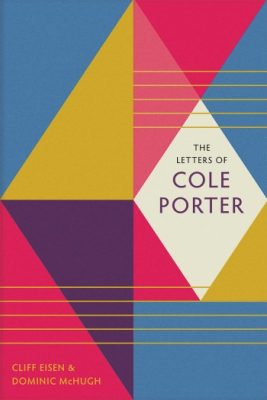
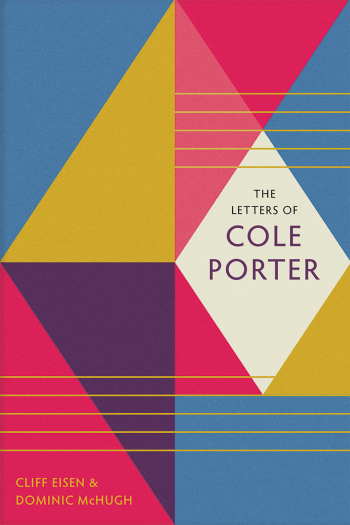
…..In The Letters of Cole Porter, a comprehensive collection of surviving correspondence that has recently been published, much of what is known about Porter is discussed by Porter and his family, friends, and business associates. In a recent interview, Dominic McHugh, the book’s co-author (with Cliff Eisen), told me that one of the results of the book is that “several of the big biographical tropes that we associate with Porter are either modified or contested by the letters,” and that “when you put together these letters, and add our quite extensive commentary between the letters, it creates a different picture of him. Our idea was to show what the archives say about Cole Porter in contrast to what people think about him.”
…..This book is revealing and, ultimately, wonderfully rewarding. It helps being a Porter fan, but it isn’t necessary because the correspondence is an often entertaining inside look at a complicated man – wealthy but frequently anxious about money; gay yet in love with his wife; devoted friend who embraces relationships and the challenge of his work with warmth and delight until health issues finally overcome his spirit.
…..With the consent of Mr. McHugh and the book’s publisher, Yale University Press, the following ten page book excerpt provides a generous example of what the reader will discover in the book. The excerpt includes correspondence in the time frame of June to August, 1953, including those with George Byron (the man who married Jerome Kern’s widow), fellow writer Abe Burrows, Noel Coward, his secretary Madeline P. Smith, close friend Sam Stark, and his lawyer John Wharton. .Between the letters, McHugh and Eisen provide commentary that add context to them.
.
My extensive interview with Dominic McHugh will be published in March, along with those with Richard Crawford, author of Summertime: George Gershwin’s Life in Music, and James Kaplan, author of Irving Berlin: New York Genius.
.
.
_____
.
.
.
Excerpted from The Letters of Cole Porter by Cliff Eisen and Dominic McHugh. Copyright © 2019 by Cliff Eisen and Dominic McHugh. Reprinted by permission of Yale University Press
.
.
Note that the letters are preceded by author commentary
.
___
.
…..In the following letter to the singer George Byron (who married Jerome Kern’s widow), Porter answers questions about the inspiration for eight of his songs:
……………………30 June 1953: Cole Porter to George Byron
Dear George:
…..Under separate cover, by Registered mail, I return the sheet music which you so kindly sent to me. The following are the stories which I can remember concerning the numbers included, and most of these stories are very dull.
…..1. HOT HOUSE ROSE. Fanny Brice visited Venice in 1926, when my wife and I were living in the Palazzo Rezzonico. At this time in my life I had given up all hope of ever being successful on Broadway and had taken up painting but Fannie, [sic] whom we grew to know very well, asked me to write a song for her. This was the reason for HOT HOUSE ROSE. When I finished it I invited her to the Rezzonico to hear it and afterwards she always told friends how wonderfully incongruous it was, that I should have demonstrated to her this song about a poor little factory girl as she sat beside me while I sang and played it to her on a grand piano that looked lost in our ballroom, whose walls were entirely decorated by Tiepolo paintings and was so big that if we gave a Ball for less than one thousand people in this room they seemed to be entirely lost. She never sang the song.
…..2. IT’S BAD FOR ME. This I wrote for Gertrude Lawrence. The name of the show was Nymph Errant; book by Romney Brent. I did the music and lyrics and it was produced by C. B. Cochran in 1933 in London but never played New York, although it was a great success. Gertie sang this song in a train compartment to a Parisian producer who had made her acquaintance when she boarded the train in Zurich, on her way to England from a Swiss Ladies Finishing School. Gertie was supposed to have reached home by June 20th. She did reach home June 20th but a year later, due to the advice that she received from her Science teacher, who sang to all the girls as they were graduating the song, Experiment.
…..3. EXPERIMENT. This has been explained above.
…..4. GIVE HIM THE OO LA LA. This song was written at the last moment in Boston during the tryout of DU BARRY WAS A LADY, when we all suddenly realized that Ethel Merman didn’t have quite enough material, as she was so great in this show. This show was also interesting for the fact that it was the first time Betty Grable played Broadway, and she made an instantaneous hit.
…..5. AFTER YOU. I shall always be grateful to AFTER YOU because I had been engaged by Dwight Wiman for Gay Divorce. Our great hope was to persuade Fred Astaire to play the lead. We were living in Paris at the time and I asked Fred over to the house to hear what I had written so far. Once I had played AFTER YOU he decided to do the show.
…..6. LOOKING AT YOU. I wrote LOOKING AT YOU for Clifton Webb, when I was doing a review at Les Ambassadeurs in Paris in 1927. Clifton did it so well that in 1929 I put it in the score of WAKE UP AND DREAM in London, where it was sung by Sonny Hale. Later, when Jack Buchanan starred in WAKE UP AND DREAM on Broadway he sang this song.
…..7. OURS. I wrote OURS for the motion picture BORN TO DANCE in 1936. It was thrown out. I put it in the score of RED, HOT AND BLUE, a Broadway show starring Ethel Merman, Jimmy Durante and Bob Hope. It was thrown out.
…..8. WALTZ DOWN THE AISLE. I wrote WALTZ DOWN THE AISLE for a Broadway show named ANYTHING GOES. It was thrown out, so the next year I put it in the score of JUBILEE. It was thrown out.
Let me congratulate you on all three albums. I played the Kern Album and the Gershwin Album* over and over and they are delightful.
…..My best to you both.
…..Sincerely,
…..[unsigned]
.
…..In the middle of a positive period of work, with Can-Can set in for a long run and the Kiss Me Kate film in the middle of production, Porter wrote to his friend and copyist Dr Albert Sirmay and mentioned his next Broadway project:
.
9 July 1953: Cole Porter to Albert Sirmay
.
Dear Doctor:
…..Thank you very much for your letter of June 30th. I don’t like any of Mr. Kassern’s French lyrics enough. If you think I should pay him something for his effort I should be delighted to do so and then, if later I change my mind and use the lyrics, I shall naturally pay him whatever he would ask. For the time being, however, get me out of this tactfully.
…..I don’t see why you continue giving flattering offers to the people connected with Kismet as Frank Loesser tells me that he is publishing the score.
…..In answer to your letter of July 3rd, regarding your bet that we would receive unanimously favorable notices for CAN-CAN. You simply use as a weapon one notice from Variety. This was made before the weekly magazines appeared with their blasts, so you will have to dine with me at Le Pavillon when I return and we shall discuss this matter in detail – over a big souffle. It does seem, however, as if the unfavorable notices have done little harm as Cy Feuer, who is here, assures me that we shall be sold out over the dog-days.
…..Keep this under your old Hungarian hat, but Cy came out to see me regarding doing a new show with him and Ernie [Martin], and brought along an excellent script written by George S. Kaufman and his wife. It is based upon NINOTCHKA but it is much funnier, with an excellent love story. I have decided to do it so I go back into slavery on August 1st, scared but happy. Thank you very much for the new sheet music cover for MY HEART BELONGS TO DADDY.
…..Lots of love,
…..[signed:] Cole
.
…..Porter also mentioned the Ninotchka musical – based on the famous Greta Garbo film of 1939 – to his lawyer, John Wharton, who by now was managing all his business affairs. The show would become Silk Stockings (1955). The letter furthermore discusses a possible revival of Nymph Errant, which had been produced in London by Charles Cochran in 1933:
.
9 July 1953: Cole Porter to John Wharton
.
Dear John:
…..I enclose a letter from one of my dearest friends, L. C. Hanna, Jr. He was in my class in college and he is now a very big shot in Cleveland. Will you please look into the contents of his letter and answer him direct?
…..I don’t see how you can possibly get all the rights to do this show,* without infinite work, and I wonder if it is worth it. As you probably remember, Charlie Cochran died about two years ago and I imagine his estate is in the hands of his wife, Evelyn, who has been drunk for years. In any case, try to answer Len Hanna as tactfully as possible.
…..Keep it under your hat, but it looks as if I was going to do a new show for Feuer and Martin. They have come up with an excellent script.
…..All my best.
…..Sincerely,
…..[signed:] Cole
.
Wharton replied in July to say that he believed the materials were lost.
…..Also in mid-July Porter replied to Burrows’s letters from June, because he had not had the writer’s address while he was abroad. The most interesting part of his reply is his initial reaction to Kiss Me Kate on the screen (four months before its official release), with a mixture of feelings about the use of technology:
.
14 July 1953: Cole Porter to Abe Burrows
.
Dear Abe:
…..I haven’t written you before because I attempted to send you a birthday cable and the news came back that you had left your Paris hotel, leaving no forwarding address. I don’t believe this.
…..Now that I know you are safe in New York again I want to thank you so much for the two great letters you sent me. Your paragraph in one letter, describing the show as having all the attributes of a child, is so true that I have put it in my scrapbook. In your other letter you wrote me how much you liked the painting by Vertes. I can’t tell you how happy I am that it pleased you.
…..I have been watching KISS ME, KATE at Metro. Unfortunately, it has been shot in that silly 3D (how I hate those glasses!) and it has also been shot in “flat”. In both versions there is a wide screen. Metro has a new color process called Ansco* which is very superior to Technicolor and the picture is extraordinarily beautiful to look at. I don’t know the pace of the picture yet as there was [sic] always long pauses between each reel. The revelation of the picture, however, is the performance of Howard Keel,† who is an excellent Petruchio. He is everything that one would NOT expect – flamboyant and romantic. Also, his diction is perhaps even better than Alfred Drake’s.
…..I spend a lot of time here going out in the evenings, and it is so much fun to loll in somebody’s sitting room and see an unreleased picture every night– although I still think it is unfair to the picture to be plied with Martinies and New York Cut and then have all the lights go out.
…..Cy and Posey [Feuer] have been here and it was a joy to see them.
…..Isn’t it nice that our little CAN-CAN is doing so well!
…..My love to you and Carin and, again, my gratitude for those two wonderful letters.
…..Love,
…..[signed:] Cole
.
…..In July, Noël Coward wrote to Porter to ask for permission to perform his own lyrics for ‘Let’s Do It’ during his cabaret residency in Las Vegas. In his response Porter mentions Linda’s health, which had only recently recovered from problems over the winter:
.
14 July 1953: Cole Porter to Noël Coward
.
Dear Noley:
…..Thanks a lot for your letter of June 11th, explaining the lyrics of LET’S DO IT.
…..I hear nothing but great reports about your different efforts.
…..We are having a heat wave here and I am in a constant rage. The reason I always come to this place for the summer is to avoid the horror of our east coast.
…..Linda is at our house in the Berkshires and having a ball. After being seriously ill most of the winter she is entirely well again and it makes me so happy every time we talk on the telephone. Her guests now are Mainbocher and his friend, Pollard. They stay through July and then Natascha [Wilson] and Nickie come up, so she is well taken care of while I gad about with the Goetzes.
…..Love,
…..[signed:] Cole
.
…..At the end of June, the New York Times had revealed that Porter’s mother left $551,550 in her estate, most of it to Cole. It is noticeable that he complains of his finances much less often in the letters from 1953. Perhaps Porter’s recent inheritance was behind his decision to raise his secretary’s salary in July:
.
15 July 1953: Cole Porter to Madeline P. Smith
.
Dear Mrs. Smith:
…..Ever since arriving here I have been conscious of doing you an injustice, as you do so much work for me while I am away. Therefore I have arranged with Ford Dixon today to send you your full salary, retrospective to the last half of May. You will be on full salary throughout the year and, if circumstances permit, we will continue this arrangement in the future but the time might arise when I could no longer afford this and would have to put you on half-salary again in my absence.
…..Please send the Arthur Fiedler Boston Pops record of CAN-CAN to all the original list. Each of these records should have an adaptor placed in it’s [sic] center before sending. The company from whom you order these will understand what I mean.
…..Also, please send to me here one MGM album (33 speed) of THE BAND WAGON. Send me two Jan August recordings of ALLEZ-VOUS EN.
…..Sincerely,
…..[signed:] Cole Porter
.
…..In the 1950s the nature of celebrity shifted with the expansion of televi- sion. At the same time, the mature Porter had started to realize, thanks to the guidance of Wharton and his colleagues, that his name was a brand that could be significantly commercialized. The next two letters show an approach, and Porter’s uncertain response to it, from Old Angus scotch, who wanted to use his name in their advertising:
.
21 July 1953: Lawrence Fertig & Company to Cole Porter
.
Dear Mr. Porter:
…..It is the most difficult thing in the world, I think, to come to an artist (and a sophisticated one at that!) with anything remotely resembling a business endeavor! But come to you I must for I have the conviction that you would be perfect for the following endeavor and will not, of course, be satisfied until I learn your pleasure.
…..One of this advertising agency’s clients, the Old Angus scotch people, have a yearly campaign featuring four celebrities of various realms, celebrities who will have an appeal to the men who are ostensibly their audience – men who are metropolitan in ways, well-read, dignified in their behavior and who have reached a point in life where they can afford to enjoy the work of those celebrities. In the past, we have featured Bennett Cerf, Peter Arno, Ogden Nash, Sir Cedric Hardwicke, Arthur Fiedler and Maurice Evans,* and I have just concluded successful negotiations for S. J. Perelman for this year’s campaign. I would, of course, like to maintain this pattern, and, of course, enhance it. It is for this very reason that I come to you (as a matter of fact, it is with an enormous amount of restraint that I remain this objective – having the personal idolatry I do for your music!).
…..Our advertising is done almost entirely in The New Yorker, Time and Esquire magazines and we offer (other than a television set or like piece of furniture, or the client’s product or a check in the amount of $500 – really more a gratuity than an enticement!) the opportunity of a credit line (in your case, I would imagine your record albums would be your choice) which would benefit by an audience of the width and kind of this campaign.
…..Would you be good enough to let me know what your decision is and if you should wish any other particulars, I shall be happy to oblige. I am enclosing a tear sheet of one of the past ads for your information.
…..Thank you for your courtesy.
…..Cordially yours,
…..[signed] Patricia Bunker
.
23 July 1953: Cole Porter to Robert Montgomery
.
Dear Bob:
…..Will you please look into the enclosed from the Lawrence Fertig Advertising agency? If, without much trouble, I could get $500.00 for the Runyan [sic] Cancer Fund for this ad it might be wise for me to do it. On the other hand, in the past I have received much more than this for lending my name and photograph to products and maybe it would be a bad precedent to come down suddenly to $500.00. As I remember, I received either $2,500.00 or $2,000.00. Whatever you decide will be O.K. with me.
…..Best regards,
…..Sincerely,
…..[signed:] Cole
.
…..By early August, Porter was hard at work on the musical based on Ninotchka, which would eventually become Silk Stockings. The subject of the show had been announced in the New York Times on 26 July: ‘[The] department ferret now brings to light the fact that the musical Mr. Porter will do is “Ninotchka”. George S. Kaufman and his wife, Leueen McGrath [sic], are well along in their task of fashioning the book based on Melchior Lengyel’s* satire of Soviet life . . . Probably only the basic idea will remain and, indeed, the title is bound to go the morning someone gets an inspiration either in the shower or while shaving.’ The following letter to Ernest Martin, co-producer of the show with Cy Feuer, suggests Porter was looking for material that he could use in the song ‘Paris Loves Lovers’:
.
5 August 1953: Cole Porter to Ernest Martin
.
Dear Ernie:
…..Could you put your Research Department on the following:
…..Phrases, nouns, verbs, adjectives and adverbs which are most commonly used by Soviet Russia?
…..The first adjective that comes to my mind is “capitalistic”. These phrases, etc., should be pro-communistic and anti-communistic.
…..Love to you and Pem Davenport.
…..[signed:] Co e [sic]
.
.
…..Two weeks later, Porter had also drafted the song ‘All of You’, then titled ‘Of You’ in a letter to Cy Feuer:
.
21 August 1953: Cole Porter to Cy Feuer
.
Dear Cy:
…..Please find enclosed the newest lyric to OF YOU, which I also consider the best. Please destroy the other two lyrics which you have. I have a series of substitute lines for this song which we can use in case the enclosed lyric doesn’t apply.
…..Tell Ernie [Martin] that his niece, Ann, came to lunch with me yesterday and has started the research on the current Russian cliches. I found her very attractive and as bright as a button. She explained that she had been employed by Ernie and you to do this work, so that I no longer felt embarrassed about asking for favors. Thank you both a lot for helping me in this research.
…..Haven’t you a spare script of Ninotchka around that you could send to me? Even though it is not yet correct, by reading it over and over again I could perhaps get some good ideas.
…..All my best.
…..Sincerely,
…..[signed:] Cole
.
…..In August, Porter wrote a typically eclectic letter to Sam Stark, though he did not mention Silk Stockings. The comments on two other famous musicals – Rodgers and Hart’s Pal Joey and Wright and Forrest’s Kismet – are intriguing:
.
21 August 1953: Cole Porter to Sam Stark
.
Dear Sammy:
…..Your charming letter, full of treasure, appeared and I thank you. As for the Boston Pops recording* – throw it in the sea!
…..I have examined the photographs of you in detail and I will NOT take this alibi about your fatness keeping you from coming up for lunch one Sunday. Why don’t you be honest and simply say that you don’t want to come to lunch? You write that a cousin of Harriet’s [sic] arrives on Sunday. Cousins of Harriet’s [sic] are always arriving. How many are there?
…..I saw KISMET† last night and a lot of it is excellent. It is corn but, after all, you prefer corn. I don’t think, however, you will like it as much as the Student Prince.
…..You cannot lure me to dine with you at Perino’s on Tuesday, September first, and go to see Pal Joey* with you. I hate dining early and I hate Pal Joey, but I would love nothing better than to have you both come up and dine with me one night, without cousins. That is, if this is not too long a trek for you, since after dinner there is no way in which I could provide a Broadway production . . .
…..Love to you both.
…..Your former friend,
…..[signed:] Cole
.
___
.
.
.
Excerpted from The Letters of Cole Porter by Cliff Eisen and Dominic McHugh. Copyright © 2019 by Cliff Eisen and Dominic McHugh. Reprinted by permission of Yale University Press
.
.
Cliff Eisen is professor of music history at King’s College London. Dominic McHugh is reader in musicology at the University of Sheffield and a leading authority on Broadway.
.
.
.