
.
.
“The Stuff That Dreams Are Made Of” was a short-listed entry in our recently concluded 66th Short Fiction Contest, and is published with the consent of the author.
.
.
___
.
.
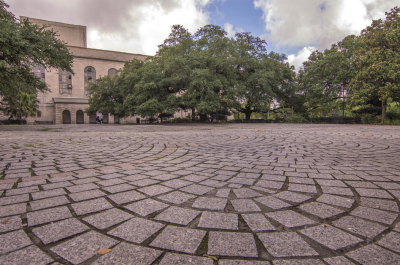
Congo Square, New Orleans/Wayne Hsieh/CC BY NC 2.0
.
The Stuff That Dreams Are Made Of
by Vishwas R. Gaitonde
.
…..Samson’s head was bent as he walked to his favorite corner café. He was meeting Dulcie there. Last night he had dreamed that he was chatting with his best friend Dickie at the kitchen table over burgers and beer. These days, his dreams recurred with increased frequency. What disturbed him is that while he could recall some of them in vivid detail, he remembered nothing of others. He knew a dream had come to him but who were in it and what dramas were enacted in that world in his head — these were totally lost to his waking mind.
…..The dreams that he only partially remembered left him uneasy. Take last night’s dream. Dickie and he were in animated conversation, then he had choked on a piece of hamburger after a big gulp of beer. Dickie had bent him over the sink and thumped him on the back. After Samson spat out the food, Dickie had gotten excited, waving his hand and shouting at him. But what had Dickie said? What had they been talking about? What had triggered Dickie so?
…..Reality and dreams, light and shadow. We flitted back and forth between the two worlds, thought Samson. And whichever world we happened to be in was light, and the other, shadow. Magic. Black magic.
…..He reached the café a little ahead of Dulcie. She was scrupulous about punctuality, almost to a fault. He ordered what they always gorged on: beignets, praline bacon and café au lait. Dulcie adored beignets; she called them sugar-shake pillows. An appropriate name, Samson thought, for Dulcie always managed to shake the sugar onto her face, her hands, and her dress, and even her handbag placed on the floor beside her. She once told him that their café conversations over beignets were like pillow talk.
…..They occasionally ordered Dulce de Leche. But though they enjoyed the caramelized milk jam, beignets ruled. Samson liked Dulce de Leche because it was his nickname for Dulcie. He often shortened it to DdL.
…..“So tell me what have you decided, Sam?” Dulcie took her time lowering herself into her chair, slow enough for Samson to note that she had slapped on a couple more unflattering folds of flesh around her middle.
…..“What’s to decide, DdL? I ordered the usual. Including the pig strips. Want anything else, baby?”
…..“Oh, for the love of Christ, Sam, I’m not talking about food. College, dat’s what I’m talking about. HBCUs are the way to go, I’ve told you so over and over again, and you’ve always dodged me. No straight answers from you. Time’s running out. Which colleges have you put down on your list? Morehouse, I hope. Howard? Hampton? And Fisk, Sam, don’t forget Fisk.”
…..Samson stared at her, perplexed and dismayed. She really was storming her way into it. They’d had this discussion before on more occasions than he cared to remember, but for the first time she had named specific colleges. And all of them were several hundred miles away. He had no intention of stepping foot outside of New Orleans, to part from Dulcie. His bond with his girl was blossoming, despite Dickie sniggering and taking potshots at their relationship whenever he had the chance. Best friends they were, but Dickie didn’t mind — indeed, enjoyed — making Samson squirm.
…..“I don’t want to leave you, Dulcie,” Samson blurted out. “We’ve paired up solid, we are a couple solid, this is no time to split.”
…..“Leave me? Split? What are you saying — what exactly do you mean, Sam?” Dulcie’s eyes withdrew into her cheeks. “Our love ain’t strong enough to survive being four years apart, dat what you’re saying?”
…..When Samson did nothing but just stare at her, Dulcie continued, “Remember, you’ll be back during semester breaks, and Thanksgiving and Christmas. And Mardi Gras, how can you not come for dat! And you’ll return for good after graduation.”
…..“Fine,” said Samson.
…..“I want something more than fine, Sam. I want to matter to you as much as you matter to me. I want you to care about us. Us.”
…..“Of course I care about us, DdL,” said Samson, planting a kiss on her cheek, embarrassed when a fat teardrop wriggled out of her eye. He rushed on, “And of course, you matter to me.”
…..“Cross your heart?”
…..“Cross my heart. Cross my eyes. Cross my fingers, and cross my big and little toe.”
…..Dulcie dabbed at her cheek with a perfumed handkerchief and gave a wan smile that briefly exposed two rows of tiny teeth. “If you’re convinced about that, Sam Boy, there’s no problem in your going away for four years to gain knowledge and wisdom. See, from Atlanta or DC or wherever you are, you’ll get much closer to me. Absence, you know, absence, it makes the heart grow fonder.”
…..“Absence makes the heart grow fonder,” Samson repeated the mantra dutifully. But he was not convinced that it applied to this situation.
…..Dulcie loved to point out to him the alumnae of the historically black universities who had made their mark: Martin Luther King Jr, Lionel Richie, Toni Morrison, Oprah Winfrey, Thurgood Marshall, Kamala Harris. In an unfair world, Dulcie maintained, the odds were stacked against people like them. But the fostering environment of a black university prepared them to face the curveballs the world was going to hurl at them.
…..However much he mulled over it, Samson could not entertain thoughts of ripping himself from the Crescent City. There was too much to love here. There was music in the air, there was magic on the streets. Jumping the puddles in the Quarter after a brief but ferocious thundershower; watching the sky ignite and flame searing red as the sun went down behind the triple spires of the Saint Louis Cathedral Basilica etching them in silhouette; sitting on a bench in the evening on the levee by the Mississippi at Algiers Point and watching fish that vibrated with joie de vivre do dainty somersaults from the water.
…..And then there was Dulcie. Employed as a secretary, with her aging parents dependent on her and with her strong family values, Dulcie was rooted in New Orleans — and that was not going to change any more than Uranus trading places with Venus. He who would woo and wed Dulcie needed to be entrenched in the Crescent City as well.
…..“Me, I’m going nowhere, I’ll always be here,” Dulcie half giggled. “So Sam boy, you are assured of two things to come back to after graduation – the city, and me.”
…..But what if someone else came along? Somebody more charming? Going to new places meant meeting new people and making new friends. Samson wondered if that thought ever crossed Dulcie’s mind.
,
…..Just about all of Samson’s friends were Black like him, the one exception being Dickie. Dickie’s Nordic roots were reflected in his long blond hair and his bright blue eyes. Theirs was an unlikely friendship, one that neither Samson’s nor Dickie’s other friends liked. It was not healthy, they said. But Samson and Dickie ignored them. It was their life and nobody else’s.
…..The two of them shared an apartment; they regularly worked out at the gym. Samson was envious of Dickie’s six-pack abs, his biceps, and his sinewy calf muscles. Dickie sweated lightly, just enough to make his skin glisten and curl his hair into golden ringlets. Samson sweated copiously, turning into a wet rag in little time. He had flab to lose before he could dream of a six-pack. And the way Dickie bobbed his head and tossed his hair strands — Samson could never do something like that unless he let his hair sprout and entwine itself into dreadlocks. But Dickie pooh-poohed Samson’s efforts to sound deprecating. “You shine, Sammie, you shine. And I’m referring to more than sweat.”
…..Dickie was condescending towards Dulcie — and it caused friction between him and Samson. Dulcie had the habit of frequently mentioning how her parents, who she helped support, lived a stone’s throw away from Fats Domino’s house.
…..“Fatso or no Fatso, it’s still the Lower Ninth Ward,” Dickie sneered. “Not the best of neighborhoods, is it?”
…..Samson struggled to explain that Dulcie was not star struck. She was merely using Fats Domino to make a point.
…..“Fats is the example to follow, Sam Boy.” Dulcie had poked Samson’s chest with her finger, playfully but none too gently. “After Fats began selling more records than anybody but Elvis, he could have lived anywhere. Manhattan, Bel Air, Malibu, high up there in Aspen. But he chose to live in the city he grew up in. And even here, he could have bought a million dollar mansion in the Garden District without blinking an eyelash. But nah, Sam Boy, nah, he stuck to the neighborhood he grew up in. Stuck to his shotgun house, holding court in his living room like the king he was, his grand piano by his side, his couch patched up from old Cadillac seats. Serving rice and beans to his visitors. There’s a role model for you, Sam. Fats went on tour all the time from New York to San Francisco to Chicago but home was home, and he always zipped back to where he found his thrill, his Blueberry Hill.”
…..“So?”
…..“You go out into the world to do what you got to do. But you always return to the place you really love, to the person dat’s there in your heart. Always.”
…..“Well, okay Sammie, whatever you say,” Dickie stretched his hand in a dismissive gesture. “Forget Fatso, let’s talk about the point Dulcie made about the HBCU’s nurturing values — hey, listen up, here’s my counterpoint. Just as many Black people went to regular college and did equally well in the world. Maybe even better. Colin Powell, Viola Davis, Michael Jordan, Denzel Washington, and I give you the ultimate, the Man, the man himself — Barack Obama.”
…..And Dickie chortled at Samson’s crestfallen face.
…..“Hell, Sammie, why are you so determined to ignore good opportunities just to stick to this place?” Dickie demanded on another occasion. “It’s Dulcie, isn’t it? Sammie, that girl’s not going anywhere, she’s rooted here, she won’t budge an inch, she’ll be here till her Dad and Mom are buried and then, with her gray hair, it’ll be too late for her to spread her wings, got it? And remember, New Orleans is also anchored, in the mud, maybe, but anchored. Katrina and Ida floored the city but neither could land a knockout blow, and hey, we staggered back to our feet to fight another day. Sheesh, man, you can return anytime, we’re all still be here, what’s biting you?”
…..“I’ll think about it, Dickie,” Samson said, hating that he sounded weak.
…..“And Dulcie, Dull Dull Dulcie, her name is so spot on, she’s dull. Sorry, Sammie, I know you like her but man, she’s so damn ordinary, so damn predictable.” Dickie, with a sly smile, gently pinched Samson’s forearm as he asked, “Absolutely sure Dulcie’s the right person for you, Sammie? Sure that there’s no one else? Look me in the eye.”
…..There were occasions when Dickie’s sharp tongue cut into Samson’s flesh and then there were other moments when Dickie was a soothing balm, moments when Samson had never felt closer to any other person. Samson’s uncle once told him that ever since Richard Nixon was nicknamed Tricky Dick, men named Richard preferred to call themselves Rich rather than Dick. Never trust any Richard who calls himself Dick, his uncle finished. Then Dickie had tap danced into his life and Samson ignored his uncle’s injunction.
…..Dickie’s heart was set on Dartmouth College, and it made Samson’s heart sink. If he absolutely had to leave New Orleans for college, he’d rather be near Dickie if not with Dickie. But Dartmouth! An Ivy League college. Would he even get in? The chances were bleak, the prospects so daunting. But then, would Dickie get in? Dickie was a good student but not especially a standout. That was the reality — but one could always dream, and Dickie often crept into Samson’s reveries — now there was a Tricky Dick for you! — glorifying Dartmouth with honeyed words punctuated by furtive looks and unnatural smiles.
…..But Samson’s safety net, the one that he could fall back to, was New Orleans. If he wanted a “regular” college, the city had Tulane, Loyola, and the University of New Orleans. Heck, if he wanted a HBCU, there was Xavier and Dillard. New Orleans, the complete city. Now if only Dickie chose a New Orleans college, he could be with both Dulcie and Dickie. But that was a pipe dream. Dickie was hell bent on to seek knowledge in distant places.
…..A word that Dulcie frequently invoked was “faith.” Church was an important part of her life, and time and again she told Samson that it was the keystone for personal fulfillment. Samson’s mama had thought on those lines as well, and had dragged him to Sunday School and made him sing in the youth choir. She had wheedled him into keep attending when, as a teenager, his enthusiasm had flagged. To her, the church was a bulwark against her little boy straying into drink, drugs, and wayward sex. Samson resented his mother’s motivation, — it was demeaning! — but went to church anyway. He had realized that church was a community — it gave you a social network that you could turn to in times of need. One did not have to believe in the church’s teachings to tap into the network. Your regular attendance was enough to make you an insider; others accepted you, perceiving you to be one of the faithful.
…..Dickie did not bother to mask his contempt for Samson’s churchgoing. He thought that the church interfered way too much in people’s personal lives, forcing them to gulp down dogma rather than to reason for themselves about the diverse facets of life that went into living, into making a life that was a life.
…..“You don’t believe that stuff that spouts out of their mouths and into your ears every Sunday, do you? Don’t get brainwashed, do you?” Dickie was worked up, his nose twitched and he was red in the face as though he had personally been affronted. “You just go there because it is a club, a club you feel you belong to. Well, Sammie, your HBCUs are like that. The feeling of belonging to a club. Sammie, let’s apply to the same colleges together, in the Northeast, in California, in Chicago. And Dartmouth. Fingers crossed, we’ll get into the same college. I already see us as dorm mates.”
…..And he landed a thump on Samson’s back.
…..The procession of thoughts, the parade of feelings, left Samson adrift. Nothing that met the eye was what it looked like. He often walked around in Congo Square, each visit a meditation made with reverence. He was struck by how pretty the paving looked, the mostly gray stones curving in arcs. But then he saw an aerial photograph of the Square, and man oh man, what a difference! The paving was laid out in overlapping circles: there were arcs within spheres, smaller circles within larger circles, threads tangling and untangling in the semblance of waves and spirals. And the colors were not a uniform gray but shades of gray, some lighter, some darker, and some with a striking overlay of cobalt.
…..And, Samson wondered: were dreams also like this? Interweaving with each other so closely and so intimately, so you never could tell when reality ended and a dream began, and when a dream reverted to the real world again. Or when one dream picked another dream to segue into. Or, for that matter, to what extent dreams were real and how far that which he had believed to be real was merely ethereal.
…..That night, Samson slowly descended into the very depths of sleep, into the realm of dreams. And in his dream, he was scrunching beignets with Dulcie at the corner café, watching her powder herself with sugar. Shouldn’t true red-blooded New Orleanean be well versed in eating a beignet without getting sugar dust all over them? He was better than her in this. Or was it very New Orleans to mess yourself up with beignets?
…..“I love this city, DdL, but there comes a time when one has to decide whether it’s best to stick on here or move along.” Samson saw his dream self getting animated, his face flushed, clenching and unclenching his fist. “I know this place will always be here for me. But I need to consider what’s best for me, Sugar, and it may not be the black universities. Though I’ll probably get more acceptances from them than from —”
…..“Sam. Sam Boy. Why don’t you think for yourself?” Dulcie drummed hard on the table with her spoon. “You let that pig-nosed Richard decide what you should or shouldn’t be doing. Then he —”
…..“Dickie doesn’t decide for me,” Samson cut in, stung that she had brought up Dickie’s tic, the way his nose twitched when he was angry or irritated. “I listen to him like I listen to you and, and —”
…..“Don’t yell at me, Sam. I don’t deserve dat from you. It’s a fact, people who leave town with the wrong attitude don’t return.”
…..“But don’t you see, Dulcie, that’s the test. Those who won’t come back have never really cared for this place and its people. Despite all its faults and God knows it has so many, if New Orleans is in their hearts, they will return. And this city, every street corner, is in my heart, and so are you.”
…..“Am I, Sam? Am I? There’s someone else, isn’t there?”
…..Her sudden thrust caught Samson flatfooted. He stared at her, swallowed twice and said nothing. Dulcie steadily staring back.
…..“Dulcie. DdL,” Samson found his voice. “I spend all my spare time with you, every minute of it, every second. Girl, where’s the fucking time for anyone else?”
…..Dulcie’s gaze wavered and she dropped her eyes. They parted from each other in discord.
…..On the walk back to his apartment, Samson reflected on how much sweeter Dulcie was in his dreams. In his dream she looked at him with her big puppy dog eyes, saying, “I want something more than fine, Sam. I want to matter to you as much as you matter to me. I want you to care about us. Us.”
…..“I care about us, DdL,” Samson was horrified to see the wet tracks of her tears disfiguring her cheeks. He blurted out, “You matter to me.”
.
…..Dickie was waiting for him in their apartment, and they left together to the gym. After a strenuous workout, they returned, tired, after picking up some fast food. They sat at the kitchen table, washing down their burgers and fries with lager. Samson bit off a too-large piece of burger and bun and choked as it stuck in his throat. Dickie grabbed him, bent him over the sink and pummeled him vigorously on the back till the offending morsel was ejected.
…..“Spit out Dulcie’s words from your mind like you puked out the food from your throat. You can kick out a thought by replacing it with another. I’ll be your exorcist,” Dickie squeezed Samson’s hand as he guided him back to the table. “Her words are a trap, Sammie. She can be your Delilah without giving you a haircut.”
…..Samson nodded. After regaining his composure, he took a hot shower and got into bed without bothering to slip into any nightclothes. Dickie followed, and although both were tired from their workout and preoccupied with the little excitement in the kitchen, they felt invigorated under the sheets. With passion and energy, they kissed and cuddled, and went on in a frenzy of lovemaking. They were sweaty and tired again, but much happier after this workout.
…..“So will you marry me, Sammie?” Dickie asked.
…..“You know the answer, Dickie.” Samson loved their pillow talk.
…..“Want to hear it from your mouth, dude.”
…..“Yeah, dude.”
…..“I knew it. But hey, we all want confirmation of what we know in our hearts, right? So — you’ll ditch your family values?”
…..“Yes. No, dang it, we’ll create new family values.”
…..Dickie’s face lit up, and he looked like he was going to say something but he just leaned over and planted a wet kiss on Samson’s lips. He sank back into his pillow and soon was enveloped in sleep. Samson remained wide awake, adrift in his thoughts. Dulcie had become part of dreams that fade but Dickie — Samson watched the rhythmic heaving of Dickie’s chest and the tips of his golden eyelashes pressed against his cheek, and impulsively flung his arm across Dickie. This was the stuff that dreams were made of.
.
.
___
.
.
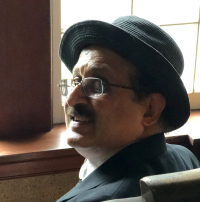
Vishwas Gaitonde’s formative years were spent in India. He has lived in Britain and now resides in the United States. His short story collection On Earth as It Is in Heaven won the 2023 Orison Prize in fiction, and will be published by Orison Books. Literary awards include: two residencies in fiction at the Anderson Center for Interdisciplinary Studies (Minnesota, USA); scholarships to the Sewanee Writers’ Conference, Tin House Summer Workshop, and Community of Writers conference; and fellowships to the Summer Literary Seminar (Montreal, Canada) and the Hawthornden Castle Writers Retreat (Scotland).
.
.
___
.
.
Click here to help support the continuing publication of Jerry Jazz Musician, and to keep it ad and commercial-free (thank you!)
.
Click here to read “Not From Around Here,” Jeff Dingler’s winning story in the 66th Jerry Jazz Musician Short Fiction Contest
Click here to read more short fiction published on Jerry Jazz Musician
Click here to read The Sunday Poem
Click here for information about how to submit your poetry or short fiction
Click here for details about the upcoming 67th Jerry Jazz Musician Short Fiction Contest
Click here to subscribe to the Jerry Jazz Musician quarterly newsletter (it’s free)
.
.
.
___
.
.

Jerry Jazz Musician…human produced (and AI-free) since 1999
.
.
.