
“The Blues Museum” — a short story by Jay Franzel

June 27th, 2018

“The Blues Museum,” by Jaz Franzel, was the winner of the fortieth Jerry Jazz Musician Short Fiction Contest, and was originally published on November 16, 2015


_____


The Blues Museum

by Jay Franzel


Camp looked through glass doors and across the shoulderless highway. A patch of grass across the road was covered with white trailers washed clean by the rain. He stared out a side window at the brown back of a gas station. A red and yellow sign, mounted so high he had to twist his neck to see it, seemed like it should have been turning but sat still against a gray sky.

What do you find in a bus station? Long waits under dirty fluorescents, grimy floor and seats, gloom on scattered faces. Soup, coffee and candy vending machines. If someone could gather it up, all the pieces a bus station’s handed down through the years, you could start a museum. You could cover the walls with black and white photos, pictures of a million people. Pick out any one person, nobody special, just someone with some place to go, or no place to go.

Behind Camp, a girl speaking on the payphone. In the corner, a soap opera playing on a small TV. Maybe when the westbound took the few watchers away the guy behind the counter would flip the channels, find something different. For a moment the girl’s voice sounded familiar. An old illusion — before Camp even turned her way he’d stopped listening.

You wouldn’t have to advertise this museum, people would just hear about it. Maybe stop in their way by. You wouldn’t promise them anything. People are promised so much. In a bus station you feel that.

Camp kept staring out the doors and window, through thin grey Windex streaks. A whitewashed concrete overhang kept rain off the glass doors. Sandy haired fellow behind the counter was friendly enough, though he didn’t answer his busy phone very often.

Don’t worry, he’d tell every ticket buyer, I’ll tell you which bus is yours.

He spent part of his time in a back room, part leaning on the counter, watching TV. Seemed like an awfully long soap opera. Must be the second one, thought Camp. Maybe the third — I’ve been here over an hour.

The Bus Station Blues Museum, it could do well. People would know the faces on the walls. Not the actual faces, but the expression, situation. We recognize our own.

Going into this museum would be like going into the station itself. Only you wouldn’t go in because of the rain, or the loneliness of the road, or running away from something to nowhere, you’d just go. Maybe to watch without being caught in it.

It would be special by being so ordinary. There wouldn’t be a station pictured because a politician gave a speech there or because it was a historic building about to be demolished. Just another gray station on another bloodless highway or dull city block or small town Main Street. Maybe near a diner or donut shop.

Vending machines, stained plastic seats, a little dust and grime behind them, someone kicking a used coffee cup around. You wouldn’t know if they worked there and that was part of the job or just felt like kicking a coffee cup. People on pay phones, maybe they were part of the place, maybe not.

A wire thin, gentle looking lady of forty to sixty slipped into the station, quietly closing the glass door behind her. She clutched a black pocketbook to her narrow frame; it looked like it could topple her over. A shopping bag in the other hand, as if for balance. Sandy hair behind the counter smiled.

Hello, Virginia.

 Hello Freddie.

      Any news about Roy, Freddie?

      Yeah, he told that girl reporter to get off his case or he’d give her a case — in court!

Well. Good for him.

Camp shook his head. Local gossip.

Freddie stepped into the back room, commercial for dish soap on the set.

Virginia left her shopping bag beside a yellow seat and walked to the Ladies Room.

When you stared at your reflection in a bus window long enough you forgot why you looked to begin with, whether you were watching something outside or just your reflection. Your image changed with the shifting light, the background flashing outside. You moved close and saw less of yourself, or moved back, watching a person across the aisle or in the seat beside you, image ghostly, wheels, motor droning underneath.

There wouldn’t be good mirrors in the museum, just some cloudy glass, in thin tin casing.

‘Do you deny having had relations with Ms. O’Day when you were in Chicago?’

      ‘I don’t deny it, no, but I didn’t conceive her child. We slept together but what’s wrong with’– Oh, she gone to the bathroom?

Freddie grinned a little sheepishly.

Yeah, I think she did.

      I was just filling her in what she missed so far. She gets out of work at two and her program’s two thirty, and her bus isn’t till three forty five. Hey, that’s your bus, too, right?

      I-

      No, that’s not yours, either. Don’t worry, I’ll tell you which one’s yours.

      Does she always come watch the soap opera?

      Oh, yes. Lessee, you got the one after, express. Hers is the local.

Virginia returned, sat carefully beside her shopping bag. Freddie caught her up on the show.

There’d be music. Maybe live, but like a soundtrack. You wouldn’t know — was the musician part of the museum, or just busking? Music and the low drone of wheels and motor and distant voices. Hooker maybe, John Lee, the blues man. How many songs did he record, under how many names? Hooker had this song, Bus Station Blues. Camp began singing to himself, tapping heavy soles on dull tile.

   Mmm, mmm, mmm….

Hooker didn’t need words, just tap his shoe, play those low notes, go Mmm, mmm, mmm…

That’s the music people would hear, but just barely, while looking at pictures on the wall, sipping bitter coffee, sitting on plastic seats, staring into cloudy mirrors, waiting…

Mmm, mmm,mmm…

Once Camp was walking toward the highway when he saw a sign on a pole saying Hooker was playing in the city nearby. He hiked to the station and caught a bus. Hooker wasn’t playing a big place, it was a bar with two rooms, both full. Camp, sandwiched between two big women called out, Bus Station Blues!

Hooker scowled.

But he sang it a lot longer than Camp had heard on any records.

Gonna get a Greyhound, and ri-hide,

get a Greyhound, and ri-hide,

      and ri-hide, and ri-hide,

      and ride ride ride-ride-ride…

Guitar in a highway rhythm, bass notes like bumps under a bus wheel,

Lord have mercy, I ain’t got no friends,

  got no friends,

      mmmmmmm…

Glancing up, Camp saw Virginia smile at him, her teeth and cardigan deep white against her dark skin. Suddenly he wanted to know her. Did she have kids?

Where was it she worked? What had etched those lines into her face and shot gray through her hair? And how had she endured it with such grace? How could she smile like that?

Virginia shifted her huge pocketbook onto her lap, pulled out needles and cloth, turned her attention to the TV. Camp didn’t move toward her. He thought someone like her would be in the museum, sitting, stitching, sometimes smiling at you.

The phone rang. Freddie leaned elbows on the counter, chin on his hands, watching the TV, letting it ring. Camp glanced at Virginia, her needles working as if by themselves. She checked her watch, folded her hands in her lap, slowly lowered her chin.

Camp looked down at his boots, waves of exhaustion pouring over him. He’d been hitch-hiking, leaving New York City in the night, standing in Delaware rain at dawn, catching rides and walking, catching rides, walking some more, finally hiking to Freddie’s bus station.

He felt his eyes closing, TV voices blurring. Folding arms on his knees, resting his head. He thought he’d check the new program but never lifted his head. Folding into his green seat and the seat beside him he thought he heard it start raining again.

Camp woke, jerking his head from the metal bar against the plastic seat.

Almost fell asleep, he thought. He blinked and looked around. All the other seats were empty, a movie on the TV. He finally noticed Freddie just behind him; Freddie’s hand still rested lightly on Camp’s shoulder.

OK my friend, that’s your bus.

Freddie smiled, jerking his chin toward a bus droning outside the windows.

Yeah thanks. Must’ve fallen asleep. What’s that?

A handkerchief was draped over the top of Camp’s pack, a clean square with embroidered edges, startling white against the pack’s dark grungy green.

 Virginia left that for you.

Camp blinked.

She does that sometimes.

  You better get your bus.

Camp hoisted his pack, pushed through the Windex’d doors, bus droning outside. Rain blew in his face, dampened the handkerchief in his hand. He paused at the door. It would be just like a regular station but you’d come away with something, something beyond a ticket stub and routine emptiness. Releasing the door he heard the phone ring behind him.

Freddie let it ring.

A guy like Freddie, could run the desk at the museum.


_____


jay


Jay Franzel

*

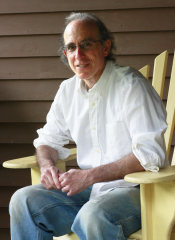
Jay Franzel lives and writes in Wayne, Maine. A poet, he has published poems in various journals and anthologies, along with two chapbooks. He has received poetry grants from Maine Arts Commission and St Botolph’s Foundation. Jay has worked with at-risk youth for over thirty years. Musicians often leave him awed by what they produce.  

(Biography originally published in Nov. 2015.  It has not been updated).

Share this:

Comment on this article:

Your email address will not be published. Required fields are marked *

Site Archive

Your Support is Appreciated

Jerry Jazz Musician has been commercial-free since its inception in 1999. Your generous donation helps it remain that way. Thanks very much for your kind consideration.

Click here to read about plans for the future of Jerry Jazz Musician.

In this Issue

Announcing the publication of Volume II of Kinds of Cool: An Interactive Collection of Jazz Poetry...The second edition of Kinds of Cool, an Interactive Collection of Jazz Poetry has just been published, and is now available for sale on Amazon.com. This edition is dedicated to publishing women poets from all over the world who share their personal passion for and relationship with jazz music, and the culture it interacts with. With a foreword by Allison Miller, one of the world’s most eminent jazz drummers, and photography and design by Rhonda R. Dorsett

Community

A collection of poetic responses to the events of 2025...Forty poets describe their experiences with the tumultuous events of 2025, resulting in a remarkable collection of work made up of writers who may differ on what inspired them to participate, but who universally share a desire for their voice to be heard amid a changing America.

The Sunday Poem

CC BY-SA 3.0, via Wikimedia Commons

"A Light Downstream" by Francis Fernandes

The Sunday Poem is published weekly, and strives to include the poet reading their work...

Francis Fernandes reads his poem at its conclusion


Click here to read previous editions of The Sunday Poem

Short Fiction

Photo by Johannes Schröter, via Pexels
Short Fiction Contest-winning story #71 – “Where the Music Wasn’t Allowed,” by Jane McCarthy....The award-winning story is about a young immigrant growing up in Southern California to the sound of music seeping into his family’s home from an upstairs neighbor’s piano, shaping the boy’s understanding of memory, family, belonging, and the improvisational ethics of music.

Interview

photo by Warren Fowler
Interview with John Gennari, author of The Jazz Barn: Music Inn, the Berkshires, and the Place of Jazz in American Life...The author discusses how in the 1950s the Berkshires – historic home to the likes of Hawthorne, Melville, Wharton, Rockwell, and Tanglewood – became a crucial space for the performance, study, and mainstreaming of jazz, and eventually an epicenter of the genre’s avant-garde.

Community

Ricky Esquivel/Pexels.com
Community Bookshelf #6...“Community Bookshelf” is a twice-yearly space where writers who have been published on Jerry Jazz Musician can share news about their recently authored books and/or recordings. This edition includes information about books published within the last six months or so (September, 2025 – March, 2026)

Poetry

painting by Linnaea Mallette
21 jazz poems on the 21st of March, 2026...An ongoing series designed to share the quality of jazz poetry continuously submitted to Jerry Jazz Musician. This edition features poets – several new to readers of this website – writing about their appreciation for the music, and the diversity and aesthetics of its sound. Along the way, readers will encounter poems that include the great musicians Horace Parlan, Shelly Manne, Keith Jarrett, Zoot Sims, Sun Ra, and Garland Wilson.

Feature

photo by Laura Stanley via Pexels.com.
Trading Fours, with Douglas Cole, No. 28: “Little Samba”...Trading Fours with Douglas Cole is an occasional series of the writer’s poetic interpretations of jazz recordings and film. This edition is based largely on a documentary – They Shot the Piano Player – about Tenório Junior, a Latin jazz musician who only produced one album (1964) before he “disappeared” in 1976.

Poetry

art by Marsha Hammel
“Learning the Alphabet of the Blues” – a poem by Mary K O’Melveny...A poem from Kinds of Cool: An Interactive Collection of Jazz Poetry, Vol. II

Interview

A Women’s History Month Profile: Interview with Laura Flam and Emily Sieu Liebowitz, authors of But Will You Love Me Tomorrow?: An Oral History of the 60’s Girl Groups...Little is known of the lives of many of the young Black women who – in the Girl Groups of the ‘60’s – sang, wrote, created, and popularized their generation-defining music, and even less about the challenges they faced while performing during such a complex era, one rife with racism, sexism, and music industry corruption. In this February, 2024 Jerry Jazz Musician interview, Laura Flam and Emily Sieu Liebowitz discuss their book’s endeavor at giving them an opportunity to voice their meaningful experiences.

Poetry

photo via Wikimedia Commons
“Empire State of GRIME” – a poem by Camille R.E....The author’s free-verse poem is written as an informal letter to tourists from a native New Yorker, (and sparing no bitter opinion).

Feature

photo via Wikipedia
“Two Famous Johns” – a true jazz story by Bob Hecht...The writer remembers an evening in New York’s Half Note in 1964 when he witnessed a John Coltrane performance that was also attended by the pop singer Johnny Mathis

Poetry

Haiku: Musings – by Connie Johnson...Exploring segments of the world of jazz – in three suites of vivid haiku poetry…

Feature

“Bohemian Spirit” – A Remembrance of 1970’s Venice Beach, by Daniel Miltz...The writer recalls 1970’s Venice Beach, where creatives chased a kind of freedom that didn’t fit inside four walls…

Poetry

Linnaea Mallette/publicdomainpictures.net
A 2026 jazz poetry calendar...12 individual poets contribute a jazz-themed poem dedicated to a particular month, resulting in a 2026 calendar of jazz poetry that winds through the year with a variety of poetic styles and voices who share their journeys with the music, tying it into the month they were tasked to interpret. Along the way you will encounter the likes of Sonny Stitt, Charles Mingus, Jaco Pastorius, Wynton Kelly, John Coltrane, and Nina Simone.

Feature

Boris Yaro, CC BY 4.0, via Wikimedia Commons
“The Bowie Summer” – a personal memory, and how art can fundamentally reshape identity, by G.D. Newton-Wade

Poetry

photo via NOAA
“Taking The Littlenecks” – a prose poem by Robert Alan Felt...Expressing the joy and sorrow of life at age 71 with grace, wisdom, and appreciation.

Short Fiction

photo by Iryna Olar/pexels.com 
“The Fading” – a short story by Noah Wilson...The story – a finalist in the recently concluded 70th Short Fiction Contest – examines the impact of genetic illness on a family of musicians and artists.

Poetry

Poems on Charlie “Bird” Parker (inspired by a painting by Al Summ) – an ekphrastic poetry collection...A collection of 25 poems inspired by the painting of Charlie Parker by the artist Al Summ.

Short Fiction

Los Angeles Daily News, CC BY 4.0 , via Wikimedia Commons
“The Pet Shop” – a short story by Sherry Shahan...The story – a finalist in the recently concluded 70th Short Fiction Contest, – is about an octogenarian couple who accept a part-time caretaker position at Crazy Goose Burlesque when the theater is temporarily shuttered due to archaic public indecency laws.

Poetry

Laura Manchinu (aka La Manchù), CC BY 2.0 , via Wikimedia Commons

A Letter from the Publisher

The gate at Buchenwald. Photo by Rhonda R Dorsett
War. Remembrance. Walls.
The High Price of Authoritarianism– by editor/publisher Joe Maita
...An essay inspired by my recent experiences witnessing the ceremonies commemorating the 80th anniversary of liberation of several World War II concentration camps in Germany.

Jazz History Quiz

photo by Mel Levine/pinelife, CC BY 2.0, via Wikimedia Commons
Jazz History Quiz #186...While he had a long career in jazz, including stints with, among others, Coleman Hawkins, Roy Eldridge, Sonny Stitt and Stan Getz, he will always be remembered primarily as the pianist in Charlie Parker’s classic 1947 quintet. Who is he?

Playlist

photo by Robert Hecht
“Spring is Here!” – a playlist by Bob Hecht...With perhaps Lorenz Hart’s most sardonic lyric — which is saying something! — this song remains one of the greats, and has been interpreted in many ways, from the plaintive and melancholy to the upbeat and hard swinging, such as John Coltrane’s version. Check out this bouquet of ten tracks to celebrate this great season!

Poetry

Wikimedia Commons
“Dorothy Parker, an Icon of the Jazz Age” – a poem by Jane McCarthy

Short Fiction

“Lies, Agreed Upon” – a short story by M.R. Lehman Wiens...The story – a finalist in the recently concluded 70th Short Fiction Contest – uncovers a man’s long hidden past, and a town’s effort to keep its involvement in it buried.

Short Fiction

photo by Bowen Liu
“Going” – a short story by D.O. Moore...A short-listed entry in the recently concluded 70th Jerry Jazz Musician Short Fiction Contest, “Going” tells of a traumatic flight experience that breaks a woman out of her self-imposed confines and into an acceptance that she has no control of her destiny.

Community

Nominations for the Pushcart Prize L (50)...Announcing the six writers nominated for the Pushcart Prize v. L (50), whose work appeared on the web pages of Jerry Jazz Musician or within print anthologies I edited during 2025.

Interview

Interview with Tad Richards, author of Listening to Prestige: Chronicling its Classic Jazz Recordings, 1949 – 1972...Richards discusses his book – a long overdue history of Prestige Records that draws readers into stories involving its visionary founder Bob Weinstock, the classic recording sessions he assembled, and the brilliant jazz musicians whose work on Prestige helped shape the direction of post-war music.

Poetry

“Still Wild” – a collection of poems by Connie Johnson...Connie Johnson’s unique and warm vernacular is the framework in which she reminds readers of the foremost contributors of jazz music, while peeling back the layers on the lesser known and of those who find themselves engaged by it, and affected by it. I have proudly published Connie’s poems for over two years and felt the consistency and excellence of her work deserved this 15 poem showcase.

Feature

Albert Ayler’s Spiritual Unity – A Classic of Our Time, and for All Time – an essay by Peter Valente...On the essence of Albert Ayler’s now classic 1964 album…

Contributing Writers

Click the image to view the writers, poets and artists whose work has been published on Jerry Jazz Musician, and find links to their work

Coming Soon

An interview with Paul Alexander, author of Bitter Crop: The Heartache and Triumph of Billie Holiday's Last Year; New poetry collections, Jazz History Quiz, and lots of short fiction; poetry; photography; interviews; playlists; and much more in the works...

Interview Archive

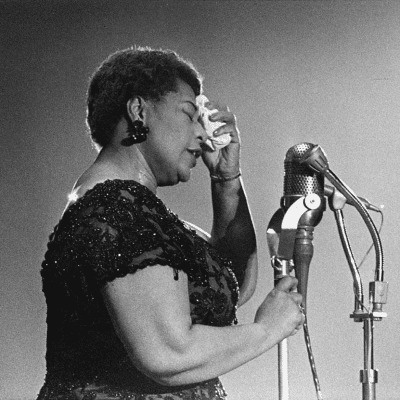
Ella Fitzgerald/IISG, CC BY-SA 2.0 , via Wikimedia Commons
Click to view the complete 25-year archive of Jerry Jazz Musician interviews, including those recently published with Judith Tick on Ella Fitzgerald (pictured),; Laura Flam and Emily Sieu Liebowitz on the Girl Groups of the 60's; Tad Richards on Small Group Swing; Stephanie Stein Crease on Chick Webb; Brent Hayes Edwards on Henry Threadgill; Richard Koloda on Albert Ayler; Glenn Mott on Stanley Crouch; Richard Carlin and Ken Bloom on Eubie Blake; Richard Brent Turner on jazz and Islam; Alyn Shipton on the art of jazz; Shawn Levy on the original queens of standup comedy; Travis Atria on the expatriate trumpeter Arthur Briggs; Kitt Shapiro on her life with her mother, Eartha Kitt; Will Friedwald on Nat King Cole; Wayne Enstice on the drummer Dottie Dodgion; the drummer Joe La Barbera on Bill Evans; Philip Clark on Dave Brubeck; Nicholas Buccola on James Baldwin and William F. Buckley; Ricky Riccardi on Louis Armstrong; Dan Morgenstern and Christian Sands on Erroll Garner; Maria Golia on Ornette Coleman.