



.
.
New Short Fiction Award
Three times a year, we award a writer who submits, in our opinion, the best original, previously unpublished work.
Shannon Brady of Rocky Point, New York is the winner of the 55th Jerry Jazz Musician New Short Fiction Award, announced and published for the first time on November 16, 2020.
.
.
_____
.
.
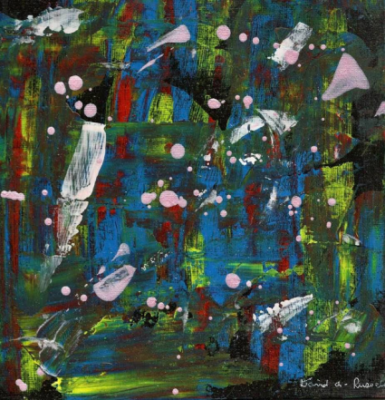
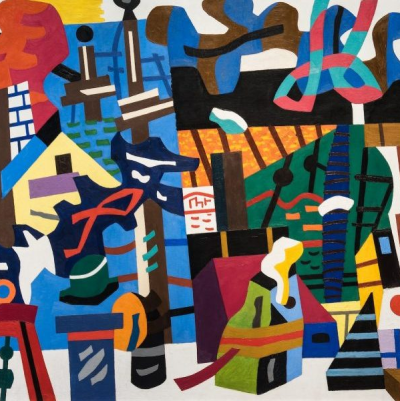
“In Time,” by David Russell
.
.
Chromesthesia
by Shannon Brady
.
___
.
.
…..He still has his father’s old records.
…..That single cardboard box is all that Ken has left of the man. That and memories. He remembers those swirling blue winter nights: sitting on the living room rug, right between the full-blast radiator and Dad’s battered old armchair, watching the record turn around and around and fill the room with Duke Ellington’s piano. The summer Sundays, where the warm breeze came in through the window, and the cleaning of their apartment turned into a game backed by Dizzy Gillespie’s big band, deep orange-pink like strawberry lemonade.
…..He couldn’t play. Neither of them could, but he still feels a strange film of shame on him at the thought of the smile on his father’s face as the music played, a study in complete and total satisfaction. His soft, forest-green laugh. Neither Ken’s attempts at learning the piano for himself (valiant but woefully inadequate) nor his learning how to put on a canvas the colors it played in his head (so good it surprised him still, good enough to propel him into art school) could ever completely replicate them.
…..Oh, it had made Dad happy, sure. He had never not been proud of his only child. But while he’d smiled on the accomplishments of Ken’s life, it had never been Ken that made his eyes turn warm and his body sink into relaxation. Not even his son’s hand gripping his — with all the love and strength he could muster, silent, as lime green flashed in his head with every sharp beep of the heart monitor, burning there as it finally went flat — could bring that comfort. When it mattered, Ken could do nothing for him.
…..At least, that was the way Ken saw it. The nurses who cleaned his father’s cold body had assured him that they rarely saw anyone so content at the moment of passing, and he supposed that if they had bothered to speak up at all, they had no reason to lie. And there weren’t many people who saw the world the way Ken did, and still does.
…..Ken is nineteen now. He’s walking through the subway station, on his way from the building that holds his classroom to his own apartment, and he tries as hard as he can to memorize the lightshow it sparks for him, to hang onto it for the canvas. He would have better luck trying to hold a fistful of water.
…..Living in New York City is a perpetual stirring of all five senses. (He knows he can never live anywhere else; it would just be too quiet.) But in Ken’s head, sound dominates over all else. The bright red rumble of the cars on the tracks; the cloudy dun murmur of the crowd around him, strong but largely unintelligible unless he picks a voice to home in on; any pair of footsteps loud enough to stand out blunt in his ears but silvery in his head.
…..He can picture it all, popping and swooping out of a pitch-black backdrop. His fingers worry at the strap of his backpack, wishing they held a brush instead.
…..It’s always been irritating to try and explain it to other people. Sure, it’s a condition with a name, but the science only goes so far to clarify. Sounds don’t become color in the field of his vision, like somebody flashing lights in his face. They’re just there in his brain, they fill it, and while the creative applications come naturally to him, the words never seem to. Unless he’s ended up talking with another synesthete who’d never realized it about themself, he’s pretty sure he leaves people more confused about the whole thing than he’d found them.
…..He’s got no idea how he could even begin to bring it up to Trumpet Guy.
…..Ken never used to pick favorites among the people who played music on the streets and in the stations for money. He doesn’t see the point. The man with the lively violin by Literary Walk, the pumped-up band with a saxophone and drum in the Bedford Avenue station, the solemn girl who strums an old guitar around Fifth Avenue…he drops a dollar bill (or change, if he’s really short that month) into each of their upturned hats as he passes by, even if he can never stop to listen. Of course he does the same for the people who can only sit with a cardboard sign and hope — it’s what he would want, if their places were reversed — but he has no way of knowing their colors.
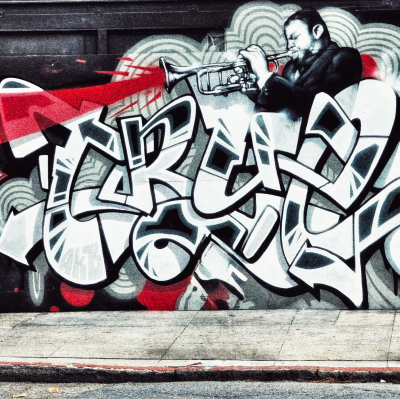
…..Now, however…well. He doesn’t fully understand what draws him to Trumpet Guy, who’s there every day in the subway, in the same place if not the same time, blasting away like his life depends on it. (Which, of course, it probably does.) They share the same dark brown skin and eyes, but other than that, Trumpet Guy looks nothing like Ken’s father: short and stocky where Dad had been tall and wiry, a rounder face, definitely more wrinkles. And it’s not like he’s the only one who plays jazz and blues out here.
…..Still. This is the long way back and forth, but he takes it anyway just to hear him play those beautiful sounds and even more beautiful colors. They’re both too good to go unknown, and even if Ken had no platform at all, nothing to bargain for them, he still wouldn’t be able to let it go.
…..Fortunately, he has an idea. All he’s had left to do is work up some nerve, which had taken a couple weeks.
…..Ken finds him in the middle of a song, and waits until he’s finished, leaning against the opposite wall and pretending to scroll on his phone. There’s a stream of people walking between them, acting as if they don’t hear, and he wishes that their footsteps would quit tarnishing the fresh color of Trumpet Guy’s notes. His fingers itch to be moving a paintbrush over canvas.
…..When he chances a quick glance up at him, his eyes are bright with concentration, but his fingers move so deftly it seems effortless. It’s always been a strange thing, the sensation of admiration and jealousy both spreading through his veins, strong and searing hot. Like a shot of medicine in one arm and poison in the other.
…..Two minutes before the song ends, but for all the effort Ken has to expend just to pretend his heart isn’t pounding harder every second, it might as well be two months. His legs feel like lead as he weaves through the passing people, ignoring any dirty looks he gets for going against the flow. He doesn’t bother forcing a salesman’s smile; he’s never been very good at faking things. He just drops a five-dollar bill into the shoebox at Trumpet Guy’s feet, and steels himself to look him in the eyes.
…..“Um…I like the way you play.”
…..“…Thank you, young man.”
…..Up close, Trumpet Guy looks even older than he had assumed: hairline not just receding but damn near fleeing the country, and more wrinkles show themselves off as the man’s face scrunches up in suspicion when this stranger doesn’t move on and just keeps staring. Belatedly, Ken realizes he’s too close, too, and takes a half step back.
…..“Listen, I, uh…this is going to sound weird.”
…..“…Okay,” he says, not taking his eyes off Ken as he slowly packs his trumpet into its buffeted case.
…..“I…was wondering…if you would come back to my apartment with me. Not for anything weird, or…!” He stumbles over his words when Trumpet Guy raises one bushy eyebrow. “It’s just…I’m a painter, an art student, and I have this condition, I see sounds as colors, I don’t know if you’ve heard of it, it’s—”
…..“Synesthesia,” Trumpet Guy says, nodding. “Sure I’ve heard of it. I know a thing or two.”
…..“Yeah. Then…would you…mind playing for me back home? So I can paint it right? I can’t pay you what you deserve for a performance, but I can make dinner, and you could crash on my couch…”
…..For a moment way too long for a New York train station, they’re both standing still, while Trumpet Guy looks him up and down, considering him carefully, and Ken clutches his backpack strap and swallows to moisten his dry throat. His nerve is about a second from breaking when the musician sighs, evidently deciding that Ken doesn’t look like a serial killer.
…..“All right, Mister Art Student. Why not?”
…..Trumpet Guy’s name turns out to be Davis.
…..“Birk Davis,” he had admitted on the train ride, “but I’ve never much liked my first name. So you can just call me by my last one.”
…..Ken had nodded. “Edward Kennedy II. But I just go by Ken.”
…..Dinner back at his studio apartment is just as subdued as usual, but considerably more awkward. He had never felt self-conscious sitting on the loveseat and eating cup ramen before — his college friends’ places don’t look much different — but then again, he has never had a guest here.
…..He tries not to stare as Davis looks around at the three hundred square feet he lives in, and it’s only a small relief that his eyes seem to be drawn to the paintings strewn around the room, complete and works in progress alike, instead of the air mattress, bare walls, and empty floor. At least he’s made sure it’s all clean.
…..There’s a lot of things he needs to hone his skills in where art is concerned. His human anatomy and lighting, in particular, leave a lot to be desired, at least in the view of his professors. But Ken is still barely a sophomore, and is sure that he ought to perfect his more abstract style first before expanding his arsenal. Once he captures a song to his complete satisfaction…then, maybe, he’ll be able to move on. The blank canvas already set up on his easel beckons him, pulls at him magnetically.
…..Davis’ eyes have found the box of records in the corner, gathering dust. “You got records, but no record player?”
…..“Had to sell it. Along with the rest of my dad’s stuff. School, rent, art supplies, shit’s expensive.” His last slurp of noodles doesn’t go down too well. “I can’t get rid of them. But I can’t play them anymore, either. So that’s why I need you, Mr. Davis.”
…..“I see. You sure your neighbors won’t mind?”
…..“No, sir. Not till it gets dark.” Between the yappy dogs, suspicious creaking, and explosive arguments, he figures nobody on any side of his place has a leg to stand on, anyway.
…..“All right, then.” Davis tosses his empty cup in the small trash can. “So how about we get started?”
…..Before he’s even finished speaking, Ken is standing up and crossing the room; it feels good to finally let the pull of the canvas move him. Behind him, he hears the click of Davis’ trumpet case opening.
…..“Any requests?”
…..Ken’s eyes flick over to the records box. He can’t read the names and song titles on the frayed labels from this angle, but he has their order memorized. He has his opinions on which are best — he’d discussed them at length with Dad — but his aren’t the crucial ones here.
…..“Your favorites,” he says, reaching for his palette.
…..It’s every bit as beautiful as Ken had hoped it would be.
…..He is in his element, truly. Every trace of doubt and insecurity flows out of him like toxins being filtered from his blood, as Davis’ music fills his head and his paints fill the canvas.
…..Blue first, a smooth opening: a rich navy that quickly lightens, as he paints across the liquid-white expanse, to a bright summer sky. Then pale yellows edged in gold — short, high notes, staring at the sun — flowing wide, giving way to bursts of new color formed by quick flicks of his wrist. Like a fast-blooming flower, or Fourth of July sparklers, though he’s never seen either in quite these shades of blue-green, decorated with the tiniest flecks of white.
…..So much. So much. So much.
…..This is a song Ken heard several times before, bouncing off the walls of the subway tunnel. But this time its colors are clear and unsullied in his head, and his own hand is numb, it and the brush blurring over the canvas. He’s not thinking, only moving, and it’s the best: his thoughts only clog up inside him and freeze him into uselessness.
…..What is left on the canvas is his heart, pure and simple and opened by the proud and earnest notes of Davis’ trumpet. Song after song, and not a single sour one.
…..Dimly, Ken recognizes that this one still has about twenty seconds to go, but a cramp hits his painting hand and jolts him back into reality. He carefully sets his brush down in its cup, leans back in his chair, and flexes his stiff fingers. When the silence comes back, ringing in his ears, it takes him a moment to notice.
…..Davis’ footsteps creak softly across the wood floor, and stop at Ken’s shoulder. His presence there is an oddly familiar feeling.
…..“Look at that. That’s my trumpet, huh?”
…..“It’s how I see it,” Ken murmurs. “When it’s playing. There’s not too much deeper meaning behind it, it’s just…”
…..“Is that what your teachers tell you?”
…..“Not all of them.”
…..Davis laughs lightly. “Well, I see the beauty you see in it. I see how much you must love it, and I hadn’t realized that before. That sounds like a deeper meaning to me.”
…..Ken wonders if desire and love are at all the same thing. Envy and love certainly aren’t.
…..“Thank you,” he says anyway. He shifts his shoulders, and notices that the sun is now very close to setting. “Uh…Mr. Davis, am I right assuming that you…don’t have any place to go tonight?”
…..He chuckles again, as if that’s a joke. “The shelter a few blocks down opens up around now. Unfortunately I blew all my other options a long time ago. Wish I was your age again.”
…..Ken nods, not knowing what else to do. “My shower doesn’t work too well, but you’re welcome to it if you like. And like I said, you can crash on my couch tonight, or if it’s too small, I’ve got the air mattress…”
…..“Come on, I’m not going to take your bed,” says Davis, shaking his head. He smiles, but studies Ken the same way he had at the station: puzzled, maybe with a trace of nervousness. Still, he heads for the tiny bathroom area anyway.
…..As the door closes, Ken leans further back in his chair and runs his hand through his buzzed-short hair. His gaze roves out the window, towards the parts of the sky he can see past the buildings, and it’s only lately that he’s really started to pay attention to the layers upon layers of deepening colors in the sunset. He can’t help but look back at his painting, knowing it’s irrational to compare the two and still feeling the urge anyway.
…..Most of him is still numb. He can’t see his own flaws in it yet, though come morning, that will change. He’s in no hurry for it to come, then, for a number of reasons.
…..Morning comes on mild, even for early summer. Still, it doesn’t make Ken feel any better about it. After breakfast of Corn Pops in single-serving cups, Davis’ eyes keep flicking towards the door, despite still talking with Ken. He’s kept his trumpet case and his bag close beside him.
…..“So, what do you plan to do with that? Something tells me it’s not for some school assignment.”
…..Ken looks back over his shoulder at the painting: their painting, he figures he ought to be calling it. Allowed to dry a fair bit overnight, its textures have changed, its colors not as much. Is it still beautiful? He can’t tell.
…..“Not sure yet.”
…..“Yeah?”
…..He really isn’t, but it can’t be for nothing, so…
…..“Maybe try to get some attention with it. Sell it, if I’m lucky, and people are interested in me. Of course I’d give you a cut if it came to that,” he adds quickly. “I’m not about to take all the credit.”
…..“Mm, I figured you weren’t the type, Ken. You’re still trying to figure out a way that I can stay under your roof tonight.”
…..Ken winces, and suddenly can’t make eye contact. “I don’t want to just…send you out, after…I mean, but my landlord, and…”
…..“I got it. I got it. Pardon the expression, but I’ve been around the block a few times. I’ve been fine for a long time, you don’t have to worry about me.”
…..With that, Davis gathers up his belongings, and finally starts for the door. He only gets a few steps around the loveseat before he’s startled by Ken jumping to his feet.
…..“If…! If anything changes…” He doesn’t think he can move his legs. Should his heart really be going so fast? “I could…I’ll give you my number, and I can…”
…..Davis smiles. Ken isn’t sure if it reaches his eyes or not.
…..“I said don’t worry. If you want to do this again, though, I’m game.” He indicates the painting with his trumpet case. “You did good here, son. That’s amazing.”
…..Ken can’t remember the last time his throat closed entirely up. He can’t say goodbye — he tries, this time, but he can’t — as the door closes behind Davis. The man’s music is a one-man symphony of colors, but his voice is forest green.
…..He’s still standing there, staring at that door for…he loses track of how long. His silence is still shameful, sharply conspicuous among the muffled sounds of traffic outside, clouding his head like so much smog, peppered with red. Again, he couldn’t do anything.
…..It occurs to him, though, that he should turn around.
…..He doesn’t realize why until his eyes land on the easel again. Of course the painting has flaws. It must have flaws. But he can’t see them. There’s only pride and residual love in his heart, swelling up like someone had popped the cork on them, after an eternity of being stoppered up. He can’t tear his eyes away.
…..This is good, Ken can think. It’s good.
…..The painting and Dad’s records aren’t too far away from each other. For the first time, they look right there, together in his vision.
.
.
___
.
.

Shannon Brady graduated cum laude from Purchase College, and holds a Bachelor of Arts degree in Creative Writing. Her other works can be found in Queer Sci Fi, Scare Street, and Ink 2 Screen. When not writing, she can be found reading, baking, and looking for new movies to watch.
.
.
Listen to a 1955 recording of Miles Davis play “I See Your Face Before Me” (with Red Garland, piano; Oscar Pettiford, bass; Philly Joe Jones, drums)
.
.
___
.
.

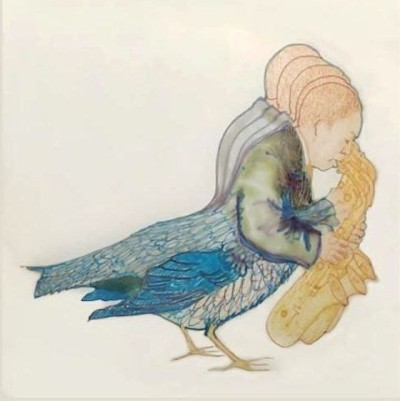
The painting “In Time” is published with the courtesy of David Russell. Born in 1940, Russell is a resident of London UK, and is a writer of poetry, literary criticism, speculative fiction and romance, as well as a visual artist, photographer and singer-songwriter. Many of his music tracks are on YouTube. He is also Editor of Poetry Express Newsletter, produced by Survivors Poetry and Music. Published extensively online in International Times. His Eco poetry collection is titled An Ever River (Palewell Press 2018).
Click here to visit his website
.
.
,
,
,





















A wonderful story, very poetically written! And I loved the way Davis’s voice was the same color as Ken’s father.