
Guy Lombardo — “about as artistically creative as the average comic book”

December 30th, 2014


_____

“If you can dance at all, you can dance to [Guy] Lombardo’s music,” the Metronome writer George T. Simon wrote in 1942.   The Lombardo band’s popularity was once so immense and widespread that he set attendance marks wherever he went, including at Harlem’s Savoy Ballroom. His appeal came despite what Simon described as the band’s “exaggerated sax vibratos, the clippety brass phrases with their illegitimate tones…and the style of singing that lets you hear all consonants and no vowels,” leading to what some musicians would ridicule as being “about as artistically creative as the average comic book.”

But, as Simon wrote in the chapter on Lombardo from his essential 1967 book The Big Bands, “Lombardo believed implicitly in his music, and he succeeded handsomely in selling it to two generations of dancers.”

For many of us born in the years following World War II -– raised culturally by the likes of Elvis and the Beatles -– our exposure to Lombardo’s immense popularity was a yearly New Year’s Eve dread spent in the company of family members from a generation who outwardly “partied” to this man’s music. This televised celebration, often culminating in Lombardo wearing a party hat while conducting “Auld Lang Syne,” was an almost comical view of a preceding generation whose popular culture could otherwise -– at times, at least -– be held in reasonable esteem.

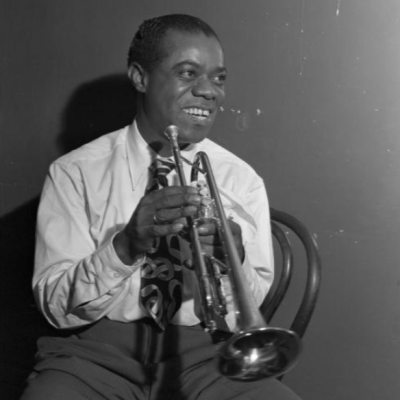
This comical view of Lombardo, however, was not held by the 20th Century’s most important popular musician. Lombardo may have been “corny,” but to Louis Armstrong, it was his favorite band, even “my inspirators!”

“I haven’t heard no band that plays more perfect music than Guy Lombardo yet,” he once quite famously told Life magazine. “That’s the way I feel and I don’t let my mouth say nuthin’ my head can’t stand.” For those of us who grew up being exposed to Lombardo’s saccharine music every New Year’s Eve on television, it is hard to imagine that someone of Armstrong’s stature could have possibly believed that.  But the late jazz writer Ralph Gleason wrote in a 1973 essay that Armstrong “determinedly insisted that [Lombard was his favorite band] and there’s no trace of put-on in his statement.” “Any time I walk up on the stage with Guy Lombardo,” Armstrong said, “I’m relaxed.”

So, it is with respect for Armstrong’s appreciation of Lombardo, as well as with some measure of nostalgia, that I present several different clips of him:


Lombardo appears on “What’s My Line?” on New Year’s Eve, 1950

A segment of the “Guy Lombardo Show”…No “Auld Lang Syne” but a sweet (what else?) piece called “Wedding Bells are Breaking Up that Old Gang of Mine”

Lombardo brings in 1958


Bringing in 1977, Lombardo’s final New Year’s Eve celebration (check out the rather hilarious rendition of Barry Manilow’s “I Write the Songs” — a song that invites almost endless parody)




Share this:

10 comments on “Guy Lombardo — “about as artistically creative as the average comic book””

  1. Can’t imagine two musicians as different as Armstrong and Lombardo with such mutual respect. Who’d have guessed? Despite the fact that the Royal Canadians could, when pressed, play “credible jazz”–this is not the style of Lombardo music Armstrong was so fond of.

  2. The Guy & Louis connection is further evidence of the fact that good jazz musicians tend to be much more charitable towards their less fashionable peers than jazz fans and critics–Charlie Parker died watching the Dorsey Brothers TV show, Johnny Hodges cut an album with Lawrence Welk.

  3. The Guy & Louis connection is further evidence of the fact that good jazz musicians tend to be much more charitable towards their less fashionable peers than jazz fans and critics–Charlie Parker died watching the Dorsey Brothers TV show, Johnny Hodges cut an album with Lawrence Welk.

  4. The second clip started with “Darktown Strutter’s Ball” one of the first tunes recorded by the Original Dixieland Jass Band, and written by Shelton Brooks-even though it’s done in a relatively corny type fashion Louis Armstrong probably appreciated the scope and musicality of this band and fact that Guy Lombardo knew that he was there to entertain and play for the people-something Louis subscribed to all his days, even though he was the greatest single most influential musician in America’s history in my opinion.

  5. The second clip started with “Darktown Strutter’s Ball” one of the first tunes recorded by the Original Dixieland Jass Band, and written by Shelton Brooks-even though it’s done in a relatively corny type fashion Louis Armstrong probably appreciated the scope and musicality of this band and fact that Guy Lombardo knew that he was there to entertain and play for the people-something Louis subscribed to all his days, even though he was the greatest single most influential musician in America’s history in my opinion.

  6. Guy Lambardo was my mom’s favorite band and had LPs.most if not all of them. She played them all the time. If my MOM thought he was great, then he was!

  7. Guy and some of his musicians according to a book written about Guy use to go to a club after hours and sit in with Louis. This was in the 20’s. Louis then went on a later occasion with a few of his musicians and sat in with the Lombardo Orchestra. The club owner using the n word said get them off the stand and out of his club. Led by usually quiet Lebert, the entire band left the stand and the club. The owner went and brought them back and said Louis and his friends could sit in. Louis never forget it, and this only added to his admiration of the band and the Lombardos.

Comment on this article:

Your email address will not be published. Required fields are marked *

Site Archive

Your Support is Appreciated

Jerry Jazz Musician has been commercial-free since its inception in 1999. Your generous donation helps it remain that way. Thanks very much for your kind consideration.

Click here to read about plans for the future of Jerry Jazz Musician.

In this Issue

A collection of poetic responses to the events of 2025...Forty poets describe their experiences with the tumultuous events of 2025, resulting in a remarkable collection of work made up of writers who may differ on what inspired them to participate, but who universally share a desire for their voice to be heard amid a changing America.

The Sunday Poem

photo by Garry Knight/CC BY 2.0

”Six String Sizzle” by Ian Mullins

The Sunday Poem is published weekly, and strives to include the poet reading their work...

Jerry Jazz Musician editor Joe Maita reads Ian Mullins’ poem at its conclusion


Click here to read previous editions of The Sunday Poem

Interview

photo by Warren Fowler
Interview with John Gennari, author of The Jazz Barn: Music Inn, the Berkshires, and the Place of Jazz in American Life...The author discusses how in the 1950s the Berkshires – historic home to the likes of Hawthorne, Melville, Wharton, Rockwell, and Tanglewood – became a crucial space for the performance, study, and mainstreaming of jazz, and eventually an epicenter of the genre’s avant-garde.

Poetry

photo of Red Allen by William Gottlieb/Library of Congress
21 jazz poems on the 21st of February, 2026...An ongoing series designed to share the quality of jazz poetry continuously submitted to Jerry Jazz Musician. This edition features poets – several new to readers of this website – writing about their appreciation for the music, how it shows up in their daily lives, and displaying their reverence for the likes of Billy Strayhorn, Joe Henderson, Ernestine Anderson, Miles Davis, Louis Armstrong and Red Garland.

Feature

photo by Laura Stanley via Pexels.com.
Trading Fours, with Douglas Cole, No. 28: “Little Samba”...Trading Fours with Douglas Cole is an occasional series of the writer’s poetic interpretations of jazz recordings and film. This edition is based largely on a documentary – They Shot the Piano Player – about Tenório Junior, a Latin jazz musician who only produced one album (1964) before he “disappeared” in 1976.

Poetry

photo by Lorie Shaull/CC BY 4.0
“Poetry written in the midst of our time” – Vol. 2...Poets within this community of writers are feeling this moment in time, and writing about it...

Poetry

photo via Wikimedia Commons
“Empire State of GRIME” – a poem by Camille R.E....The author’s free-verse poem is written as an informal letter to tourists from a native New Yorker, (and sparing no bitter opinion).

Short Fiction

photo via Freerange/CCO
Short Fiction Contest-winning story #70 – “The Sound of Becoming,” by J.C. Michaels...The story explores the inner life of a young Southeast Asian man as he navigates the tension between Eastern tradition and Western modernity.

Poetry

art by Martel Chapman
"Ancestral Suite" - A 3-Poem Collection by Connie Johnson...The poet pays homage to three giants of mid-century post-bop jazz – Booker Ervin, Lou Donaldson, and Little Jimmy Scott

Feature

“Bohemian Spirit” – A Remembrance of 1970’s Venice Beach, by Daniel Miltz...The writer recalls 1970’s Venice Beach, where creatives chased a kind of freedom that didn’t fit inside four walls…

Feature

Boris Yaro, CC BY 4.0, via Wikimedia Commons
“The Bowie Summer” – a personal memory, and how art can fundamentally reshape identity, by G.D. Newton-Wade

Poetry

photo via NOAA
“Taking The Littlenecks” – a prose poem by Robert Alan Felt...Expressing the joy and sorrow of life at age 71 with grace, wisdom, and appreciation.

Short Fiction

photo by Iryna Olar/pexels.com 
“The Fading” – a short story by Noah Wilson...The story – a finalist in the recently concluded 70th Short Fiction Contest – examines the impact of genetic illness on a family of musicians and artists.

Poetry

Poems on Charlie “Bird” Parker (inspired by a painting by Al Summ) – an ekphrastic poetry collection...A collection of 25 poems inspired by the painting of Charlie Parker by the artist Al Summ.

Short Fiction

Davidmitcha, CC BY-SA 3.0 , via Wikimedia Commons
“Blue Monday” – a short story by Ashlee Trahan...The story – a finalist in the recently concluded 70th Short Fiction Contest – is an imagining of a day in the life of the author’s grandfather’s friendship with the legendary Fats Domino.

Poetry

National Archives of Norway, CC BY 4.0 , via Wikimedia Commons
“Wonderful World” – a poem by Dan Thompson

A Letter from the Publisher

The gate at Buchenwald. Photo by Rhonda R Dorsett
War. Remembrance. Walls.
The High Price of Authoritarianism– by editor/publisher Joe Maita
...An essay inspired by my recent experiences witnessing the ceremonies commemorating the 80th anniversary of liberation of several World War II concentration camps in Germany.

Jazz History Quiz

photo by Mel Levine/pinelife, CC BY 2.0, via Wikimedia Commons
Jazz History Quiz #186...While he had a long career in jazz, including stints with, among others, Coleman Hawkins, Roy Eldridge, Sonny Stitt and Stan Getz, he will always be remembered primarily as the pianist in Charlie Parker’s classic 1947 quintet. Who is he?

Playlist

“Darn! All These Dreams!” – a playlist by Bob Hecht...In this edition, the jazz aficionado Bob Hecht’s 13-song playlist centers on one tune, the great Jimmy Van Heusen/Eddie DeLange standard, “Darn That Dream,” with the first song being a solo musician recording and each successive version adding an instrument.

Poetry

Wikimedia Commons
“Dorothy Parker, an Icon of the Jazz Age” – a poem by Jane McCarthy

Short Fiction

“The Mysterious Axeman’s Jazz” – a story by Ruth Knafo Setton...Upon returning from the horrors of World War II to post-war New Orleans, a trumpeter learns of a dark secret that reveals how his family fought their own evil, and uses jazz to bury the ghosts of war and reclaim the light through music.

Feature

photo via Wikimedia Commons
Memorable Quotes – Lawrence Ferlinghetti, on a pitiable nation

Short Fiction

photo by Bowen Liu
“Going” – a short story by D.O. Moore...A short-listed entry in the recently concluded 70th Jerry Jazz Musician Short Fiction Contest, “Going” tells of a traumatic flight experience that breaks a woman out of her self-imposed confines and into an acceptance that she has no control of her destiny.

Community

Nominations for the Pushcart Prize L (50)...Announcing the six writers nominated for the Pushcart Prize v. L (50), whose work appeared on the web pages of Jerry Jazz Musician or within print anthologies I edited during 2025.

Interview

Interview with Tad Richards, author of Listening to Prestige: Chronicling its Classic Jazz Recordings, 1949 – 1972...Richards discusses his book – a long overdue history of Prestige Records that draws readers into stories involving its visionary founder Bob Weinstock, the classic recording sessions he assembled, and the brilliant jazz musicians whose work on Prestige helped shape the direction of post-war music.

Poetry

“Still Wild” – a collection of poems by Connie Johnson...Connie Johnson’s unique and warm vernacular is the framework in which she reminds readers of the foremost contributors of jazz music, while peeling back the layers on the lesser known and of those who find themselves engaged by it, and affected by it. I have proudly published Connie’s poems for over two years and felt the consistency and excellence of her work deserved this 15 poem showcase.

Feature

Albert Ayler’s Spiritual Unity – A Classic of Our Time, and for All Time – an essay by Peter Valente...On the essence of Albert Ayler’s now classic 1964 album…

Community

Community Bookshelf #5...“Community Bookshelf” is a twice-yearly space where writers who have been published on Jerry Jazz Musician can share news about their recently authored books and/or recordings. This edition includes information about books published within the last six months or so (March, 2025 – September, 2025)

Contributing Writers

Click the image to view the writers, poets and artists whose work has been published on Jerry Jazz Musician, and find links to their work

Coming Soon

An interview with Paul Alexander, author of Bitter Crop: The Heartache and Triumph of Billie Holiday's Last Year; New poetry collections, Jazz History Quiz, and lots of short fiction; poetry; photography; interviews; playlists; and much more in the works...

Interview Archive

Ella Fitzgerald/IISG, CC BY-SA 2.0 , via Wikimedia Commons
Click to view the complete 25-year archive of Jerry Jazz Musician interviews, including those recently published with Judith Tick on Ella Fitzgerald (pictured),; Laura Flam and Emily Sieu Liebowitz on the Girl Groups of the 60's; Tad Richards on Small Group Swing; Stephanie Stein Crease on Chick Webb; Brent Hayes Edwards on Henry Threadgill; Richard Koloda on Albert Ayler; Glenn Mott on Stanley Crouch; Richard Carlin and Ken Bloom on Eubie Blake; Richard Brent Turner on jazz and Islam; Alyn Shipton on the art of jazz; Shawn Levy on the original queens of standup comedy; Travis Atria on the expatriate trumpeter Arthur Briggs; Kitt Shapiro on her life with her mother, Eartha Kitt; Will Friedwald on Nat King Cole; Wayne Enstice on the drummer Dottie Dodgion; the drummer Joe La Barbera on Bill Evans; Philip Clark on Dave Brubeck; Nicholas Buccola on James Baldwin and William F. Buckley; Ricky Riccardi on Louis Armstrong; Dan Morgenstern and Christian Sands on Erroll Garner; Maria Golia on Ornette Coleman.