
“As good as it will ever get” was the winning entrant in a recent Jerry Jazz Musician Short Fiction Contest. When I wrote to inform Ms. Parks that “As good” was the winning story, she graciously replied that it had just been chosen for publication by The Quill, a Canadian literary magazine, the day before I contacted her, which prevented her from accepting the award.
Now that the exclusivity period has passed, Ms. Parks has granted permission to share her excellent story with the Jerry Jazz Musician community of readers.
As good as it will ever get
by
Julie Parks
_____
Swoosh! Shhh. Shhhhh! I hear the ear numbing screech and the train finally stops moving. Nine seconds and the loud beep will announce the door opening. Heels clack against the icy early morning pavement. The mass of cigarette smoke hazes my sense of direction until we finally reach the end of the Binario 12 and my ears welcome the familiar sound of strings.
It’s distant and quite mellow but I can still make out the song. It’s a new one. He’s only played it a few times. I know it. Everyone loves it because it’s from that movie. The one with fifty sexy stuff or something like that, that isn’t appropriate for a five year old. My mother can say what she wants; I still listened to the song. The walls in our apartment aren’t as thick as she thinks. The voices and action scenes made little sense coming in all muffled and silenced through the electric plug-in holes that serve as the best audio link between our bedrooms. But the song was beautiful.
Tally Weil loves it. They play the tune all day long. Tabaccheria in our station loves it. The sales guy even knows the lyrics. The woman next door hums it when she takes out her garbage. The young guy who always reads graphic novels on the train had it on his headphones this morning. Even Mango and Zara sometimes put on a disco version of the song.
But nobody plays it like Hank does.
He’s the sound of Milano Centrale. The lone thick-bearded man who stands right under the bright green Gelateria sign. The man whose eyes are forever closed, channeling only the sounds that vibrate around him.
I call him Hank because I think the name suits his style. His brown leather coat and rugged black clown-like shoes look like Hank. His yellow knit hat is so Hank. Even the Gandalf beard is Hank. And his eyes…well, like I said, I’ve never actually seen them open but I’m sure they’re as much Hank color as everything else about him.
He’s sliding his bow against the strings vivaciously right now, full of morning energy. Probably had one of those tiny cups my dad keeps drinking in every bar we pass on the way to the station. He’s had four this morning. I counted. Usually it’s something between two and six. Once he was so sleepy after a long shift at the hospital that he downed nine before we even got on the train to Milano. He fell asleep right after the conductor had inspected our tickets.
My dad works very hard. He says he’s saving people’s lives but I think someone needs to save him from working so hard.
We pass the spot where Hank has settled for the day, his violin case propped open in front of him. And I drag my legs as slowly and heavily as I possibly can. I get away with it because I’m only five and quite on the short side, so my dad believes I’m either sheepish or not fully awake yet. I want to stop and linger a little longer because Hank is finished with the song and I hate leaving and not knowing what he will play next. A young girl and her mother have stopped to throw in a coin into his violin case. I peek inside and smile relieved that he’s made more than enough for a fresh apple brioche and something warm to drink.
You need only about ten moneys for that and he definitely has more than that in his case.
It’s a shame they don’t sell hot coco in Milano Centrale. My plan is to make a big cup of hot coco and bring it in mommy’s portable mug to Hank one day. See if he loves the sweet drink as much as I do. But my dad says helping people on the streets isn’t good. Their problems are much bigger than we know and by handing things to them for free on the streets we’re culprit who deny a much bigger picture. That’s also the reason we never stop at the refugee help center on the other side of the wide lobby of Milano Centrale. There are thin men with dark skin and tired eyes, women with slumped shoulders and tears in their eyes, children with messy hair and dirty clothes, shoes so old they’re more fallen apart than holding together and bags with holes so big my entire fist would easily fit through there.
In my short life I have not seen ugliness bigger than that surrounding these refugees.
I offered to give them my last year’s yellow sneakers because they’re too small for me anyway but then I would be culprit who deny a much bigger picture. The same went for my thick blue pants that itch and I hate to wear myself and even the frizzy rabbit I no longer need for sleep. Though maybe a plush toy isn’t all that helpful when you have no home and no clothes to wear.
Nonna says these people were abandoned by their own God.
My dad says they are fragments of war that’s going on in the world.
Mommy says these people sailed here on boats like Jack Sparrow, though they’re from a place much closer than that of Jack Sparrow. Also she says they need help beyond that of a train station workers and passersby, they need a new God.
My nonna and mommy dress up nice and go to church every last Sunday of the month. But I don’t have to go with them. Not until I’m old enough. Not until I understand better. So I don’t know anything about their God or the refugee God but maybe they could simply love Hank. Like I do. Hank is as good as any God will ever get. When he plays, the sounds he makes draw up angels in the air. Flicking their invisible wings to the melody of Hank’s strings they see everyone who can see them. And when you see them they grant you with one wish that will come true that same day. I always wish for something and I always get it the same day.
The first time I met Hank and his angels, I wished for my dad to pick me up early that day. And he did.
The second time I wished for the sun to come out so that our teacher would let us visit the fountains and gardens on the other side of the city. And we did.
The third time I wished for a Bolognese for lunch. And boom. I had two plates.
And so on and on. Hank’s angels always do as they promised.
So I know for sure. He is as good as it will ever get.
****
After that morning, I don’t see Hank for a good week or even more. He’s been absent for so long that I feel guilty to admit I lost hope and stopped counting the days. I know it isn’t unusual for the street musicians to change their spots. I’ve seen so many coming and going through the station over the last year since my parents got me into the bilingual city preschool and my dad started taking me along in the mornings. But Hank was special. He’s the only one that made people pause and turn their heads to listen. He’s the only one who made them smile. The only person in Milano Centrale who really made a difference.
One evening my dad has a meeting with a friend and we arrive in the station much later than we usually do. It is almost past my bed time but hearing the crisp high pitch of a new song booming through the front entrance, I feel fully awake and even skip a step urging my dad to walk faster. The wide lobby is filled with lights and Hank’s angels are dancing all around, the sound of the song he’s stringing so melodically echoes high up in the marble ceiling. And there are so many people everywhere. Either Trenitalia is on strike again, or it’s a special occasion. It seems every single corner of the long space, every arch, covered or opened, is buzzing with chatter and laughter. Glasses are clinking and teenage girls with purple hair are dancing. A strange guy has painted himself with something as white as Mrs Cinzia’s blackboard chalk block and is doing a mime show. The smell of prosciutto cruddo and parmesan lingers in the air outside the only bar that’s open this late.
And then there’s Hank.
The barely visible presence right under the bright green Gelateria sign with a sound so powerful he could be the man in the symphony orchestra. The one in the front who plays the solo number while everyone else has to remain silent, clinging to their instruments admiring him.
My dad spots a man he knows from work and they decide to get a round or two. I promise not to get lost and while keeping the visual contact, sneak closer to the spot where Hank is hiding behind his violin case. To my disappointment he stops playing when the song ends and walks up to collect his case. His eyes are open now and to my even bigger disappointment they’re not Hank at all. They’re dark and saggy and so full of sadness I believe he’s been holding them closed only because his eyelids are too tired to keep all that sadness awake.
“Are you coming back?” the words escape my lips before I can control myself.
He turns slightly, scanning the space behind the bright green Gelateria sign for anyone he might recognize. Then he lowers his head and meets my face, his mouth smiling through his beard. And for a moment his eyes are filled with something a little lighter than that before. Hope maybe? Or relief? Was he expecting someone else?
“What’s your name?” he asks.
“Matteo.” I answer. I don’t ask what his name is. I’m sure it’s Hank. Despite the sadness in his eyes that doesn’t fit his otherwise Hank-like appearance, I’m still sure it’s Hank. It couldn’t be anything other than Hank.
“Nice to meet you, Matteo. Tomorrow. Will you come to listen?” he asks again.
I nod and he smiles again. This time I see his teeth. They’re more yellow than mine. Dad says it’s usually because of the black drink in those tiny cups that keeps the world running. I want to ask if Hank drinks as many tiny cups as my dad but he winks at me and turns to leave.
Hank isn’t in the station when we arrive the next morning. Or in the evening of that day. Neither in the morning or evening after that. I try not to be a crybaby and remind myself that it isn’t Hank’s job to keep me entertained. Although I do feel that it is his job to draw up the angels with his music so that I could see them and get my wish for the day.
Over the next two weeks, the refugee station on the opposite end of the lobby grows bigger and bigger until there are so many refugees gazing and wandering around that my dad says it looks like Casablanca the night Bogie met Ilsa. Whatever that means. The noise in the air also has grown so much that I have to shout in my dad’s ear just to be heard. And when I do, I keep begging him for an ice-cream every single time we pass through just to make sure we keep close to the Gelateria and I could see if Hank is back.
It is late on a Wednesday night – I know because my dad has the ER shift on Wednesdays and those babies can drag on forever – right after we leave the Gelateria, me eagerly licking my way down a Pistachio cone, when I spot Hank just arriving, his violin case hanging over his left shoulder. His clothes look like they’ve grown a size since the last time I saw him. Or maybe Hank has lost his beer belly. My mommy always tickles my dad’s belly and calls it a beer belly, although I don’t know why she would say that because all my dad drinks are those tiny cups and a round or two. But she insists that losing the belly is a good thing so I’m glad Hank has lost his.
He settles in and gently removes the sleek instrument from its case. His moves are slow and clumsy. At one point it even looks like he’s in pain. I want to help him get started faster so that I could listen to at least a full song before my dad urges me to leave, so I step closer and wave. I would offer Hank my ice-cream but it might be insensitive seeing that he’s just lost his belly.
“Remember me?”
“Matteo.” He smiles through his beard, which I think has gotten slightly thinner.
“Will you play?” It’s a silly question, I know. But I’m so small that people still call me cute, so if I have to tolerate that, they can tolerate my childish inquiries.
“For you always.” He gives me a devilish wink and closes his eyes.
And boy do I feel ready to be blown away.
He begins with a quiet drum on the strings, then gently pads them with his bow and then lets his right arm sway above the delicate pear shaped instrument. And the world is full of music again. The chatter disappears. The people fade out. The lobby calms. I close my eyes too and let my head sway along with Hank’s rhythm until the angels’ invisible wings start softly tickling my cheeks. I swallow hard and still keeping my eyes closed make a wish. I wish to hear Hank play every day. Every single day. Forever. I know it’s a big one but his angels have never let me down before so I know they can do anything. They can bring Hank to the station every time I walk through. With that silent resolution I turn around and follow my dad to our evening train.
****
This year the winter is long and snowless. I think it’s good that we don’t have snow because all those people with no clothes to wear would be very cold and might even die. And even if they were abandoned by their God, they don’t deserve to die. I know I’m young and have my whole life ahead of me, but even the older people sometimes don’t deserve to die. Nonna says we die when it’s our turn and my turn won’t be for a very long time. Even her turn won’t be for a while. So I think the refugees in Milano Centrale are probably also far from their turn.
I feel disappointed and angry at Hank’s angels for not bringing him to the station over the next week. But we have also started taking an earlier train to make it on time to my preschool and dad’s hospital. My dad has gotten a bigger job and has more on this plate now. So I have to be in bed earlier and get up earlier so that we can pull it off.
Maybe Hank can’t wake up this early.
But since I don’t see him in the evenings either, I’m not sure if he’s playing at all.
On the last day of the week, despite the heavy rain outside and us arriving on the early train again, I inhale the unavoidable cigarette smoke mixed with his first notes. His violin sounds somehow lonely today. Maybe because of rain. Maybe he’s still sleepy. Maybe he regrets shaving his beard off. His face looks lonely without it now. His coat has grown another size since I last saw him. Now the arm that keeps sliding in and out of the sleeve while holding onto the bow looks almost as skinny as the bow itself. His eyes are closed as ever so I don’t get to see if there’s sadness in them.
It’s obvious Hank doesn’t like the rain. Nobody does.
At least getting up this early makes my dad slow and thirsty for caffeine – the secret inside the tiny cups. So I get to enjoy a whole lot of Hank’s daily selection while my dad empties three cups and drags his feet through the thick mass of sleeping refugees across the long lobby. I can’t believe they sleep on the floor here. It must be cold and hard and bad for your back.
My dad says it’s a tragedy and do I get the bigger picture now?
I don’t know what a tragedy is but I do like big pictures, so I don’t see how they could be a part of it. They look more like they have no picture they belong to because they certainly don’t look good in Milano Centrale. This is a place for people who arrive on their trains and then come back to their trains in the evenings. This is not a good place to sleep on the cold floor.
I finally see it.
Their God really has abandoned them.
But maybe he has led them to a new God which is Hank. Because unlike me, who can only hear him while passing by, they get to listen to him all day long. And what can be a better way to go through the winter. Maybe sleeping on the floor isn’t so bad if you have angels with invisible wings in the air above your head.
****
Hank doesn’t show after that. This time, eager to get my wish and hear him play forever, I’ve been counting the days since he’s been gone. Sadly, today is the forty-seventh day. Tomorrow will be the forty-eighth. And after that the forty-ninth. Maybe Hank likes round numbers and he’s waiting to play every fifty days from now on.
It turns out that the bigger picture meant Carabinieri coming and simply escorting all the refugees to a shelter. I can only hope it’s warmer and more comfortable than Milano Centrale. On the morning of the forty-ninth day, my dad lets me stand and watch them while he’s sipping at his tiny cup. The uniformed officers are walking around with some sort of a list. They write down everyone’s names, then help them collect their dirty bags and blankets from the floor and point to a mini bus that’s parked right outside. My eyes follow a little girl holding onto her mother’s skirt while they very slowly walk outside, probably because her mother doesn’t have enough money for caffeine, and another uniformed officer slides the car door open for them.
The little girl turns her head and looks back.
She doesn’t smile.
Something breaks in me at that moment. Even seeing how terrible their life has been in this train station, I feel sad seeing them go. In a weird way, they’ve become like neighbors.
I close my eyes and hold them tight. I can’t see her drive away or I will cry. And five year olds don’t cry.
The next morning, we arrive late because my dad overslept his alarm which only happens once in a blue moon. The station is quiet and busy at the same time. I have a feeling this is what regular looks like. We reach the end of the platform and then pass the bar but there’s no time for even one tiny cup today. We walk fast, my dad gently pulling me forward by the arm. The green Gelateria sign stays behind. The wide doors lead us outside where barely visible rays of sun welcome a new day. I fight back a loud yawn as we wait for the green light, then cross the street and turn the corner towards a smaller street where we wait for the bus. When it comes and we can finally sit down, I rest my head against the window. I my eyelids drop almost immediately.
I don’t think I am asleep because I can still hear the bus stop announcements but somewhere in between all the voices and traffic sounds outside I can suddenly hear it. The gentle slide, the bow trembling across the strings, the melody rising until its body is echoing against the lobby walls high above people’s heads.
A wide smile spreads across my face.
It’s so Hank.
He’s back.
Forever.
__________
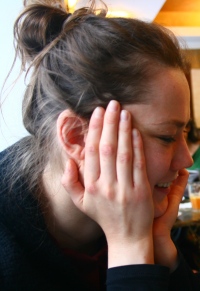
Julie Parks has lived all around the place – Latvia, New York, Italy, England, Germany and recently Switzerland. Coming from a background of acting for film and theater, she started writing plays and scenes back in school. Her articles and short stories have been published in The Baltic Times, Veto Magazine, The Quill Magazine and soon in daCunha. “As good as it will ever get” was first published earlier this year by The Quill Magazine in Canada.