
.
.
“Committee Room,” a story by J.W. Wood, was a short-listed entry in our recently concluded 58th Short Fiction Contest, and is published with the consent of the author.
.
.
.
[altered] photo by Hendrik Schöttle, CC BY-SA 3.0 , via Wikimedia Commons
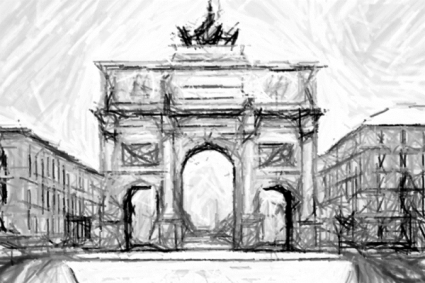
The Siegestor in Munich, Germany
.
.
Committee Room
by J.W. Wood
.
…..“What I have to say now stays between us.”
…..The Chairman’s face flushed a little. I sensed one of his rants was coming, and I was not disappointed:
…..“In my opinion, Jakub Hoch is a pseudo-liberal loudmouth of minimal talent who has no place as Musical Director of this orchestra.”
…..Born into a German family, Jakub Hoch had been educated in England, deciding on a career in music before his eleventh birthday. A respectable, if not glittering, career at the Royal Academy culminated in a finalist’s position for the British “Young Musician of the Year” competition. He followed this with marriage to a glamorous cellist and a two-year appointment at a regional orchestra in Canada after graduation.
…..Dieter Lahm, a former banker who now acted as the Chairman of this orchestra, drummed his stubby fingers on the table. His jowls wobbled as he spoke:
…..“Well, come on. What does everyone else think?”
…..Felix Vyshinsky, the orchestra’s First Violin and member of the selection committee, leaned his thin frame forward against the polished oak table and smiled.
…..“Jakub Hoch is comfortably the most experienced conductor under consideration. He has worked in Europe and North America and plays both the piano and the viola competently. From our point of view as musicians” – and here, the woman by his side, whatever she was called, nodded vigorously – “Hoch is the outstanding candidate.”
…..Susanne Bode, the lay member of our panel who sat next to Dieter Lahm, twisted a lock of her hair in the manner of a sexually excited teenage girl. She put down her solid gold pen from one of those luxury shops frequented by the petty bourgeois and began to speak, mouth rouged in a simulacrum of post-coital flush:
…..“Well, talent is not everything,” she said, turning to Lahm, whose fat chops parted slightly in what might be sympathy, if Lahm possessed a soul capable of emotion. “One must also think of how candidates play with the public. Thierry de Fontaines is much adored by music lovers as Second Assistant at the London Symphony Orchestra. To poach such a rising star – and he’s good in front of the camera, let’s say – would be a victory for us. Imagine the press!”
…..As Bode spoke, I reflected on Jakub Hoch’s career. In the world of music, early success is tolerated only if homage is paid to the powerful. And in this nuanced matter, Jakub Hoch revealed his naïveté. He demanded better standards across the board at the Canadian orchestra, insisting on a musical programme more recherché, shall we say, than their corporate sponsors preferred.
…..Hoch wanted Beethoven’s Third to make way for Xenakis; the Mass in B Minor to be tossed aside for Steve Reich. As you might imagine, the option to renew his contract was not taken up by the Canadians.
…..Meanwhile, Lahm nodded in agreement with Susanne Bode as the clock on the wall recorded another second with an arthritic hand.
…..“That’s true. We know this Frenchman, de Fontaines, will play ball. At least he won’t tell us we should be playing thunka-chunka crap. Not like Jakub Hoch. Is that correct, Maximillian?”
…..I smiled to hear my Christian name. Everyone knows I prefer formality in these situations; a simple “Doctor Frisch” would have been sufficient. Lahm asked me first because he knew I approved of Hoch’s comments about the musical program in Canada. And who would not? Is it an orchestra’s role to repeat a cycle of Cosi Fan Tutte, Smetana’s Má vlast or snatches of Rigoletto and the first movement of Beethoven’s Fifth?
…..“Herr Lahm. No-one believes that novelty is the sine qua non of music,” I replied, glancing at Frau Bode. If they did, then they might be better placed in public relations for a teenage girl’s magazine.”
…..I brushed an imaginary crumb from my jacket. “However, there is nothing wrong with challenging public taste. May I remind you that our history stretches back before the divine Wolfgang Amadeus. As such, it is our duty to the people of Munich, Bavaria and, without exaggeration, Europe to select the person with the greatest talent.”
.
***
.
…..Herr Lahm looked down at his stubby fingers after I had finished speaking. The slight smile he wore while listening had faded. For the first time, I noticed mild eczema around his fingernails, saw the evidence of wildly high blood pressure in the venous networks of his hands. He looked up again.
…..“All right, Doctor Frisch. Thank you. Now, Madame Tricot. We have yet to hear from you, so let us do so. Madame?”
…..Lahm’s eyes, sunken in fat, turned to the silent woman who sat next to Vyzhinsky. So this mousey thing was French. The French, lovers of Cartesian rationality and backroom policy. Onion soup and a dagger in the back. That was why she’d agreed with Vyshinsky throughout the process. She was biding her time. I awaited her views much as the Boa Constrictor awaits the Water-Vole.
…..Madame Tricot took a sip of water. She wore a simple black polo sweater with a string of pearls around her slender neck. Her chestnut hair, just beginning to fleck with silver, fell about her delicate Roman features.
…..“I can speak only as a musician, because that has been my life’s work.” (Promisingly modest, yet possibly hubristic too). “There is no doubting Jakub Hoch’s abilities as a musician. As Felix” (Vyshinksy’s first name: a technique to emphasize their solidarity) “has said, Hoch had the best rapport with the orchestra as a guest conductor. He knows both canonical works and those of lesser and emerging composers. And regarding Herr Lahm’s comments, well, musicians admire someone who is unafraid to take risks.”
…..Bravo, madame, I thought. But then:
…..“However, if the rest of the panel feel another candidate might be preferable for political reasons, then I recommend Thierry de Fontaines. Between the other two candidates, I feel Fontaines to be more sympathetic, even if his appreciation of how to manage the nuances of a score leaves something to be desired.”
…..Oh, ma vieille. The fool. She was leaving the door ajar for Lahm and Bode to pounce.
…..“What do you mean?” asked Bode, scarcely able to disguise her delight at finding the Frenchwoman’s jugular so easily. “Are you saying de Fontaines is not a professional musician? At least he doesn’t criticize sponsors and call them philistines like Hoch. I don’t call that professional!”
…..Madame Tricot looked at Vyshinsky, whose Slavic features remained impervious. She answered:
…..“Politics and sponsorship are worlds of which I am ignorant. But please consider how de Fontaines handled the Introitus to Mozart’s Requiem when we met the candidates. You will recall the orchestra begins sotto voce, then ends fortissimo before the choir enters. De Fontaines ignored the woodwinds completely, something I found remarkable.”
…..“Of course, you are entitled to your opinion as a professional,” smiled Frau Bode, spreading her hands on the table, light glinting from the facets of her obscene diamond rings. “And in matters of music, I am unable to comment. That is why you are on this panel. But taste? How does one measure taste? Surely it is the most subjective quality. Surely we cannot base our decision on something called ‘taste’” – again a simpering gaze at Lahm, which this time went unacknowledged. I had to interject.
…..“Frau Bode, I beg to differ. Whilst we cannot subject taste to the same rational criteria as employed with a balance sheet, taste is nonetheless what makes an artist. It is that faculty which enables a conductor to enchant an audience, the difference between a competent journeyman and a conductor of real gifts. Taste is –”
…..“Thank you, Doctor Frisch,” said Lahm.
…..He breathed out and stretched his hands above his head, patches of damp sweat showing where his arms joined his body. Then he checked his watch ostentatiously. I noticed the watch came from the same luxury brand that produced Frau Bode’s gold pen.
…..“So I don’t have all day to chat – I have another committee for the local hospital. Let me sum things up, then I’m going to ask Doctor Frisch to make the case for Hoch one last time. Then we’ll vote.”
…..“Now – I don’t know music from my elbow, but this guy Hoch is a loose cannon. And I don’t want that while I’m chair of this company. I mean orchestra. Frau Bode” – she straightened her back like a begging dog – “I think you feel the same way as me. Am I right?”
…..Frau Bode lowered her eyes to reveal dark mascara on her eyelids. “I believe Thierry de Fontaines to be the lower-risk candidate, yes.”
…..“OK, good. And our musician friends tell us Hoch is technically best out of the three, but Madame Tricot believes de Fontaines could do the job as well. Is that fair?”
…..I looked past Madame Tricot, through the tall windows at the gothic roof of the Frauenkirche far off in the distance. I could see where this was going. In ordinary circumstances, I would have held with the English poet that discretion is the better part of valor, but not now. I decided to attack as soon as I could.
…..“Doctor Frisch, the floor is yours” – the steel-blue eyes in Lahm’s pudgy face flashed to Frau Bode, then down to his half-drunk cup of coffee. He picked up the cup and drained it, small droplets falling from it to join the prior stains on his shirt.
…..“Thank you,” I began. “May I ask the panel a question: did Beethoven’s meanness, his deafness or his general uselessness in polite company impede his genius? I think we know the answer. Was Gesualdo any less brilliant because he butchered his wife and her lover in cold blood? Again, we know the answer. That a creative artist chooses to speak truth to power ought not to discourage us from selecting them as the best candidate.”
…..I closed my eyes briefly, and the image of Jakub Hoch when I last saw him in performance came to mind: limbs flailing at the climax of Bruch’s Violin Concerto, sweat sheening his forehead, drenching his shirt, hair wild. That a talent such as this should be denied for the peccadillo of a vulgarian and his poule I would not allow; nor would modern management school thinking hold sway over the spirit of music. This meeting was now all-out warfare. I struck again:
…..“Jakub Hoch is one of Europe’s most talented young musicians. Everyone knows it.”
…..“Really?” Lahm interjected. “Then why didn’t he have a proper job for seven years?”
…..I was being treated like one of Dieter Lahm’s direct reports. I had told Lahm something he did not wish to hear, and would now be psychologically dismantled, the slightest scintilla of doubt in my evidence exaggerated into outright lies.
…..“Herr Lahm. Music is not without its fashions and concomitant errors of judgement, as you know,” I offered, attempting to hand him an olive branch.
…..“I don’t know anything about that. I’m a banker. I know a bit about risk, right?”
…..Lahm smiled at Frau Bode, who resumed her annoying habit of twisting her hair, an aging Salome of the suburbs. “And I know a risky proposition – like Jakub Hoch. I mean, the guy said the Canadians were stupid for putting Mozart on the program. What does he want? Konstantin Rin Tin Tin, or whoever?”
…..Lahm paused, pushing his perspiring bulk away from the table.
…..“All right,” he sighed. “Doctor Frisch, please tell me what’s wrong with the other candidates – this Guzman fellow from Venezuela, and Monsieur de Fontaines.” A patina of spittle hit the polished table’s surface as Lahm’s tongue struggled with the Frenchman’s aristocratic surname.
…..“Guzman is an amateur, in the worst sense,” I replied. “He believes puppyish enthusiasm and willingness to please can supplant talent and effort. He is riding the current vogue for South American musicians: I deplore his constant references to his allegedly underprivileged background. And our musician friends” – I nodded at Vyshinsky, long legs sunk beneath the table, and Madame Tricot – “do not consider him able to cope with the demands of the position.”
…..“Fine. So he’s out,” said Lahm. Frau Bode vigorously crossed the name ‘Guzman’ off her pad with her gold pen. “Now what about Monsieur” (he twisted his tongue to deliver an exaggerated French accent) “Thierry de Fontaines? What’s wrong with him, Doctor Frisch?”
…..I hated the way Lahm spat out the word “Doctor,” his brutal contempt for anything that spoke of ability or grace.
…..“Nothing is wrong with Thierry de Fontaines – and everything,” I responded with a cryptic smile. Madame Tricot’s lips shifted upwards in a grin before she drew back, eyes watching Vyshinky. “Thierry de Fontaines is perfectly competent. And I deplore competence, along with mediocrity. He has none of Hoch’s genius, no éclat or passion. He is a conductor of whom accountants or financial auditors might dream – but not lovers of music.”
…..“Forgive me, Doctor Frisch,” said Lahm with exaggerated politesse. “What’s wrong with competence? I think it’s called doing your job. I hired guys to do that for me for forty years.”
…..I felt the weight of his fleshy steamroller flatten the tarmacadam of my soul. I arranged my papers in a neat pile in front of me, then lowered my voice:
…..“Herr Lahm. I will not support any candidate proposed for this role apart from Jakub Hoch.”
…..Lahm looked straight down the table’s empty, gleaming surface. There was a pregnant silence.
…..“Well, I” – he began.
…..“Herr Lahm. Please allow me to add something.”
…..To my amazement, the French mouse, Tricot spoke, her slender presence resisting Lahm’s hulk.
…..“Doctor Frisch is absolutely right,” she began, and Handel’s Hallelujah Chorus exploded in my head. “Jakub Hoch is the best candidate, and I vote for him. However, we cannot re-run this recruitment process, so I will live with whatever decision is made.”
…..“Fine,” said Lahm, the crumbs and stains now more visible on his shirt under the chandeliers of the committee room. “So that’s two for Hoch, two for de Fontaines. Herr Vyshinsky, where are you in this debate?”
…..Vyshinsky, who had been sinking lower and lower in his chair, sat bolt upright.
…..“Ladies and Gentlemen,” he announced. “I find myself in the invidious position of wishing to vote for Herr Hoch, but recognizing that management’s views diverge wildly from those of the panel’s two professional musicians. If we hire Hoch and things go wrong, or if our patrons find his programming unattractive, then we musicians will be blamed.”
…..Vyshinsky stood up and tucked his chair into the table. He picked up his pen and sheaf of papers with one hand and took a drink of water with the other, putting his glass down with more force than necessary.
…..“I abstain from voting in protest at the way political considerations are occluding the selection process.”
…..He drew the heels of his patent leather shoes together with a click and walked briskly out of the room. Now it was Madame Tricot’s turn to support her head with her hands, her palms covering her face, fingers blocking the inevitable from her sight.
…..“Thank you, Herr Vyshinsky,” said Lahm with a smile. “I think we all understand the position without a formal vote. Two of us want Hoch to be appointed, and two of us believe de Fontaines is our man. One abstention. As Chair, it falls to me to cast a deciding vote in these circumstances, and I – ”
…..But I did not need to hear this. I did not want to read the press release announcing de Fontaines’ appointment. I did not need to see Lahm’s smug, pudding-dough face in the news proclaiming de Fontaines’ talent. And above all, I had no desire to see mediocrity perpetuated on the grounds of low risk.
…..I left the room, hearing no protest as I did so. And when I returned to my tiny apartment near the Marienkirche some minutes later, I poured myself a large vodka and apricot brandy and listened to my recording of Hoch conducting Brahms. The piece he had conducted so brilliantly at the Conservatoire in Paris, the first violin rising first querulously then imperiously as the third movement reached its climax.
…..I considered my position on the committee. Of course, I would have to resign. And I thought of Hoch opening the rejection letter in some dismal post-Soviet block of flats in Riga, his beautiful young wife at his shoulder or reading a book nearby as the news of another crushing disappointment came. Then the rage and tears, the lack of comprehension. Then perhaps comfort from his by now slightly impatient spouse and too much wine before sleep overcame him and he woke to another day spent teaching finger exercises to children and reading some pointless article on the violent origins of the madrigal.
…..Some time later I fell asleep and woke to a bright, overcast Munich morning still dressed in the clothes I’d worn to the committee meeting. From my window, I could see the towering achievement of the Siegestor in the middle distance. I wondered how many risks Ludwig the First had assessed before he commissioned the building; whether von Gartner had thought about his public profile as he first sketched its outline, and how many public relations agents Messner had employed to help him finish it.
…..Later that day, I laughed to see a picture of Dieter Lahm shaking hands with Thierry de Fontaines on the front cover of Bayerische Rundschau. New Musical Director Appointed ran the headline – and yet the melody, the leifmotif, the rhythms and time signatures would be the same, the same as they have been since we ceased to explore, to listen, to love. And yes, I wept. I wept for Jakub Hoch; I wept for his talent, for the future of music. But most of all I wept for the modern world, a world that prizes low risk and lack of ambition over everything else.
.
(for J.W.A.L)
.
.
.
___
.
.

J.W. Wood is a British writer currently living in North America. His work is forthcoming in anthologies to be published in the US, UK and Canada, and in several magazines around the world. In Spring 2022, Terror House Press (US/EU) will publish his satire, “By Any Other Name”. He is the author of six published collections of poetry and a novel selected for film rights auction at the Rome Film Festival. For more information, please visit: www.jwwoodwriter.net
.
.
.
Click here to read “Mouth Organ,” by Emily Jon Tobias, the winning story in the 58th Jerry Jazz Musician Short Fiction Contest
.
Click here for information about the upcoming Jerry Jazz Musician Short Fiction Contest
.
.
.