
“C’est Si Bon” – at trip’s end, a D-Day experience, and an abundance of gratitude

June 6th, 2023

.

.

“These endured all and gave all that justice among nations might prevail and that mankind might enjoy freedom and inherit peace.”

(Inscribed on the chapel at the Normandy American Cemetery and Memorial in Colleville-sur-Mer, France.  Author unknown)

.

.

___

.

.
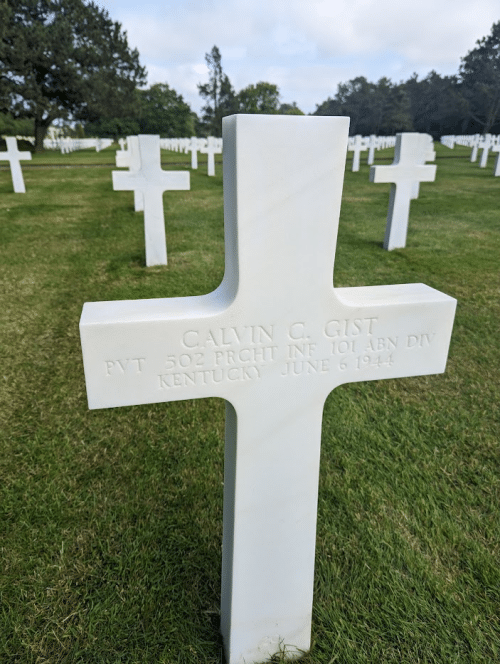


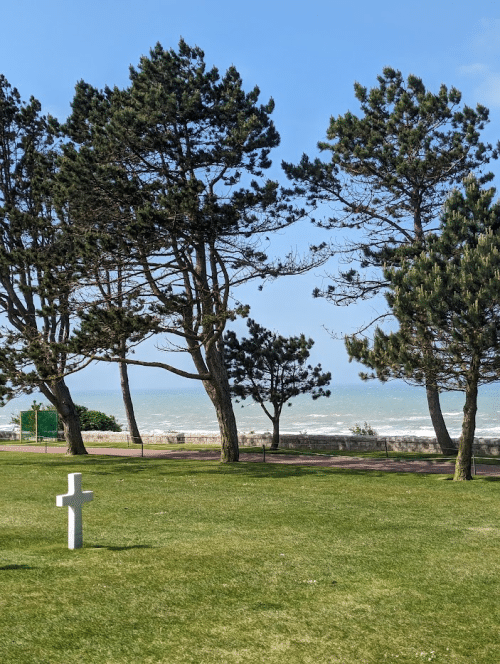
The headstone of Private Calvin C. Gist in the Normandy American Cemetery and Memorial; Colleville-sur-Mer, France

May 30, 2023

.

___

.

.


…..I don’t know much of anything about Calvin C. Gist.  I do know he was from Daviess County, Kentucky, and that he was a private in the 502nd Parachute Infantry Regiment Division in the 101st Airborne.  And, since I stood at his grave last week while visiting the Normandy American Cemetery and Memorial in Colleville-sur-Mer, France, I know that he died on June 6, 1944. D-Day.  Seventy-nine years ago today.

…..I also don’t know how old he was on that day, but judging by his photograph he was likely around the average age of the 9,386 soldiers buried there, which is 23.  Prime-of-life time, when a spirit for adventure and the thrill of the unknown mingles with a curiosity about life, and about love.  Ordinarily, thoughts of death would be decades away.

…..No doubt well-trained in the art of parachuting and fighting, and best-prepared for his mission as possible, Calvin had to have felt the chill of it.  Imagine, the weight of the world on the shoulders of 23-year-old men.

…..As we know, Private Gist was part of a mission to ultimately liberate whole countries from the tyranny Nazi Germany wrought on Europe so that people could one day return to enjoying the benefits of freedom and contentment.  People like me.  I’ve just concluded a five-week vacation in Europe, culminating in the fulfillment of a life-long desire to feel the enormity of the history on the beaches of Normandy.

…..During my European travels, I visited some of the continent’s most beautiful museums, nourished myself on its classic wine and cuisine, and sampled its thriving contemporary culture.  I strolled through the historic centers of its great cities and villages, and biked along urban paths and in classic inner-city parks.  It was a perpetually rich experience that allowed me to fulfill my own personal pre-trip mission to activate my underutilized “exterior” – to emerge from an “interior” that has been dominating my life since COVID, and especially since the June, 2022 termination of my 34-year marriage.

…..We tend to take the freedoms allowing this kind of personal travel experience for granted, even in the face of centuries of history on the European continent where corrupt monarchs, political tyrants and their murderous sycophants made the prospects for living in freedom a far-fetched notion.  This painful history is evident everywhere.  It doesn’t take a lot of effort to be consumed by it – you can often feel it by merely walking the streets.

…..Among the many museums I visited was Munich’s NS-Dokumentationszentrum (Documentation center), which focuses on the history and consequences of Germany’s National Socialist (Nazi) regime, as well as the role Munich played as the “capital of the movement.”  The four-floor museum exhibits the shocking details that created the environment in which Hitler rose – the breaking down of democratic institutions (i.e. the judiciary) and the ginning up of grievances built on outrageous lies about the blameless and most vulnerable and cultivating the ordinary citizenry to participate in a wholesale discrimination that ultimately normalized the mass murder of innocents.  It was a powerful exhibit and a blunt reminder of how this can happen anywhere if we allow ignorance and fear to overcome our humanity. (The museum is also a fine example of how Germany has embraced the telling of its complex history)..

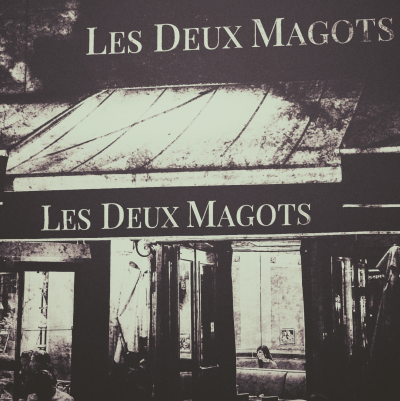
…..Toward the end of my trip I spent some time in Rouen, the capital city of France’s Normandy region.  Much of Rouen was devastated during World War II, but charm and character is easily revealed, and in the historic center I was able to find a table for dinner outside the lovely Victorine Jazz and Wine café.  It was a classic European setting, with diners seated in the presence of an immense gothic cathedral and bathed in the light of a heavenly sunset while bustling waiters delivered a bounty of delicious food and wine.
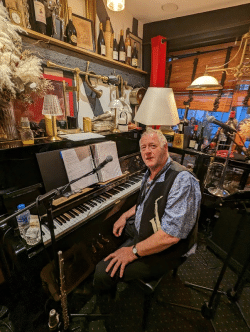
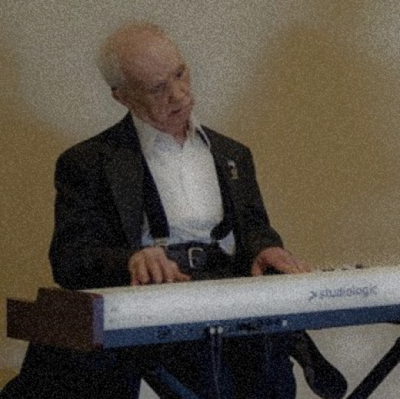
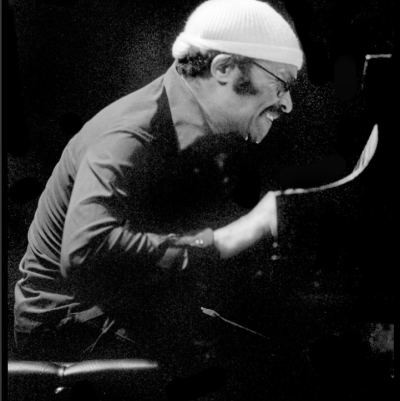
…..What especially stood out in this moment was the music that emanated from the small club and drifted dreamlike out its front door to the sidewalk where I sat. First it was Louis and Ella’s famous recording of “They Can’t Take That Away From Me,” followed by Lady Day singing Gershwin’s “Summertime.”  Then the live band began playing.  Consisting of two elder gentlemen – a pianist (Philippe Ecrepont) who also sang a credible Armstrong, and a multi-instrumentalist who did a wondrous imitation of Sidney Bechet – their tender renditions of jazz classics warmed every molecule, and reminded me of the music’s universal appeal.  When the duo played the beloved French tune “C’est Si Bon” (“It’s So Good”), I felt the abundance of this experience, and all was right with the world.

…..It was a moment that encapsulated so much about my trip, and also what attracts me to jazz  – the emotion of the music, the community inspired by it, and its history and meaning.  All of it was laid out before me in that Rouen club, and on that sidewalk.

…..I thought about that moment while walking the Normandy American Cemetery three days later.  And I also thought about other joyous pleasures of my trip – the gelato in Verona; the pasta in Matera; the fish in Bari; the jazz in Prague and Vienna; the piazza in Lecce; the wild enthusiasm of Venice; the opera in Innsbruck; the bike ride through Munich’s English Garden; the Paris patisseries; the string quartet in Salzburg; the Chagall exhibit in Otranto.  These moments were my unforgettable interactions with the exterior world Europe offered – all experienced in the peace and quiet of my own time.

…..Standing before his grave, I understood that none of this would have been possible without the heroism of Private Calvin C. Gist, whose acts of supreme courage allowed me to immerse myself in this freedom.  My love and deep appreciation for him and all the heroes sharing this solemn place on Earth will be forever abundant.

.

Joe Maita
Editor/Publisher


.

.
.

.

___

,

,

Click to listen to the final bars of “C’est Si Bon” coming from the Victorine Jazz and Wine Cafe; Rouen, France.  May 27, 2023

.

.

Listen to the 1994 recording of Abbey Lincoln, accompanied by pianist Hank Jones, sing (in French) the Henri Betti/Andre Hornez composition “C’est Si Bon” [Universal Music Group]

.

___

.

Other posts about and from my European journey

.

Click here to read “My pursuit of the exterior”

Click here to read “In Prague, things just sort of worked out”

Click here to read “Beyond Category…Two Vienna jazz clubs”

Click here to read “A friendship made in Verona”


.

.

___

.

.

Click here to subscribe to the Jerry Jazz Musician quarterly newsletter (it’s free)


.

.

___

.

.

 

Jerry Jazz Musician…human produced (and AI-free) since 1999

.

.

.


.



Share this:

One comments on ““C’est Si Bon” – at trip’s end, a D-Day experience, and an abundance of gratitude”

  1. Joe, A very heartfelt article. The sadness of the 23 year old young men and their sacrifice and the beauty and resilience that was allowed to grow because of them is expressed perfectly. In my own life my Uncle landed at Normandy was almost killed by a landmine and while he was a nice man with a great sense of humor he was an alcoholic who could hardly hold down a job because of post traumatic stress.
    Of course ending with Abby Lincoln was perfect. Even her name resonates freedom.

Comment on this article:

Your email address will not be published. Required fields are marked *

Site Archive

Your Support is Appreciated

Jerry Jazz Musician has been commercial-free since its inception in 1999. Your generous donation helps it remain that way. Thanks very much for your kind consideration.

Click here to read about plans for the future of Jerry Jazz Musician.

In this Issue

Announcing the publication of Volume II of Kinds of Cool: An Interactive Collection of Jazz Poetry...The second edition of Kinds of Cool, an Interactive Collection of Jazz Poetry has just been published, and is now available for sale on Amazon.com. This edition is dedicated to publishing women poets from all over the world who share their personal passion for and relationship with jazz music, and the culture it interacts with. With a foreword by Allison Miller, one of the world’s most eminent jazz drummers, and photography and design by Rhonda R. Dorsett

Poetry

photo by William Gottlieb/adapted by Rhonda R. Dorsett
21 jazz poems on the 21st of April, 2026...An ongoing series designed to share the quality of jazz poetry continuously submitted to Jerry Jazz Musician. In this edition…Mix in poems on the blues with some Coltrane, Monk, Bix, Mingus, Miles, Art Farmer, King Oliver, Desmond, and Brubeck, and you have one hell-of-a lively and entertaining collection to take in. Enjoy!

Community

A collection of poetic responses to the events of 2025...Forty poets describe their experiences with the tumultuous events of 2025, resulting in a remarkable collection of work made up of writers who may differ on what inspired them to participate, but who universally share a desire for their voice to be heard amid a changing America.

The Sunday Poem

photo via Pixabay

The Sunday Poem: “Shivers” by Howard Osborne

The Sunday Poem is published weekly, and strives to include the poet reading their work...

Howard Osborne reads his poem at its conclusion.


Click here to read previous editions of The Sunday Poem

Short Fiction

Photo by Johannes Schröter, via Pexels
Short Fiction Contest-winning story #71 – “Where the Music Wasn’t Allowed,” by Jane McCarthy....The award-winning story is about a young immigrant growing up in Southern California to the sound of music seeping into his family’s home from an upstairs neighbor’s piano, shaping the boy’s understanding of memory, family, belonging, and the improvisational ethics of music.

Interview

photo by Warren Fowler
Interview with John Gennari, author of The Jazz Barn: Music Inn, the Berkshires, and the Place of Jazz in American Life...The author discusses how in the 1950s the Berkshires – historic home to the likes of Hawthorne, Melville, Wharton, Rockwell, and Tanglewood – became a crucial space for the performance, study, and mainstreaming of jazz, and eventually an epicenter of the genre’s avant-garde.

Poetry

photo by Tsutumu Takasu/via Flicker/CC BY 2.0
“Cajun Glory” – a prose poem by Robert Alan Felt

Community

Ricky Esquivel/Pexels.com
Community Bookshelf #6...“Community Bookshelf” is a twice-yearly space where writers who have been published on Jerry Jazz Musician can share news about their recently authored books and/or recordings. This edition includes information about books published within the last six months or so (September, 2025 – March, 2026)

Poetry

Six poets write eight poems (in the midst of our times)...Poets within this community of writers are feeling this moment in time, and writing about it. This collection is another example.

Feature

photo by Laura Stanley via Pexels.com.
Trading Fours, with Douglas Cole, No. 28: “Little Samba”...Trading Fours with Douglas Cole is an occasional series of the writer’s poetic interpretations of jazz recordings and film. This edition is based largely on a documentary – They Shot the Piano Player – about Tenório Junior, a Latin jazz musician who only produced one album (1964) before he “disappeared” in 1976.

Short Fiction

photo J. & L. Caswall Smith
“Bitty’s Last Request” – a short story by Jill Bronfman...In the story – a finalist in the recently concluded 71st Short Fiction Contest – a very old dancer visits her young relative with stories to tell about the old days in the clubs.

Poetry

art by Marsha Hammel
“Learning the Alphabet of the Blues” – a poem by Mary K O’Melveny...A poem from Kinds of Cool: An Interactive Collection of Jazz Poetry, Vol. II

Short Fiction

Alejandro Aznar/via Pexels.com
“Down at the Crossroads” – a short story by David Rudd...In this story – a finalist in the recently concluded 71st Jerry Jazz Musician Short Fiction Contest – a jazz composer hears a lone fiddler play a tune that enters his head and won’t leave it, like a virulent earworm, wrecking his playing, his friendships, and indeed, his life, until he finally finds a way to remove it.

Feature

photo via Wikimedia Commons
Memorable Quotes: Two, by Edward R. Murrow…

Feature

photo via Wikipedia
“Two Famous Johns” – a true jazz story by Bob Hecht...The writer remembers an evening in New York’s Half Note in 1964 when he witnessed a John Coltrane performance that was also attended by the pop singer Johnny Mathis

Poetry

Haiku: Musings – by Connie Johnson...Exploring segments of the world of jazz – in three suites of vivid haiku poetry…

Jazz History Quiz

photo of "Hot Lips" Page by William Gottlieb
Jazz History Quiz #187...This trumpeter began his career in California, where he organized a big band that had a residency in China in 1934, and, during a trip through Kansas City in 1936, was invited to join Count Basie’s orchestra, replacing “Hot Lips” Page (pictured). Who is he?

Feature

“Bohemian Spirit” – A Remembrance of 1970’s Venice Beach, by Daniel Miltz...The writer recalls 1970’s Venice Beach, where creatives chased a kind of freedom that didn’t fit inside four walls…

Poetry

Linnaea Mallette/publicdomainpictures.net
A 2026 jazz poetry calendar...12 individual poets contribute a jazz-themed poem dedicated to a particular month, resulting in a 2026 calendar of jazz poetry that winds through the year with a variety of poetic styles and voices who share their journeys with the music, tying it into the month they were tasked to interpret. Along the way you will encounter the likes of Sonny Stitt, Charles Mingus, Jaco Pastorius, Wynton Kelly, John Coltrane, and Nina Simone.

Feature

Boris Yaro, CC BY 4.0, via Wikimedia Commons
“The Bowie Summer” – a personal memory, and how art can fundamentally reshape identity, by G.D. Newton-Wade

Short Fiction

photo by Iryna Olar/pexels.com 
“The Fading” – a short story by Noah Wilson...The story – a finalist in the recently concluded 70th Short Fiction Contest – examines the impact of genetic illness on a family of musicians and artists.

Poetry

Poems on Charlie “Bird” Parker (inspired by a painting by Al Summ) – an ekphrastic poetry collection...A collection of 25 poems inspired by the painting of Charlie Parker by the artist Al Summ.

Feature

Albert Ayler’s Spiritual Unity – A Classic of Our Time, and for All Time – an essay by Peter Valente...On the essence of Albert Ayler’s now classic 1964 album…

Poetry

Laura Manchinu (aka La Manchù), CC BY 2.0 , via Wikimedia Commons
“Ron Carter Apple Sauce” – a prose poem by Martin Durkin

A Letter from the Publisher

The gate at Buchenwald. Photo by Rhonda R Dorsett
War. Remembrance. Walls.
The High Price of Authoritarianism– by editor/publisher Joe Maita
...An essay inspired by my recent experiences witnessing the ceremonies commemorating the 80th anniversary of liberation of several World War II concentration camps in Germany.

Playlist

photo by Robert Hecht
“Spring is Here!” – a playlist by Bob Hecht...With perhaps Lorenz Hart’s most sardonic lyric — which is saying something! — this song remains one of the greats, and has been interpreted in many ways, from the plaintive and melancholy to the upbeat and hard swinging, such as John Coltrane’s version. Check out this bouquet of ten tracks to celebrate this great season!

Poetry

Wikimedia Commons
“Dorothy Parker, an Icon of the Jazz Age” – a poem by Jane McCarthy

Community

Nominations for the Pushcart Prize L (50)...Announcing the six writers nominated for the Pushcart Prize v. L (50), whose work appeared on the web pages of Jerry Jazz Musician or within print anthologies I edited during 2025.

Interview

Interview with Tad Richards, author of Listening to Prestige: Chronicling its Classic Jazz Recordings, 1949 – 1972...Richards discusses his book – a long overdue history of Prestige Records that draws readers into stories involving its visionary founder Bob Weinstock, the classic recording sessions he assembled, and the brilliant jazz musicians whose work on Prestige helped shape the direction of post-war music.

Contributing Writers

Click the image to view the writers, poets and artists whose work has been published on Jerry Jazz Musician, and find links to their work

Coming Soon

An interview with Paul Alexander, author of Bitter Crop: The Heartache and Triumph of Billie Holiday's Last Year; New poetry collections, Jazz History Quiz, and lots of short fiction; poetry; photography; interviews; playlists; and much more in the works...

Interview Archive

Ella Fitzgerald/IISG, CC BY-SA 2.0 , via Wikimedia Commons
Click to view the complete 25-year archive of Jerry Jazz Musician interviews, including those recently published with Judith Tick on Ella Fitzgerald (pictured),; Laura Flam and Emily Sieu Liebowitz on the Girl Groups of the 60's; Tad Richards on Small Group Swing; Stephanie Stein Crease on Chick Webb; Brent Hayes Edwards on Henry Threadgill; Richard Koloda on Albert Ayler; Glenn Mott on Stanley Crouch; Richard Carlin and Ken Bloom on Eubie Blake; Richard Brent Turner on jazz and Islam; Alyn Shipton on the art of jazz; Shawn Levy on the original queens of standup comedy; Travis Atria on the expatriate trumpeter Arthur Briggs; Kitt Shapiro on her life with her mother, Eartha Kitt; Will Friedwald on Nat King Cole; Wayne Enstice on the drummer Dottie Dodgion; the drummer Joe La Barbera on Bill Evans; Philip Clark on Dave Brubeck; Nicholas Buccola on James Baldwin and William F. Buckley; Ricky Riccardi on Louis Armstrong; Dan Morgenstern and Christian Sands on Erroll Garner; Maria Golia on Ornette Coleman.