
.
.
“All Our Fields,” a story by Jay Franzel, was a finalist in our recently concluded 53rd Short Fiction Contest. It is published with the permission of the author
.
.
.
“Spinning Tennis Ball” by Martyn Fletcher/(CC BY 2.0)

.
.
All Our Fields
by
Jay Franzel
.
…..I’m in bed, my windows open to the summer breeze, when I hear the guy outside again, singing. The curtains shift, as if with his voice, and glow a little, from the streetlight nearby. I’m thinking about the Apollo nose cone bobbing in the waves, about catching a tennis ball thrown high over the road. My dog’s on the floor, wedged between my bed and the dresser. He’s a Dalmatian, a big one. He got mean for a while—for weeks he’d try to bite whoever came near us. He nipped Walter Meynen on the finger one day, and Walter vowed revenge. During a softball game, Walter stole my sweatshirt off the lawn near home plate. Walter’s dad had gotten a Doberman they were training to be a guard dog, and Walter told me how he’d swat Hans on the face with my sweatshirt. He’d shove the shirt into Hans’ nose and say, “Kill, Hans, kill!”
…..It’s late, maybe two AM, but I’m still awake, a habit I still have, when I hear the guy singing. It’s not like you or I might sound, not even English, but Italian, and so loud I still hear him long after he’s passed under my window. The guys making pizza at Salvatore’s taught me some Italian—swears mostly—but this guy’s singing opera. Night after night I hear him,but only when it’s late, a summer singer wrapped in black curtain, his audience behind locked doors.
…..I figure I’ll ask some guys at the park about him. We played softball and basketball down at the park, which is what we called the schoolyard behind the junior high. The field was concrete, its rough surface like petrified cottage cheese. It turns out some of those guyshave heard the opera singer, too, but nobody knows who he is. We talk about staking him out some night, but mostly they just make fun of him then forget it.“Hey opera-loser,” they say to me,“you playin’ or what?”
…..We’re playing three on three hoops, at the court behind what would have been deepest center field for the guys playing softball, and we stop our game as a long fly ball sails in from the softball field. Eddie Epsteinjust stands there, nonchalant in the lane, as we all duck away, the outfielder panting toward us. The ball fills the sky like an Apollo nose cone arcing seaward, so to me it suddenly seems darker, and everyone moving in slow motion. Eddie catches the ball barehanded, flipping it to the outfielder. When the ball pops Eddie’s palm, a light snapsin my darkening sky.
…..Eddie was an Orioles fan but he got a tryout with the Tigers. He told me, “I can guarantee you two things if I make it to the Majors. I’ll steal fifty bases and be the biggest flake in baseball.” I imagined Eddie coming home winters, telling us stories about life in the major leagues.
…..I watched all those NASA nose cones come home, on TV, diving into the sea. It was like they’d crossed back from an unreachable world, after stitching a tent in the sky. I tried to imagine being an astronaut inside one, but I couldn’t.
…..Weeks passed, and I never saw Hans, nobody did. Some guys would say to me, “There is no Hans.” Walter said they didn’t want Hans around people so he’d get meaner, and be a good guard dog. And he kept trying to steal more of my clothes.“Don’t worry,” guys tell me, “Walter just wants to scare you.” Truth is, he’s doing a good job.
…..We usually played softball at the intersection, Fifty First Avenue and Morini Lane, not on concrete but asphalt, smooth, black, cross-patched over the years. That’s where Walter stole my clothes. Anyone could play, it didn’t matter how good you were.
…..From home plate the road ran straight over third base. The curb was foul, so the third baseman basically played left field, a ways down the road. Eddie used to hit ground balls to third—we hit fungo—then he’d just stand in front of the curb at home plate, waiting for you to catch it. And when you did he’d look at you, like he was daring you to throw him out, holding his bat at home plate, crouching down with a little smile while you squeezed the ball, caught by that look. Finally, you’d wheel toward first, where the tar patches met, and fire the ball, only to see Eddie somehow beat your throw. I never threw Eddie out, but used to think I really wanted to.
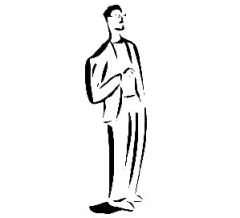
…..We played soccer there, too, though we didn’t know the rules. Sidney played a few times. He was older than us, no one even knew who he was. He wore street shoes, black dress pants against pale skin, white button-down shirt. I thought he looked like a ghost. I even have a picture of him, I don’t remember why or where from. One day he just shows up at the intersection, watches us for a while, then starts chasing the ball.He runs kind of funny, on his toes, with small, street shoe steps. He gets red-faced and sweaty and says his name is Andy, though for some reason we call him Sidney.
…..Meanwhile, I keep seeing Hans in my head..We’re in Salvatore’s, sauce dripping like thick blood from Hoffman’s slice as he folds it into his mouth, the triangle of pizza a muzzle, white mozzarella a wall of teeth. Hoffman says, “Maybe there is no Hans,” but he doesn’t sound very convinced.
…..I’m in the intersection, playing back of third one day, when Walter comes over the hill with Hans. Hans is less than a year old but already a giant, and when Walter sees me he marches right into the game, unhooks the leash, points at me and shouts, “Hans, Kill!” The game stops and everyone steps back as Hans charges, gaining speed as he runs.
…..Right around that time we find out that Andy, who we call Sidney, is the guy walking around the neighborhood all night, singing opera.I think of an interview I heard with Bob Dylan. Dylan’s putting the interviewer on, says, “I’m just as good a singer as Caruso. You have to listen closely, but I hit all those notes. And I can hold my breath three times as long if I want to.” I tell Sidney this because it’s all I can think of remotely connected to opera. I don’t even know exactly who Caruso is, maybe he used to walk around his neighborhood all night singing, too. Sidney says, “Dylan? Dylan doesn’t sing—he talks. I’ll show you what singing is.”
…..He takes me to his house, a brick house on a small hill. We go upstairs, it’s dark on the narrow stairway, and I don’t really know this guy. We’re alone, I’m thinking, “‘Phantom of the Opera,’ why did I come?” I start walling myself off inside, I suddenly think, ‘like I’m in a spacesuit.’We go into a little room, he puts on some music, the opera, and he starts to sing.
…..There’s an explosion of notes, like a hundred-ton rocket rising, and I’m suddenly empty, the fear that I felt on his steps burning away. Hawk on an air current—no need not to feel anything—and when he’s done I tell him, “I never heard anything like that before, it’s like going to a different world.”
…..“Ah, I was cheating,” he says, “singing along.” I don’t really know what he means but I know this guy can do something special. “Yeah,” he says,“I maybe could’ve done something—if I didn’t fuck up my throat.”
…..Rocket burns up, nose cone plunges into the sea—what if it doesn’t come up?
…..I guess I asked him about his family. I don’t remember exactly what he said, but he didn’t seem to get along with his parents. Back then who did? He said something about Law School, and failing the Bar Exam, and fucking up his throat.
…..I don’t tell anybody about it except Hoffman, who says, “We gotta get your dad’s tape recorder and record this guy!”
…..We used to play with my father’s big reel-to-reel. When Hoffman would leave, I’d sit, running my fingers over the thin tape, flat brown on one side, glossy on the other, wondering how it could capture our voices, and why, when I spoke to my father, he couldn’t hear me.
…..When Hans came charging at me over third base that day, I froze from fear. I tried to relax, but I could hear his nails clattering over the asphalt. As he got closer I saw him yap his mouth, his neck muscles tightening, but I never heard him bark. Then he leapt for my face.
…..But when I think of games on that lopsided, asphalt softball field, I think of stickball games, too, further up the road. Not the intersection now, just the road, by John Lee Bateman’s house, curbs marking foul territory. And after a stickball game, John Lee would come out and throw us younger kids high pops—throw after throw, sky high they seemed to me. He’d just materialize—we’d be playing and toward the end of the game I’d notice John Lee leaning on a parked car in front of his house. His pointed Adam’s Apple shivers when he breathes, his arms loose and long at his sides, and what I most remember, and maybe it was just in my head, was this sadness around John Lee..His body seemed as lost in soul as the earth in space. And I remember the yellow tennis ball, coming back down, like one of those nose cones, after stitching a rent in the sky.
…..So one day, I’m sitting here, forty years and four hundred miles from all that, when I hear about an incident in the old neighborhood. It’s on the news: A guy kills his mother, his father, three friends, and wounds two others. He drives off, breaks into a house, takes a couple of older people hostage, faces off with the cops then kills himself.
…..And it’s Sidney, though they call him Andy, and everyone’s saying, “Why?”
…..I thought of his house on the hill, the steep stairs to his music room where he sang that aria, now soaking up blood. And I remember, I have this picture of Sidney still—I could contact the National Enquirer—I could say, “Yeah, I knew this guy, years ago.We recorded him singing opera on the sidewalk. He played soccer with us sometimes. I’ve been away, but, look, here’s his picture—black street shoes, dress pants, white shirt hanging over pot belly, fists out in one of those Wallace Beery poses”—and I could tell ‘em some stories and maybe the Enquirer would pay me a whole lot of money.
…..And I remembered the tennis ball touching the sky. I loved the schoolyard, the intersection, the side street—all our fields—where anyone could play—and John Lee—his long skinny arm, wrist twisting, elbow snapping off throw after throw. And with every flight of that tennis ball, I felt this secret arcing sadness quietly carve its way through me, till there wasn’t room for much else. One day John Lee’s family moved away, and it struck me how I never really knew him, yet somehow always knew, something in John Lee I saw with my heart, something in both of us. We can’t talk about it, but he can throw the ball up high and I can catch it,and then go home with a nod when it’s dark.
…..Hoffman became a Rabbi, and Eddie—someone said something about selling lizards and snakes. I know he hurt his knee and never made the majors. I like to think he would have. I guess Sidney’s buried somewhere, maybe near his mother, who he stuffed in a hole in the basement, sealing her up after he killed her—it took the cops over a month to find her body.
…..I didn’t cry when Hans leapt at my face, I guess I was too scared. But it turns out if I had, he would have just licked the tears. Turns out, too, Hans is mute. When he barks, you see his throat muscles tighten, but all you hear is a breath.
…..I took Hans for a walk one day. We circled the bases at the intersection, Hans sniffing the asphalt, taking a drink from Kavanaugh’s big sprinkler like he’s gonna swallow the nozzle. We walk up the road, sit on the curb in front of what used to be John Lee’s house. I say to Hans, “I was really scared of you, man. Before I ever saw you, I prayed you’d get hit by a car, or eat poison. You were supposed to be mean.”
…..Hans wags what he has of a tail,and starts licking me. Eddie’s still got two good knees, Sidney’s still got opera in his soul, John Lee’s already gone. Hans is licking my salty face, he’s trying to bark and I can’t say anything else but I watch his mouth open and close and I wonder if that’s how I look to my father sometimes, and why I can’t just lick his face.
…..I never called the damned Enquirer, but I looked up all the articles about Sidney in a news archive. People called him Crazy Andy, and talked about how he rented out porn videos, loan sharked and ran bets for people. How he stared at strangers and shot car windows out with a BB gun, played golf on neighbors’ lawns and cast a fishing line over the curb—but they never mentioned soccer in the street, not even the opera.
…..Maybe he felt like nobody heard him, but,somewhere along the line,.I guess he just stopped singing.
.
.
_____
.
.

.
Jay Franzel lives in Wayne, ME, recently retired after working with at-risk youth for over 30 years. He has published poems in numerous journals and anthologies and received poetry grants from the Maine Arts Commission and St Botolph’s Foundation. He is the organizer of The Bookey Readings, a spoken-word series at the Harlow Gallery in Hallowell, Maine.
.
.
.