
Trading Fours, with Douglas Cole, No. 23: “The Wave”

March 12th, 2025

.

.


Trading Fours with Douglas Cole is an occasional series of the writer’s poetic interpretations of jazz recordings and film.

In this edition, Douglas’ poem is written partly as a reference to the Antonio Carlos Jobin song “Wave,” but mostly to get in the famed Japanese artist Hokusai’s idea of the wave as being a huge, threatening thing.  (The poem initially sprang from listening to Cal Tjader’s “Along Came Mary”). 

 A recording of Mr. Cole reading his poem is found at its conclusion.

.

.

___

.

.
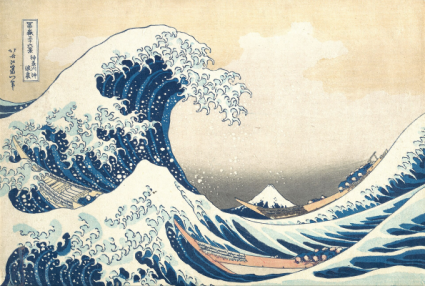
The Great Wave off Kanagawa. By Katsushika Hokusai (1760-1849)

.

___

.


.

The Wave

Imagine that you’re beachside
after a couple cubre libres,
not a care in the world in all
that low bronze sunlight,
and could be a mushroom cloud
out there, could be any time now—
the war gods took the gloves off,
the earth is tipping dangerously,
so better keep playing music,
here in the tsunami zone.

Looks like fires up and down the coast.
Can’t tell if ships are heading out or in,
but I know an Armada when I see one.
So, yeah, maybe try your A-game, brother,
because it’s feeling sort of Phrygian
for most of us in the tsunami’s path.

…………….You can duck and cover
…………….throw salt over your shoulder
…………….hope for the best and
…………….put your best foot forward—
…………….something’s in the wind,
…………….something’s in the water
…………….makes your skin crawl
…………….face to face with a stranger.

No way I’m going out after this.
What’s happening in the street?
They’re tearing down Cal Tjader,
the campus is boiling over.
I wish I had that energy, conviction,
not just three chords and the truth.
And it’s good thing they pay in drinks
and hillside shelter in tsunami land.

All to fear is fear itself and the mob,
agents going through your mail,
agents going through your trash,
mob on a mission, mob mentality
with a dose of end-of-the-world fever.
Who here thinks they’ll get to heaven?
Hold off for a little while, okay?
Some of us have jobs to do
out here in this tsunami field.

See, you’re top deck, cocktail hour,
sunset-grooving in the key of G,
then you’re running for your life—
you get it? You know what I mean?
Any minute now, any moment
it could all come tumbling down.
It’s a minefield of bad Intel,
a talking head parade, warm breeze
stirring up the coals again—
windblown hills and big boom
rolling tides across Tsunamiville.

…………….You can duck and cover
…………….throw salt over your shoulder
…………….hope for the best and
…………….put your best foot forward—
…………….something’s in the wind,
…………….something’s in the water
…………….makes your skin crawl
…………….makes everything seem
…………….to move much slower.

It’s a Dorian mood that blows
no good, a people’s concert
with star of Mary singing ohh
my tribulations no one sees
the curse of faults in me—
settling into the sounds until
that air raid siren goes off,
people running, beautiful pandemonium,
with nowhere to go in a tsunami bowl.

So you can cha cha, mambo,
play the cubano loco amigo,
fierce on the congas dilating
cascade wall of—timbales,
and there’s some code in there
goes right over our heads,
while the boots arrive, orders,
and it’s a top-down show, you know,
the way that tsunami flows.

Oh maybe it’s not fair to say
he compares to the original greaser,
but he sure has a hate on, he’s not alone—
they’re crawling out of their holes,
banging against trees, telephone poles,
and all that work, and all those notes,
that knowledge going up in smoke—
it feels more like no one’s in charge
when that tsunami rolls.

…………….You can duck and cover
…………….throw salt over your shoulder
…………….hope for the best and
…………….put your best foot forward—
…………….something’s in the wind,
…………….something’s in the water,
…………….something’s calling us to wander.

So I’m buying a boat, that’s my next move.
I’ll collect up the animals of the land,
head out to Japan, maybe, if they’ll have me,
or circle the globe with nowhere to go,
eternal refugee looking for a magic shore
beyond the hissing cloud and the quick
liquefaction while all the pinched mouths
and pearl-clutching bystanders say, what?
beneath that high curling tsunami wave.


.

Listen to Douglas Cole read “The Wave”

.

___

.

.

Listen to Cal Tjader playing “Along Comes Mary” [Virgin Music Group]

.

.

Listen to the 1967 recording of Antonio Carlos Jobim playing his composition “Wave.”  [Universal Music Group]

.

.

.

___

.

.

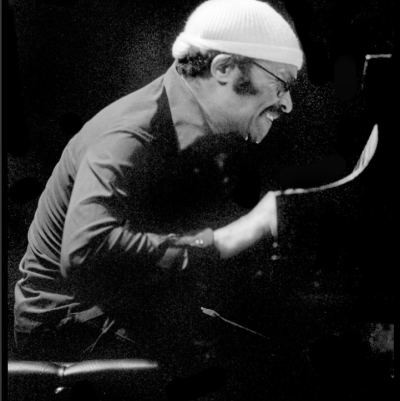
photo by Jenn Merritt

.

Douglas Cole has published eight poetry collections, including   The Cabin at the End of the World,  winner of the Best Book Award in Urban Poetry.  His novel,  The White Field,  won of the American Fiction Award, and his screenplay of  The White Field  won Best Unproduced Screenplay award in the Elegant Film Festival. His work has appeared in journals such as  Beloit Poetry,  Fiction International,  Valpariaso, The Galway Review  and  Two Hawks Quarterly.  He received the Leslie Hunt Memorial prize in poetry, the Best of Poetry Award from Clapboard House, First Prize in the “Picture Worth 500 Words” from  Tattoo Highway,  and the Editors’ Choice Award in fiction by RiverSedge.  He has been nominated Eight times for a Pushcart and Nine times for Best of the Net.

Douglas’ poem, “What We Talk About When We Talk About Kind of Blue,” published as part of his “Trading Fours” series, was nominated for the XLVIII Pushcart Prize

Click here to visit his website.

.

.
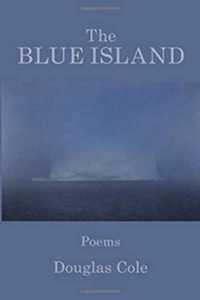
The poet’s collection, The Blue Island

.

.

___

.

.


Click for:

Previous editions of Trading Fours with Douglas Cole

The Sunday Poem

More poetry on Jerry Jazz Musician

Bluesette,” Salvatore Difalco’s winning story in the 67th Jerry Jazz Musician Short Fiction Contest

More short fiction on Jerry Jazz Musician

Information about how to submit your poetry or short fiction

Subscribe to the (free) Jerry Jazz Musician quarterly newsletter

Helping to support the ongoing publication of Jerry Jazz Musician, and to keep it commercial-free (thank you!)

.

___

.

.

Jerry Jazz Musician…human produced since 1999

.

.

.
Share this:

Comment on this article:

Your email address will not be published. Required fields are marked *

Site Archive

Your Support is Appreciated

Jerry Jazz Musician has been commercial-free since its inception in 1999. Your generous donation helps it remain that way. Thanks very much for your kind consideration.

Click here to read about plans for the future of Jerry Jazz Musician.

In this Issue

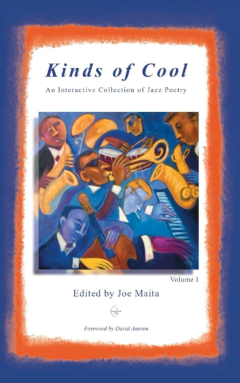
Announcing the publication of Volume II of Kinds of Cool: An Interactive Collection of Jazz Poetry...The second edition of Kinds of Cool, an Interactive Collection of Jazz Poetry has just been published, and is now available for sale on Amazon.com. This edition is dedicated to publishing women poets from all over the world who share their personal passion for and relationship with jazz music, and the culture it interacts with. With a foreword by Allison Miller, one of the world’s most eminent jazz drummers, and photography and design by Rhonda R. Dorsett

Poetry

Andrzej Barabasz, CC BY-SA 4.0, via Wikimedia Commons
21 jazz poems on the 21st of June, 2026...An ongoing series designed to share the quality of jazz poetry continuously submitted to Jerry Jazz Musician. In this edition…An eclectic mix of poetic styles and subjects display a collective love for the music and culture at the core of this creative community.

The Sunday Poem

The Sunday Poem: “Refreshing My Education” by Mike Mignano

The Sunday Poem is published weekly, and strives to include the poet reading their work...

Mike Mignano reads his poem at its conclusion.


Click here to read previous editions of The Sunday Poem

Performance

The performance poet Emmett Wheatfall
A Letter from the Editor…On “The Weary Blues: Celebrating Langston Hughes and the Harlem Renaissance”A brief recap and photos of the February 7, 2026 Jerry Jazz Musician-produced performance of “The Weary Blues: Celebrating Langston Hughes and the Harlem Renaissance”

Interview

photo of Billie Holiday by William Gottlieb/Library of Congress
Interview with Paul Alexander, author of Bitter Crop: The Heartache and Triumph of Billie Holiday’s Last Year...The author talks about the courage and resilience of the legendary Lady Day, and his outstanding book – an inspirational and revealing portrait of an iconic American, that, like his subject, exudes compassion and creative soul.

Feature

Book Excerpt from Crossing Bar Lines: The Politics and Practices of Black Musical Space, by James Gordon Williams...In this entire chapter from his book, the author explains how the trumpeter Ambrose Akinmusire expresses his political views and lived geography through his improvisational music, notably his critique of police brutality that has, as he states, “become a leitmotif throughout my albums.”

Poetry

Yves Moch, CC BY-SA 3.0, via Wikimedia Commons
“Remembering Sonny Rollins” – a collection of poetry...Over the years, many poems have been published on Jerry Jazz Musician that were written in reverence of the man we refer to simply as “Sonny.” In the wake of his death, many more have been written. The unsolicited poems making up this collection is an example.

Short Fiction

Photo by Johannes Schröter, via Pexels
Short Fiction Contest-winning story #71 – “Where the Music Wasn’t Allowed,” by Jane McCarthy....The award-winning story is about a young immigrant growing up in Southern California to the sound of music seeping into his family’s home from an upstairs neighbor’s piano, shaping the boy’s understanding of memory, family, belonging, and the improvisational ethics of music.

Interview

photo by Warren Fowler
Interview with John Gennari, author of The Jazz Barn: Music Inn, the Berkshires, and the Place of Jazz in American Life...The author discusses how in the 1950s the Berkshires – historic home to the likes of Hawthorne, Melville, Wharton, Rockwell, and Tanglewood – became a crucial space for the performance, study, and mainstreaming of jazz, and eventually an epicenter of the genre’s avant-garde.

Short Fiction

“The Cartographer” – a short story by Timothy Collyer...The story – a finalist in the recently concluded 71st Short Fiction Contest – is a work of speculative fiction about the gentrification of memory. It follows a recovering alcoholic who is building a guerrilla augmented-reality map of Philadelphia’s lost jazz history—specifically the “Blue Note” era of the 1960s—while battling a corporate developer who wants to sanitize the data for tourists.

Feature

Memorable Quotes: Abraham Lincoln..."I like to see a man proud of the place in which he lives..."

Community

Ricky Esquivel/Pexels.com
Community Bookshelf #6...“Community Bookshelf” is a twice-yearly space where writers who have been published on Jerry Jazz Musician can share news about their recently authored books and/or recordings. This edition includes information about books published within the last six months or so (September, 2025 – March, 2026)

Poetry

Six poets write eight poems (in the midst of our times)...Poets within this community of writers are feeling this moment in time, and writing about it. This collection is another example.

Short Fiction

collage by Judith Beth Cohen
“The Eating Club” – a short story by Judith Beth Cohen...The story – a short-listed entry in the recently concluded 71st Short Fiction Contest – centers on an affair two writers share around gourmet meals.

Poetry

Peter Buitelaar, CC BY 2.0 , via Wikimedia Commons
Two Poems for Miles Davis

Feature

photo by Laura Stanley via Pexels.com.
Trading Fours, with Douglas Cole, No. 28: “Little Samba”...Trading Fours with Douglas Cole is an occasional series of the writer’s poetic interpretations of jazz recordings and film. This edition is based largely on a documentary – They Shot the Piano Player – about Tenório Junior, a Latin jazz musician who only produced one album (1964) before he “disappeared” in 1976.

Short Fiction

kaboompics.com/via Pexels
“The title is not included in the word count…” – a short story by Scott Cash...In this story – a finalist in the 71st Short Fiction Contest – self-ordained genius Kevin feels that life has been against him. But he thinks he has discovered a loophole and can exceed the 3,000 word limit for a writing contest by utilizing the title. When this is thwarted, he instead lands upon footnotes as a way to exceed the limit. This story is a celebration of writers and the act of writing.

Jazz History Quiz

Besides being one of the first to be influenced by Charlie Christian (pictured), in 1944 this electric guitarist employed Charlie Parker on his first recording date and eventually led an R&B-oriented group “The Rockin’ Highlanders” that featured the saxophonist Red Prysock. Who is he?

Poetry

Poems on Charlie “Bird” Parker (inspired by a painting by Al Summ) – an ekphrastic poetry collection...A collection of 25 poems inspired by the painting of Charlie Parker by the artist Al Summ.

Contributing Writers

Click the image to view the writers, poets and artists whose work has been published on Jerry Jazz Musician, and find links to their work

Coming Soon

New poetry collections, Jazz History Quiz, and lots of short fiction; poetry; photography; interviews; playlists; and much more in the works...

Interview Archive

Ella Fitzgerald/IISG, CC BY-SA 2.0 , via Wikimedia Commons
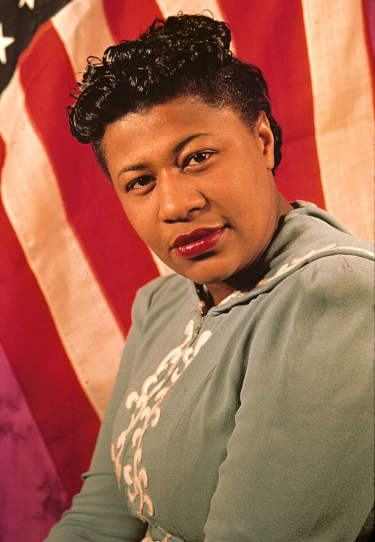
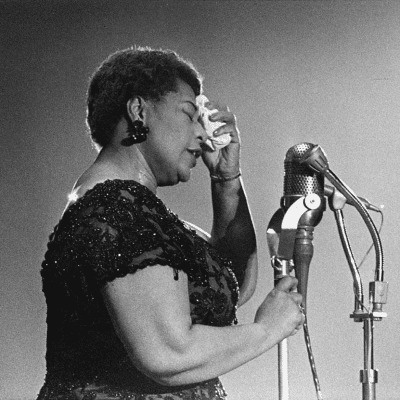
Click to view the complete 25-year archive of Jerry Jazz Musician interviews, including those recently published with Judith Tick on Ella Fitzgerald (pictured),; Laura Flam and Emily Sieu Liebowitz on the Girl Groups of the 60's; Tad Richards on Small Group Swing; Stephanie Stein Crease on Chick Webb; Brent Hayes Edwards on Henry Threadgill; Richard Koloda on Albert Ayler; Glenn Mott on Stanley Crouch; Richard Carlin and Ken Bloom on Eubie Blake; Richard Brent Turner on jazz and Islam; Alyn Shipton on the art of jazz; Shawn Levy on the original queens of standup comedy; Travis Atria on the expatriate trumpeter Arthur Briggs; Kitt Shapiro on her life with her mother, Eartha Kitt; Will Friedwald on Nat King Cole; Wayne Enstice on the drummer Dottie Dodgion; the drummer Joe La Barbera on Bill Evans; Philip Clark on Dave Brubeck; Nicholas Buccola on James Baldwin and William F. Buckley; Ricky Riccardi on Louis Armstrong; Dan Morgenstern and Christian Sands on Erroll Garner; Maria Golia on Ornette Coleman.