



.
.
“This Music is Not Your Nightmare” a story by Molly Ertel, was a finalist in our recently concluded 50th Short Fiction Contest. It is published with the permission of the author.
.
.
.
.
.
This Music Is Not Your Nightmare
by
Molly Ertel
.
___
.
…..She aimed her horn at my left ear and blasted it for 16 seconds that lasted the rest of my life. Even though the trumpet was pressed to her lips, I could see the smirk her mouthpiece couldn’t quite hide.
…..I’d been the one judging her out of the corner of my eye in the hallway before the show thinking, “Who is that slob of a woman wearing a muumuu and a backwards ball cap?” I assumed she was a friend of a friend of a friend that they let in for free, out of pity. When they announced her name, she, Janie Burch, lumbered onto the stage flaunting my disdain.
…..She wasn’t the kind to do something normal like say, “Good evening” to her audience or talk about her new album. Hell no. She had a signature greeting, and it was to let us have it with one everlasting shrill note that had enough power to pierce the heart of the world. And we felt relief when it was over and gratitude that she gave us a split second of silence so we could pledge ourselves to her, in the hopes she would not cause us any more pain. We, her now-adoring audience, had Stockholm syndrome and were beholden to her for the rest of the show.
…..I was the one holdout with my sucking-lemons face. Channeling my mother’s, “You call that music?” when she caught me listening to Bob Dylan on the radio at age fourteen, I thought-bubbled those immortal words out towards the stage. The “from” part of the thought bubble pointed to me. Cartoon character that she was, Janie saw it and sent me a “to.” Note-shot wound to the ear. My front row table six feet from, and at ninety degrees to, the stage had my left ear in the perfect position and Janie was rat-a-tatting away at it. Shards of notes bled out of my ear in telltale trickles that signaled me as the Janie Burch Cult defector.
…..Back to reality, my unprotected ears were throbbing. True Manhattanites, such as my daughter having lived here for ten years, wear earplugs any time they go out to hear music. Though born here, I moved away decades ago and am no longer a true Manhattanite. I was not wearing earplugs.
…..Even with two glasses of cheap jazz club wine in me, my brain struggled to get the music. I tried to follow a melody. I tried to make sense of it. I tried to let go and just feel it. This wasn’t the symphony, and I knew I couldn’t just sit there hands folded in my lap, a portrait of Northern European approval. But there was no way I could tap my foot to it or groove with my head without jerking around like I was covered in red ants.
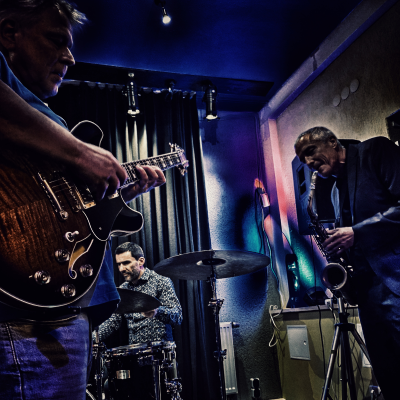
…..Janie wasn’t much of a talker, but halfway through the set she finally introduced her cellist, bass player, and drummer. Even within spitting distance of the stage, I’d barely been able to hear them. I’d watched the cellist, her eyes closed in concentration, boutique eyelashes fluttering ever so slightly while her bow floated above the strings. The bassist, rapt, undulated his shoulders to a vibration that only he could feel. The drummer basted the tops of his drums with a brush, the buttery beats just loud enough to close any gaps between yelps of the horn. Janie’s bandmates were mere decorations.
…..Pleasantries done, that damn woman was blasting away again. She should take her horn to a quarry to break up boulders. She should use it as an emergency siren to alert people it was time to dive down into their basements. I wish I were in a basement right now. Where it was quiet.
…..She didn’t deserve the loyalty of her bandmates or the devotion of her audience. She was a fraud, and I seemed to be the only one who knew it. Again she heard my thoughts. I could tell from the way she smiled at me, a stupid, naked-eared boomer. I’d wasted time earlier in the evening choosing an outfit and trying to look nice for this torture. Double plus idiot me, especially since she looked like she’d dressed out of the trash bin behind a Goodwill store. She grinned and hit me with another series of blasts.
…..There was a microsecond lull and the words, “This music is not your nightmare,” broke through to my brain. It wasn’t really a voice but a thought so clear it brought its own sound with it.
…..“What?” I said.
“Did you say something?” my ear-plugged daughter said leaning in closer.
…..“No, nothing.” I didn’t want my daughter to think that I’d reached that stage of my, uh, development, that I muttered to myself.
…..I wondered if Janie was communicating telepathically with me. Maybe she was supernatural. Maybe she was super-resentful at a front row seat being taken up by someone who hated her music, so she decided to take sonorous revenge. I wanted to ask her, “If this music is not my nightmare, then what the hell is?”
…..But she was still on stage, testing our ability to fend off migraines with another few compositions from her own dissonant mind. Finally, the announcer had us applauding the Janie Burch Quartet’s exit. I wanted to jump up and down shouting, “Bravo! Bravo!” that she was finally leaving. She bowed before she left the stage. Bowed! I imagined her ball cap falling off and her being weird enough to do a headstand to get it back on, showing her hairy legs and white cotton panties in the process. I shuddered.
…..“So, what did you think?” Elisa asked, eyebrows tenting together.
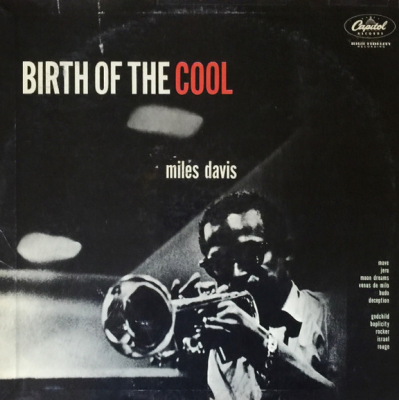
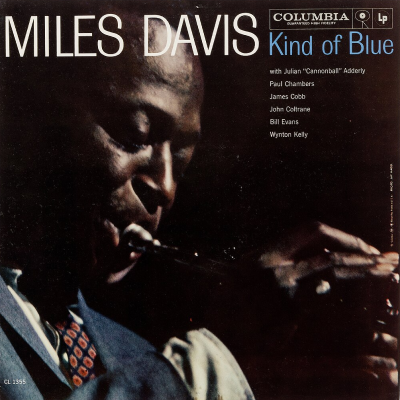
…..I had been thinking I wanted Miles Davis to play for me. I wanted his trumpet to sidle inside my mind, stroke my cheek, massage my shoulders, and relax these hands of mine that clenched the world. But long-dead Miles wasn’t about to come back to this hell on earth.
…..“Oh, I enjoyed it.” Not very convincing, I knew, so I rushed in some filler. “I like to experience new things. My brain didn’t quite know what to do with it, but, well, you can’t say you don’t like sushi if you’ve never tried it. Right?”
…..That was bad. Elisa’s eyes quivered, trying hard not to roll around. “You want to get a bite to eat somewhere?” she asked.
…..We didn’t eat sushi.
…..Later that night I was trying to sleep on the foldout sofa as 100 per cent humidity rushed over me with each swipe of the ceiling fan’s blades. I said to myself, “I know that bitch jinxed me.”
…..I fell into a dark swamp of my own sweat. I was up to my neck in murk, possibly eyeball to eyeball with alligators and snakes. No stars winked. No frogs croaked a welcome. In a state of sluggish panic, I struggled to wake up but couldn’t quite. The heavy clouds above made an opening just wide enough for the full moon to spotlight the inky water out in front of me. A chair stood in the circle of light. A trumpet sat on the chair.
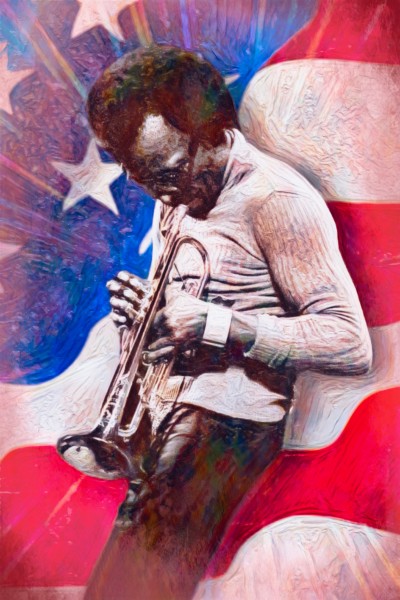
…..Miles Davis emerged from a stand of cypress trees on the far side of the swamp and walked across it to the chair. He sat and caressed his trumpet. He raised it to his mouth as he glanced in my direction, a hint of a smile on his face. Then he hit me with those sixteen agonizing, eternal seconds of Janie’s opening note. It pierced the air, killing every mosquito in a hundred-mile circumference. When I took my hands off my ears and opened my eyes, the chair was empty. Miles was laughing thunder all the way back up to the clouds as they closed behind him. “So what!” I yelled at the sky.
…..The moonlight gone, I felt myself to be floating on the swamp’s surface. I heard voiceless words again. They said, “You asked what the hell it is. Do you think music has to be pretty? Should you be able to hum along? Clap your hands? Play it as background dinner music to aid digestion? Fuck no. Music is art. It reflects our world. Is our world pretty?”
…..I woke up on the couch that felt marshy with its caved-in cushions. “Jesus, a lecture in the middle of the night to top it all off.”
…..Elisa mumbled something from the bedroom. I think it was, “Everything ok?”
…..“Yeah, can’t sleep is all. Sorry.” The couch was working at putting an “S” curve in my spine before morning, but I’d volunteered to sleep on it, not wanting to disturb my daughter’s routine during my visit.
…..In the morning over gluten-free muffins and green tea, Elisa offered to sleep on the couch for the rest of my visit. “I don’t mind. You take the bed.”
…..“Mmm, I don’t know. We’ll talk about it later. I’ve been thinking about buying Janie Burch’s album. You know, that trumpet player?”
…..“Mom, you hated her.”
…..“Shush,” I said. “I’ll grow to love her. Expand my mind.”
…..“I thought you guys had psychedelics way back when for that.”
…..I let her have that one.
…..I didn’t tell her I’d broken up with Miles, at least for a time. The way he made fun of me…it hurt, made me feel fragile. I know what he was thinking – that I’m close-minded and unable to let new music just wash through me without judgment.
…..I also didn’t tell my daughter that I’d already downloaded Janie’s album after “returning from the swamp.” I listened to it through earbuds over and over again. Her music wasn’t anything like an ear worm that merely pulsates and loops around. It was an electric eel that found every nook and cranny of my brain and filled it with the intolerable brightness of sound.
…..And it took me places. I stood atop a sunflower and looked at the earth far below with ants, real ants, scuttling around like city people. I lay plastered against a license plate on the front of a pickup going eighty miles an hour down the freeway. I could barely breathe, but the thrill of it bonded me with every dog I’d ever seen with his head out the window of a speeding truck. I returned to the swamp and dove inside the mouth of an alligator when it opened its jaws. I marveled at the mountain ranges of teeth above and below, some blade sharp, others rounded. One near the back had a cavity and oozed brackish stuff, and it made me laugh imagining “Allie” in a dentist’s chair.
…..By the end of he album I had danced in and out of a candle flame, eaten my way out of a bar of dark chocolate, and shoved an apple into the mouth of every yapping kid on a yellow school bus. I became part of each scene, and each scene was perfect. They appeared in succession without segue, and no explanation was necessary.
…..Fifty-seven minutes of Janie’s album had allowed me to live superlatives; the tallest, tiniest, fastest, and weirdest… It was so vastly different from my conventional life. I was grateful, but it pained me to admit that I had boxed myself into a comfortable, but closed, world and had ceased to really live. I had become my own nightmare. I sure as hell didn’t want to see my daughter’s knowing look if I confessed as much.
…..Pushing aside my plate with the half-eaten muffin I joked, seemingly out of nowhere, “From here on out, I am going to play Janie’s damn album every May – What was yesterday’s date? – every May 15th. Oh, and I’ll be wearing a muumuu and a backwards ball cap.”
…..“Glad you’re coming around,” was all Elisa said.
.
.
_____
.
.

Molly Ertel has been writing in random notebooks and on scraps of paper since she was six. Recently, she began to formalize her approach by using a computer, saving her work, and submitting it. She writes mainly flash and short fiction and has been published by Akashic Books and The Dark City Mystery magazine. She is also a reader for the Silver Blade Anthology, considering it an educational opportunity to learn from other writers. She is currently working on a novel in which the ghost of Clara Schumann figures heavily.
*
.
.
Details about our 51st Short Fiction Contest
.
.
.












Molly Ertel beautifully depicts that inglorious intersection when someone (like me) is forced to reconsider stale attitudes derived from stale comfort that gets chipped away to reveal the sort of discomfort we all need to keep growing. She hits me first, with her humor, my eyes drawn to the glossy surface, then with staring longer, I see the many layers, social, personal and philosophical that underpin this story of self evolution. I hope to see more of her writing! Perhaps a novel to curl up with?
A fantastic critique of convention and a celebration of boundary breaking. Terrific story!