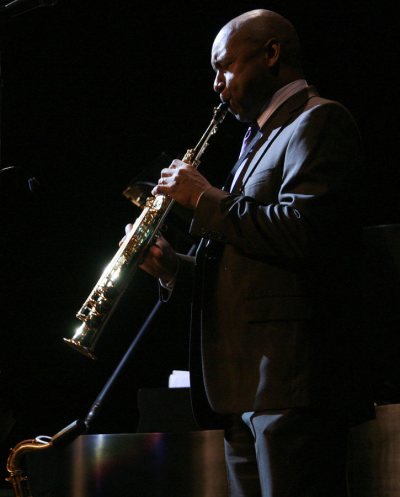

Joshua Redman entered the jazz world with tons of expectation and perhaps an unreasonable amount of hope. Pat Metheny went so far as to suggest Redman is “the most important new musician in twenty years.”
While Metheny’s point can be argued, Redman has created some of the most consistently compelling jazz during the last ten years. His music borrows from a storied past and experiments with an elegant future.
His place among modern tenor saxophonists consistently resides at or near the top, and at age 32, he is no longer a young lion but a wise veteran of whom Peter Watrous of the New York Times has said, “There’s only a handful of naturally gifted musicians, and Joshua’ s one of them. Everytime you hear him, he’s at a higher level.”
Redmans perspective of A Love Supreme is of great interest, particularly since he calls it “my favorite jazz record of all time.”
Interview hosted by Jerry Jazz Musician publisher Joe Maita.
_______________________
JJM Who was your hero, Joshua?
JR My musical hero?
JJM Well, that or your boyhood hero .
JR I think my mom was my hero. My mom took great care of me and she was a person I looked up to. I didn’t really have heroes like clear role models, like people or figures that I idolized
JJM Your mom is a great answer! In fact, I was hoping you could tell me a little bit about her. She provided you with an exposure to music that could be described as being pretty eclectic. You were exposed to music ranging from A Love Supreme to Sgt Pepper’s..
JR I grew up in a very musical household. It was a very small household. For the first 18 years of my life, I lived in a small, one bedroom apartment with my mom. It was small in physical area, but very large in musical, stylistic breadth. My mom loved all kinds of music. She loved jazz, classical, classic rock, classic soul, Indian music, and Indonesian music. She didn’t have a huge record collection, but she had great records from great artists in all of those different styles. I grew up with a sense of very few stylistic boundaries, if any at all. One minute I would be digging on Sgt Pepper, and the next minute I would be digging on Aretha Franklin’s Greatest Hits, and the next minute I would be digging on Coltrane’s A Love Supreme.
JJM Would you go to the record store with her?
JR I think the first record I ever bought was a Sonny Rollins record, Saxophone Colossus, and from that point on Sonny Rollins became a hero of mine. I was nine or ten or so at the time, and my mom paid for the record
JJM Do you remember what record store in Berkeley you went to?
JR We probably went to Leopold’s.
JJM How old were you when you first heard A Love Supreme?
JR I feel like I have been listening to A Love Supreme since the day I was born. I can remember looking at the album cover and hearing that music. It is one of the first albums that I ever remember being aware of. I am sure it was playing in the house from the day I was born, because it was one of my mom’s favorite records.
JJM So, you weren’t a musician when you first heard it then …
JR No, not at all. I didn’t start playing the saxophone until I was ten years old. I had been listening to A Love Supreme for ten years before I even picked up a saxophone.
JJM What effect do you suppose that album had on your interest in music?
JR That’s a difficult question to answer because, it’s hard to say what effect an album like that or an album like Sgt Pepper’s or other records of my mom’s had on my relationship to music because that was music for me. In other words, those records were my first exposure to music, so they were kind of the definition of music to me. It’s hard for me to remember what I was feeling when I was four years old, listening to that music. Who knows why my attention span was at that time? I think the thing that always impacted me about A Love Supreme was just the intensity and the force of the music, and the soulfullness of it. I don’t mean soulfullness in the sense of a style of music, but just the sheer passion came through, maybe from the first time I heard it. I think that is the case for most people when they hear that record, whether they ever hear another lick of jazz or not. They may not have any understanding of what’s happening musically, the incredibly deep and complex musical issues that Coltrane is tackling, but I think the conviction and the intensity and the passion and the sincerity – the honesty – you feel these qualities when you hear this record, and that’s what makes it so compelling, it’s what makes it one of the greatest jazz albums of all time.
JJM In the liner notes to Mood Swing, you wrote, “In the eyes of the general public, jazz appears as an elite art form reserved for a select group of sophisticated (and rather eccentric) intelligentsia who rendezvous in secret, in underground haunts (or inaccessible ivory towers) to play obsolete records, debate absurd theories, smoke pipes, and read liner notes.” Given the direction Coltrane took his music, how much did he have to do with perpetuating this public perception of jazz being inaccessible?
JR Coltrane, in a certain way, is a paradox, because he is one of the most elusive and one of the most uncompromising artists – one of the purist artists in the history of jazz. You can’t get purer than Coltrane. Everything that he did was all about music and all about the artistry and spiritual quest. No concessions were made to commercial issues or even performance issues – issues of audience satisfaction. Yet, at the same time, he is one of the most compelling, and in some ways one of the most accessible artists in the history of jazz. There are people who own Coltrane albums, and those are the only jazz albums they own or they are the only jazz albums that they like. I think he was accessible and compelling precisely because he was so uncompromising . The integrity and purity that he had was so apparent to people. You could hear it in the music, you could see it in photographs. All you have to do is look at the cover to A Love Supreme. It’s beautiful and accessible in its intensity, and the sense of resolve and devotion is so visible on his face.
JJM Yes, as you said, he is the sort of artist that people connect with in a deep, spiritual sense. I know that when I put on anything by Coltrane from A Love Supreme back, my friends love it. The minute I go A Love Supreme forward, they want to leave the room. He was such a powerful figure and he gave free jazz a real shot in the arm. What I am curious about is because of his personal and musical power and influence, if that didn’t result in the music getting beyond the reach of the average listener, and they left jazz as a result …
JR I think a lot of people may have misunderstood what I was trying to say in those liner notes. I never once was making a claim that jazz was inaccessible. I believe that a lot of free jazz is actually very accessible. For example, if I put Ornette Coleman on for some people, and don’t tell them its Ornette Coleman, or don’t tell them that it’s free jazz, sometimes people love it and they can relate to it because there is melody, there is deep blues feeling, there is an incredible sense of humor. There is a perception that has developed that jazz is inaccessible, but I have never accused the music itself of being inaccessible. Like a lot of serious art forms, often times there develops a culture or sub-culture connected with that art form, a culture of people who are passionate about it and zealous about it, and for good reason. But sometimes those people can help create this image of jazz being an insider’s or elite music. There are a lot of insider aspects to jazz, but I think that also there is so much that can be appreciated about it. You don’t have to have a membership in the club to appreciate it. I think that is true for Coltrane’s work, I think that is also true for a lot of the work of free jazz artists.
JJM What are some of the things that you have in common with John Coltrane?
JR I don’t know, nothing, although he has obviously been a huge influence on me …
JJM Let me ask it differently. It was said of him that he was interested in examining life from different angles. What I get from that is he was very well rounded, very eclectic, very open to experience, open to the world from a traditional way, and from a spiritual way. You seem to share some of this in that you have eclectic tastes, and a real love of culture in general. You don’t seem to be stuck in this “it has to be jazz or nothing” attitude. Do you feel you had anything in common with him?
JR He was definitely an influence on me in that sense. I have always seen John Coltrane as an artist who has been incredibly focused but also very eclectic. I realize that’s kind of a paradox, but there is nothing more focused than Coltrane’s sound and approach and his dedication at any particular point in his musical development to his single-minded pursuit of whatever his musical goals were. There is also the sense of inclusiveness and a willingness and a desire to take in all that he could from other music and other art forms. He was one of the first musicians to really bring in the influence of Eastern music, especially Indian music, and that has always had a huge influence on me. Coltrane is a model for a jazz musician, to be completely innovative and original and focused in his aesthetic, but also in no way exclusionary and completely open minded in terms of what’s around him and what can influence him. I once read something that was attributed to him, “I believe in all religions.” I think that that is a sign of his inclusive spirit. In terms of what he practiced, it was part Christian, part Islam, but he saw the spiritual forces and the human values and the experiences that connected people to all different belief systems and all different cultures. I think there is something about his music that seeks to address those fundamental human issues and expresses fundamental human values. That is what makes his music so compelling to so many different people. Even though it’s a complete individual aesthetic, there is a universal quality to it. I think especially his music during his middle period – the stuff from My Favorite Things on to Transition, with A Love Supreme and Crescent being the peak, – that work is very humanist to me.
JJM You were commissioned by a playwright to create a piece of music, Twilight … and Beyond (on the Beyond CD), that would be used in her play, Twilight, which dealt with the LA Riots. She wanted you to create a piece of music that put the listener in a state of twilight, where things are unclear, in a time of change Did you feel any kinship toward Coltrane and his recording of “Alabama” during this creative process?
JR His influence can never be that far away. No matter what you do, music is a part of your identity, it’s a part of who you are. It’s very dangerous for me to see myself in relation to someone like Coltrane while I am doing my own work, because if I do that, I am basically going to stop playing. I am never going to sound as good as John Coltrane, I am not going to come close to achieving what he did, so I basically try, on a conscious level, to put him and his music completely out of my mind when I am working on my own music, because otherwise it will almost be this albatross, like this ghost that is haunting me.
JJM That must be very hard for you …
JR It’s like this ghost, shaking his fingers at me, saying “That ain’t going to work!”
JJM It’s sort of like, how do you play “Chelsea Bridge” and not hear Ben Webster?
JR But what I am saying is that if you are playing “Chelsea Bridge,” you probably shouldn’t be thinking about Ben Webster. If I am writing a piece of music like “Twilight,” I shouldn’t be thinking about Coltrane .
JJM I guess what I meant too, Joshua, was not so much that you hear “Alabama” while you were doing this; I am wondering if you ever chuckled to yourself and said “I wonder if my creative process while composing ‘Twilight’ is what Coltrane felt while he composed ‘Alabama’?
JR I understand what you are asking, and I am saying no. I am saying that for me it’s very important to not be thinking about what my relationship is to different historical figures. If I am too concerned with my relationship to a legacy or to history, then I start to see myself, for better or worse, as being an historical figure. Whether I am continuing a part of tradition, or slaughtering a part of tradition, it doesn’t matter, I start to see myself outside the actual creation. For me the creative process is about really being in the moment, whatever that musical moment is. If I am on stage improvising, then it’s being in that improvisation, in that solo. If I am sitting at the piano, composing, it’s being in that compositional world I am creating for myself. If it’s composing for a play, or something like that, then it’s important I try to capture that feeling. That’s what it’s about for me. If I start trying to place my work in a historical context then for me it loses some of its strength and vitality.
JJM I have been doing some studying of Ralph Ellison of late, and he wrote something I wanted to share with you. He said, “A great religious leader is a ‘master of ecstasy.’ He evokes emotions that move beyond the rational onto the mystical. A jazz musician does something the same. By his manipulation of sound and rhythm he releases movements and emotions which allow for the transcendence of everyday reality.” I love that, and to me, when I read that, I think of John Coltrane. If ever there was a master of ecstasy, someone who was transcending everyday reality, it was him.
JR Very true. I wanted to say one other thing, thinking about yourself in relation to other artists, especially their heroes and their creative processes. My sense of Coltrane was that that was the last thing he was concerned with. Here is a saxophone player who was clearly steeped in the tradition of his instrument and the language of his predecessors. You could hear everything in his playing from Lester Young to Dexter Gordon to Charlie Parker to even some Sonny Rollins and Stan Getz. Even though Coltrane was clearly one of the most innovative musicians, destined for greatness, I don’t think he ever thought of himself in relation to history or of himself being a historical figure. I think about his music in terms of this never ending search, this quest for deeper and deeper truth, for more spiritual awareness, for connection with himself, with other musicians, with the world at large. I think he never saw himself in relation to history, I think he saw himself in relation to the music of the moment.
JJM You said something in an interview that I thought was very interesting, especially given the events of September 11. You said, “Ultimately the driving force behind your creativity as a musician is your soul.” I guess that any great musician feels that way. Given how everyone’s soul has been impacted by the events of September 11, how is that tragedy affecting your creativity?
JR In a certain sense it is reminding me and other musicians, in a very brutal, painful way, of where our creative priorities are, where our life priorities should be. It reminded us of precisely that value, of the idea that ultimately, what this is all about, is saying something that is soulful, meaningful, expressive, and passionate – trying to create something that is beautiful. Hopefully, through the creation of that, it establishes some kind of larger connection among the people who are experiencing the music. No matter how religious or spiritual you are, music does have that power to transcend, like the Ralph Ellison quote that you shared, music has that power to take people out of their everyday lives and their pride and sometimes parochial, selfish interests. People discover their connections with others in the moment and to discover and express the things that connect them with other human beings. I think that’s what each of us, as musicians, are all trying to express something that is uniquely our own, but we are trying through that honest and hopefully original self-expression, we are trying to create something which is greater than us, and that connects us to others. I think the events of 9-11 have just reminded us once again, as musicians, how important that is. It definitely puts a proper perspective on other issues that are not as important, such as how is my career coming along? How is my record deal? How many gigs do I have? How much am I going to be working this year? I am not saying these issues cease to be relevant, but they are placed in their proper place.
JJM I get the sense people have returned to very simple values, and that people are hopeful that some beauty is returned to the culture.
JR Yes.
JJM One last question. If you could have attended one event in jazz history, what would it have been?
JR Wow, that’s a tough question. I would have to say being there for the recording of A Love Supreme. There are so many great moments, but that’s my favorite jazz record of all time, if I had to name a favorite. It’s the most important one to me, the one that has been in my life the longest. It’s probably the purest jazz record, not stylistically, but pure in terms of emotion and tension. The sign of a truly great album is that it still speaks for itself, and is complete in and of itself.
________________________________
Joshua Redman products at Amazon.com
John Coltrane products at Amazon.com
Joshua Redman web site
_______________________________
Interview took place on December 12, 2001
*
If you enjoyed this interview, you may want to read our interview with John Coltrane’s pianist, McCoy Tyner.
*
Other Jerry Jazz Musician interviews