
.
.
New Short Fiction Award
We value creative writing and wish to encourage writers of short fiction to pursue their dream of being published. Jerry Jazz Musician would like to provide another step in the career of an aspiring writer. Three times a year, we award a writer who submits, in our opinion, the best original, previously unpublished work.
Jackson Lassiter of Washington, DC is the eighth recipient of the Jerry Jazz Musician New Short Fiction Award, announced and published for the first time on March 15, 2005.
.
*
.
Jackson Lassiter
.
*
.
Jackson Lassiter grew up nearly feral in the hills of Wyoming, where he gained an appreciation of the vagaries of Mother Nature and human nature. He currently lives in Washington, DC, with his partner and a snappy Shih Tzu named Mona. Jackson pushes paper for a major university to make rent and spends the rest of his time writing furiously.
Contact him at [email protected]
.
.
_____________
.
.
.
Natural Selection
by
Jackson Lassiter
.
_____________
.
….. The rigid wooden slats of the park bench press relentlessly against the length of my goose-pimpled back. A stocking cap rides low over my ears and most of my forehead, and a wool blanket — cocooned around my prone body — laps over my chin and tucks snugly around the sides of my face. Only my eyes, nose, and weather-cracked lips brave the raw chill. I gaze skyward as the frozen minutes slowly pass. I wouldn’t normally choose to rest here in the dead of winter, but tonight I didn’t have a choice. In life you are either a have or a have-not. Mike and I are have-not’s.
….. The arctic air mass stalled over the city is colder than hell, I think, and with this thought a snort escapes my chattering teeth: how cold is hell, anyway? The damp sound rises as mist in the frigid night, swirling lighter than feathers in the stillness above. But this remnant of warmth quickly freezes and two tiny ice crystals — all that remain of the moisture — fall back to my ashy face, an amusing pinprick of sensation on my cold-deadened skin. I blow another breath through shivering lips, and this plume goes higher than the first but just as quickly disappears. No ice crystals tickle my face this time, though. They are vaporized by the dry, subzero night before they can fall the longer distance back.
….. This January darkness is as still as death and except for Mike and me, the graveyard quiet of the inner-city park opens only to an eerie emptiness. I like the serenity. Soon enough this crossroads will be busy — at sunrise these grounds shake off the bitter night’s hibernation and rumble to life as a parade of characters trample through.
….. The homeless who spent the night at the shelters show up first. They are kicked out of their cots at 7:00 a.m. and don’t have anywhere to go. So they park on these benches and wait for the eager, winter-wrapped tour groups who come to snap photos of the famous marble fountain standing watch over these glacial gardens. The down-and-out will ask the well-off to part with their spare change (like the bums know anything about spare change; when you have only pennies, nothing is spare).
….. The beggars ignore the workers who cross this square as a short cut to their downtown cubicles just a few blocks away. These upwardly-mobile professionals sport the season’s most expensive trends; we know where their spare change goes. They scurry by in furs and topcoats, steaming espressos and cappuccinos warming polished nails through leather gloves, fresh-scrubbed faces glowing pink from the nip of frost. Makes me sick. But they don’t like me, either. These locals see me every day. I am urban blight and they like to pretend I don’t exist. I am simply something to be stepped around on the way to kiss the man’s ass for the dollar. Like dog shit.
….. But that all happens later. Right now, not even the rats are out. This cold snap shatters all records and the rats have enough sense to stay in their dens. But since Mike and I wander den-less, we end up lying head-to-head on this bench, the fuzz of our wool caps just touching. Mike’s blanket covers his face, and he sleeps, only God knows how. The wooden benches are damn uncomfortable and my blanket only partially fends off the killing frost. Besides, I am still high from the crack cocaine. So I shiver and fidget beneath the cover, too cold and too agitated to sleep.
.
*
.
….. Mike and I can’t stay at the shelters, you see. The drug ban stops us cold. Those are rules we can’t live by. The fit survive, though, and sometimes being fit means being resourceful. Mike and I survive hunkered in the shack we built of salvaged cardboard and stolen tarps. Tucked between the backside of an empty office building and a vibrating HVAC unit, our castle is no Hilton but it works. We stay warm and dry and we answer only to ourselves. Each night when the drug rush fades and sleep creeps in to take her place, Mike and I lay side-by-side in our bed of wool blankets and harvest each other’s warmth. Our toasty little shack radiates with the comforts of home.
….. “How’s the weather?” Mike asks every night, snickering like a schoolgirl. He likes this ritual. For Mike, habit replaces the usual securities.
….. “Clear and still,” I reply. “Clear up to your ass and still snowin’.”
.
*
.
….. But tonight’s story reads differently; ritual took a hit earlier. We returned to our alley shack after a day of scratching for a living on the streets to find only open sky above and hard asphalt below. The building’s owner inspected his grounds and when he found our shanty, he hauled it off as trash. He couldn’t see that the propped cardboard walls and pitched blue roof were shelter; he couldn’t imagine that the banged-up red cooler and odds-and-ends dishes were a kitchen, or the layers of rugs and cardboard were a mattress. One man’s home is another man’s . . . junk.
….. I am sure he found pleasure in destroying our camp. In my outrage I can imagine him throwing the last pieces of it — a half-eaten can of stew and the cracked mirror we hung for decoration — to the top of the heaped dump truck. He curses, “Fucking waste products,” as he wipes his hands of us.
….. “Look at that,” I say, “the fucker left our blankets.” They are wadded in a heap on the top of the HVAC unit. A kind gesture, but again, maybe he just forgot to throw them away.
…..“God dammit!” We swear together.
….. “What are we gonna’ do?” Mike finally asks. I don’t like the fear I hear in his voice.
….. “Fuck!” I yell. “Fuck. Fuck. Fuck.”
….. I kick the humming HVAC unit. I need a rock.
.
*
.
….. A fat man sits in his idling BMW at the intersection of 20th and P Streets. The car’s heater runs at full blast to keep the wind-chill at bay. The trash-littered corner hosts a busy Burger King, whose customers we ask to part with their change. Many do. They can’t just brush us off with a guilty “don’t have any”. We watch through the storefront windows; we have seen the cashier drop coins to their cupped palms. We know they have change, and they know we know. This transparency works in our favor, and our funds accumulate. So it is here the fat man loiters, holding what we buy with the money we scavenge.
….. His name is Alvarado, and he is always eating, always wiping grease or oil or mayonnaise from his fat fingers and fat lips but never quite getting them clean, always smacking or swallowing as the next customer ambles toward the car (all trying to look like they aren’t doing anything illegal). Alvarado is like an overweight, slick eagle. He has a pointed, hawkish nose and shiny black hair that he smoothes back with thick hair wax. His bird-like eyes are cunning, always searching, always on the lookout. Until he spots a sale, and then he can’t be distracted.
….. Alvarado is a business man with good business sense, but his heart is no damn bigger or softer than the hard little bits of crack he sells us. He takes our panhandled pennies and nickels and turns them into a nice living. It doesn’t matter that we deposit our coins with him rather than eat. He’s only a supplier, he says, in a land where the natural order of supply and demand sets the course. People make their own choices, Alvarado says.
….. I give him the last of our money and he gives us a rock. He retreats behind the tinted windows of his warm car while we walk through the cold to the basement entrance on the backside of a building just off the busy corner. We’re below street level, enclosed in the concrete box at the bottom of a flight of cement stairs, tucked away from the wind and relatively hidden from sight. We use this pit often, and so do the other crackheads in the neighborhood. Sometimes in the summer we have to wait up top with the shady-looking group loitering on the sidewalk, trying not to look like we are loitering, as we take turns in the secluded space below.
….. But not tonight. Tonight Mike and I have the joint to ourselves.
…..Spindly, leafless crepe myrtle branches drape across the open top, a natural ceiling that encloses the box. The spent blooms — in August they hung in brilliant pink bunches — lie in mushy, brown lumps in the dank corners of this cell, squished up with hundreds of burnt matches and nearly as many bits of plastic and paper that used to wrap our drugs. Even in the blast of clean, winter-fresh air, the rancid stench in this hole lingers: fetid, but strangely sweet. The odors of rotting flowers, urine, and smoke mingle in the frostiness.
….. I watch as Mike pisses in the corner, his back to me and his squat shape straddling the steaming puddle of his urine. His barrel-chested torso sprouts thick, short arms — like stubby wings — and abbreviated, unbending legs that cause him to move with a jerking, penguin-like shuffle, almost a hop from one foot to the other. These shrunken arms and legs are the remnants of a childhood ailment and have set him apart ever since. I wonder how he survived on the streets before we found each other, but when he turns toward me and his open face shines in the dim light, I understand.
…..Mike’s dumb innocence provides for him, for both of us really. It’s like he hails from a different place, accidentally cast out of some higher reality to find shelter in this underworld. There is a goodness that dwells in Mike. Innate goodness. He even refuses to use the cardboard sign I give him that reads: Please help, diabetic. He would rather do without than deceive.
….. “It’s not true,” Mike says of my crude, hand-lettered sign. “I can’t do that. That’s lying.”
….. I swear at him but I also make a different sign, and for this Mike thanks me. But I don’t care either way. Please help, disabled and hungry works just as well and the coins accumulate.
….. Intellect bypassed Mike. It skirted right past his soft brown eyes and wide, easy grin. Instead of smarts, Mike glows with naïve good-heartedness — the same now as when I met him in rehab seven years ago. We have hung together ever since. What we have works. Our prey responds better to Mike’s quiet stillness than my nervous agitation. I scare them. But I keep our predators at bay. I take care of Mike in a world that might beat him down, and his good nature keeps me human.
.
*
.
….. I put the larger half of the rock in a small brass pipe and tuck the leftover piece in the front pocket of my jeans. “Save this for later,” I reason. “We’ll be glad to have it then.”
….. I light up first and suck the sweet, hot smoke deep into my lungs. I thwart the pressing cough with clamped lips and a willed refusal to let my chest tighten, and pass the pipe to Mike. He inhales and passes it back to me. We hold each smoke-filled breath as long as we can, passing the pipe back and forth until smoke stops and the dry, lifeless ash blows away on the icy breeze. And then we ride the wave of the high, floating away from the urine-soaked concrete on sturdy wings of smoke. Even the crepe myrtle seems to have a sudden flash of life; the barren branches shiver, as if in anticipation.
….. “I’m flyin’ man, I’m fuckin’ soarin’. Nothing compares, man, nothing fuckin’ compares,” I say. I put my hand in my pocket and roll the little bit of crack cocaine between my fingers. I can live as long as I can feel that.
….. Later we make our way through deserted streets to this park, wrap as best we can in our blankets, and ready for the long night ahead. We have nowhere else to go. I’m still high and in that warm glow I can ignore the cold-tingling of my toes and fingers. I stay awake through the night chattering about all kinds of bullshit but Mike is quiet.
.
*
.
….. Eventually the sun rises but day breaks freaky and slow. The sky gradually changes from the weird, bright black of the winter night to a dull grey, and then a pale light spreads over the grounds. Next thing you know, the sun pops up.
….. The fountain looms to my right, towering over the ice-bound gardens. A tourist once told me what the three white marble figures sharing the center column symbolize, but I can’t remember exactly. The one looking out at me now may represent the seas. The smooth marble woman hoists a small sailboat in one hand and she pets a seagull with the other, but I appreciate her beauty more than I appreciate the symbolism. In fact, I laugh.
….. “Fuckin’ gulls,” I swear, “flyin’ fuckin’ rats. Gull shit everywhere. Hate fuckin’ gulls, Mike, don’t you?”
…..Mike doesn’t answer.
….. The early birds have been discharged from the shelters and take their place on the open benches. The first of the walking commuters begin to filter through as the traffic noise from outside the square grows louder. Another day unfolds but Mike and I stay put. The sun might be up but not the temperature, and the long night has drilled the chill to our very core. It will take time to thaw.
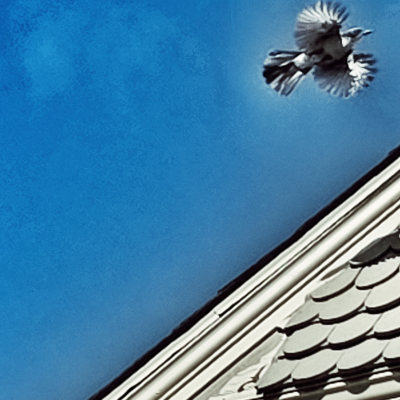
….. A flock of pigeons abandons its roost to search for breakfast on the sidewalks circling the fountain. After a moment they take to flight again, all of them lifting as one to make looping, playful patterns in the sky. They are stretching, waking up. They rise over the park and swing left and right, the nearly horizontal rays of the low morning sun flashing white on their bellies as they turn together, changing from dark shadows to white sparkles as they circle. They are like a school of fish darting effortlessly, fluidly, in the cold blue ocean of sky above. These pigeon-fish paint a beautiful picture across the ocean-sky, but I am the only one looking up.
…..And then just as suddenly as they rose the birds return to the ground — a flock acting with single-minded will — to scratch out a living on these streets. I check my pocket for a crumb to toss them, but the cupboard is bare except for the tiny bit of drug.
….. “Sorry, little fuckers,” I say, “you don’t get this.”
…..Maybe I said something wrong because suddenly they all jump to the air, every single one of them, their wingtips slapping together at the bottom of each down stroke as they shove off. Every bird makes the same sound — whap-whap-whap-whap-whap — and as a flock they raise quite a ruckus. Sounds like people clapping for a show.
….. Flapping feathered bodies surround me, but they are different this time. The pigeons are scared, not playful, and when I see a bigger shape among them I know why. It’s a falcon, and before I can do anything he has grabbed one pigeon in midair — just a few feet after takeoff — and slammed her back to the frozen earth, her plump body grasped in his sharp talons. She struggles for just a second but the falcon places two accurate pecks at her head and she stops wriggling.
….. No one else notices the fight. The workers power walk toward their careers, breaths like puffs of exhaust from their revved-up engines churning-churning-churning at full throttle, while the beggars sit idle, waiting for the busses to disgorge the tourist class who might, if luck prevails, offer up enough spare change to grant another day’s survival. The birds are so far out of everyone’s routine that they don’t exist.
….. The falcon lifts off on strong, silent wings, dead pigeon swinging from one hooked claw. He lands in a sycamore tree and begins to pluck the pigeon. He’s an expert plucker and feathers soon float on the breeze like snowflakes, falling on Mike and me, falling over the people walking. A woman brushes white down from her raven hair, but still doesn’t notice the death story in the bare branches above. As she walks onward the dead pigeon’s plumage drifts silently over the brittle yellow grass of winter.
….. The falcon finishes plucking and lifts his head above the naked corpse, his open beak addressing the cold white sky. He screams an eerie victory screech, but I don’t know for whom he yells. Doesn’t matter: I’m the only one who hears him, so I guess he cries for me.
….. “Jesus, Mike, do you see this shit? Fucker got him some breakfast.”
…..Mike does not stir under his blanket, so I sit up and put the last of the rock in the pipe. My back aches from hours pressed against the hard bench and the movement pains me, but this spectacle of nature — so out of place in this urban setting — demands an audience. Besides, it’s a wake and bake morning and although I know I should share with Mike, snoozers lose and we only have half a rock. I light the pipe and watch the falcon rip and swallow strips of flesh from the pigeon as I inhale the smoke. When I have finished I tap the ash from the pipe and return it to my pocket. Time to move on. I lean over and jab Mike with a sharp elbow. But he doesn’t move.
…..“Wake up, fool,” I say, as I pull the blanket away from his face.
….. Right off I know he is dead. From the looks of him, he’s been dead most of the night. His eyes are open but crystallized, frozen solid. They are like mud puddle ice: shiny and reflective but cut through with the crisscrossed cracks that come with freezing. In their surface I see a distorted, broken-mirror reflection of the sky above. In Mike’s frost-nipped eyes, the morning splinters and the shards don’t line up at the edges. Broken pieces of cloud float across one eye and in the other I see the branch of a tree cutting a jagged gash across the blue sky. On this branch rests the half-eaten body of the pigeon, shreds of blood-red meat hanging in strings from her thin white bones. Her still-feathered head dangles, red eyes open but lifeless, a death cry strangled in her gaping beak. The falcon sits beside her, wiping the blood from his face on the rough wood of the branch between his feet.
….. The walking workers walk, the begging homeless beg. The tourists tour with their cameras ready. Horns honk and drivers drive in the traffic mess beyond the borders of this park.
….. I pull Mike’s blanket back over his face.
….. “Fuckin’ falcon,” I mutter to myself. “Fuckin’ everything,” I continue, as a well-dressed tourist steps aside to avoid me.
…..“Hey, lady, spare some change for coffee?” I say. I must not scare her too badly, or maybe just enough. After she spills her pocket in my outstretched hand, I walk away.
…..“Fuckin’ falcon,” I repeat.
.
.
_______________________________
.
.
.
.