



.
.
New Short Fiction Award
Three times a year, we award a writer who submits, in our opinion, the best original, previously unpublished work.
Nathaniel Whelan of Ottawa, Canada is the winner of the 54th Jerry Jazz Musician New Short Fiction Award, announced and published for the first time on July 13, 2020.
.
.
___
.
.
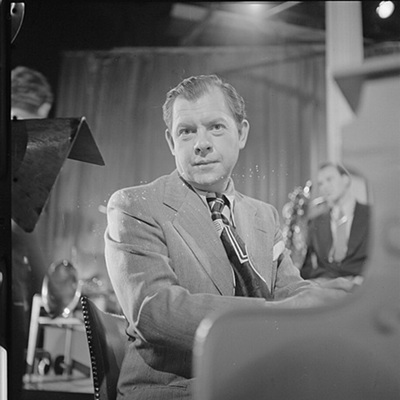
FDR Presidential Library & Museum / CC BY

Radio City Music Hall; New York, 1940
.
_____
.
A Failed Artist’s Paradise
by Nathaniel Whelan
.
…..He’s here again, his mossy hair visible at the back of the crowd. I’ve seen him a few times before and it’s always the same: he leans against a pillar, arms crossed, a hungry look in his eyes. There’s a bit of rebel in him. I don’t know if it’s the cigarette or the rimless sunglasses perched on the edge of his nose, but he doesn’t fit in with the polished and the proper.
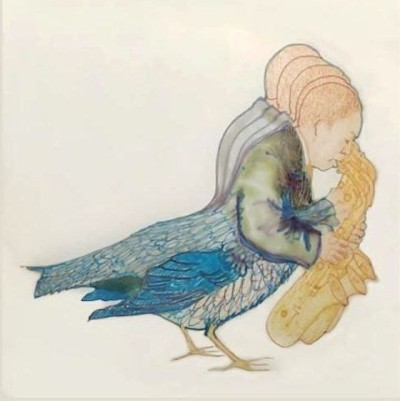
….. Lips tightly pursed around the mouthpiece of my saxophone, I focus on the song: A, E, E flat, F—a sultry rhythm if there ever was one. It’s a four note melody I’ve played many times before, here and at other venues. Better venues, where my audience isn’t sour-faced, stiff-backs, but rainbow-clad dancers, gyrating from dusk until the alcohol runs dry. I’ve played in clubs packed with jiving zealots, safe spaces where bohemians congregate for a night of wild euphoria, where races mix and women wear hemlines at scandalous lengths.
….. But that was years ago.
….. I still travel, but they never tell me where. I don’t even know where I am now. Paris? Munich? It’s hard to guess when you’re playing in an old bread factory. I’d like to think I’m somewhere in Vienna; the city reminds me of a peaceful time—a bloodless time—before I was a jazz musician, back when I spent my childhood summers with my aunt and uncle. I suppose it doesn’t matter where I am though. All of Europe is the same these days—plastered with propaganda.
….. I fight to keep my eyes trained on the floor, but my gaze wanders over the supervising officers, tiny swastikas pinned to the lint-free lapels of their freshly pressed uniforms. They ignore me for the most part. And why shouldn’t they? I’m an obedient servant of the State. I toot my sax on command and don’t stop until they instruct me to do so. Goebbels himself has dubbed me an exceptionally reliable and unremarkable museum piece. It’s odd to hear, but I guess that is the point. Despite being allowed to indulge my passion, I’m forbidden from giving in to my creative urges. Forbidden from having a personality.
….. I go where they tell me to go. I play how they tell me to play. It’s not like my childhood was all rainbows and gingerbread, but there’s no other way to put it: this is hell.
….. Without conscious thought, my eyes stray to the pillar at the back from where the mystery man is keeping watch. But he’s not there. Where did he go? I search the crowd and spot him approaching.
….. An anxious belch grumbles from the bell of my saxophone. Thankfully, the officers don’t notice—jazz, it’s all a bunch of discordant noise to them.
….. The man slinks through the crowd, an eddying sea of brochures detailing the threat of degenerate art. Whatever happens, I mustn’t stop playing.
….. He halts in front of the velvet rope that separates me from the purity of the people. The corners of his mouth curl upward, a new cigarette pinched between freshly-licked lips. He mutters a string of unintelligible phrases. I don’t know what language he’s speaking until I catch one word. There’s nothing foreign about it at all—his Polish is so poor I can’t understand my own native tongue.
….. “No good, huh?” the man says, switching to English. Even to a European, his accent marks him as a New Yorker. “If you understand me now, give us a wink.”
….. I understand him—my grade school instructor had a knack for languages and did all she could to pass that talent on to her pupils. Nonetheless, both my eyelids remain fully open.
….. “Let’s try this again. If you understand English, play G, B, D flat right… now.”
….. By happenstance, I do just that. No, I tell myself, there is no coincidence here. This man, whoever he is, must be familiar with Duke Ellington.
….. The man chuckles. “You got talent, kid. I’ll give you that.”
….. Kid? Judging from his full head of hair, I have ten years on him.
….. “Where’s your friend? The trombonist?”
….. I continue to ignore him lest I go the same way as my friend.
….. “I’ve been watching you for weeks now. Not sure if you’ve noticed.”
….. Another attempt at conversation failed; I refuse to even acknowledge him.
….. “You can’t stop playing. I get it,” the man says, his voice oddly businesslike. He reaches into a breast pocket and pulls out an embossed card. He doesn’t try to give it to me; it’s just for show. “Jones. Bart Jones. I suppose that name doesn’t mean much to you. I’m a talent scout of sorts, affiliated with a string of jazz clubs in Times Square. You know, the Big Apple.”
….. I shimmy sideways in my small space and continue to play for the busy room. This doesn’t help with the nerves. Officers aside, everyone here is your run-of-the-mill museumgoer out for a lazy Sunday excursion, but uniform or not, someone in my position will never find peace among such people.
….. “Of course, I know who you are,” Jones says, pretending his interests are elsewhere for appearances sake. “Born in a little village on the western border of Poland. Mother a schoolteacher. Father a pig farmer. Quite a dull existence for a young boy who craved adventure. But you got a taste of the city life when you visited your aunt and uncle in Austria, every summer capped off with a trip to see the Vienna Philharmonic.”
….. He takes a long drag from his cigarette. When I don’t react, he continues.
….. “You discovered your own talents as a musician after inheriting your uncle’s trumpet. Pneumonia, not a merciful way to go. Despite your mutual admiration for the classics, you decided to pursue jazz. It was more exciting, you thought—the adventurous life you always wanted embodied in music.”
….. My Adam’s apple bobs with each note. And still I ignore him.
…..“On your twenty-fifth birthday, you spent all your savings on a one-way ticket to Berlin. You struggled for years, but eventually carved out a name for yourself. Not in bright neon lights mind you, but you did alright. Played for a decade in dive bars having the time of your life. And then one night, just over three years ago, it all came to a crashing halt. The Gestapo raided your club. They beat you. Cuffed you. Dragged you away.”
….. Jones smiles as if he’s been telling a pleasant bedtime story. He splays his hands in a gesture of finality. “And the rest, as they say, is history.”
….. I glance at him for the first time. With such a lengthy monologue, it’s a miracle none of the guards have either, but it seems they’re more interested in supervising the crowd at large, to prevent the corruption of the weaker-minded individuals who can’t resist the hypnotic sway of my so-called jungle music.
….. Jones proceeds to observe our surroundings over the purple lenses of his sunglasses. Then, turning back around, he inspects the sign erected next to the velvet barrier:
.
……………………………….What Happened to Schubert and Strauss?
…………………………………………………The Decay of Music
.
….. “Damned degrading. You, my friend, are not in good company. Guess you should’ve followed your uncle’s influence after all. I hope there’s no bad blood between you and your aunt.” He pauses. “Of course, according to the man with the mustache, you’re all bad blood.”
….. Again, I don’t reply, but instead find comfort staring ahead at the enlarged photographs of King Oliver performing in a Chicago club. I can’t read it from here, but the small sign underneath reads: Uncivilized Music for Uncivilized Men.
….. Meanwhile, people continue to filter in from the modern art exhibit held in the adjoining room. A cluster of teenage boys distort their faces in apparent ridicule of the abstract paintings. The tallest of the bunch pockets a can of spray paint—this must be the only exhibition in the world that tolerates vandalism.
….. Many of the new arrivals pass me by, visibly upset by the vulgar squeal of my saxophone, while others stop to listen, unpleasant grimaces crumpling their faces. But no one, including the elderly man studying me with a curious intellect, pays more attention to my little corner than Bart Jones.
….. “I suppose this is better than the alternative,” he says, indicating the yellow star carelessly fastened to my corduroy jacket. “You could’ve been chucked into one of those labour camps I keep hearing about. At least here you can play, right?”
….. The three letters he’s searching for is Y-E-S; my saxophone responds with C-G-F sharp.
….. A quick drag from his cigarette. Twin streams of smoke billow from his nostrils. “But still. Such injustice. You’re a caged animal. This rope is no better than bars. You deserve to have your talent appreciated instead of being used as an example of… lesser music.”
…..A caterpillar of sweat inches down my jaw. If one of the officers heard him speak this way, we’d both be in trouble. Again, I try to shuffle away, but my roped-off area is only so big.
…..At the edge of the throng, a little boy holds hands with his mother. I catch his electric blue eyes staring forward with rapturous intensity. It seems Jones isn’t the only one interested in me anymore.
…..“I can offer you a better life.”
…..The words are jolting. My eyes shift to him for the second time.
…..“Someone like you shouldn’t be playing for these cockroaches. Or for free for that matter.” Jones hikes up his trousers; I catch a flash of pink socks. “Now, I’m not going to pretend my actions are selfless. Strictly speaking, my motivation is purely financial. But your story—the jazz musician who escaped the evil clutches of Nazism—could pack Radio City Music Hall. And given your current situation, I’m led to believe that this agreement would be mutually beneficial. I’ll give you… three percent of ticket sales. And your freedom, of course.”
…..Cheeks ballooning with breath, my fingers continue to tap-dance on the keys of my saxophone. Music bounces about the voluminous room. I want to ask the obvious question—how am I going to get away from these goose-stepping goons?—but Jones doesn’t seem to consider this an issue.
…..My pulse quickens suddenly. It’s not because of Jones. Like a bloodhound sniffing out conflict, one of the younger officers notices the little boy bobbing his head to the beat.
…..Oblivious to the child, Jones scoffs. He makes a jabbing motion with his hand, a dying ribbon of smoke trailing from the end of his cigarette. “Goebbels has you well-trained, huh?”
…..For the first time, I’m not listening. All my attention is glued to the boy. A smile splits his spotted face. He has even started tapping his foot! I shake my head no with such subtlety he doesn’t notice I’m trying to communicate.
…..Scowling, the officer marches forward with determined speed. The boy’s mother takes notice and looks down. Mouth agape, she jostles her son so harshly he yowls in surprise. Those in the immediate vicinity stop to stare.
…..Stretching to his full height, the officer gestures toward the exit. I’m not a skilled lip-reader, but his stony expression says: “I’m going to have to escort you and your son outside.”
…..“He’s a good boy! Has always been a good boy. It was a moment of weakness,” is what I imagine the mother spluttering as they’re led from the makeshift museum.
…..Whispered criticisms flutter like moths.
…..“Control your boy!” a nearby woman hisses, a knitted shawl enveloping a weedy garden of grey hair. Her neighbour tuts loudly.
…..Jones sighs and pushes his sunglasses up the bridge of his nose. “Listen, you can stay here and continue to be a part of this little drama that’s playing out across Europe, or you can come with me and do what you were born to do. Don’t convince yourself you can wait it out. This is war, friend. What if they win? Do you really think they’ll let you keep playing?”
…..Those words are a bucket of ice water. But, as always, I mustn’t stop playing.
…..Agitated, the remaining officers begin to circle the crowd like vultures, scanning for any sign of nonconformity. A man built like a mountain locks eyes with me and furrows his brow. The veins in my neck throb with intensity.
…..“Next stop on the tour is Prague,” Jones explains, leisurely picking at his nails.
…..Stop talking!
…..“At the train station, after you arrive, tell your… babysitter… that you need to go to the bathroom. Make sure to use the one next to the tobacconist. That is important. Now, the bathroom is under construction, but still operational. The guard will undoubtedly go in with you. Use the third stall. There’s a window that’s usually covered with a tarp. It will have been removed in advance. Your job is simple: climb through the window. My associate will be waiting with a car.” He clucks his tongue and imitates hitting a baseball. “Easy as homemade apple pie.”
…..The mountain starts nudging his way through the crowd. My eyes dart between him and Jones who has retrieved his business card again. This time, he lets it flutter to the ground. Scared of being accused of conspiracy, I hurry to cover it with my foot.
…..“You know, if Hitler considers all this to be bad,” Jones adds with finality, indicating the entire exhibition, “it’s no wonder why he failed to get into art school.”
…..With a wink, he makes for the exit.
…..The mountain’s severe expression slackens slightly. He stops mid-stride when a gaggle of teenagers block his way to mock my performance. I’m used to this type of abuse. I always tell myself: at least I’m still playing. But Jones is right. For how much longer?
…..The teenagers start to jive uncontrollably. A tall boy with noodle arms throws back his head and wails like Tarzan. It’s all an act, but desperate to maintain the peace, the mountain averts his attention to police the young rascals.
…..What I think about then isn’t Jones and his offer, but the little boy and his tapping foot. No doubt they let his mother off with a strict warning—a blue-eyed angel like him—but it’s clear to me that he has rhythm. A rhythm I had awakened.
…..As I transition into a new melody, I feel Jones’s card pulsing under my shoe, steady like a heartbeat. Normally by now I’d want a break, my breath wearing thin, but I feel reinvigorated. My cheeks burn bright pink. I match the escalating tempo of the card. Somewhere in a faraway club in New York, I hear the bray of a trumpet, the rat-tat-tat of a snare drum, the twinkling trill of a xylophone. Energy, electric and hot, fills my body. There’s a slight bounce in my shoulders, a subtle spasm in my heels.
…..Some of the officers look my way, curious as to how abrasive teenagers might cause me to behave this way, but I’m only doing what I’ve been instructed to do: play jazz.
…..I am uncivilized. I am a degenerate.
…..And I wouldn’t have it any other way.
.
.
___
.
.
photo by Shamit Tushakiran

Nathaniel Neil Whelan has an M.A. from Carleton University and a diploma in Professional Writing from Algonquin College. When he is not serving coffee at his local Starbucks, he can be found reading, writing, or buried under a pile of LEGOs. He currently lives in Ottawa with his partner and pet cats Goose and Loki.
.
.
.
.
.
















Loved Nathan’s story.
I didn’t want it to end. Fantastic!
Great Story!! Liked it to the end!
Beautiful story!