
.
.
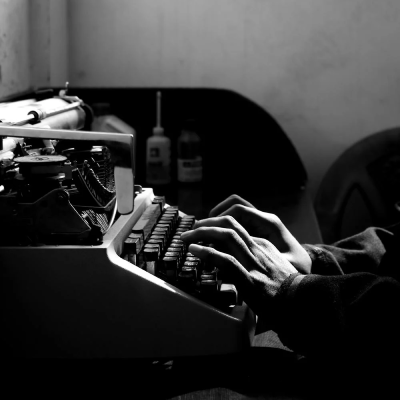
photo via Pexels

.
Monologue of a Broken Cassette
by Fendy Tulodo
.
…..I learned something strange about silence once. Not the kind that settles in between conversations when two people have nothing to say, not the kind that wraps around you in an empty house when the fridge hums and the walls breathe. No, this was a different kind. The kind that comes when music stops at the wrong time—when a note is supposed to land, but it doesn’t. When a song is supposed to carry you, but it dies midair, falling into some invisible crack where all unfinished melodies go to be forgotten.
…..It happened when I was ten, sitting on the cold tile floor of my parents’ house, rewinding a cassette tape of an old Indonesian pop song I barely understood but played over and over because the melody felt like something I needed. The tape player clicked and whirred, the spools tightening as it crawled backward, and then—I pressed play. But instead of music, instead of the familiar warble of a voice I had come to know like a distant friend, there was nothing. Just a low, gasping whine before the tape gave out completely.
…..That was the first time I understood something could disappear while you were still holding it.
…..Later, much later, I’d feel that same silence in other places. In the breath before my father answered a question he didn’t want to, in the space between my mother’s words when she was tired. In the way a song I was making on Cubase would sometimes sound perfect in my head but refuse to exist in reality. In the way an idea—so whole and electric in my mind—could crumble into static when I tried to shape it into something others could hear.
…..It wasn’t about music, really. It was about how some things lived inside you but couldn’t survive outside.
…..I think that’s why I started producing songs alone, late at night, when Hera and Chan were asleep, when the world forgot to ask me for anything. In those hours, I could let the sounds stretch and breathe, free from expectation. I wasn’t playing for anyone, wasn’t thinking about mixing levels or how a bassline would land in a Spotify algorithm. I was just chasing something—some shape, some moment before it slipped through my fingers.
…..Some nights, I’d get close. I’d build a track, layer by layer, each note folding into the next like something inevitable. And then, just as I felt it forming into the thing I had heard in my head—just as I felt the music becoming alive—I’d freeze. Because what if I wasn’t hearing it right? What if, when I finally finished it, it wasn’t what I thought it would be? What if it was just another broken cassette, another unfinished song, another silence waiting to happen?
…..I wonder, sometimes, if this fear belongs only to musicians. If painters feel it when they hesitate before the final brushstroke. If writers feel it when they stop just before the last sentence. If anyone who tries to make something real feels it—that moment when they hold their breath, waiting to see if what they’ve made will stand or if it will collapse into nothing.
…..I remember my first time in a real studio. Not the kind where you make music on a laptop in the corner of a bedroom, but a real, padded-room, control-booth, expensive-equipment kind of studio. I had saved up for months just to rent an hour in that space, convinced that if I had the right tools, the right environment, maybe the sounds in my head would finally come out the way I wanted them to.
…..I walked in with a melody I had been working on for weeks, one I was sure would be my best yet. The producer—a guy who looked like he had been doing this forever, with the casual indifference of someone who had seen a hundred musicians just like me—nodded as I played him the rough demo. “Alright,” he said, spinning his chair towards the console, fingers already moving over the dials, “let’s see what we can do.”
…..And for a moment, it felt real. The way the track came alive in the speakers, the way the sound wrapped around me, the way it felt like I had finally brought something into existence that couldn’t disappear.
…..Then he turned to me and said, “It’s good, but it’s missing something.”
…..I didn’t know what he meant. I still don’t.
…..We spent the rest of the session tweaking things, layering instruments, adding effects. But by the time my hour was up, I couldn’t even recognize the song anymore. It wasn’t bad. It just wasn’t mine. It was as if, in trying to make it better, I had erased the thing that made it matter to me in the first place.
…..I left the studio with a USB drive full of polished, professional, high-quality tracks and an empty feeling in my chest. I didn’t listen to them for weeks.
…..Maybe that’s the real fear—not that something will disappear, but that it will stay and you won’t recognize it anymore. That in trying to perfect it, you will lose whatever it was that made it yours.
…..I still think about that first studio session whenever I work on a new song. I still hesitate before I finish a track, still worry that the final version will betray the one I first heard in my head. But sometimes, late at night, when everyone else is asleep and it’s just me and the sound, I let myself believe that maybe, just maybe, I can hold onto it.
…..At least for a little while.
…..There’s something about unfinished songs that haunts me. They linger in the back of my head like ghosts, half-formed and restless, waiting for something—some missing note, some perfect moment—to complete them. But that moment never comes. So they stay trapped, looping endlessly in my mind, teasing me with what they could be but never are.
…..I’ve lost count of how many tracks I’ve abandoned. Some are just half a melody hummed into my phone at a red light, some are full instrumentals that I spent nights perfecting but never dared to release. Others exist only as fragments—one verse, one chord progression, one bassline that once felt like the start of something great but now just sits there, unfinished, gathering dust in my hard drive like an old cassette with a snapped ribbon.
…..Hera once asked me why I never finish my songs. We were sitting on the living room floor, Chan asleep in the next room, my laptop open between us. She had been reading something on her phone, some article about creativity or productivity or whatever it is people read when they’re trying to understand the people they love. “You start so many,” she said, scrolling through my folder of unfinished projects, “but you never finish them. Why?”
…..I didn’t know what to say. How do you explain to someone that sometimes, finishing something feels like killing it? That as long as a song is unfinished, it can still be perfect. It can still be whatever you imagine it to be. But the moment you call it done, the moment you let it go—it becomes real. It becomes flawed. It becomes something people can judge.
…..“I just haven’t found the right sound yet,” I said, closing the laptop before she could press play on anything. It wasn’t a lie, but it wasn’t the whole truth either.
…..The real truth is, I’m afraid of that silence. The one that comes after. The moment when the music stops, when the song is over, when there’s nothing left to tweak or adjust. Because what then? What if it’s not good enough? What if I listen to it a month later and realize I hate it? What if it never means as much to anyone else as it does to me?
…..I used to think this was just a music thing. That it was just me being too much of a perfectionist, too scared of making something that wasn’t perfect. But the more I think about it, the more I realize it’s not just music. It’s life.
…..I think about my father, the way he used to hesitate before answering questions, the way he would start stories and then stop halfway through, like he was deciding whether or not it was worth finishing. He was a police officer—strict, disciplined, always measuring his words like they were evidence in a case he hadn’t solved yet.
…..I remember once, when I was twelve, I asked him if he ever regretted anything. We were sitting on the porch, the night air thick with the smell of damp earth and distant cigarettes. He had just gotten home from work, his uniform still stiff, his face tired. He looked at me for a long time before answering.
…..“Regret comes from unfinished business,” he said finally, lighting a cigarette and exhaling slow. “From things you should’ve done but didn’t. From words you should’ve said but never did.”
…..I didn’t understand what he meant at the time. But now, years later, as I sit in front of my computer, staring at another unfinished track, I think I do.
…..It’s not just about music. It’s about everything. About conversations left hanging, about friendships that fade without a real goodbye, about dreams you tell yourself you’ll chase but never do. About all the things we leave unfinished because we’re too scared to know what they’ll be when they’re done.
…..And yet, sometimes, things finish whether we want them to or not.
…..Like the time I played one of my unfinished tracks for a friend. It was a simple beat, just a rough demo, something I had been messing around with at 2 AM, half-asleep. I wasn’t even sure if I liked it. But he heard it and nodded, eyes closed, letting the rhythm sink into him.
…..“This is it,” he said, pointing at the screen. “This is the one.”
…..I laughed. “It’s not even finished.”
…..“It doesn’t need to be,” he said. “It already is.”
…..I didn’t know how to respond to that. Because to me, it wasn’t done. It wasn’t ready. It was missing something.
…..But he heard it differently. He heard it as whole.
…..Maybe that’s the trick. Maybe nothing is ever really finished. Maybe we’re all just working on our own songs, trying to find the right notes, but in the end, someone else will hear them differently. Maybe what we think is incomplete is already enough.
…..Or maybe that’s just something we tell ourselves so we can finally let go.
…..There’s an old cassette tape sitting on my shelf. I don’t even know why I keep it. The ribbon inside is tangled and warped, the plastic casing cracked along the edges. It doesn’t play anymore. If I try, all I get is a warbled mess of sound—melodies stretched thin, voices melting into static. But I can’t bring myself to throw it away.
…..It’s a mixtape my father made.
…..I don’t know when, exactly. Maybe before I was born. Maybe when he was still young, before the weight of responsibility settled into his bones, before he became the man I knew—the man with tired eyes and measured words. All I know is that it exists. A collection of songs he chose, recorded one by one, carefully rewinding and playing until he had them in the right order.
…..I used to play it when I was a kid, lying on the floor, staring at the ceiling, letting the music fill the empty spaces of my room. The songs weren’t ones I would’ve picked for myself. They were old, slow, filled with longing.
…..There was one track I remember more than the others. An Indonesian song, something from the ‘80s. “Aku masih seperti yang dulu, menunggumu sampai akhir hidupku…” (“I am still the same as before, waiting for you until the end of my life…”)— It played near the end of the tape, after a series of foreign rock ballads, and even though I didn’t understand the lyrics back then, I could feel something heavy in the way the singer’s voice stretched over the notes. A kind of sadness that didn’t need translation.
…..I never asked my father why he put that song on the tape. By the time I was old enough to be curious, we weren’t the kind of people who asked each other those things.
…..But I wonder about it now.
…..I wonder if that song meant something to him. If it was tied to a memory, a moment in time that he didn’t talk about. I wonder if, when he listened to it, he saw something I couldn’t—someone’s face, a place he used to be, a promise he made and never kept.
…..Maybe that’s why I keep the cassette. Not because I need it, not because I listen to it, but because it feels like a piece of him that I don’t fully understand yet.
…..Music does that to people. It holds things that words can’t.
…..I didn’t always want to be a musician.
…..For a long time, I thought I’d end up in business, something stable, something that made sense. I even studied Management at Airlangga University, telling myself it was the smart choice, the responsible one. But music kept pulling me back. Late nights spent layering sounds in Cubase, trying to turn emotions into frequencies. A stubborn need to make something—anything—that felt real.
…..At first, it was just a hobby. Something I did on the side, in between work, in between life. But the more I made, the more I realized that music was the only thing that let me say what I really meant. That somehow, a melody could express what I struggled to put into words.
…..I started releasing my own songs, just small things, digital tracks floating in the vastness of the internet. No big label, no expectations—just me, a laptop, and a quiet hope that someone, somewhere, might hear them and understand.
…..It’s funny. I don’t even know what I’m hoping people will understand.
…..Maybe it’s the feeling of being in between—between past and future, between certainty and regret. Maybe it’s the sound of unfinished things, of echoes that never fully fade.
…..Or maybe it’s just the simple fact that music, at its core, is never really about the person who makes it. It’s about the people who listen.
…..There’s a moment after a song ends that always gets to me. That brief silence before the next track begins. It’s like the world pauses for half a second, holding its breath, waiting to see what comes next.
…..I think about that a lot.
…..About how life is filled with those in-between moments. About how we’re all just waiting for the next thing to start, filling the silence however we can.
…..I don’t know if I’ll ever finish all the songs I’ve started. Maybe they’ll stay as they are—fragments, echoes, pieces of something that almost was.
…..But maybe that’s okay.
…..Maybe some things aren’t meant to be finished. Maybe they’re meant to linger, to keep playing in the background of our minds, reminding us of the things we still have left to say.
…..Or maybe, just maybe, they’re already enough.
.
.
___
.
.
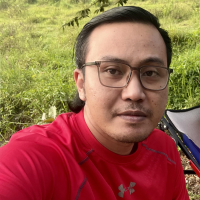
Fendy Satria Tulodo is a writer and storyteller with a keen interest in the intersection of language, memory, and sound. His writing delves into the nuances of human emotion, often weaving lyrical prose with rich, introspective narratives. Beyond the written word, he is also a musician and songwriter, releasing music under the name Nep Kid. Drawing inspiration from a wide range of genres, he explores the rhythm of thought and the resonance of untold stories, whether through literature or music.
.
.
.
.
___
.
.
Click here to read other essays published on Jerry Jazz Musician
Click here to read The Sunday Poem
Click here for information about how to submit your poetry or short fiction
Click here to subscribe to the (free) Jerry Jazz Musician quarterly newsletter
Click here to help support the ongoing publication of Jerry Jazz Musician, and to keep it commercial-free (thank you!)
.
.
___
.
.

Jerry Jazz Musician…human produced (and AI-free) since 1999
.
.
.