
“Memories of Ray” — a true jazz story by Alan Swyer

October 21st, 2022

.

.


photo courtesy Alan Swyer
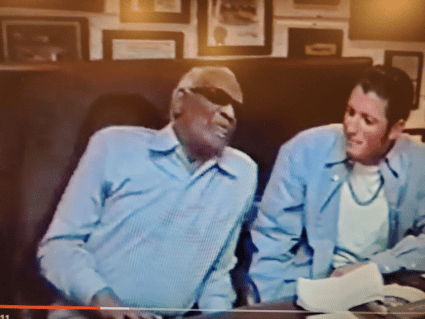
Ray Charles being interviewed by Jonas Swyer; Spring, 2000

.

.

___

.

.


…..For several years, Ray Charles and I had a running joke.  In the midst of a conversation about some other topic, he would suddenly shift gears and try to put me on the spot.  “How come you never ask for shit?” he would ask.

…..“What could I possibly want?” I would reply.

…..“How about CD’s?”

…..“Who do you think wrote introduction for a bunch of reissues?” I would counter.  “And was a producer on the Love Songs compilation.”

…..“What about tickets?”

…..“To see you playing with a bunch of guys reading music?”

…..Invariably, Ray would sigh.  “One of these days you gotta ask.”

…..That happened on a February morning when I placed a call to him.  “I’m asking,” I said.

…..My older son, who at that point was a senior in high school, was taking a course on the Sixties, for which each student had to do a project about someone meaningful in that decade.  Not eager to do a research paper, Jonas asked me what he could do that might be more fun, interesting, and lively.  When I suggested that he interview someone he’d gotten to know through me, he immediately asked if it could be Ray.

…..Once I explained the situation to Ray, he playfully protested.  “I wasn’t just important in the Sixties.”

…..“But you were important then.”

…..“Okay,” said Ray.  “But I’m doing it for him, not just for his dad.”

…..“And if I film it?”

…..“Don’t fuck it up!” replied Ray with his inimitable cackle.  “Just tell me when.”

.

…..My friendship with Ray began when I was approached about writing something about him.  Though both flattered and thrilled, I nevertheless insisted on two conditions.  First, I wanted to be able to tell the truth.  Second, I wanted serious access to Ray.  That led to two lengthy meetings with his manager, Joe Adams, who vetted and grilled me before setting up a face-to-face with the man I’d longed hope to meet.

…..“I hear you know your shit,” Ray said once the two of us were alone.  “Name three acts no one wanted to follow way back when.”

…..“Guitar Slim,” I began.

…..“Bopping through the audience with that giant cord,” said Ray approvingly.  “Who else?”

…..“Joe Tex.”

…..“With those microphone tricks James Brown and everybody copped from him,” acknowledged Ray.  “And third?”

…..“A dancing bear.”

…..A look of disbelief spread on Ray’s face, then he started laughing so hard he nearly fell out of his chair.

…..“We’re gonna get on fine,” Ray announced.

.

…..We got on better than fine.  In addition to responding to questions about both his life and his work, Ray was always curious to know what I was hearing from others –  past and present – who had been part of his life.  He was amazed I’d tracked down Gosady McGee, the guitarist in his first group, the Maxim Trio, who wound up marrying Mama from “Amos & Andy.”  He was stunned that I’d found Alexandra Brown, whose first gig as a Raelette was at a benefit concert for Martin Luther King that yielded a face-off between the National Guard and the KKK.  And he was delighted to learn I’d spent time with Sid Feller, who produced Ray’s duet album with Betty Carter.

…..Though Ray and I had reached the point where we could joke with each other and do some teasing, in truth we were what I would call friendly, without quite being friends.  That changed, however, when Ray mentioned hearing that my wife was a good cook.  “Not good,” I corrected.  “Excellent.”

…..“So how come you never invite me?”

…..Immediately a dinner was scheduled.  But the night before, he called to say that his one remaining “Auntie” was ill, so he was getting on a plane for Florida.

…..Upon his return, a second date was chosen.  But that, too, was scratched when Ray announced apologetically that he had a conflict.

…..“You know baseball,” I told Ray once a third date was selected.  “Three strikes and you’re out.”

…..“Hell or high water, I’ll be there,” Ray assured me.

…..Still, when the big day arrived, I received an early call from Joe Adams.  “Just want to let you know,” he stated, “Ray won’t be there this evening.”

…..“Are you calling on Ray’s behalf?” I inquired.  “Or to warn me?”

…..“I’m saying he’ll find an excuse.”

…..“Why would he do that?”

…..“Because he doesn’t eat in public.”

…..“But we’re not public.  Want to bet he’ll come?”

…..“How much?”

…..“Lunch anywhere in town.”

…..“Dinner, motherfucker,” said Joe gleefully.  “An expensive one, with our wives.”

…..Hanging up, I promptly called Ray.  “Joe Adams says you won’t be showing up tonight.”

…..“Fuck him!” shouted Ray.

…..After we discussed a menu, I asked Ray what he’d like to drink.  “Now you’re in trouble,” Ray said with a laugh.  “Dom Perignon.”

…..I brought home a magnum, which Ray proudly opened.

…..“To good friends?” he asked while raising his glass to toast.

…..“And two birthdays!” I added, pointing out that it was September 24th, the day after Ray’s birthday, and two days before my son’s.

…..“Let’s make this a tradition,” Ray insisted

…..That’s what it became.

.

…..I sent a one-word email to Ray two days after our conversation about the proposed interview: “When.”

…..I I immediately received a day and time.

…..Though Jonas was excited, I insisted he calm down.  This was something, I explained, that he couldn’t simply wing.  Given the number of interviews Ray had been subjected to throughout his career, serious preparation was needed.

…..Together the two of us had several chats.  Then, on the designated morning, off we drove to Ray’s office.

…..After hugs were exchanged, Ray put Jonas at ease by saying he had more confidence in him as an interviewer than in me as a cameraman.

…..Ray beamed as Jonas introduced one provocative topic after another.  First was the daring that resulted in the breadth of Ray’s musical ambitions:  Blues, R&B, Country, Soul, Show Tunes like “Oh! What A Beautiful Morning,” and even “America.”  Next, how the man known as “The Genius” came to own his own masters.  Then, a series of questions about Ray’s involvement with Martin Luther King.

…..Again and again, Ray offered praise.  “Those are some great questions,” he said at one point.  “People ask me the same stuff over and over,” he said later, “but you’re making it fun.”  Then later he announced,  “Gimme some skin!”

…..When one of his staffers opened the door mid-interview, Ray waved her off.  “Can’t you see I’m doing something important?” he growled.

…..After more hugs, plus a promise to get together in September for yet another joint birthday dinner, Jonas and I climbed into my car.

…..“That was amazing!” Jonas gushed.  “I don’t even know what to compare it to.”

…..“Since you’re a baseball guy,” I said, “you just interviewed Babe Ruth.”

…..Jonas nodded and smiled.  “I can’t wait to bring this to school tomorrow.”

…..“You can’t,” I said.

…..“W-why not?” asked Jonas, crestfallen.

…..“Because the teacher will want to keep it.  First I’ll make some dubs.”

.

…..In the weeks that followed, I searched for a way to express my gratitude above and beyond simply saying thanks.  An opportunity presented itself when I got a call from the promoter of the Chicago Blues Festival.

…..“I’d like to book Ray as the headliner,” Barry Dollens began.

…..“So what’s the problem?”

…..“Can we talk off the record?”

…..When I said yes, he mentioned that as much as he respected Ray, he didn’t want to put him on-stage with a bunch of guys reading music.  So, he wanted to know, was there any way to make the evening special?

…..“How about if we reunite him with the guys from the great band who are still active, but not with him?” I suggested.

…..Barry instantly asked who I had in mind, allowing me to name Hank Crawford, David “Fathead” Newman, Leroy Cooper, Marcus Belgrave, and Phil Guilbeau.

…..“Great idea!” gushed Barry.  “How can I get ’em?”

…..“I’ll help,” I said, “if you’ll pay them real money.”

.

…..Thrilled, Ray insisted that I fly to Chicago on the redeye with him and Joe Adams.  Dumping our bags at two different hotels – I chose to stay at the same place as the musicians and Raelettes rather than with Ray and Joe – we drove to the festival site for a run-through.

…..People walking through the park that morning got to hear the greatest Ray Charles performance in ages.  Then I got a hoot of joy from Ray when, midway through the rehearsal, I surprised him by having my friend Mable John, who had once been the lead Raelette, join the current version.

…..Though excellent, the evening show lacked a little of the freshness of the run-through, compounded by the fact that some old grudges started resurfacing.

.

…..Sadly, the joint birthday celebrations came to an end when Ray got sick.  Though he told me that he would bounce back, just as he’d overcome adversity in the past, that was not the case.

…..Not long after, our wonderful times together came to a definitive end.  My wife, son, and I were flattered to be invited to Ray’s funeral, which, amidst the sadness, featured moving performances by B.B. King, Willie Nelson, and Stevie Wonder.

.

…..Though we cherished the memories, plus of course Ray’s music, the interview my son did with Ray inevitably was largely forgotten over the decades that followed.  That changed twenty-two years later when, over lunch with the curator of the Rock & Roll Hall of Fame, I was asked if I had something that could be used in an exhibit about Ray that was in preparation.

…..A search party yielded the one remaining DVD, which proved that despite Ray’s teasing, I hadn’t botched the camerawork.

…..Best of all, beyond being wonderfully informative, it was imbued with a warmth toward my son that Ray rarely ever displayed in public.

.

.

___

.

.

Alan Swyer is an award-winning filmmaker whose recent documentaries have dealt with Eastern spirituality in the Western world, the criminal justice system, diabetes, boxing, and singer Billy Vera. In the realm of music, among his productions is an album of Ray Charles love songs. His novel ‘The Beard’ was recently published by Harvard Square Editions.

.

.

Listen to the 1958 recording of Ray Charles performing “Tell Me How Do You Feel” [Rhino/Atlantic]

.

.

___

.

.

Click here  to learn how to submit your own True Jazz Story

Click here  to subscribe to the Jerry Jazz Musician  newsletter

.

.

.

 

Share this:

One comments on ““Memories of Ray” — a true jazz story by Alan Swyer”

Comment on this article:

Your email address will not be published. Required fields are marked *

Site Archive

Your Support is Appreciated

Jerry Jazz Musician has been commercial-free since its inception in 1999. Your generous donation helps it remain that way. Thanks very much for your kind consideration.

Click here to read about plans for the future of Jerry Jazz Musician.

In this Issue

Announcing the publication of Volume II of Kinds of Cool: An Interactive Collection of Jazz Poetry...The second edition of Kinds of Cool, an Interactive Collection of Jazz Poetry has just been published, and is now available for sale on Amazon.com. This edition is dedicated to publishing women poets from all over the world who share their personal passion for and relationship with jazz music, and the culture it interacts with. With a foreword by Allison Miller, one of the world’s most eminent jazz drummers, and photography and design by Rhonda R. Dorsett

Poetry

photo by William Gottlieb/adapted by Rhonda R. Dorsett
21 jazz poems on the 21st of April, 2026...An ongoing series designed to share the quality of jazz poetry continuously submitted to Jerry Jazz Musician. In this edition…Mix in poems on the blues with some Coltrane, Monk, Bix, Mingus, Miles, Art Farmer, King Oliver, Desmond, and Brubeck, and you have one hell-of-a lively and entertaining collection to take in. Enjoy!

Community

A collection of poetic responses to the events of 2025...Forty poets describe their experiences with the tumultuous events of 2025, resulting in a remarkable collection of work made up of writers who may differ on what inspired them to participate, but who universally share a desire for their voice to be heard amid a changing America.

The Sunday Poem

photo by Duncan Light/via Pexels

The Sunday Poem: Three poems on Mother’s Day

The Sunday Poem is published weekly, and strives to include the poet reading their work...

Readings of the poems by Daniel Warren Brown, Erren Kelly, and Michael L. Newell can be heard at their conclusion.


Click here to read previous editions of The Sunday Poem

Short Fiction

Photo by Johannes Schröter, via Pexels
Short Fiction Contest-winning story #71 – “Where the Music Wasn’t Allowed,” by Jane McCarthy....The award-winning story is about a young immigrant growing up in Southern California to the sound of music seeping into his family’s home from an upstairs neighbor’s piano, shaping the boy’s understanding of memory, family, belonging, and the improvisational ethics of music.

Interview

photo by Warren Fowler
Interview with John Gennari, author of The Jazz Barn: Music Inn, the Berkshires, and the Place of Jazz in American Life...The author discusses how in the 1950s the Berkshires – historic home to the likes of Hawthorne, Melville, Wharton, Rockwell, and Tanglewood – became a crucial space for the performance, study, and mainstreaming of jazz, and eventually an epicenter of the genre’s avant-garde.

Poetry

photo by Tsutumu Takasu/via Flicker/CC BY 2.0
“Cajun Glory” – a prose poem by Robert Alan Felt

Community

Ricky Esquivel/Pexels.com
Community Bookshelf #6...“Community Bookshelf” is a twice-yearly space where writers who have been published on Jerry Jazz Musician can share news about their recently authored books and/or recordings. This edition includes information about books published within the last six months or so (September, 2025 – March, 2026)

Poetry

Six poets write eight poems (in the midst of our times)...Poets within this community of writers are feeling this moment in time, and writing about it. This collection is another example.

Feature

photo by Laura Stanley via Pexels.com.
Trading Fours, with Douglas Cole, No. 28: “Little Samba”...Trading Fours with Douglas Cole is an occasional series of the writer’s poetic interpretations of jazz recordings and film. This edition is based largely on a documentary – They Shot the Piano Player – about Tenório Junior, a Latin jazz musician who only produced one album (1964) before he “disappeared” in 1976.

Short Fiction

photo J. & L. Caswall Smith
“Bitty’s Last Request” – a short story by Jill Bronfman...In the story – a finalist in the recently concluded 71st Short Fiction Contest – a very old dancer visits her young relative with stories to tell about the old days in the clubs.

Poetry

art by Marsha Hammel
“Learning the Alphabet of the Blues” – a poem by Mary K O’Melveny...A poem from Kinds of Cool: An Interactive Collection of Jazz Poetry, Vol. II

Feature

photo via Wikimedia Commons
Memorable Quotes: Two, by Edward R. Murrow…

Feature

photo via Wikipedia
“Two Famous Johns” – a true jazz story by Bob Hecht...The writer remembers an evening in New York’s Half Note in 1964 when he witnessed a John Coltrane performance that was also attended by the pop singer Johnny Mathis

Poetry

Haiku: Musings – by Connie Johnson...Exploring segments of the world of jazz – in three suites of vivid haiku poetry…

Jazz History Quiz

photo of "Hot Lips" Page by William Gottlieb
Jazz History Quiz #187...This trumpeter began his career in California, where he organized a big band that had a residency in China in 1934, and, during a trip through Kansas City in 1936, was invited to join Count Basie’s orchestra, replacing “Hot Lips” Page (pictured). Who is he?

Feature

“Bohemian Spirit” – A Remembrance of 1970’s Venice Beach, by Daniel Miltz...The writer recalls 1970’s Venice Beach, where creatives chased a kind of freedom that didn’t fit inside four walls…

Poetry

Linnaea Mallette/publicdomainpictures.net
A 2026 jazz poetry calendar...12 individual poets contribute a jazz-themed poem dedicated to a particular month, resulting in a 2026 calendar of jazz poetry that winds through the year with a variety of poetic styles and voices who share their journeys with the music, tying it into the month they were tasked to interpret. Along the way you will encounter the likes of Sonny Stitt, Charles Mingus, Jaco Pastorius, Wynton Kelly, John Coltrane, and Nina Simone.

Feature

Boris Yaro, CC BY 4.0, via Wikimedia Commons
“The Bowie Summer” – a personal memory, and how art can fundamentally reshape identity, by G.D. Newton-Wade

Short Fiction

photo by Iryna Olar/pexels.com 
“The Fading” – a short story by Noah Wilson...The story – a finalist in the recently concluded 70th Short Fiction Contest – examines the impact of genetic illness on a family of musicians and artists.

Poetry

Poems on Charlie “Bird” Parker (inspired by a painting by Al Summ) – an ekphrastic poetry collection...A collection of 25 poems inspired by the painting of Charlie Parker by the artist Al Summ.

Short Fiction

Los Angeles Daily News, CC BY 4.0 , via Wikimedia Commons
“The Pet Shop” – a short story by Sherry Shahan...The story – a finalist in the recently concluded 70th Short Fiction Contest, – is about an octogenarian couple who accept a part-time caretaker position at Crazy Goose Burlesque when the theater is temporarily shuttered due to archaic public indecency laws.

Feature

Albert Ayler’s Spiritual Unity – A Classic of Our Time, and for All Time – an essay by Peter Valente...On the essence of Albert Ayler’s now classic 1964 album…

Poetry

Laura Manchinu (aka La Manchù), CC BY 2.0 , via Wikimedia Commons
“Ron Carter Apple Sauce” – a prose poem by Martin Durkin

A Letter from the Publisher

The gate at Buchenwald. Photo by Rhonda R Dorsett
War. Remembrance. Walls.
The High Price of Authoritarianism– by editor/publisher Joe Maita
...An essay inspired by my recent experiences witnessing the ceremonies commemorating the 80th anniversary of liberation of several World War II concentration camps in Germany.

Playlist

photo by Robert Hecht
“Spring is Here!” – a playlist by Bob Hecht...With perhaps Lorenz Hart’s most sardonic lyric — which is saying something! — this song remains one of the greats, and has been interpreted in many ways, from the plaintive and melancholy to the upbeat and hard swinging, such as John Coltrane’s version. Check out this bouquet of ten tracks to celebrate this great season!

Poetry

Wikimedia Commons
“Dorothy Parker, an Icon of the Jazz Age” – a poem by Jane McCarthy

Community

Nominations for the Pushcart Prize L (50)...Announcing the six writers nominated for the Pushcart Prize v. L (50), whose work appeared on the web pages of Jerry Jazz Musician or within print anthologies I edited during 2025.

Interview

Interview with Tad Richards, author of Listening to Prestige: Chronicling its Classic Jazz Recordings, 1949 – 1972...Richards discusses his book – a long overdue history of Prestige Records that draws readers into stories involving its visionary founder Bob Weinstock, the classic recording sessions he assembled, and the brilliant jazz musicians whose work on Prestige helped shape the direction of post-war music.

Contributing Writers

Click the image to view the writers, poets and artists whose work has been published on Jerry Jazz Musician, and find links to their work

Coming Soon

An interview with Paul Alexander, author of Bitter Crop: The Heartache and Triumph of Billie Holiday's Last Year; New poetry collections, Jazz History Quiz, and lots of short fiction; poetry; photography; interviews; playlists; and much more in the works...

Interview Archive

Ella Fitzgerald/IISG, CC BY-SA 2.0 , via Wikimedia Commons
Click to view the complete 25-year archive of Jerry Jazz Musician interviews, including those recently published with Judith Tick on Ella Fitzgerald (pictured),; Laura Flam and Emily Sieu Liebowitz on the Girl Groups of the 60's; Tad Richards on Small Group Swing; Stephanie Stein Crease on Chick Webb; Brent Hayes Edwards on Henry Threadgill; Richard Koloda on Albert Ayler; Glenn Mott on Stanley Crouch; Richard Carlin and Ken Bloom on Eubie Blake; Richard Brent Turner on jazz and Islam; Alyn Shipton on the art of jazz; Shawn Levy on the original queens of standup comedy; Travis Atria on the expatriate trumpeter Arthur Briggs; Kitt Shapiro on her life with her mother, Eartha Kitt; Will Friedwald on Nat King Cole; Wayne Enstice on the drummer Dottie Dodgion; the drummer Joe La Barbera on Bill Evans; Philip Clark on Dave Brubeck; Nicholas Buccola on James Baldwin and William F. Buckley; Ricky Riccardi on Louis Armstrong; Dan Morgenstern and Christian Sands on Erroll Garner; Maria Golia on Ornette Coleman.