



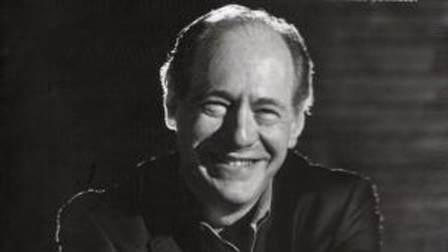
Gary Giddins,
author of
Bing Crosby: A Pocketful of Dreams
When Gary Giddins, the jazz critic and columnist for the Village Voice, began work on an in-depth biography of Bing Crosby, many asked him, “Why?” He has explained that Crosby, perhaps the most famous entertainer in America between 1927 and 1956, has been unjustly forgotten since his death in 1977.
His career statistics are astounding: nearly 400 records on the charts from 1927 to 1962, including 38 number-one singles. “White Christmas” remains the most popular record of all time. For five years he was Hollywood’s top box-office attraction and he ranked among the most popular movie stars 15 times. Yet today his records are little known, the majority of his films rarely seen.
Giddins’ book, Bing Crosby: A Pocketful of Dreams, The Early Years 1903-1940, aims to restore his reputation. A second volume will cover the remainder of Crosby¹s career.
Paul Morris conducted our exclusive Jerry Jazz Musician with Giddins in March, 2001.
*
*All photographs are courtesy of the Gary Giddins Collection, and appear in the book, Bing Crosby: A Pocketful of Dreams . They are published as part of this interview with the written permission of the publisher, Little, Brown and Company.
Bing Crosby, 1940
JJM To start early in Crosby’s career, I thought your treatment of minstrelsy was interesting. You describe its tradition in American show business and its effect on Crosby and other entertainers, both white and black. You write, “The minstrel show was the first unifying form of entertainment America ever knew.”
GG It was a very codified kind of entertainment. The individuality was completely suppressed by the mask of minstrelsy. All minstrel troops basically looked alike – they were all wearing the same costume – the black face, the wig, the white gloves, the holding the banjos. They all had the same format – “Mr. Interlocutor,” the two end-men jokesters, the olio (variety show), the solo tenor player, the skits, the same songs. Minstrel troupes, which traveled all over the United States, came to basically every town, bringing the same talent and the same jokes, year after year, to all parts of the country.
So anybody growing up during that period would have in common certain songs by Stephen Foster the same way that anyone growing up during this last century had in common songs we heard on the radio. If you were born in 1945, 1950, 1955 or 1960, you have everybody in that generation’s collective memory songs that we all have heard when we were 13 or 14 years old. They become our oldies and get marketed to us as we get older. Thirty years ago on late night television, people approaching their 70’s were being sold all the great songs of World War II, and then later on it became the teen hits from the 1950’s. Now, I see them selling the “great songs of the 70’s.” They market us from womb to tomb; they never let us go.
But even in the 19th century, when it was much slower, people who were born in 1860 and 1870 did not have different memory banks of pop songs; they had basically the same memory bank. Those songs were spread around the country, not through the technology of juke boxes and radio, but through these minstrel shows because there were so many of them. There were hundreds of them, and they all did the same material everywhere in the country. Incidentally, they were equal opportunity offensive. It wasn’t just blacks – they went after every minority. They were merciless about the Irish, the Jews, the Germans, the Dutch – you name it.
JJM After reading your book, I am finding minstrelsy everywhere.
GG Yes, you really do find it everywhere. It is still very much alive, I’m sorry to say.
JJM The stage patter that performers used in the 30’s and 40’s, or in Las Vegas in the 50’s, seems to owe a lot to minstrelsy.
GG If you remember Johnny Carson, for years and years he used to do a kind of a “Kingfish,” routine, which was part of his patter. He would get into that “Well, you know-a, we-a,” and that whole thing. Dean Martin used to do it. You can’t get away from it, and what I was surprised to discover was how many minstrel movies were made in the 1940’s when there was a real revival of it.
JJM In the 40’s?
GG Yes. There were so many blackface pictures. Mickey Rooney does blackface. Judy Garland does blackface. Crosby did it. Hope did it. Donald O’Connor – it’s just unbelievable. Jack Benny and Fred Allen did a minstrel routine. Al Jolson had his big comeback in 1946 and 1947. By that time – this is hard to tell black people – it had really nothing to do with race. From what I could tell, from all the interviews I did, it was no longer an issue of race. It was just an old show biz convention, and that was the way they justified it to themselves, because they all grew up on the minstrel jokes, the minstrel songs, the minstrel routines.
It’s a very complicated issue. I know a number of black performers, like Bobby Short, for example, who collect minstrel artifacts, who are just fascinated by it. Much the way I know a number of Jewish scholars who collect anti-Semitic nonsense from the Nazis in the 20’s and 30’s because it’s sort of fascinating if you’re the victim and you’re seeing the way other people perceive you. But minstrelsy is complicated also because, as I explained in the book, the abolitionists were totally pro-minstrelsy. They felt it helped their cause, because most white people around the country had never seen a black person, and from looking at those stereotypes and thinking, “Gee, black people are morons,” they looked at them and said, “Black people are human – how could they be enslaved?”
JJM It had a humanizing effect.
GG Exactly. Donald O’Connor was very adamant about this. I found him to be a very appealing character. He said, “Look, none of us would have been doing this if we thought it was racist. We thought we were playing parts.”
JJM I think a lot of jazz listeners first realized there was more to Bing Crosby than “White Christmas” when they heard his records such as Mississippi Mud and “I’m Coming, Virginia” with the Paul Whiteman band that included Bix Beiderbecke. How did this style or version of Bing Crosby hit American listeners in the late 20’s?
GG The few people who were really following jazz were astonished by it. I quote Alistaire Cooke in the book. Over in England there was a word out that there was this new great jazz singer and he was white, for heaven’s sake! Nobody could believe it. Crosby, really, is the first jazz singer (outside of blues people like Bessie Smith and theatrical performers like Ethel Waters) who sang jazz, but also sang the pop tunes of the day. This includes Louis Armstrong, for example. He started out singing Bing’s early hits.
The main thing is that he was the first white singer that really “got” the notion of time, spontaneity, swing – and he had all of that in his music. A lot of people think his approach to swing, since it’s so much a two-beat rhythm as opposed to Armstrong’s four-beat rhythm, seems dated. I think there’s some truth to that. Certainly, jazz singing did not go in that direction per se; it went more in Armstrong’s. But I also think that it has its own integrity. The best of his jazz records hold up wonderfully. I think Some of These Days, from 1932, is quite simply one of the great jazz recordings of that period, and Crosby’s solo is by far the best on the record.
I think for young white kids who had been following jazz, and knew about Louis Armstrong and knew about Beiderbecke and Bessie Smith, Crosby was just one of their own, and was just as important to them as Beiderbecke was. Beiderbecke proved that it was possible for a white musician to play jazz without imitating black players. He was influenced by them without actually imitating them. Crosby was the same. He never attempted to have a blues voice, or a black voice – he never did any of that. He always adapted what he had learned from Armstrong and from jazz into his own style, which was just as much influenced by Jolson and John McCormack and so many others.
JJM I was amazed too when I first heard those records, because I am from Eastern Washington, and to hear a guy from Spokane who’s that good
GG That’s one of the incredible things about Crosby. In a way, he is so provincial. The guy never left Spokane until he was 22 years old and in a sense he always remained a kind of a homebody. He didn’t go to Europe until 1944. I find that just amazing! Never had the desire. After that he became a world traveler, especially in the 50’s and 60’s, but for the most part he created his world around wherever he was-his home.
That provincialism also is a governing factor in the way he controls his whole life. He is not intimidated. Like Armstrong, he doesn’t look down at anybody, but he doesn’t look up to anybody. They are completely self assured, completely know who they are.
There is a kind of hometown American resilience that runs through Crosby that I think the rest of the country identified with, yet at the same time there is this kind of genius where he hears music that is coming into Spokane through recordings, primarily heard on the radio, and he completely identifies with it and makes it his own.
JJM You’ve written that the modern style of American popular singing was originated by four performers: Bessie Smith, Ethel Waters, Armstrong and Crosby. The first three made appearances in Ken Burns’ jazz documentary. Why not Crosby?
GG Well, you know, now we are getting to “Why did I have to write this book?” It’s all part of “why is Crosby so forgotten?” When Ken’s people interviewed me, you can bet I spoke about Crosby. In fact, some of what I said about Whiteman ended up in the narration, but everything about Crosby ended up on the cutting room floor. I think the basic answer to the question is, “Why is there no Dinah Washington? Why is there no Errol Garner? Why is there no Albert Ayler, George Russell, Pee Wee Russell”, on and on and on. It’s not the encyclopedia of jazz, it’s the story about the rise of jazz, told through a handful of major figures.
I would like to think that if Ken were making the film now, or five years from now, that he would not overlook Crosby. I hope that the book will have that kind of an impact, that people will go back and that his rightful place will be reclaimed, but I think that several years ago, Crosby was still just off the map. Only jazz people knew about him. Jazz audiences themselves are very provincial in a way, and very arrogant, because we listen to a music that is “very inside” and off the beaten path.
Very often, audiences or at least critics and ardent followers completely give up on artists who make it into the mainstream, when they become popular. When I was a kid, I remember Stan Getz was always being attacked. Stan Getz, one of the greatest musicians music has ever produced, criticized simply because he had some big hits. This sort of thing is preposterous, and it certainly happened to Crosby, it happened to Sinatra, it happens to any kind of performer once they really cross over.
One of the things that critics do is re-investigate performers who have fallen off the map. People forget, but until T. S. Eliot wrote about John Donne nobody had read John Donne for a couple hundred years. Eliot published his essay, and then all of us had to read him in college.
I think that Crosby is a monumental figure. It’s amazing to me the degree to which he has been forgotten. On my book tour, I knew that people didn’t know all the statistics, and didn’t know how important he was, and they would be surprised to learn how admired he was in the jazz circles in the 20’s and 30’s and even into the 40’s. I wasn’t expecting the degree of ignorance about his entire career that I kept encountering. It really became a question of “Bing who?”
JJM Did you go to Spokane for your book tour?
GG I spent a wonderful day at Andy’s Book Store in Spokane. It’s a full square block and two stories. It’s amazing to find a store like that in Spokane. We had almost 200 people come out.
JJM Do they remember Crosby there?
GG They remember him there, but even in Spokane, even in the Northwest, in Seattle and Bellingham and other places, they did not know very much about him, and they did not know the story of the Crosby family. That surprised me. The first book ever written about the Crosby’s came out in 1914. Crosby’s paternal ancestors had been major pioneers in that area, and very well known. Even as late as the 1940’s you could routinely find magazine articles about the legendary Nathaniel Crosby. Even all that has been wiped out of history.
We don’t really honor our forebears in this country to the degree that we may think we do. It has come down to Washington and Lincoln for most people, and there is a lot of history that is worth reclaiming. Biographers and historians will be busy for a long time just revitalizing a history that is increasingly lost to us.
JJM You write in some depth about Louis Armstrong’s influence on Crosby’s singing and you have a number of good stories about their close relationship in show business. What was important for Crosby in what he learned from Armstrong?
GG Certainly the improvisation and the spontaneity and the scat singing. But I think even larger than that in some ways, you have to remember the first time that Bing saw Louis in Chicago in the fall of 1926, he had just come off a year in vaudeville, doing music and comedy. To hear music and comedy combined at the genius level of Armstrong was a revelation to him. Armstrong would play a solo and have everybody in the place in tears. Then he would put on a black frock coat and put glasses on the end of his nose and do the Reverend Satchelmouth parody and have everybody convulsed. This made an impression on Crosby, because Crosby immediately recognized that Armstrong was a genius, but he realized that the genius did not have to separate from the ability to entertain and to be funny, spontaneous, to really interact with the audience.
This is another thing, you know, the line Artie Shaw said to me that’s on the back of the book and has been quoted a lot, that Bing was “the first hip white person born in the United States.” It’s not just that he was the first person to get Armstrong rhythmically and musically, but he was one of the first people to really understand that you did not have to separate the magnanimity of Armstrong’s power as an entertainer from his genius as a musician. This is something that I talk about at great length in my book Satchmo, that especially white critics just could not handle this. They wanted him in an ivory tower, and they wanted it so that only they could appreciate his greatness. They didn’t want him singing pop songs. My argument was that Armstrong’s genius is every bit as evident in a record like “Love Walked In” as it is in “West End Blues.”
JJM Another influential musician was Eddie Lang. I think after reading your book, you don’t hear Crosby’s early records the same – Lang’s rhythmic drive is always there. How long was he with Crosby?
GG I think they met in either late ’26 or early ’27, when Bing got to New York with the Whiteman band. The jazz guys didn’t get into Whiteman’s band until after Bing. After a while he only worked with Lang on records and freelance assignment before Lang actually joined the orchestra. That would have been until 1932.
They had done “The Big Broadcast” together, and then Bing had a proviso put into his contract with Paramount, that every major film had to have a speaking part for Eddie. The next film would have been “College Humor.” Lang was nervous about his speaking role – he was really going to have lines – and he had a tonsillectomy, with the encouragement of Bing and everybody. [It resulted in Lang’s death.] Today, if he had died under those circumstances, his family would have had a multimillion-dollar lawsuit. There was no excuse for him to die; it was a complete screw-up on the operating table. He was murdered by incompetence, in my judgment. Of course, Bing never forgave himself because he encouraged Eddie to have this ordinarily harmless procedure.
JJM Your book includes a wealth of information about the history of technology behind popular entertainment in the 20th century. You wrote that Crosby was there at the right time to benefit from the introduction of the condenser microphone and electrical recording.
GG It’s one of those amazing parallelisms. While you have Bing and Al Rinker in their broken-down Model T, making their way from Spokane west to Seattle and south to L.A., at that very moment, the recording industry is switching from acoustic to electric. Local radio stations are being consumed by the first network. Warner Bros. buys the rights to the scientific research of the Vitaphone Company, which leads directly to sound films. All of these things are happening right then and Bing comes along and he is the ideal person to take advantage of it all.
The condenser microphone was much more friendly to baritones than to tenors, because the baritone is a voice that gets its power in nuance and subtlety in the middle and lower range. Bing had that kind of voice, and the microphone allowed the intimacy of those nuances to be projected. Not only that, but he understands that the microphone and that electricity paradoxically makes music more human rather than less human, because you don’t have to shout, you don’t have to ring the rafters. You can now sing in a normal tone of voice, and if you combine his style, which is intimate in part because he actually interpreted the meaning of the lyrics, something that virtually no one was doing then, if you combine that with the microphone, you get a certain erotic undercurrent in popular music that didn’t exist before, outside of the blues and certain regional kinds of music. I think Ethel Waters was extremely influential in this regard. She was the other great forgotten figure. Her vocal career pretty much ended by the late 1930’s, and her work does seem more dated, I think, than most of Crosby’s, though I admire her enormously.
JJM Your book, A Pocketful of Dreams, discusses Crosby’s repertoire in the 30’s. Could you talk about the question of whether his early greatness was killed by the commercialism of Decca Records?
GG I have mixed feelings about that. I think that where I fault Crosby most is the fact of how undiscriminating he was in the songs he allows himself to record. I find it fascinating that, while he allowed Jack Kapp to choose most of his songs to record, he insisted on choosing all the songs that he sang on the radio. If you compare the radio logs with his recording career, you will see him in the studio doing junk like “My Dog Rover,” and then he will go in on the radio singing the latest Hoagy Carmichael or Duke Ellington songs, most of which he did not record. It’s very frustrating.
There were a lot of pressures on him in the studio to record. First of all, he had to record the movie songs, and then because he was so big, he wasn’t encouraged to do covers. So, that right away limits a lot of the best songs of the period. He always had to introduce new songs and I think that kills some of his greatness. Although if you look at his discography, you realize he is singing a lot of junk from the very beginning; it’s almost inevitable.
In the 1940’s he becomes so important to the general public’s “welfare,” in a sense, that he records too much, and you can hear that his voice is losing some of its sparkle, especially in the mid 40’s. He is simply using it too hard. He is on the victory caravan tours, and making hundreds, if not thousands of transcription broadcasts, and regular broadcasts, and the recording studio and the live radio, so that a certain amount of his style is sacrificed. Yet, even then, in every phase, you will see every once in a while he will do a session with someone like Eddie Heywood or Les Paul, Eddie Condon, a bunch of jazz guys, and he will make great recordings.
Without Kapp, if he had continued in the way he was going with Eddie Lang and his friends in the 1930’s, I am not sure if he would have matured a great deal as a jazz singer. I think that, in a sense, was the height of what he could do in that style. As a jazz singer, he does a lot of his best work in the later years, but it’s in a different style that is partly a result of all the mainstream work he is doing, which causes him to lose a lot of the mannerisms. So, he is no longer a scat singer, but remember that Louis Armstrong didn’t do much scat singing after the late 30’s either. He is also swinging in a much hipper and more mature way. For example, one recording that I discuss at some length in the book is You Must Have Been a Beautiful Baby with Bob Crosby’s band. I think that is one of the greatest records he ever made, and it shows a maturity, a relaxation, a swing, an improvisation ability and an ability to embellish the melodic line, that’s far beyond a lot of what his early jazz recordings were, so I think he is growing at the same time that he is being held back by the commercial dictates of Jack Kapp, the business, and his own popularity.
JJM I’m hoping that as a result of your book that the ideal anthology CD of his 30’s recordings will be released.
GG Me too. I tried to convince both Columbia and MCA to do a companion CD. Columbia originally was gung ho for it, but then they reneged. MCA wasn’t interested, and I don’t know what that’s about. I do hope that if the book has any impact, it will mean that a lot of his greatest recordings will be reissued, and that a lot of his best films, which haven’t been seen in decades, will be distributed again, put out on DVD or broadcast on American Movie Classics.
JJM Do Crosby’s 30’s movies hold up?
GG I think that a lot of them do. I think “We’re Not Dressing” is superb. “Here Is My Heart” is a completely forgotten film that is well worth seeing, a very good drawing room comedy. “The Big Broadcast’ is one of the most interesting – and surreal – movies ever made in Hollywood, certainly in that period. It is very much influenced by Renee Clair-it has wonderful visual effects, and it is very funny. Crosby plays it completely against type. He is playing Bing Crosby, but he is playing him as he was known in those days, as an alcoholic, wild, completely irresponsible, always getting into trouble, never showing up at the gig. It’s a wonderful picture.
A lot of the movies, of course, don’t hold up. But even “Double or Nothing,” which is not the best-directed movie, has a very funny plot idea, has some very good music, and there are bits and pieces of those films that even stand up. If they just put out the good ones-“Sing You Sinners” is a picture that ought to be revived. It’s a fascinating movie. The 40’s pictures are better known, but they too have been very neglected and underestimated, especially the two Leo McCarey films, which were so highly regarded when they came out, which are now often dismissed as being sentimental. I think those are much deeper films than they are given credit for. I will be spending a lot of time discussing those films in the second volume.
JJM During your research for the book, you came across letters that had belonged to Dixie Crosby. Could you tell a little of that story?
GG Somebody in England, a Crosby person, put me in touch with another Crosby person, a fanatic, who was touring the United States. He went to visit a Crosby collector in his 90’s in the Northwest who had a huge collection of Crosby material. He showed him letters that he claimed Dixie Crosby had thrown into the trash in the 40’s. Someone retrieved them and they went from hand to hand and ended up in this man’s possessions. When the guy from England got back to his hotel room that night, having read all the letters, he wrote down as much detail as he could remember and sent it to a friend of mine in England, who said “Is it okay if I show Gary your notes?” So he showed them to me and I couldn’t believe the letters. They were just mind blowing, especially for a biographer; it’s like being a fly on the wall inside their home. Very personal, very candid, very informative letters.
I finally got hold of this 90-year-old guy’s address, and I wrote him a letter, as diplomatic a letter as I could, and I offered to share any of my materials. I got a rather nasty, abrupt letter from him, saying he was basically going to take them to the grave. I thought that was the end of it. I wrote back to the guy who had transcribed his recollections of the letters, and I said, “If I want to use some material, can I use you as a source?” He said, “Not if this guy is alive, because he will feel that I betrayed him.” The guy died, and I figured, that’s the end of that.
A few weeks go by, and somebody calls me who had been very helpful to me, a Crosby collector in the Midwest, and he said he was going to send me a letter that I would find very interesting. It’s a letter from Bing’s accountant from 1937. I asked if these were the letters from this old guy, Al Sutton? He paused, because I was not supposed to know about these letters. He said yes, and I said I thought he destroyed those letters. He said that no, he [Sutton] couldn’t bring himself to do that, so he sent them to him. Turns out he has all the letters. I said, you have to let me see these letters! He said he couldn’t do that and I asked him, why not? He said some of them show Dixie in a very bad light and she is not alive to defend herself.
I said, “I’m spending my whole life writing this book and you aren’t going to give me these letters and some other biographer is going to come along in ten years and use them? First of all, everyone is attacking Crosby for the way he treated Dixie, and these letters tend to exonerate him in a lot of ways.” He said he would think about it.
A few days went by, and I wrote him the best letter I could write, making the case for why he should let me see them. About a week later photocopies arrived here. I read through these letters, and what a treasure they are – it’s unbelievable stuff. I ended up having to revise the page proofs on “A Pocketful of Dreams “so I could put in some of the financial information that I thought was fascinating.
JJM This was the letter from his accountant telling him he didn’t really have all that much money to spend?
GG Yes, everybody at the time thought he was the richest guy in Hollywood. The letters that will mostly figure into volume two, which come from the early 40’s, detail the degree to which Dixie, who was an alcoholic, was completely out of it. There was terrible hysteria going on in the household over this. It shows a lot of the dynamics of the relationship between Bing and Dixie in a way that would be otherwise speculative.
JJM There are a number of references in your book to passages from St Augustine. Why the St Augustine thing?
GG I decided when I was at Gonzaga that I was going to try to read as much as I could of what I could determine was Bing’s syllabus. I read a lot of people I had not read before. I hadn’t read Cicero and I hadn’t read Macaulay’s “Horatio at the Bridge.” When I got to Augustine – I actually had read the Confessions, I think, when I was an undergraduate – not all of them, but sections. This was the first time I had read them from cover to cover.
I kept coming across these lines that I was laughing aloud, they just seemed to completely describe Bing. I figured that of all of these people, Augustine, and he knew Augustine’s work very well, and there is an Augustinian theme to the book. Bing does have his Augustinian change of life, in the 1950’s when he gets a second chance, when he finally decides to put all of the wildness of his youth behind him.
So I used a number of these lines because in part I thought it was so ironic: Augustine’s description of being a performer, all the drinking, and trying to find approbation and fame. It was just too perfect. In fact, I got a letter from a priest – I got a number of letters from Catholic priests who told me they went into the church because of “Going My Way,” and now they are into their seventies and they are still trying to emulate Father O’Malley. I got one letter from a priest who was an authority on Augustine, and he was just thrilled by the quotes; he thought they were very amusing. For the people who appreciate them, they are there.
JJM I noticed a quote from Augustine popped up in something Francis Davis wrote about the Ken Burns documentary, how the history of jazz is a redemptive tale. I think you started something!
As a native of Eastern Washington, I wanted to tell you I think you got the details of that area right.
GG Thanks, that’s very nice to hear. I did hear from people that knew the Crosby family back then who said that I got it right. Howard Crosby, his nephew, said, “I was there and you weren’t, and I don’t know how you did it but that’s how I remember it.” So, that kind of stuff makes you feel very good.
_______________________________
Bing for Beginners
Though many of Bing Crosby’s best recordings are out of print, following is Gary Giddins’ recommended starter set of CDs.
Bing Crosby 1926-1932 (Timeless CBC 1-004). A representative sampling of the Whiteman years, expertly remastered.
Bing-His Legendary Years 1931-1957 (MCA MCAD4-10887). An essential four-disc survey of Crosby’s most fruitful period-with Decca Records.
Bing Crosby 1928-1945 (L’Art Vocal 20). A French import and the best single-disc introduction to Crosby in print.
Bing Crosby and Some Jazz Friends (Decca/MCA GRD-603). A one-volume anthology of the Decca years, focusing on jazz collaborations.
Bing’s Gold Records (MCA MCAD-11719). Also from Decca, a collection of all 26 Crosby million-sellers.
I’m an Old Cowhand (ASV AJA 5160). Western songs, including his hymnlike “Home on the Range,” a favorite of Franklin Roosevelt.
Bing Crosby Kraft Shows (Lost Gold Records LGR 7598). Two complete radio broadcasts, with Duke Ellington and Nat (King) Cole as guests.
Havin’ Fun (Jazz Unlimited JUCD 2034). Highlights from Crosby’s radio broadcasts with Louis Armstrong.
Bing with a Beat. (May be available as an import) A masterly 1957 album, with Bob Scobey’s Frisco Jazz Band.
The Voice of Christmas (MCA MCAD2-11840). The ultimate mistletoe collection, two discs, complete with a rejected take of “White Christmas.”
Copyright, 2001 – Gary Giddins
_______________________________
JJM Who was your boyhood hero?
GG Well, Armstrong, from the time I was 15. Aldous Huxley is the other boyhood hero I have never let go of. I often think about writing a book about him. For years I went about collecting first editions of fifty some volumes of his. Dwight Macdonald had a huge influence on me as a critic when I was very young. Bach and his “B Minor Mass” really changed my life in a way, and it was in fact because I knew the “B Minor Mass” that I think Armstrong had the impact that he did on me, because that was the first music I had heard since the “B Minor Mass” that moved me in quite that way, that gave me that same kind of emotional excitement. It’s funny, it’s all kind of circular, because I got to Bach through Huxley. I had read “Point Counter Point,” and in the third chapter there is a description of the flute and strings “Suite in B Minor,” so I ran out to buy that and that’s what started me on Bach. I loved Gershwin, and got into “Rhapsody in Blue.” I heard some jazz live, bought Armstrong’s 1928 recordings and that was really the central religious experience of my life. Nathaniel Hawthorne was big for me, “The House of the Seven Gables,” which was the book that I think first made me want to be a writer. All my heroes were either literary or musical.
_______________________________
Bing Crosby: A Pocketful of Dreams
by
Gary Giddins
_____
*All photographs are courtesy of the Gary Giddins Collection, and appear in the book, Bing Crosby: A Pocketful of Dreams . . They are published as part of this interview with the written permission of the publisher, Little, Brown and Company.
Gary Giddins products at Amazon.com
Bing Crosby products at Amazon.com
If you enjoyed this interview, you may want to read our interview with Jelly Roll Morton biographer Phil Pastras




















A beautiful interview with fine perceptions. My teacher. Willie the Lion Smith, and friend Eubie Blake liked and watched Amos N Andy TV show. They were proud to see their friend such as Tim Moore and Spencer Williams Jr get work and perform. It’s interesting that Bill Cosby was partially responsible for forcing A N A off the air, putting good people out of work. Fats Waller’s humor comes partially from black vaudeville, which owed so much to minstrel tradition. Leo Watson would have been different, too.
A beautiful interview with fine perceptions. My teacher. Willie the Lion Smith, and friend Eubie Blake liked and watched Amos N Andy TV show. They were proud to see their friend such as Tim Moore and Spencer Williams Jr get work and perform. It’s interesting that Bill Cosby was partially responsible for forcing A N A off the air, putting good people out of work. Fats Waller’s humor comes partially from black vaudeville, which owed so much to minstrel tradition. Leo Watson would have been different, too.