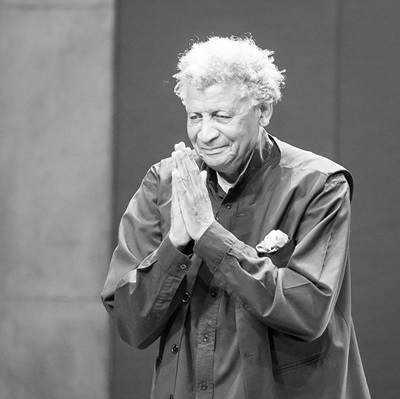

Author Eric Nisenson has devoted much of his adult life to reporting jazz. The genesis of his passion for jazz was his introduction to Miles Davis’ Kind of Blue at an early age – a passion so strong it eventually led to a friendship with Miles. The subjects for his three biographies are no less than Miles, John Coltrane, and now, Sonny Rollins, all key musicians and all strong, unique personalities worthy of icon status in the world of music. Nisenson discusses his friendship with Miles and his new book, Open Sky : Sonny Rollins and His World of Improvisation, in this exclusive Jerry Jazz Musician interview.
*
Sonny Rollins
_____________________________
JJM What was the first jazz you listened to?
EN The very first time I heard jazz was when my brother got his hands on a record by the Dukes of Dixieland, and he brought it home, and I hated it! I remember saying to myself, “If that’s jazz, it’s horrible!” I still don’t like Dixieland very much. I like the real early stuff by people like King Oliver and Louis Armstrong’s Hot Five is really great. I think it was probably Brubeck that I heard next.
JJM What year are we talking about, mid 50’s?
EN No, this was 60’s. I became a jazz snob. I got so I hated Brubeck. Now, I like Brubeck again, in fact I think he is underrated. Then, it was Miles Davis’ “Kind of Blue” that made me a hardcore jazz fan. There are a lot of great jazz records, but nothing quite as great as that one. It was one of those albums that was accessible, and was truly a great piece of work.
JJM It must have been an amazing thing, later on in your life, to find yourself hanging out with Miles and writing a book on him.
EN When I first met Miles, I was terrified of him. Until I got to know him, I wasn’t terrified of him anymore
JJM He sounded like he was a handful for you. Sounded like he wanted you to do things for him that would have put your freedom in peril. I am sure you had to balance that with wanting to move your friendship along.
EN Well, I was writing a book and he held that over me. There was this book I wanted. So he was quite manipulative. Apparently he did the same thing with Quincy Troupe.
JJM I thought it was interesting how the editor on your book on Miles was Joyce Johnson, who was connected with the Jack Kerouac
EN She didn’t like me and I don’t think she liked Miles much either. I am sure she was something of a feminist, and Miles treated women like crap
JJM Who were your childhood heroes?
EN I would have to say Miles and Coltrane.
JJM If you could pick an event in jazz that you could have witnessed, what would it have been?
EN I would have loved to have seen the first time Charlie Parker and Dizzy Gillespie played 52nd Street together. Would have been great to be there about 1946. Imagine going down the street and Art Tatum is at one club, Charlie Parker is at another, Coleman Hawkins is across the street, Billie Holiday is around the corner I mean, my God!.
JJM I find it interesting that the people you have chosen to write about, Miles Davis, John Coltrane, and now Sonny Rollins – none of these men are what could be called “the boys next door.” They are all strong personalities with anti-establishment, alienated sort of behavior. Is there a reason that you are attracted to these sorts of personalities?
EN First and foremost they were great musicians. I guess that, yes, I am drawn to alienated types, who aren’t plugged into mainstream society. Sonny Rollins and I became close because of that. There are social and political issues that we really feel strongly about. During the writing of the book we would always have these side conversations that tended to go on and on. Sonny is such a straightforward person. In a way, as guitarist Jim Hall called him, he is kind of an “innocent” .not to say he is stupid, of course, he is incredibly bright
JJM Yes, and he is such a connection to the bop era. Unfortunately, there are so few of those legendary musicians still around, that you can really reach back and get first hand accounts from that era from
EN My respect for Sonny has grown tremendously. Most of the time, when you meet your heroes they are going to disappoint you. But not Sonny, in fact, I have much higher regard for him after knowing him.
JJM Who would be the fourth guy to write about that fits in with these three?
EN I would like to write about Charlie Parker, but its already been done. There are lesser known players I would like to write about but I don’t get to do it because publishing jazz books, unless its about a very famous jazz musician, is tough. I would like to do a book about Art Farmer, but that’s not likely to happen.
JJM How would you best describe Sonny Rollins? What are his most prominent personality characteristics?
EN He is a very humble guy. An interesting thing about Sonny Early in his life, he used to mug little old ladies, steal musician’s horns do all kinds of bad things. It’s almost like his life since then, once he got over his drug habit and straightened himself out, he has tried to make up for his bad choices early in life. More upright, more honest, more humble.
JJM Would you say that he was always looking to do the right thing, not just as a person but in terms of his music? I am thinking in terms of his sabbatical from music
EN That’s a good point. He felt that even when he was getting great critical acclaim, he felt for himself that he wasn’t playing as good as he wanted to play. He took his famous sabbatical because he felt he wasn’t playing on a level he wanted to play. Sonny tended to be very self-critical, so he took some time off until he felt he was playing the way he was capable.
JJM You make an interesting point early on in the book about having some regret about not having experience playing in a big band. What big band do you think he would have best fit in with?
EN Maybe Ellington’s band. The closest he ever came to playing in a big band was “Sonny With Brass” which came out on Verve. That would give you some idea of what he would sound like in a big band.
JJM Which of his earliest recordings would you say made the jazz world take notice?
EN The recordings with JJ Johnson and Bud Powell, probably. Playing with Bud Powell was a treat to Sonny, and was very important early to his career.
JJM You talk of his relationship with Monk how important was that to him?
EN I talked a lot to Sonny about Monk, because I felt Monk was a strong influence on him, but he said he didn’t really play all that much with Monk. He rehearsed a lot with Monk. He got a lot from Monk, particularly how to use space in his solo. He used elements of the melody, much as Monk did, to create a solo. It wasn’t like Monk was telling him how to do things.
JJM Would you say that Monk was his musical soul mate?
EN He was more like a father to him, a mentor
JJM Who was Sonny’s soul mate musically? Was it Clifford Brown?
EN I am sure Clifford was definitely there, and drummer Max Roach. Sonny was very happy in the group with Clifford and Max.
JJM In the early 50’s, he got pretty involved in drug use, and you describe this period as the ugliest time of his life. What was the key consequence of these bad choices he made at the time?
EN His whole career was a mess during this time. He was still getting jobs though because he was so good. He was living almost homeless. His mother would take him in – she would always take him in.
JJM Who was he playing with at the time?
EN One of the people he was playing with at the time was Miles Davis. But Miles, during that early 50’s period, was just as screwed up as Sonny, and wasn’t getting that many gigs.
JJM What sort of relationship did Miles and Sonny have at that time?
EN Miles and Sonny always seemed to get along pretty well. However, Sonny has a policy of never saying anything negative about another musician. So, it’s hard to really know if he got along with Miles. There is no reason to believe he didn’t, but I don’t know really.
JJM That’s contrary to Miles, of course, who was open to criticizing anybody at any place, any time.
EN Miles tore down everybody!
JJM I wonder if Sonny learned from that and saw the consequences of that
EN Sonny would feel that jazz musicians had enough negative things going on as it was, and that making a living was difficult enough without musicians tearing into each other.
JJM What can you tell us about Sonny and Charlie Parker?
EN Charlie Parker totally disapproved of Sonny’s lifestyle at the time, and Sonny said he felt as if he was really letting Bird down. Parker knew how influential he was to some of the young musicians, and he felt terrible when he saw some of this young talent as addicted to drugs as he was. This was one of the things that got Rollins to quit drugs. He didn’t do it right away, but he decided he needed to stop around this time.
JJM Sonny Rollins never felt comfortable with recording …
EN He believes in playing “in the moment” and never was comfortable with recording, no. Even when he is playing live, if he knows he is being recorded, he doesn’t play as well as when the recording machine is off. One or two examples of when he got away from this when Our Man in Jazz was recorded, he said they played over and over the same thing every night, so he forgot the recording machine was on, so he played in a much more relaxed style. Sonny believes that true jazz is music that is played one time for one audience, and that’s it. It’s only heard once, and once it’s over, it’s never heard again.
JJM The world of jazz and even beyond is very well aware of this somewhat romantic vision of Sonny Rollins blowing his saxophone on the Williamsburg Bridge during the late 50’s and early 60’s. What made him come to this decision and how did he find this spot?
EN He was living in downtown New York with his wife. There was a pregnant woman living in the building, and he was afraid his playing would bother her. So, he walked around the neighborhood and noticed that he could walk on top of the Williamsburg Bridge and there was a walkway there. If he played there at night, there was no one there, no one ever walked there, and if he wanted to play over the sound of the traffic and the water, he had to play a really strong sound. He found it to be an ideal place to practice. He would bring other musicians up there too, like Steve Lacy. He also told me that he has found all kinds of weird places to practice, like Pallisades, New Jersey, right on the cliffs there is a great place He would play under some amazing circumstances. He would walk all around the clubs and try to hear the different effects his horn would make from different parts of the club. One time, he was playing outdoors, and the stage was something like six feet over the ground. He was walking around like he usually does when he plays, and evidently, he stepped off the stage, fell, and broke his ankle. Here he is, lying on his back, and he continues playing his solo
JJM It was during the same period that Sonny was on the bridge that Coltrane began experimenting with the soprano saxophone. Did Sonny consider playing another horn?
EN Yes. He played soprano saxophone on a couple of the early Milestone recordings. He played it very nicely. I liked it. He gets a very nice sound out of it. He actually started out playing alto.
JJM But these are pretty much straight-ahead jazz recordings. Let me rephrase my question How did he respond to all the changes that were going on in jazz during that period?
EN That’s an interesting question, because Sonny feels, as I do, that he was one of the father’s of the Free Jazz movement. Don’t forget that he was playing in a piano-less trio for years, and exploring the harmonic frontiers that way. His music started technically moving outside. Even something as famous as the “Blue Seven” has its harmonic ambiguity to it. Don’t forget that he played with Ornette Coleman as early as 1957, and he felt he was on the same wavelength as Ornette. So, to him, it was a natural evolution of jazz and it was a direction he was going anyway. I once went to a concert – it was a dream concert at Lincoln Center – devoted to the tenor saxophone. The different groups were Zoot Sims, Coleman Hawkins, Sonny Rollins, John Coltrane and Archie Shepp. So, Sonny came on and played a weird little set with Yusef Lateef, who did most of the playing. People were disappointed that Sonny played such a short set and didn’t play very much, which was typical of Sonny, since he always like to “torture” his audience. He told the audience upon leaving that he would be back to play with Coltrane. Coltrane came out, and this was just when he had broken up his Quartet, and the group included Alice Coltrane and Don and Albert Ayler – so, it was sort of a freak-out thing. People were pouring out to the exits! They couldn’t get out fast enough. Sonny never showed!
JJM What was the most spontaneous act of Sonny Rollins’ career?
EN The third time he left the jazz scene, he spontaneously walked on to a plane that was going to India – he didn’t pack or anything, he just walked on. On the plane, some people were talking about this “guru”. He heard about it and went to this guru and spent several weeks with him.
JJM If I have five minutes to get into Sonny Rollins, and this is your chance to sell me on his playing, what song would you suggest I listen to?
EN Maybe “Blue 7”, from Saxophone Colossus. It’s simple, but shows his technique of using thematic improvisation. You can hear exactly how he fills up a solo. It’s simple but very compelling and brilliantly designed. The genius of Sonny was that he had the ability to give his solos great structure spontaneously.
JJM Is this a favorite of his?
EN It’s not really a favorite of his. I asked him once what his favorite albums were, and he couldn’t name any. He said he thought the Live at the Vanguard was the closest, and he said maybe “Saxophone Colossus” only because everyone else does.
JJM Ultimately, what will his legacy be?
EN Well, what can you say other than he is one of the “Mozart’s of our time?” He recorded enough great music that I am sure he will be remembered as one of the great jazz artists ever, and that his stuff is some of the best the jazz world has ever heard.
Open Sky
Sonny Rollins and His World of Improvisation
*
Eric Nisenson products at Amazon.com
Sonny Rollins products at Amazon.com
_______________________________
*
If you enjoyed this interview, you may want to read our interview about Sonny Rollins with jazz critic Gary Giddins.