
Cover Stories with Paul Morris, Vol. 7

July 6th, 2014


Paul Morris is a graphic designer and writer who collects album art of the 1940’s and 1950’s. He finds his examples of influential mid-century design in the used record stores of Portland, Oregon.

This edition features Alex Steinweiss album covers from his prime period — the late 1940’s and early 1950’s.

__________

     I’ve gathered together some Alex Steinweiss covers from what I consider his prime period, the late 40’s and early 50’s. These illustrations share what I’ll call a modernist European style. There are influences of Surrealism and an overall tone of irony and wry humor. The musical works are all western European. For Russian and eastern European works he often featured dancing peasants and other rural subjects.

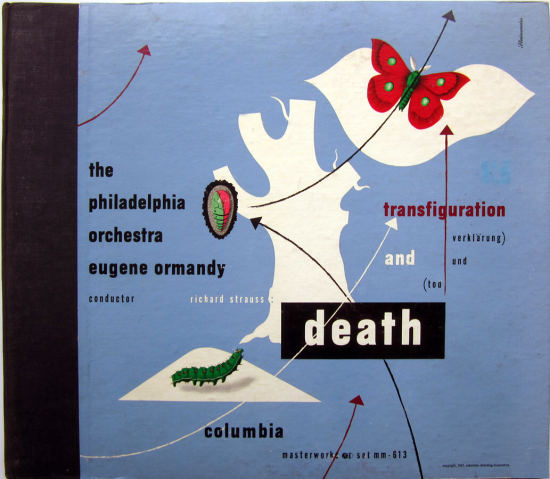
     The first cover illustrates Strauss’s Transfiguration and Death, a good soundtrack for the Age of Anxiety. It dates from 1947. The moth is cheerful enough, but there is a starkness to the composition and the black box enclosing the word death darkens the mood.
morris-1

__________

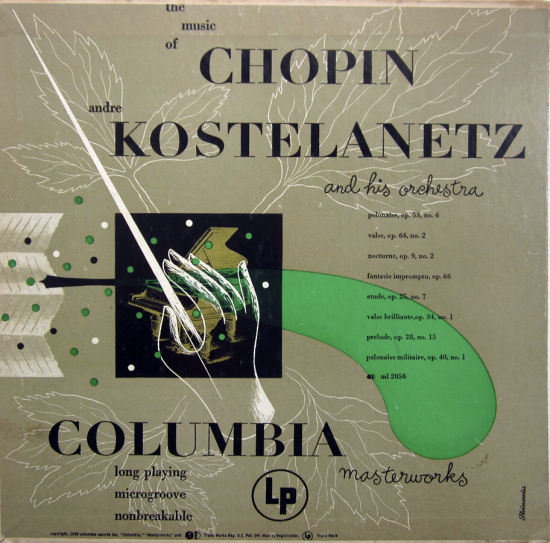
     This Chopin cover from 1949 uses an old engraving of a piano, in negative. Other devices that recur in Steinweiss’s illustrations are the conductor’s hand with baton and the composer’s quill pen and manuscript paper.
morris-2

__________

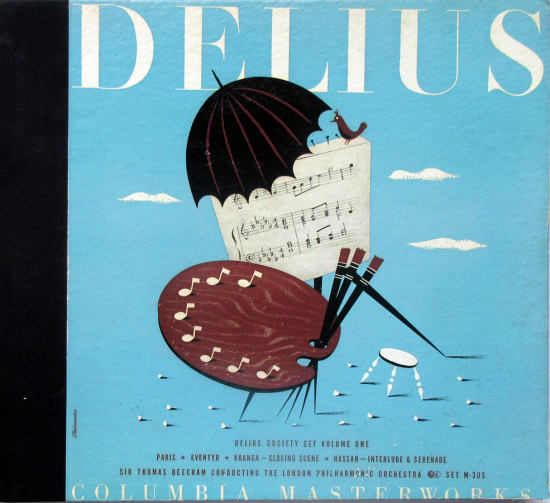
     The Delius cover with a bird on it is one of my favorites. The references in a Steinweiss cover usually correspond to something in the music, but I haven’t found any themes about painting in these works. Probably he just liked the conceit of the painter choosing notes from his palette. Perhaps the music shown is from one of the pieces on the album, but probably not, as there’s a mistake in the middle staff, where two half-note D-flats are followed by a quarter-note D-flat. Too many beats for one measure.
morris-3

__________

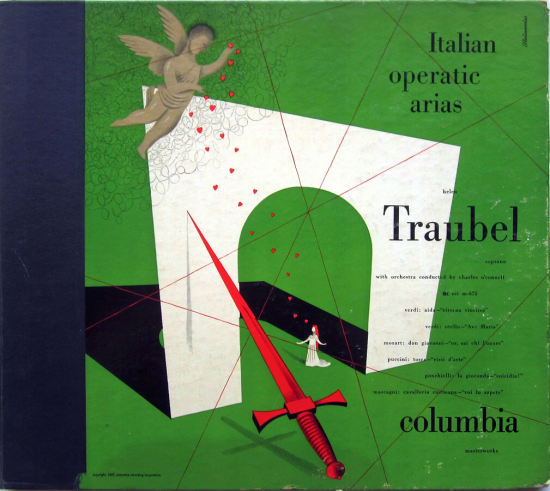
     This 1947 cover for an album of 78-rpm records is striking, but I admit I don’t know what the cupid and the sword refer to. Possibly it’s the first aria on the record, one from Aida in which the heroine sings of her beloved, Radamès, who is returning from battle.
morris-4

__________

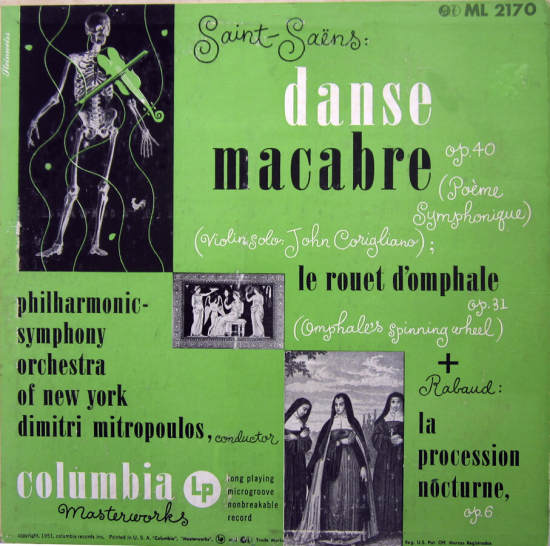
     Moving to 1951, the LP has arrived, and Steinweiss often had to somehow illustrate two disparate works on the same cover — many compositions fit easily on one side of the record. These double-title covers surely were harder to pull off successfully, and this one doesn’t really hang together, but I think it is a lot of fun. First, the Danse Macabre is given prominence. Second, there’s the negative image of the skeleton with the green violin. And there’s a lot of the Steinweiss Scrawl. If anyone can explain the rooster near the skeleton’s knee, please write in.
morris-5

__________

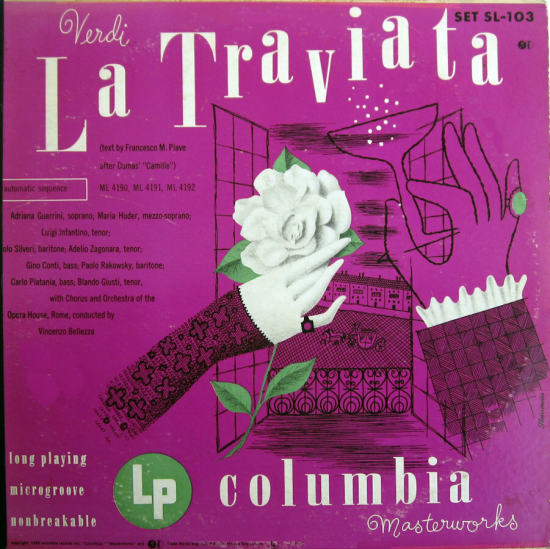
     This illustration for La Traviata features a French scene and a delicious purple background. The man’s hand is drawn in a familiar fashion-in numerous covers it is a conductor’s hand holding a baton, as on the Chopin cover above.
morris-6

__________

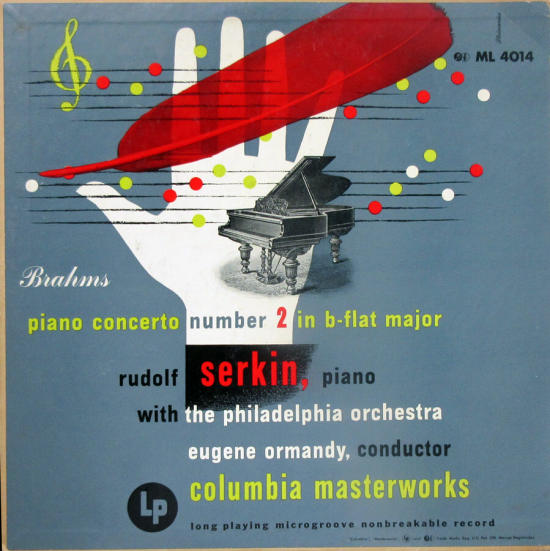
     Another hand, another piano engraving, and a big red composer’s quill pen-combined in a very lively composition. Most likely this was from the early 1950’s, though it was not printed with the more modern four-color process. This uses four ink colors-red, yellow/chartreuse, blue-gray, and black.
morris-7

__________

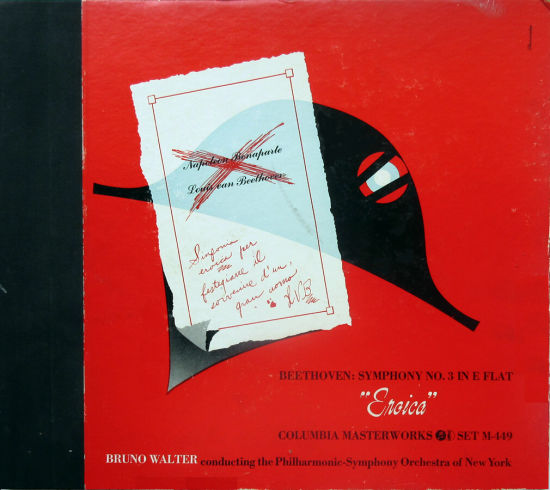
     Beethoven evidently struck a chord with Steinweiss; his illustrations are memorable. This relatively simple illustration refers to the possibly mythical story in which Beethoven dedicated his symphony to Napoleon, then changed his mind when the French ruler named himself emperor. The inscription “Sinfonia Eroica per festeggiare il sovvenire di un Grand Uomo” means “Heroic symphony, [composed] to celebrate the memory of a great man.”

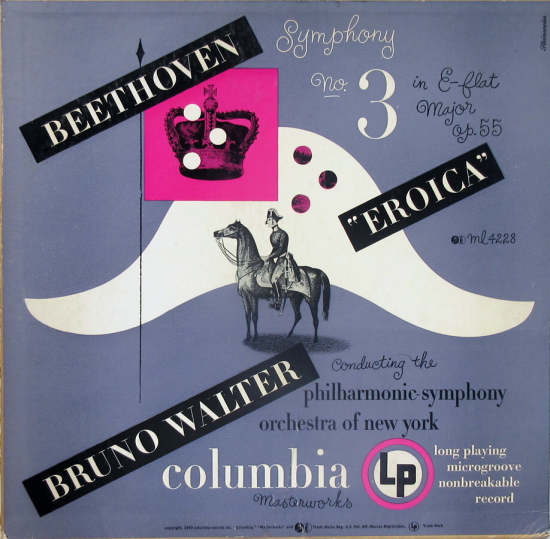
      The second cover for the Third Symphony again uses the Napoleonic hat, along with the emperor’s crown.
morris-8

morris-9

__________

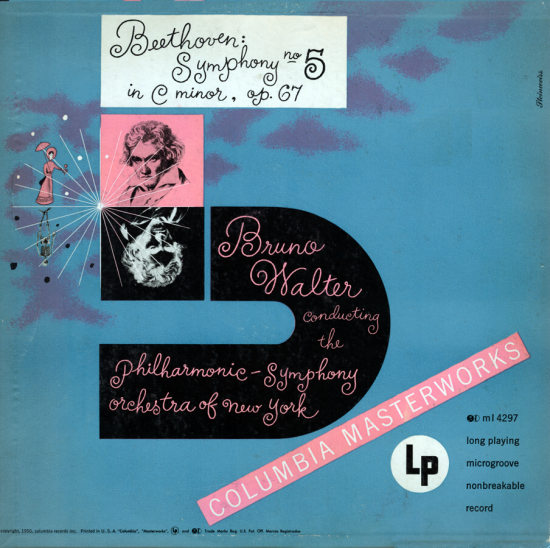
     The Beethoven Fifth cover is from 1950. The composer’s face is shown in positive and negative; these images are flanked by a lady holding out a flower and a skeleton, again in reverse. I have noticed that many album designers who tackle a fifth symphony make use of a large numeral “5.” I think this is because the 5 fills the square space of an album cover in a balanced, satisfying way. Much nicer than a large 2 or 7.

     Why the skeleton and the lady with the parasol? My best guess is that Beethoven’s music encompasses the extremes of human emotion and experience.
morris-10

__________

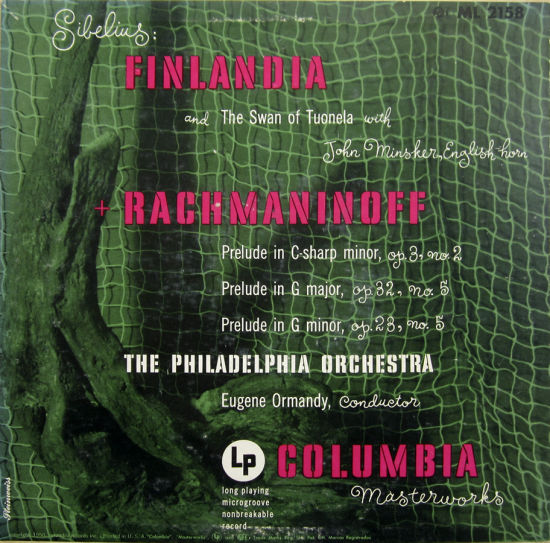
     Also from 1950 is this somewhat less successful cover for Finlandia and some works by Rachmaninoff. The background is a photo of driftwood and a fishing net. To my eye, the colors are a bit overripe.
morris-11

__________

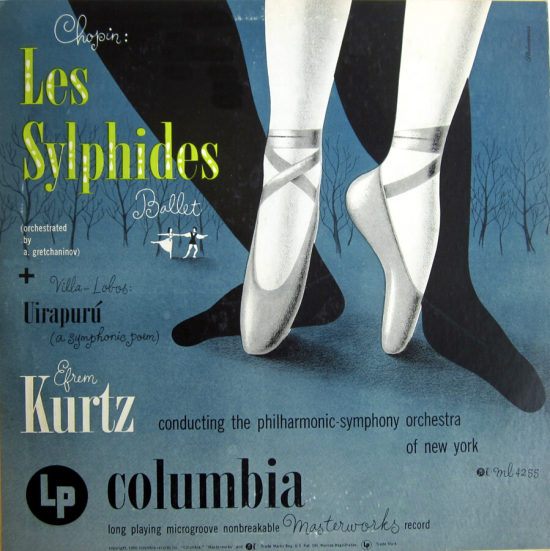
     The illustration here is for the first piece on this record, the ballet Les Sylphides, based on music by Chopin. Here Steinweiss chose a soft, tender mood to depict the dancers. The Villa-Lobos piece doesn’t get its own picture.
morris-12

__________

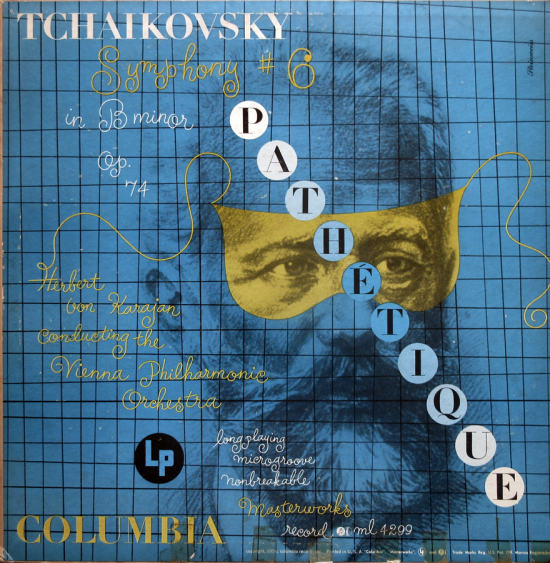
     Tchaikovsky in a mask? This delightful and odd cover shows how logical it is to arrange things in a diagonal composition, from upper left to lower right. It was released in 1950. I believe the mask refers to the composer’s statement that his symphony had a programme, or narrative, but that he would not reveal it. At this time Tchaikovsky’s sexuality was not commonly discussed in liner notes, but today it’s hard not to read the image as a closeted gay man. The notes describe the Pathétique as “a masterpiece of strong emotions, of magnificent colors which are sometimes somber, sometimes flaming.”
morris-13

__________

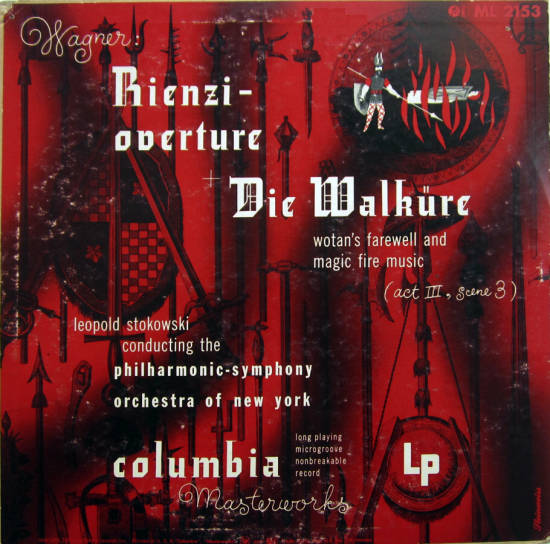
     The last example of the European Steinweiss is Wagner, who brings out our artist’s dark side. The color is an ominous red, and the background bristles with knives, swords, and spears. The picture at the upper right is Wotan saying farewell to Brünnhilde in Die Walküre. The opera Rienzi, on the other side of the record, does involve war and coups in medieval Italy, but such a profusion of arms is hard to explain. He must have found a trove of old engravings of weapons and decided he couldn’t resist them.
morris-14

__________

Next time: I confess my fascination with records on the floor.

In Volume 1 of “Cover Stories,” Paul shared his collection of covers by Alex Steinweiss, known as the father of the record album cover, and for many years in charge of Columbia Records’ art department.

Volume 2 focused on Columbia covers

Volume 3 featured jazz illustrations from the early years of the record album

Volume 4 revisited the 1950’s with images of fans holding and enjoying their albums

Volume 5 explored the work of Alex Steinweiss when he used the pseudonym “Piedra Blanca”

Volume 6 featured teenagers of the 1950’s enjoying their music

Share this:

2 comments on “Cover Stories with Paul Morris, Vol. 7”

  1. I’m not sure if this blog is still active, but it’s giving me a lot of pleasure. Thanks so much for posting all this. I love Steinweiss, and album covers from those days are a lot of fun to look at!
    A couple of corrections: As indicated by the arrows on the cover (clever!), the title of the work on the first album photo is “Death and Transfiguration” by Strauss. Also the middle system on the cover of the Delius is actually correct, there are only 4 beats. In typical piano-reduction notation, the two quarter notes would be played during the time of the second half note.

    The Beethoven “Eroica” covers are two of my favorites. The first was from a 1941 recording and the second was a 1949 recording on tape (as opposed to shellac in 1941) and is a clear riff on the earlier cover – now with bullet holes through both the crown of royalty and the Napoleonic hat!

    As an aside, Steinweiss also designed a cover to the 5th Symphony from 1941 (Bruno Walter, Philharmonic-Symphony Orchestra of New York), which appears stylistically to be a partner for the photo you have posted. That cover had the Morse code for “V” [for victory] which is dot-dot-dot-dash, mimicking the famous rhythm in the opening of the symphony. For that reason, and the obvious musical trajectory of the work, it was played very often during WWII to bolster morale. I’m not entirely sure but I expect the Morse code association with the work preceded Steinweiss’s use on this cover.

Comment on this article:

Your email address will not be published. Required fields are marked *

Site Archive

Your Support is Appreciated

Jerry Jazz Musician has been commercial-free since its inception in 1999. Your generous donation helps it remain that way. Thanks very much for your kind consideration.

Click here to read about plans for the future of Jerry Jazz Musician.

In This Issue

photo by William Gottlieb/design by Rhonda R. Dorsett
21 jazz poems on the 21st of November, 2025...An ongoing series designed to share the quality of jazz poetry continuously submitted to Jerry Jazz Musician. This edition features poems communicating the emotional appeal of jazz music, as well as nods to the likes of Miles Davis, Regina Carter, Maynard Ferguson, Ornette Coleman, and Max Roach.

The Sunday Poem

photo via PickPik

”Caught in a Storm” by Michael L. Newell

The Sunday Poem is published weekly, and strives to include the poet reading their work.... Joe Maita reads Michael L. Newell’s poem at its conclusion


Click here to read previous editions of The Sunday Poem

Short Fiction

photo via Freerange/CCO
Short Fiction Contest-winning story #70 – “The Sound of Becoming,” by J.C. Michaels...The story explores the inner life of a young Southeast Asian man as he navigates the tension between Eastern tradition and Western modernity.

Community

Calling All Poets…Submissions guidelines for the anthology “Black History in Poetry”...We are currently seeking poetry from writers of all backgrounds for Black History in Poetry, an anthology scheduled for publication in the Summer of 2026. The anthology will be a means of celebrating and honoring notable Black Americans by offering poetry that teems with imagery, observation, emotion, memory, testimony, insight, impact, and humanity. Our aim is to give readers a way to visualize Black history from a fresh perspective.

Poetry

photo via Shutterstock
“The Music of Lana’i Lookout” – a poem by Robert Alan Felt...The 17th anniversary of president-elect Barack Obama's scattering of his beloved grandmother's ashes is at the center of the poem, and serves as a reminder that moral personal character of leadership is what makes a country great.

Poetry

Poems on Charlie “Bird” Parker (inspired by a painting by Al Summ) – an ekphrastic poetry collection...A collection of 25 poems inspired by the painting of Charlie Parker by the artist Al Summ.

Community

Letter from the Editor: “A Jerry Jazz Musician Experience”...Sharing a bit of what I’ve been up to of late, and make you aware of a new endeavor of mine…

Poetry

National Archives of Norway, CC BY 4.0 , via Wikimedia Commons
“Wonderful World” – a poem by Dan Thompson

Feature

Press Release for “The Weary Blues: Celebrating The Harlem Renaissance and Langston Hughes...I recently wrote about a new endeavor of mine – producing a show in Portland celebrating the poetry of Langston Hughes and the Harlem Renaissance. What follows is the complete press release for the February 7 performance at the Alberta Abbey in Portland, Oregon.

A Letter from the Publisher

The gate at Buchenwald. Photo by Rhonda R Dorsett
War. Remembrance. Walls.
The High Price of Authoritarianism– by editor/publisher Joe Maita
...An essay inspired by my recent experiences witnessing the ceremonies commemorating the 80th anniversary of liberation of several World War II concentration camps in Germany.

Poetry

Wikimedia Commons
“Dorothy Parker, an Icon of the Jazz Age” – a poem by Jane McCarthy

Feature

Memorable Quotes: Horace Greeley, on character...“Fame is a vapor, popularity an accident, and riches..."

Community

Nominations for the Pushcart Prize L (50)...Announcing the six writers nominated for the Pushcart Prize v. L (50), whose work appeared on the web pages of Jerry Jazz Musician or within print anthologies I edited during 2025.

Interview

Interview with Tad Richards, author of Listening to Prestige: Chronicling its Classic Jazz Recordings, 1949 – 1972...Richards discusses his book – a long overdue history of Prestige Records that draws readers into stories involving its visionary founder Bob Weinstock, the classic recording sessions he assembled, and the brilliant jazz musicians whose work on Prestige helped shape the direction of post-war music.

Poetry

"Swing Landscape" by Stuart Davis
“Swing Landscape” – a poem by Kenneth Boyd....Kenneth Boyd writes poetry based on jazz paintings. “Swing Landscape” is written for a Stuart Davis painting of the same name.

Playlist

“A Perfect 10” – a playlist of tentets by Bob Hecht...Bob adds another instrument to his progressive playlist feature, and shares what a variety of arrangers have been able to accomplish writing for a tentet.

Jazz History Quiz

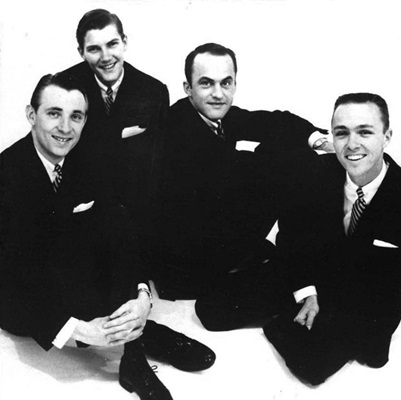
Jazz History Quiz #185...This posthumously-awarded Grammy winning musician/composer was the pianist and arranger for the vocal group The Hi-Lo’s (pictured) in the late 1950’s, and after working with Donald Byrd and Dizzy Gillespie became known for his Latin and bossa nova recordings in the 1960’s. He was also frequently cited by Herbie Hancock as a “major influence.” Who is he?

Poetry

photo via Wikimedia Commons
Jimi Hendrix - in four poems

Playlist

A sampling of jazz recordings by artists nominated for 2026 Grammy Awards – a playlist by Martin Mueller...A playlist of 14 songs by the likes of Samara Joy, Brad Mehldau, Dee Dee Bridgewater, Branford Marsalis, the Yellowjackets and other Grammy Award nominees, assembled by Martin Mueller, the former Dean of the New School of Jazz and Contemporary Music in New York.

Poetry

Ukberri.net/Uribe Kosta eta Erandioko agerkari digitala, CC BY 2.0, via Wikimedia Commons
In Memoriam: “Color Wheels” – a poem (for Jack DeJohnette) by Mary O’Melveny

Short Fiction

“Alas, for My Poor Heart” – a short story by Daryl Rothman...The story – a short-listed entry in the recently concluded 69th Short Fiction Contest – concerns art and its truest meanings—where you just might have to look twice at what the shadow and light of a piece says about that within your soul.

Essay

“Escalator Over the Hill – Then and Now” – by Joel Lewis...Remembering the essential 1971 album by Carla Bley/Paul Haines, inspired by the writer’s experience attending the New School’s recent performance of it

Poetry

“Still Wild” – a collection of poems by Connie Johnson...Connie Johnson’s unique and warm vernacular is the framework in which she reminds readers of the foremost contributors of jazz music, while peeling back the layers on the lesser known and of those who find themselves engaged by it, and affected by it. I have proudly published Connie’s poems for over two years and felt the consistency and excellence of her work deserved this 15 poem showcase.

Feature

photo of Barry Harris by Mirko Caserta
“With Barry Harris at the 11th Street Bar” – a true jazz story by Henry Blanke...The writer - a lifelong admirer of the pianist Barry Harris - recalls a special experience he had with him in 2015

Short Fiction

publicdomainpictures.net
“Corkscrew” – a short story by Mike Wilson...The story – a short-listed entry in the recently concluded 69th Short Fiction Contest – is about a night when everything goes wrong and everyone is annoying, an unexpected turn of events teaches a sarcastic lawyer that the old adage is true – a cynic is just a disappointed romantic.

Interview

Interview with Sascha Feinstein, author of Writing Jazz: Conversations with Critics and Biographers...The collection of 14 interviews is an impressive and determined effort, one that contributes mightily to the deepening of our understanding for the music’s past impact, and fans optimism for more.

Feature

Trading Fours, with Douglas Cole, No. 27: “California Suite”...Trading Fours with Douglas Cole is an occasional series of the writer’s poetic interpretations of jazz recordings and film. This edition is dedicated to saxophone players and the mood scenes that instrument creates.

Short Fiction

photo by Simon Webster
“Smoke Rings and Minor Things” – a short story by Jane McCarthy...The story – a short-listed entry in the recently concluded 69th Short Fiction Contest – is a meditation on missed chances, minor keys, and the music that outlives the room it was played in.

Essay

“J.A. Rogers’ ‘Jazz at Home’: A Centennial Reflection on Jazz Representation Through the Lens of Stormy Weather and Everyday Life – an essay by Jasmine M. Taylor...The writer opines that jazz continues to survive – 100 years after J.A. Rogers’ own essay that highlighted the artistic freedom of jazz – and has “become a fundamental core in American culture and modern Americanism; not solely because of its artistic craftsmanship, but because of the spirit that jazz music embodies.”
Community

photo of Dwike Mitchell/Willie Ruff via Bandcamp
“Tell a Story: Mitchell and Ruff’s Army Service” – an essay by Dale Davis....The author writes about how Dwike Mitchell and Willie Ruff’s U.S. Army service helped them learn to understand the fusion of different musical influences that tell the story of jazz.

Feature

Excerpts from David Rife’s Jazz Fiction: Take Two– Vol. 16: Halloween on Mars? Or…speculative jazz fiction...A substantial number of novels and stories with jazz music as a component of the story have been published over the years, and the scholar David J. Rife has written short essay/reviews of them. In this 16th edition featuring excerpts from his outstanding literary resource, Rife writes about azz-inflected speculative fiction stories (sci-fi, fantasy and horror)

Poetry

“With Ease in Mind” – poems by Terrance Underwood...It’s no secret that I’m a fan of Terrance Underwood’s poetry. I am also quite jealous of his ease with words, and of his graceful way of living, which shows up in this collection of 12 poems.

Poetry

What is This Path – a collection of poems by Michael L. Newell...A contributor of significance to Jerry Jazz Musician, the poet Michael L. Newell shares poems he has written since being diagnosed with a concerning illness.

Art

photo by Giovanni Piesco
The Photographs of Giovanni Piesco: Art Farmer and Benny Golson...Beginning in 1990, the noted photographer Giovanni Piesco began taking backstage photographs of many of the great musicians who played in Amsterdam’s Bimhuis, that city’s main jazz venue which is considered one of the finest in the world. Jerry Jazz Musician will occasionally publish portraits of jazz musicians that Giovanni has taken over the years. This edition features the May 10, 1996 photos of the tenor saxophonist, composer and arranger Benny Golson, and the February 13, 1997 photos of trumpet and flugelhorn player Art Farmer.

Community

Community Bookshelf #5...“Community Bookshelf” is a twice-yearly space where writers who have been published on Jerry Jazz Musician can share news about their recently authored books and/or recordings. This edition includes information about books published within the last six months or so (March, 2025 – September, 2025)

Contributing Writers

Click the image to view the writers, poets and artists whose work has been published on Jerry Jazz Musician, and find links to their work

Coming Soon

Interview with John Gennari, author of The Jazz Barn:  Music Inn, the Berkshires, and the Place of Jazz in American Life; Also, a new Jazz History Quiz, and lots of short fiction; poetry; photography; interviews; playlists; and much more in the works...

Interview Archive

Ella Fitzgerald/IISG, CC BY-SA 2.0 , via Wikimedia Commons
Click to view the complete 25-year archive of Jerry Jazz Musician interviews, including those recently published with Judith Tick on Ella Fitzgerald (pictured),; Laura Flam and Emily Sieu Liebowitz on the Girl Groups of the 60's; Tad Richards on Small Group Swing; Stephanie Stein Crease on Chick Webb; Brent Hayes Edwards on Henry Threadgill; Richard Koloda on Albert Ayler; Glenn Mott on Stanley Crouch; Richard Carlin and Ken Bloom on Eubie Blake; Richard Brent Turner on jazz and Islam; Alyn Shipton on the art of jazz; Shawn Levy on the original queens of standup comedy; Travis Atria on the expatriate trumpeter Arthur Briggs; Kitt Shapiro on her life with her mother, Eartha Kitt; Will Friedwald on Nat King Cole; Wayne Enstice on the drummer Dottie Dodgion; the drummer Joe La Barbera on Bill Evans; Philip Clark on Dave Brubeck; Nicholas Buccola on James Baldwin and William F. Buckley; Ricky Riccardi on Louis Armstrong; Dan Morgenstern and Christian Sands on Erroll Garner; Maria Golia on Ornette Coleman.