
Cover Stories with Paul Morris, Vol. 2

November 11th, 2013


Paul Morris is a graphic designer and writer who collects album art of the 1940’s and 1950’s. He finds his examples of influential mid-century design in the used record stores of Portland, Oregon.

In this edition, Paul focuses on the art of Columbia


__________


Alex Steinweiss, the subject of my last column, started his career as head of the art department at Columbia Records, one of the three largest companies at the time (RCA and Decca were the others). Columbia continued its success throughout the period I’m looking at. Their covers vary in style, but they usually shared a feel of quality, an uptown New York esthetic. In varying degrees they show the influence of the boss. The later Columbia look had a similarly classy look. As photographers replaced the artists in the 50’s, Columbia could afford to use the top fashion photographers from Madison Avenue.

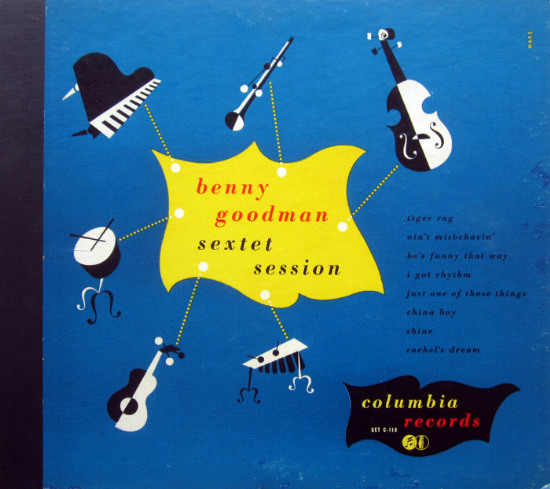
  The first example is a 1946 work by George Maas, a native of Kansas who worked later in designing book jackets and album covers for Mercury. The drawings of the instruments in Benny Goodman’s sextet are delightfully off-kilter. If you haven’t heard these recordings, you’re in for a treat. They include the early, groundbreaking work on electric guitar by Charlie Christian.
550-goodman

_____

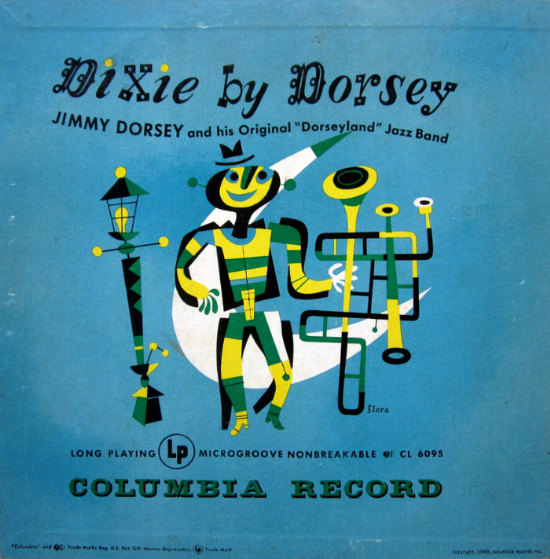
  The brightly colored, whimsical paintings of Jim Flora first appeared on Columbia releases in 1942. A jazz fan who admired Diego Rivera and the surrealist painters, Flora took over the jazz covers while Steinweiss concentrated on classical. Later in the 50’s Flora created jazz covers for RCA. I’d like to include more Flora work, but his albums are hard to find. I’m guessing that in the 40’s classical music outsold jazz.
550-dorsey

_____

  
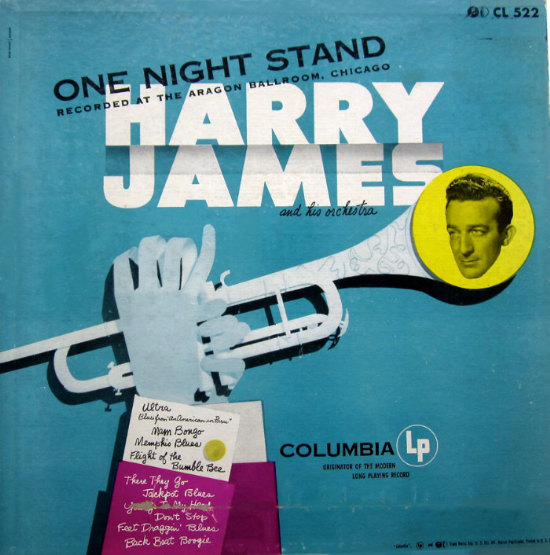
     One Night Stand by Harry James is from about 1952, and is credited to “Becker-Horowitz/Monogram.” Apparently Monogram was a design studio that frequently did work for Columbia. The hands and trumpet are painted to look like a paper sculpture. By this time photographs of the artists were becoming dominant in album cover design, and they saw fit to drop in James’s picture. Steinweiss would have said no to that photo.

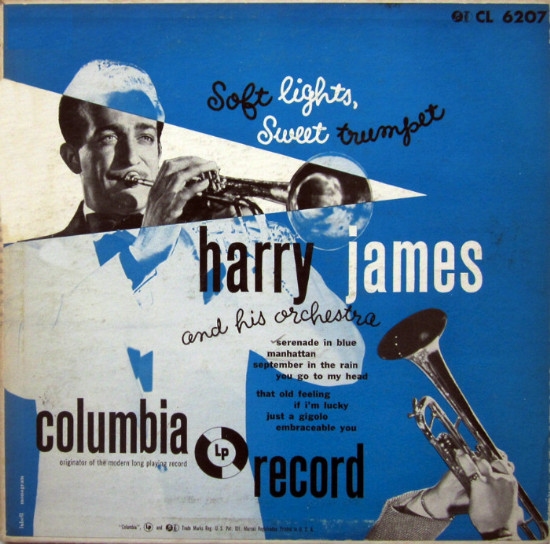
The other Harry James cover makes more effective use of photographs. It’s credited to a designer named Lubell, about whom I know nothing. The script lettering is not the Steinweiss Scrawl, but you can tell designers liked the informal note struck by the combination of hand lettering and type.

  Soft Lights, Sweet Trumpet is a 10-inch LP. For about five years, from 1948 to 1953, there were dueling record formats. Some recordings were released in 78, 45 and 33 rpm versions. There were both 10-inch and 12-inch LPs, and there were albums made up of several 45’s. This reminds me of today when musicians advertise recordings as available as download, CD, and vinyl.
550-james1

550-james2

_____


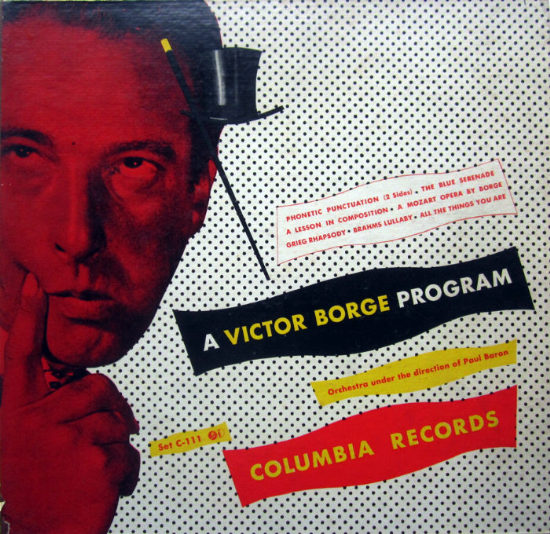
     This Victor Borge cover gets points for strangeness. I wonder if the color of the pianist’s face is what the designer intended. I’m not familiar with Borge’s playing, but I know he combined comedy and classical music, like Peter Schickle, so fans wouldn’t be surprised by a goofy design. I remember as a child that my mother especially liked it when Borge was a guest on the Jack Parr show. She liked his jokes but impressed upon me that he was a legitimately good pianist.
550-borge

_____

    The Shostakovich and Sibelius cover makes me wonder about the meeting when the graphic artist presented his idea to the art director. Neither symphony is about dancing. An ocean of empty space surrounds the image. The title uses Christmas colors. However the uncredited artist got it through, I love it. I think I know how it was done: a photo of a dancer was cut out and the portions we see were connected with pins. This was photographed and a shadow was airbrushed in. Questions: In what ballet does the dancer wear gloves like that? And is it just me, or does her leotard look a lot like an undergarment?
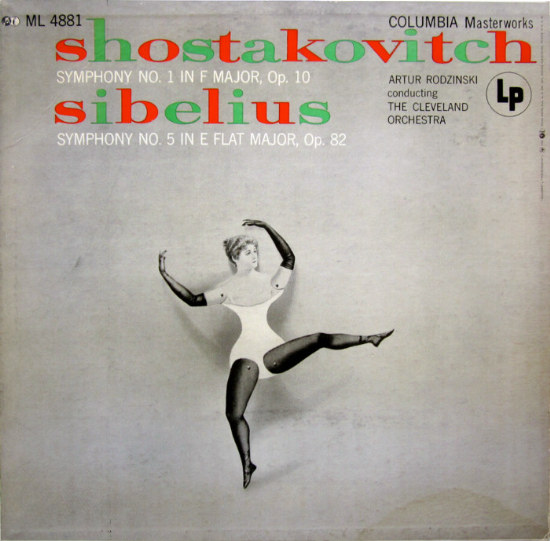
550-shosh


_____


      An album that combined two classical works was a challenge for the designer. Often the musical works had no similarity, and an awkwardly joined pair of images resulted. The rather elaborate composition on this Royal Philharmonic recording uses photographs of wicker sculptures set against a woody background that is a bit distracting. The artist, credited as Stanley/Monogram, chose a bird theme to unify the pictures. “The Golden Cockerel” does feature a magical rooster, and here “The Accursed Hunter” of César Franck’s symphonic poem has speared a songbird. The hunter is supposed to look troubled.
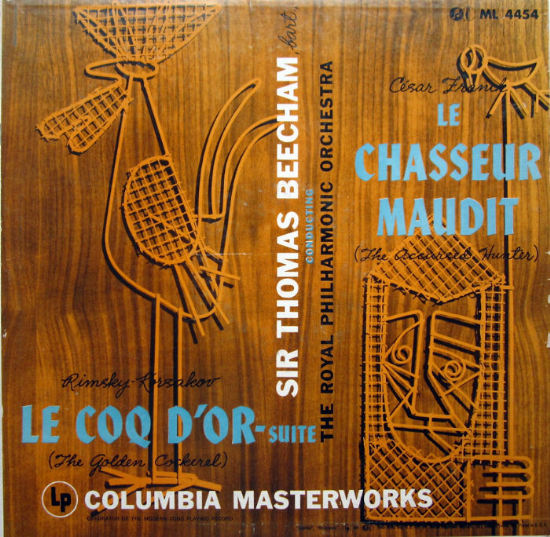
550-beecham


_____


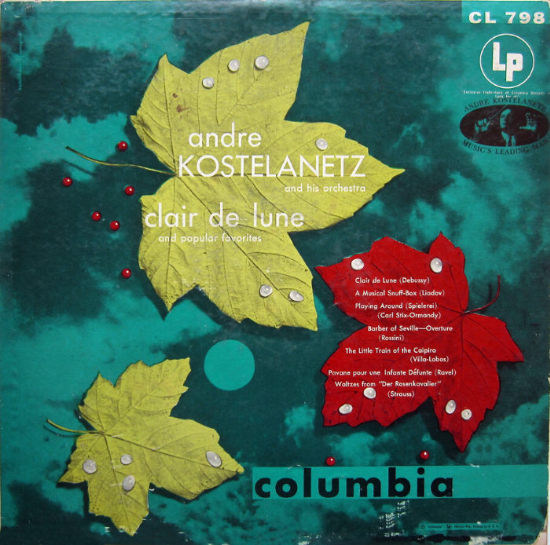
   These two Columbia covers make use of photographs cleverly manipulated in the darkroom. The designer of the Mozart sonatas cover has sketched over negative images of leaves. His signature is hard to read, but a little Googling led me to Pavel Tchelitchew, a fascinating artist born in Russia in 1898 who painted portraits of Gertrude Stein and Edith Sitwell. In the Andre Kostelanetz cover for Clair de Lune, which means “moonlight,” three leaves are placed on a night sky. I think the drops of water and the moon were painted in. Designed by “Becker-Horowitz/Monogram.”
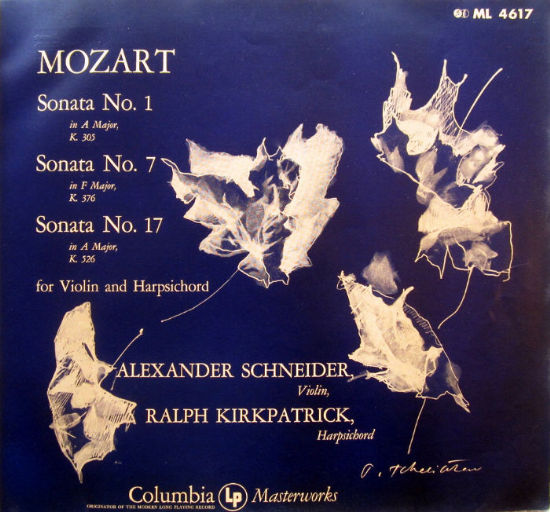
550-mozart

550-kost

_____

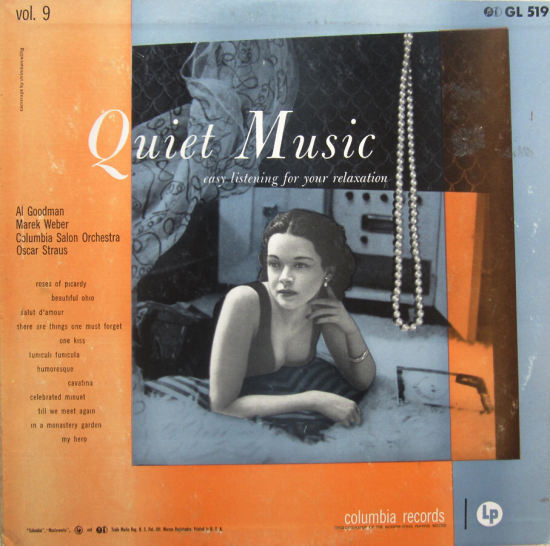
      The “Quiet Music” cover is interesting in several ways. The credit reads “Camerage by Strimban-Willig,” the handle of Jack and Bob Strimban, and Sam Willig, who also did magazine covers in the 50’s. I have one other cover with a photo collage credited to them. The picture of the model lying on a shag rug in front of the hi-fi set has a 20’s look. I hope that’s an album cover at her right — records on the floor are one of my obsessions. Images of lace and a patterned curtain are overlain, and a string of pearls, synonymous with elegance at the time, is dropped on top. The cover uses three key marketing terms for easy listening music: quiet, easy, and relaxation. The liner notes add the terms pleasant, familiar, and soothing.
550-quiet

_____

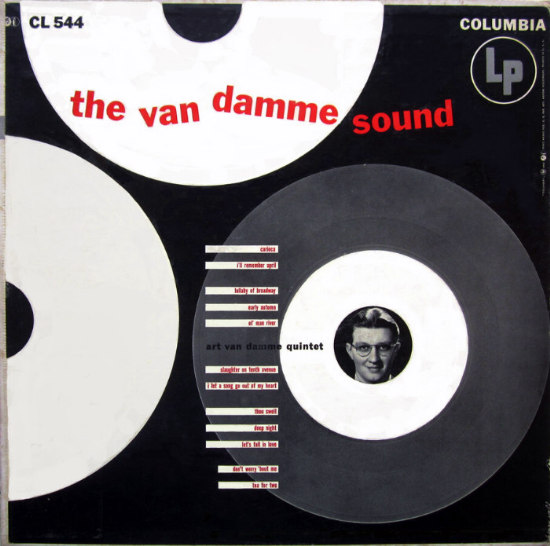
  The last example, by Henry Wolf, is from the early 50’s. Pairing geometric, “modern” designs with modern jazz artists who were said to play abstractly was popular. Wolf was art director of Esquire magazine in the 50’s, and later worked at the ad agency McCann Erickson, the firm that bought out Sterling Cooper in Mad Men. Accordionist Van Damme looks out from what could be the center hole of a 45. The song titles are set in ten-point condensed type — extremely hard to read. Records by Art Van Damme appear frequently in the used bins, so I assume he had some success, but the jazz accordion never caught on.
550-van

_____

      This has been a very brief trip through the huge Columbia catalog. A final accolade to Columbia: they were very good about crediting their designers, something RCA and Decca rarely did. This makes the sleuthing work much easier, for one thing, and it gives much-deserved credit to the creators of these unique artworks.

*

__________


In Volume 1 of “Cover Stories,” Paul shared his collection of covers by Alex Steinweiss, known as the father of the record album cover, and for many years in charge of Columbia Records’ art department.


Share this:

3 comments on “Cover Stories with Paul Morris, Vol. 2”

  1. I’m Jack Strimban’s daughter, very interesting! Do you have the 1952 cover of “The story of the Music Box.”?

  2. Don’t have that album. The other Camerage cover I have is “Hi-Fireworks” from 1953, one of the first albums by Ferrente and Teicher. Your father’s work was fascinating!

  3. Damn’t I’m also a graphic designer named Paul Morris. I’m way too generic and don’t even collect album covers.

Leave a Reply to Paul Morris Cancel reply

Your email address will not be published. Required fields are marked *

Site Archive

Your Support is Appreciated

Jerry Jazz Musician has been commercial-free since its inception in 1999. Your generous donation helps it remain that way. Thanks very much for your kind consideration.

Click here to read about plans for the future of Jerry Jazz Musician.

In This Issue

photo by William Gottlieb/design by Rhonda R. Dorsett
21 jazz poems on the 21st of November, 2025...An ongoing series designed to share the quality of jazz poetry continuously submitted to Jerry Jazz Musician. This edition features poems communicating the emotional appeal of jazz music, as well as nods to the likes of Miles Davis, Regina Carter, Maynard Ferguson, Ornette Coleman, and Max Roach.

The Sunday Poem

photo by Carol Highsmith/Library of Congress

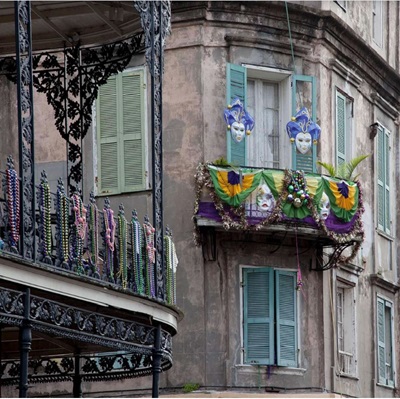
”One Night in New Orleans,” by Rebecca Watkins

The Sunday Poem is published weekly, and strives to include the poet reading their work.... Rebecca Watkins reads her poem at its conclusion


Click here to read previous editions of The Sunday Poem

Poetry

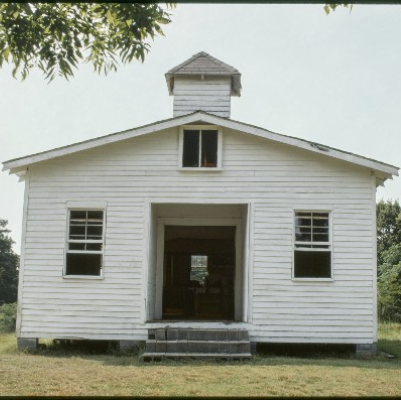
“Prayer” – a poem by Jianqing Zheng (after a photo by William Ferris)

Essay

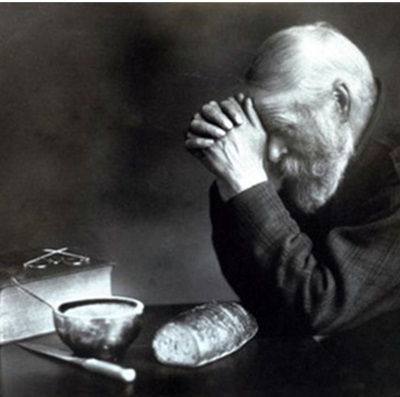
"Grace" by Erik Enstrom
Letter from the Editor/Happy Thanksgiving (a redux)...Connecting an old photograph owned since the 1970’s to gratitude for friends, family, artists, creators, website readers and contributors – (a redux)

Community

Calling All Poets…Submissions guidelines for the anthology “Black History in Poetry”...We are currently seeking poetry from writers of all backgrounds for Black History in Poetry, an anthology scheduled for publication in the Summer of 2026. The anthology will be a means of celebrating and honoring notable Black Americans by offering poetry that teems with imagery, observation, emotion, memory, testimony, insight, impact, and humanity. Our aim is to give readers a way to visualize Black history from a fresh perspective.

Poetry

Poems on Charlie “Bird” Parker (inspired by a painting by Al Summ) – an ekphrastic poetry collection...A collection of 25 poems inspired by the painting of Charlie Parker by the artist Al Summ.

Publisher’s Notes

A dispatch from Portland, 2025 – and Boston, 1969...Peaceful protest is nothing new to America. It is happening every day in Portland, where I live. It is what makes our country great. And those of us who grew up in the 1960’s probably have a history of protest – some turning violent – ourselves. The poet Russell Dupont shares text and photos from his experience while photographing the October, 1969 March against the [Vietnam] War in Boston, when plainclothes Federal officers attempted to confiscate his camera.

A Letter from the Publisher

The gate at Buchenwald. Photo by Rhonda R Dorsett
War. Remembrance. Walls.
The High Price of Authoritarianism– by editor/publisher Joe Maita
...An essay inspired by my recent experiences witnessing the ceremonies commemorating the 80th anniversary of liberation of several World War II concentration camps in Germany.

Feature

Memorable Quotes: Horace Greeley, on character...“Fame is a vapor, popularity an accident, and riches..."

Community

Nominations for the Pushcart Prize L (50)...Announcing the six writers nominated for the Pushcart Prize v. L (50), whose work appeared on the web pages of Jerry Jazz Musician or within print anthologies I edited during 2025.

Interview

Interview with Tad Richards, author of Listening to Prestige: Chronicling its Classic Jazz Recordings, 1949 – 1972...Richards discusses his book – a long overdue history of Prestige Records that draws readers into stories involving its visionary founder Bob Weinstock, the classic recording sessions he assembled, and the brilliant jazz musicians whose work on Prestige helped shape the direction of post-war music.

Poetry

"Swing Landscape" by Stuart Davis
“Swing Landscape” – a poem by Kenneth Boyd....Kenneth Boyd writes poetry based on jazz paintings. “Swing Landscape” is written for a Stuart Davis painting of the same name.

Jazz History Quiz

Jazz History Quiz #185...This posthumously-awarded Grammy winning musician/composer was the pianist and arranger for the vocal group The Hi-Lo’s (pictured) in the late 1950’s, and after working with Donald Byrd and Dizzy Gillespie became known for his Latin and bossa nova recordings in the 1960’s. He was also frequently cited by Herbie Hancock as a “major influence.” Who is he?

Short Fiction

Short Fiction Contest-winning story #69 – “My Vertical Landscape,” by Felicia A. Rivers...Touched by the stories of the Philadelphia jazz clubs of the 1960s, a graffiti artist transforms an ugly wall into something beautiful – meaningful, even.

Poetry

photo via Wikimedia Commons
Jimi Hendrix - in four poems

Playlist

A sampling of jazz recordings by artists nominated for 2026 Grammy Awards – a playlist by Martin Mueller...A playlist of 14 songs by the likes of Samara Joy, Brad Mehldau, Dee Dee Bridgewater, Branford Marsalis, the Yellowjackets and other Grammy Award nominees, assembled by Martin Mueller, the former Dean of the New School of Jazz and Contemporary Music in New York.

Poetry

Ukberri.net/Uribe Kosta eta Erandioko agerkari digitala, CC BY 2.0, via Wikimedia Commons
In Memoriam: “Color Wheels” – a poem (for Jack DeJohnette) by Mary O’Melveny

Short Fiction

“Alas, for My Poor Heart” – a short story by Daryl Rothman...The story – a short-listed entry in the recently concluded 69th Short Fiction Contest – concerns art and its truest meanings—where you just might have to look twice at what the shadow and light of a piece says about that within your soul.

Essay

“Escalator Over the Hill – Then and Now” – by Joel Lewis...Remembering the essential 1971 album by Carla Bley/Paul Haines, inspired by the writer’s experience attending the New School’s recent performance of it

Poetry

“Still Wild” – a collection of poems by Connie Johnson...Connie Johnson’s unique and warm vernacular is the framework in which she reminds readers of the foremost contributors of jazz music, while peeling back the layers on the lesser known and of those who find themselves engaged by it, and affected by it. I have proudly published Connie’s poems for over two years and felt the consistency and excellence of her work deserved this 15 poem showcase.

Feature

photo of Barry Harris by Mirko Caserta
“With Barry Harris at the 11th Street Bar” – a true jazz story by Henry Blanke...The writer - a lifelong admirer of the pianist Barry Harris - recalls a special experience he had with him in 2015

Short Fiction

publicdomainpictures.net
“Corkscrew” – a short story by Mike Wilson...The story – a short-listed entry in the recently concluded 69th Short Fiction Contest – is about a night when everything goes wrong and everyone is annoying, an unexpected turn of events teaches a sarcastic lawyer that the old adage is true – a cynic is just a disappointed romantic.

Interview

Interview with Sascha Feinstein, author of Writing Jazz: Conversations with Critics and Biographers...The collection of 14 interviews is an impressive and determined effort, one that contributes mightily to the deepening of our understanding for the music’s past impact, and fans optimism for more.

Feature

Trading Fours, with Douglas Cole, No. 27: “California Suite”...Trading Fours with Douglas Cole is an occasional series of the writer’s poetic interpretations of jazz recordings and film. This edition is dedicated to saxophone players and the mood scenes that instrument creates.

Short Fiction

photo by Simon Webster
“Smoke Rings and Minor Things” – a short story by Jane McCarthy...The story – a short-listed entry in the recently concluded 69th Short Fiction Contest – is a meditation on missed chances, minor keys, and the music that outlives the room it was played in.

Essay

“J.A. Rogers’ ‘Jazz at Home’: A Centennial Reflection on Jazz Representation Through the Lens of Stormy Weather and Everyday Life – an essay by Jasmine M. Taylor...The writer opines that jazz continues to survive – 100 years after J.A. Rogers’ own essay that highlighted the artistic freedom of jazz – and has “become a fundamental core in American culture and modern Americanism; not solely because of its artistic craftsmanship, but because of the spirit that jazz music embodies.”

Community

photo of Dwike Mitchell/Willie Ruff via Bandcamp
“Tell a Story: Mitchell and Ruff’s Army Service” – an essay by Dale Davis....The author writes about how Dwike Mitchell and Willie Ruff’s U.S. Army service helped them learn to understand the fusion of different musical influences that tell the story of jazz.

Feature

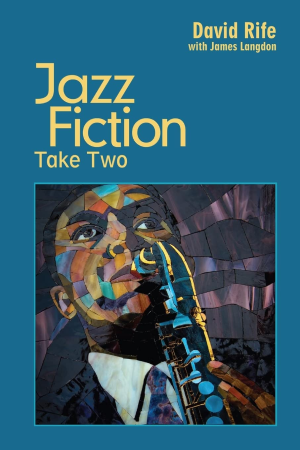
Excerpts from David Rife’s Jazz Fiction: Take Two– Vol. 16: Halloween on Mars? Or…speculative jazz fiction...A substantial number of novels and stories with jazz music as a component of the story have been published over the years, and the scholar David J. Rife has written short essay/reviews of them. In this 16th edition featuring excerpts from his outstanding literary resource, Rife writes about azz-inflected speculative fiction stories (sci-fi, fantasy and horror)

Poetry

“With Ease in Mind” – poems by Terrance Underwood...It’s no secret that I’m a fan of Terrance Underwood’s poetry. I am also quite jealous of his ease with words, and of his graceful way of living, which shows up in this collection of 12 poems.

Poetry

What is This Path – a collection of poems by Michael L. Newell...A contributor of significance to Jerry Jazz Musician, the poet Michael L. Newell shares poems he has written since being diagnosed with a concerning illness.

Playlist

“Look Ma, No Net!” – a playlist of nonets, by Bob Hecht...In this episode of our progressive instrumentation playlists, we add a ninth instrument to the mix to form a Nonet!

Art

photo by Giovanni Piesco
The Photographs of Giovanni Piesco: Art Farmer and Benny Golson...Beginning in 1990, the noted photographer Giovanni Piesco began taking backstage photographs of many of the great musicians who played in Amsterdam’s Bimhuis, that city’s main jazz venue which is considered one of the finest in the world. Jerry Jazz Musician will occasionally publish portraits of jazz musicians that Giovanni has taken over the years. This edition features the May 10, 1996 photos of the tenor saxophonist, composer and arranger Benny Golson, and the February 13, 1997 photos of trumpet and flugelhorn player Art Farmer.

Community

Community Bookshelf #5...“Community Bookshelf” is a twice-yearly space where writers who have been published on Jerry Jazz Musician can share news about their recently authored books and/or recordings. This edition includes information about books published within the last six months or so (March, 2025 – September, 2025)

Contributing Writers

Click the image to view the writers, poets and artists whose work has been published on Jerry Jazz Musician, and find links to their work

Coming Soon

Interview with John Gennari, author of The Jazz Barn:  Music Inn, the Berkshires, and the Place of Jazz in American Life; Also, a new Jazz History Quiz, and lots of short fiction; poetry; photography; interviews; playlists; and much more in the works......  Also, a new Jazz History Quiz, and lots of short fiction; poetry; photography; interviews; playlists; and much more in the works...

Interview Archive

Ella Fitzgerald/IISG, CC BY-SA 2.0 , via Wikimedia Commons
Click to view the complete 25-year archive of Jerry Jazz Musician interviews, including those recently published with Judith Tick on Ella Fitzgerald (pictured),; Laura Flam and Emily Sieu Liebowitz on the Girl Groups of the 60's; Tad Richards on Small Group Swing; Stephanie Stein Crease on Chick Webb; Brent Hayes Edwards on Henry Threadgill; Richard Koloda on Albert Ayler; Glenn Mott on Stanley Crouch; Richard Carlin and Ken Bloom on Eubie Blake; Richard Brent Turner on jazz and Islam; Alyn Shipton on the art of jazz; Shawn Levy on the original queens of standup comedy; Travis Atria on the expatriate trumpeter Arthur Briggs; Kitt Shapiro on her life with her mother, Eartha Kitt; Will Friedwald on Nat King Cole; Wayne Enstice on the drummer Dottie Dodgion; the drummer Joe La Barbera on Bill Evans; Philip Clark on Dave Brubeck; Nicholas Buccola on James Baldwin and William F. Buckley; Ricky Riccardi on Louis Armstrong; Dan Morgenstern and Christian Sands on Erroll Garner; Maria Golia on Ornette Coleman.