
“Bella by Barlight” — a short story by Steve Young

September 28th, 2020

.

.

“Bella by Barlight,” a story by Steve Young, was a short-listed entry in our recently concluded 54th Short Fiction Contest. It is published with the permission of the author

.

.

photo by-crosspraha- / CC BY-SA

Crossbasebar

.


Bella by Barlight

by Steve Young

.

___

,

…..The Pocono Lounge, in the basement behind the double doors on Temple and Broadway in downtown Los Angeles, was where, at age eighteen, I first became acquainted with “Stella By Starlight.”  One night some drunk put the music up on the stand, but he had a speech impediment or was not long off the boat and couldn’t speak English too well. He called it “Bella By Barlight,” and the name stuck. At the time, we played it straight through from beginning to end, with me yelling out the changes to Fatso Wong Louie, my bass player, while Noky Mitsumi faked it with brushes. It was an unusual tune, with a touch of chaos to it and intrigued me, so, tucked in the back pocket of my tux, I took the music home that night and tinkered with it in my spare time.

…..      The owner, Jimmy Lang, treated us badly, paid us peanuts, took to calling me his Number One Son, which would have gravely offended my dead parents, as I was Japanese, not Chinese. But what did I care back then, at eighteen? All you had to do in those days was point me toward a piano and I’d start playing, out of nervous habit, if nothing else. Occidentals had strange, demeaning ways but so did Orientals, especially the Japanese. We had Pearl Harbor to remember, too. Every year, December 7 would roll around and I’d want to hide under a rock.

…..        Besides, Lang’s place was irresistible to an eighteen year old. Lang had it tricked up like a bordello, with no place to rest your eyes on the walls or the floor or the ceiling that didn’t remind you of sex: oils of nude women lounging on couches, in stuffy, gilded frames, paintings of bowls of fruit, with phallic bananas and voluptuous, round melons above upside down triangles of grapes, wild animals cuffing playfully in the veld, and low-lit street corner scenes with the women in bright red lipstick always half in the shadows of dark buildings, half in the garish light of a lamppost.

…..     The bar consisted of three sides of a square, with a great oak top with Indianhead nickels and playing cards beneath the shellac and three-legged wooden stools in front. The counter was attended by a bartender per side, each of them aproned, bald, terse and harried. And everywhere, cigarette and cigar smoke drifted in a gray/blue cloud above our heads like poison gas. There were Boa feathers draped around the room, on the paintings and barrel taps and the Bosendorfer upright. For all I knew, it might have really been a brothel. Somewhere close by, behind some door, there could have been an even more inner inner sanctum. It would occur to me not without a trace of pleasure, from time to time: I’d become Kenneth Agaki, whorehouse pianist.

…..The patrons were all tone deaf, every last one of them, Oriental or Occidental. Maybe alcohol did that, especially gin, I noticed, or maybe it was all that sex or the reek of it in the air. They came in slick and primped, past Mr. Gee the Chinese doorman, the women sequined, pinned, bobbed, the men buttoned up, tidied up, in slate gray or pinstriped suits. All of them were undressed by the gin. The women slatternly, crude and loud; the men boisterous, belligerent, sleazy, on the edge of violence. It was as if their animal selves beneath the finery rose to the surface, took over, like a ventriloquist’s dummy taking over the body of the ventriloquist, emitting shrill chatter, and high artificial soprano laughter. All night they’d revolve drunkenly on the dance floor, and request numbers. I’d look deeply into their torsos while they made their appeals to me. They wanted to hear only the most popular tunes, of course, the real lemonade music, Tin Pan Alley crap: “Oh Johnny Oh”, “A Sunbonnet Blue”, “A Sentimental Gentleman from Georgia.”

…..We’d play and play, through it all, above and below the racket of those voices yakking at us and around us and nobody really listening. We’d play with ties and tuxes on and good-natured smiles.  The corseted torsos approached and receded, and we’d sometimes play “As Time Goes By” eleven or twelve times a night. Noky never could hold his liquor, and by the sixth set he’d start dropping bombs in the middle of slow numbers, but nobody noticed or cared but me, and by that time of night I didn’t really care either.

…..  One night a man wearing a brown and yellow checkered vest over a large stomach threatened to punch my lights out if I didn’t play “Down By the Sheltering Palms.” He shouted over the din into my ear that it was for his girl, who used to live in Florida. I tried to explain that I didn’t know the song, had never heard of it, but that just made him mad. He was smoking a cigar, a foul-smelling thick black tube, glowing red in the dark, and it almost burned a hole in my tux, that’s how close he was to me. His face was pock-marked and puffy and his hair had receded to a coil of gray curls at the top of his head. He smelled of gin and tobacco and spice cologne and something else underneath so diseased and rank I almost gagged.

…..“It’s for my baby, you slant-eyed bastard. She’s standing over there waiting to dance with me, see, and if you don’t play it, I’ll look like a dunce and she won’t go out with me again.” I was used to hearing biographies like this a dozen times or more a night, but this guy I couldn’t fix up, even if I’d happened to know the damn song. He was a loser and both of us knew it and she probably already knew it too, and there wasn’t much else to say about it. Out of curiosity, I glanced around his bulk, to find out what she looked like and also to stall for time.

….. There she was, alright, not ten feet away. She was Filipino, very young and tiny-boned, with olive skin, shiny dark hair. She wore a sleeveless flowered dress that stuck out on account of its ugliness; she looked like one of those mail-order brides, in fact.  She smiled at me sweetly, shyly, revealing the gap between her two front teeth. I think it was the gap I fell in love with, or the ugly dress, or the smile; I don’t know what it was exactly but all breath left me and I found myself staring at her, too long. Her boyfriend finally tapped me on the shoulder, hard. I could feel the heat of his cigar in my ear.

…..“Hey, Chinaman, don’t take a picture or nothing.”

….. “She’s beautiful,” I blurted out.

…..          “Yeah,” he replied heavily, as if the fact didn’t make him happy, not happy at all.

…..We finally settled on the “Miami Rag,” the only song about Florida I knew, and he bounced her clumsily around the floor for a few minutes, like he was holding a ragdoll, and then disappeared with her into the crowd. I forgot about them until during a break, on the way to the can, I saw them sitting awkwardly by themselves around one of the tiny round black tables in back. He waved his arm toward me, a sweeping, drunken gesture I was inclined to ignore. I made it a rule not to mingle with the patrons if I could avoid it. But she was there, in her flowered dress, smiling that sweet, shy smile. So I went over and said hello.

….. “You play beautiful,” she said to me, in a formal, polite way that made it sound as if she’d practiced the words. I introduced myself. She said her name was Maria. His, it turned out, was Frank.

…..Neither said anything about pulling up a chair, so I stood over them and the silence grew in a few seconds until it was about to go malignant. Frank said nothing, but there was something in the way he looked at me that made me think he wanted me there, desperately, like he was gripping my arm for dear life. More for his sake than my own, I said to Maria, “So you’re from Florida. Nice state, I hear.”

…..“Oh yes, nice state. Family there,” she said and smiled, revealing her gap again. Our eyes met and I thought I spied deep within those dark brown irises a flicker of both anguish and excitement. Save me, she seemed to be begging me, Save me from him.

…..But then she placed one of her lovely, tiny, olive-skinned hands on top of Frank’s giant, scaly, nicotine-stained paw and gave it a slight squeeze. In this small gesture, I saw the truth: she wasn’t repelled by this man. Rather, she was intoxicated by his American skin. She clung to it, as vulgar and mottled and diseased as it was. His worries were for nothing; she would never leave him. Or at least I could never take her away. She pitied me, and yearned only for her own transformation.

…..By then Noky was tapping the drums impatiently. Even Fatso Louie, whom I usually had to fetch from a broom closet in the back of the kitchen, where he went to smoke reefer between sets, was noodling on the bass. There seemed little else to say, anyway. I said goodbye to Maria and Frank and that was the end of that.

…..In the men’s room, over the urinal, scrawled in ball-point pen were the words: “For a good time, call Bambi,” and a phone number I almost had memorized. This time, I wrote it down on my palm so I wouldn’t forget.

At four AM, I went home to my second-floor walk-up on Los Angeles Street, stepping past the Chinese bums lying in the gutter and in the hallway. In my studio apartment, I picked up the phone and dialed Bambi’s number. I let it ring a dozen, two dozen times before I gave up. Then I practiced “Bella By Barlight,” in all twelve keys, on my Baldwin spinet, the soundboard muted by a wool blanket and two pillows. Over and over I played those dense, impenetrable chords, until the light of dawn crept through the cracks in my shades and I simply fell asleep at the bench.


.

___


.
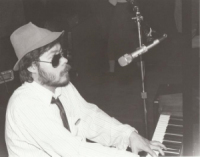
Steve Young has an MFA in Fiction from Vermont College of Fine Arts. He has published nineteen short stories including in recent issues of the  Saturday Evening Post,  The Wild Word, Barren Magazine, and Woven Tale Press.  Two of his stories have been nominated for the Pushcart Prize and BASS.   Young grew up in Vermont and is an award-winning radio journalist (over 150 stories filed with NPR). He now lives and writes in Albuquerque, New Mexico. He plays jazz piano, is half-Japanese, half-Irish and is sight-impaired. 

.

.

Listen to Bud Powell play “Stella by Starlight”

.

.

Click here  for details on our upcoming Short Fiction Contest

.

Click here  to read “A Failed Artist’s Paradise” by Nathaniel Whelan, the winning story in the 54th  Jerry Jazz Musician  Short Fiction Contest

.

.

.
Share this:

Comment on this article:

Your email address will not be published. Required fields are marked *

Site Archive

Your Support is Appreciated

Jerry Jazz Musician has been commercial-free since its inception in 1999. Your generous donation helps it remain that way. Thanks very much for your kind consideration.

Click here to read about plans for the future of Jerry Jazz Musician.

In this Issue

A collection of poetic responses to the events of 2025...Forty poets describe their experiences with the tumultuous events of 2025, resulting in a remarkable collection of work made up of writers who may differ on what inspired them to participate, but who universally share a desire for their voice to be heard amid a changing America.

Poetry

photo by William Gottlieb/design by Rhonda R. Dorsett
21 jazz poems on the 21st of November, 2025...An ongoing series designed to share the quality of jazz poetry continuously submitted to Jerry Jazz Musician. This edition features poems communicating the emotional appeal of jazz music, as well as nods to the likes of Miles Davis, Regina Carter, Maynard Ferguson, Ornette Coleman, and Max Roach.

The Sunday Poem

photo by William Gottlieb/Library of Congress

”Snowfall” by Bernard Saint

The Sunday Poem is published weekly, and strives to include the poet reading their work....

Bernard Saint reads his poem at its conclusion


Click here to read previous editions of The Sunday Poem

Short Fiction

photo via Freerange/CCO
Short Fiction Contest-winning story #70 – “The Sound of Becoming,” by J.C. Michaels...The story explores the inner life of a young Southeast Asian man as he navigates the tension between Eastern tradition and Western modernity.

Feature

Linnaea Mallette/publicdomainpictures.net
A 2026 jazz poetry calendar...12 individual poets contribute a jazz-themed poem dedicated to a particular month, resulting in a 2026 calendar of jazz poetry that winds through the year with a variety of poetic styles and voices who share their journeys with the music, tying it into the month they were tasked to interpret. Along the way you will encounter the likes of Sonny Stitt, Charles Mingus, Jaco Pastorius, Wynton Kelly, John Coltrane, and Nina Simone.

Poetry

“To Renee Nicole Good, a poet” – a poem by Erren Geraud Kelly

Community

Calling All Poets…Submissions guidelines for the anthology “Black History in Poetry”...We are currently seeking poetry from writers of all backgrounds for Black History in Poetry, an anthology scheduled for publication in the Summer of 2026. The anthology will be a means of celebrating and honoring notable Black Americans by offering poetry that teems with imagery, observation, emotion, memory, testimony, insight, impact, and humanity. Our aim is to give readers a way to visualize Black history from a fresh perspective.

Poetry

photo via Shutterstock
“The Music of Lana’i Lookout” – a poem by Robert Alan Felt...The 17th anniversary of president-elect Barack Obama's scattering of his beloved grandmother's ashes is at the center of the poem, and serves as a reminder that moral personal character of leadership is what makes a country great.

Poetry

Poems on Charlie “Bird” Parker (inspired by a painting by Al Summ) – an ekphrastic poetry collection...A collection of 25 poems inspired by the painting of Charlie Parker by the artist Al Summ.

Community

Letter from the Editor: “A Jerry Jazz Musician Experience”...Sharing a bit of what I’ve been up to of late, and make you aware of a new endeavor of mine…

Poetry

National Archives of Norway, CC BY 4.0 , via Wikimedia Commons
“Wonderful World” – a poem by Dan Thompson

Feature

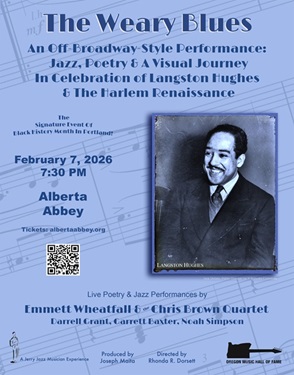
Press Release for “The Weary Blues: Celebrating The Harlem Renaissance and Langston Hughes...I recently wrote about a new endeavor of mine – producing a show in Portland celebrating the poetry of Langston Hughes and the Harlem Renaissance. What follows is the complete press release for the February 7 performance at the Alberta Abbey in Portland, Oregon.

A Letter from the Publisher

The gate at Buchenwald. Photo by Rhonda R Dorsett
War. Remembrance. Walls.
The High Price of Authoritarianism– by editor/publisher Joe Maita
...An essay inspired by my recent experiences witnessing the ceremonies commemorating the 80th anniversary of liberation of several World War II concentration camps in Germany.

Poetry

Wikimedia Commons
“Dorothy Parker, an Icon of the Jazz Age” – a poem by Jane McCarthy

Feature

Memorable Quotes: Horace Greeley, on character...“Fame is a vapor, popularity an accident, and riches..."

Short Fiction

“Frusick: Making Sweeter Music” – a short story by J. W. Wood...In the 22nd century, a medical professional takes a bunch of kids to meet one of the last musicians left in England, and has an epiphany when he hears live music for the first time …

Community

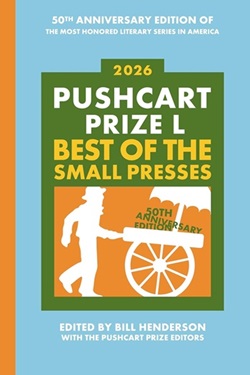
Nominations for the Pushcart Prize L (50)...Announcing the six writers nominated for the Pushcart Prize v. L (50), whose work appeared on the web pages of Jerry Jazz Musician or within print anthologies I edited during 2025.

Interview

Interview with Tad Richards, author of Listening to Prestige: Chronicling its Classic Jazz Recordings, 1949 – 1972...Richards discusses his book – a long overdue history of Prestige Records that draws readers into stories involving its visionary founder Bob Weinstock, the classic recording sessions he assembled, and the brilliant jazz musicians whose work on Prestige helped shape the direction of post-war music.

Poetry

"Swing Landscape" by Stuart Davis
“Swing Landscape” – a poem by Kenneth Boyd....Kenneth Boyd writes poetry based on jazz paintings. “Swing Landscape” is written for a Stuart Davis painting of the same name.

Playlist

“A Perfect 10” – a playlist of tentets by Bob Hecht...Bob adds another instrument to his progressive playlist feature, and shares what a variety of arrangers have been able to accomplish writing for a tentet.

Jazz History Quiz

Jazz History Quiz #185...This posthumously-awarded Grammy winning musician/composer was the pianist and arranger for the vocal group The Hi-Lo’s (pictured) in the late 1950’s, and after working with Donald Byrd and Dizzy Gillespie became known for his Latin and bossa nova recordings in the 1960’s. He was also frequently cited by Herbie Hancock as a “major influence.” Who is he?

Poetry

photo via Wikimedia Commons
Jimi Hendrix - in four poems

Playlist

A sampling of jazz recordings by artists nominated for 2026 Grammy Awards – a playlist by Martin Mueller...A playlist of 14 songs by the likes of Samara Joy, Brad Mehldau, Dee Dee Bridgewater, Branford Marsalis, the Yellowjackets and other Grammy Award nominees, assembled by Martin Mueller, the former Dean of the New School of Jazz and Contemporary Music in New York.

Poetry

Ukberri.net/Uribe Kosta eta Erandioko agerkari digitala, CC BY 2.0, via Wikimedia Commons
In Memoriam: “Color Wheels” – a poem (for Jack DeJohnette) by Mary O’Melveny

Essay

“Escalator Over the Hill – Then and Now” – by Joel Lewis...Remembering the essential 1971 album by Carla Bley/Paul Haines, inspired by the writer’s experience attending the New School’s recent performance of it

Poetry

“Still Wild” – a collection of poems by Connie Johnson...Connie Johnson’s unique and warm vernacular is the framework in which she reminds readers of the foremost contributors of jazz music, while peeling back the layers on the lesser known and of those who find themselves engaged by it, and affected by it. I have proudly published Connie’s poems for over two years and felt the consistency and excellence of her work deserved this 15 poem showcase.

Feature

photo of Barry Harris by Mirko Caserta
“With Barry Harris at the 11th Street Bar” – a true jazz story by Henry Blanke...The writer - a lifelong admirer of the pianist Barry Harris - recalls a special experience he had with him in 2015

Interview

Interview with Sascha Feinstein, author of Writing Jazz: Conversations with Critics and Biographers...The collection of 14 interviews is an impressive and determined effort, one that contributes mightily to the deepening of our understanding for the music’s past impact, and fans optimism for more.

Feature

Trading Fours, with Douglas Cole, No. 27: “California Suite”...Trading Fours with Douglas Cole is an occasional series of the writer’s poetic interpretations of jazz recordings and film. This edition is dedicated to saxophone players and the mood scenes that instrument creates.

Essay

“J.A. Rogers’ ‘Jazz at Home’: A Centennial Reflection on Jazz Representation Through the Lens of Stormy Weather and Everyday Life – an essay by Jasmine M. Taylor...The writer opines that jazz continues to survive – 100 years after J.A. Rogers’ own essay that highlighted the artistic freedom of jazz – and has “become a fundamental core in American culture and modern Americanism; not solely because of its artistic craftsmanship, but because of the spirit that jazz music embodies.”

Community

photo of Dwike Mitchell/Willie Ruff via Bandcamp
“Tell a Story: Mitchell and Ruff’s Army Service” – an essay by Dale Davis....The author writes about how Dwike Mitchell and Willie Ruff’s U.S. Army service helped them learn to understand the fusion of different musical influences that tell the story of jazz.

Feature

Excerpts from David Rife’s Jazz Fiction: Take Two– Vol. 16: Halloween on Mars? Or…speculative jazz fiction...A substantial number of novels and stories with jazz music as a component of the story have been published over the years, and the scholar David J. Rife has written short essay/reviews of them. In this 16th edition featuring excerpts from his outstanding literary resource, Rife writes about azz-inflected speculative fiction stories (sci-fi, fantasy and horror)

Poetry

“With Ease in Mind” – poems by Terrance Underwood...It’s no secret that I’m a fan of Terrance Underwood’s poetry. I am also quite jealous of his ease with words, and of his graceful way of living, which shows up in this collection of 12 poems.

Poetry

What is This Path – a collection of poems by Michael L. Newell...A contributor of significance to Jerry Jazz Musician, the poet Michael L. Newell shares poems he has written since being diagnosed with a concerning illness.

Art

photo by Giovanni Piesco
The Photographs of Giovanni Piesco: Art Farmer and Benny Golson...Beginning in 1990, the noted photographer Giovanni Piesco began taking backstage photographs of many of the great musicians who played in Amsterdam’s Bimhuis, that city’s main jazz venue which is considered one of the finest in the world. Jerry Jazz Musician will occasionally publish portraits of jazz musicians that Giovanni has taken over the years. This edition features the May 10, 1996 photos of the tenor saxophonist, composer and arranger Benny Golson, and the February 13, 1997 photos of trumpet and flugelhorn player Art Farmer.

Community

Community Bookshelf #5...“Community Bookshelf” is a twice-yearly space where writers who have been published on Jerry Jazz Musician can share news about their recently authored books and/or recordings. This edition includes information about books published within the last six months or so (March, 2025 – September, 2025)

Contributing Writers

Click the image to view the writers, poets and artists whose work has been published on Jerry Jazz Musician, and find links to their work

Coming Soon

Interview with John Gennari, author of The Jazz Barn:  Music Inn, the Berkshires, and the Place of Jazz in American Life; Also, a new Jazz History Quiz, and lots of short fiction; poetry; photography; interviews; playlists; and much more in the works...

Interview Archive

Ella Fitzgerald/IISG, CC BY-SA 2.0 , via Wikimedia Commons
Click to view the complete 25-year archive of Jerry Jazz Musician interviews, including those recently published with Judith Tick on Ella Fitzgerald (pictured),; Laura Flam and Emily Sieu Liebowitz on the Girl Groups of the 60's; Tad Richards on Small Group Swing; Stephanie Stein Crease on Chick Webb; Brent Hayes Edwards on Henry Threadgill; Richard Koloda on Albert Ayler; Glenn Mott on Stanley Crouch; Richard Carlin and Ken Bloom on Eubie Blake; Richard Brent Turner on jazz and Islam; Alyn Shipton on the art of jazz; Shawn Levy on the original queens of standup comedy; Travis Atria on the expatriate trumpeter Arthur Briggs; Kitt Shapiro on her life with her mother, Eartha Kitt; Will Friedwald on Nat King Cole; Wayne Enstice on the drummer Dottie Dodgion; the drummer Joe La Barbera on Bill Evans; Philip Clark on Dave Brubeck; Nicholas Buccola on James Baldwin and William F. Buckley; Ricky Riccardi on Louis Armstrong; Dan Morgenstern and Christian Sands on Erroll Garner; Maria Golia on Ornette Coleman.