



.
.

.
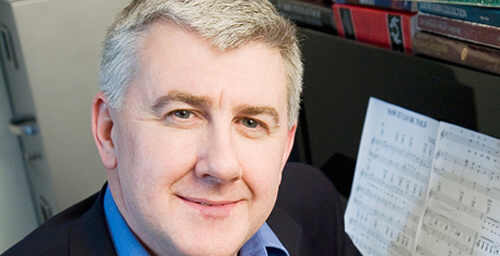
Jeffrey Magee,
author of
Fletcher Henderson and Big Band Jazz:
The Uncrowned King of Swing
.
.
___
.
.
…..If Benny Goodman was the “King of Swing,” then Fletcher Henderson was the power behind the throne. Not only did Henderson arrange the music that powered Goodman’s meteoric rise, he also helped launch the careers of Louis Armstrong and Coleman Hawkins, among others. In Fletcher Henderson and Big Band Jazz: The Uncrowned King of Swing, Jeffrey Magee offers a fascinating account of this pivotal bandleader, throwing new light on the emergence of modern jazz and the world that created it.

 …..Drawing on an unprecedented combination of sources, including sound recordings, obscure stock arrangements, and hundreds of scores that have been available only since Goodman’s death, Magee illuminates Henderson’s musical output, from his early work as a New York bandleader, to his pivotal role in building the Kingdom of Swing. He shows how Henderson, standing at the forefront of the New York jazz scene during the 1920s and ’30s, assembled the era’s best musicians, simultaneously preserving jazz’s distinctiveness and performing popular dance music that reached a wide audience.
…..Magee reveals how, in Henderson’s largely segregated musical world, black and white musicians worked together to establish jazz, how Henderson’s style rose out of collaborations with many key players, how these players deftly combined improvised and written music, and how their work negotiated artistic and commercial impulses. And Magee reveals how, in the depths of the Depression, record producer John Hammond brought together Henderson and Goodman, a fortuitous collaboration that changed the face of American music.#
…..In a January 17, 2005 interview with Jerry Jazz Musician publisher Joe Maita, Magee discusses the career of this monumental musician who helped shape an entire musical era.
.
.
___
.
.

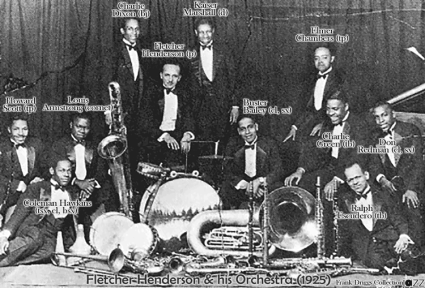
Fletcher Henderson and His Orchestra, 1925
.
___
.
“The sheer quantity of recordings by Henderson’s band, and the record labels for which it recorded, reveal that Henderson’s brand of dance music was a commercially viable product. That a black band could make dozens of recordings outside the domain of ‘race records’ marks a major achievement in the early 1920s. The early recordings of Henderson’s band are usually interpreted on stylistic grounds alone and found lacking jazz interest. Seen collectively as a rare feat for a black band, however, they stand as an important legacy of the possibilities of black culture in the period.”
– Jeffrey Magee
.
___
.
JJM Concerning the goal of your book, you wrote, “It aims to redefine Henderson’s role in American music through an analysis of the primary source materials embedded in the historical circumstances of their creation, including the Great Migration of African Americans from the rural South to the urban North, the Harlem Renaissance, the dissemination of jazz and dance music through radio, records and touring, the consolidation of the music industry in the hands of white agents and bookers, and American popular music and culture of the 1920s and 1930s.” Why was Fletcher Henderson a particularly good figure for this sort of study?
JM I can’t claim that this was the reason I began this work — I wanted to write about the music, period. But as the work developed, I came to see him as this wonderful representative of the era. So many great musicians passed through his band — Louis Armstrong, Coleman Hawkins, Don Redman, Benny Carter — and because he also worked as Benny Goodman’s arranger, the key figures of the era crossed paths with him in a very significant way. On top of that, his career very neatly intersects with all the other cultural phenomena of the era. Radio, for example, was just taking off when he arrived in New York City, and by the end of the twenties, his band reached its height of prestige just as everyone got a radio in their home, which helped disseminate his music on an unprecedented scale. At the same time, more sound recordings were being made and race records were beginning to find success. So, his career overlaps nicely with the rise of these media as disseminators of music in general, and black music in particular. He is a kind of lightning rod for these currents.
The other dimension he intersected, of course, is racial. Although the Harlem Renaissance is more often viewed as a literary and artistic phenomenon, and less so as a music phenomenon, he intersected with its ideals. It was an era when whites wanted black music to sound black, and their vocabulary of growl effects, bent pitches, the twelve-bar chord progression, and vocal effects through the horn is what white listeners craved. But it also had a narrowing effect on what black musicians could do in the public arena.
JJM You suggest that his versatility and professionalism served to foil the stereotypes of black musicians of that era.
JM Yes. Henderson’s band had a way of keeping open the musical possibilities. They were known for playing waltzes at Roseland Ballroom and for playing arrangements of the classics, and in doing that, they were constantly foiling efforts to put them in some kind of stylistic and racial box, which was very confining to musicians of that time.
JJM Henderson was born and raised in Georgia. How did he wind up in New York?
JM He graduated from college in 1920, and from everything I have seen his intent was to attend graduate school at Columbia University.
JJM To study science?
JM Possibly. He may have wanted to become a chemist working for a pharmaceutical company. I am not sure what he had in mind, but I have always wondered how seriously he really intended to go to graduate school to become a scientist. His parents probably saw the move as acceptable for two reasons; the first being the promise of higher education, which was extremely important to them, and the second was that they knew people in New York. A former teacher at his father’s school lived in New York, and he lived with her for a short time, and he had contacts with people like Harry Pace, who was a famous Atlanta University graduate and who, with W.C. Handy, became his first employer in New York. So, he had the promise of higher education at a great institution, and high quality contacts.
JJM Once he was connected with Pace, Henderson sort of rode the choices that Pace made in his own career. How did those choices affect Henderson’s career?
JM Pace was in the publishing business for a time with W.C. Handy. Being a very savvy businessman, Pace immediately saw the commercial potential for recorded music, and felt that black music in particular was going to be very popular, but he wanted to record “cultivated” music, as Ethel Waters called it. So, Pace split off from Handy and formed the Pace Phonograph Corporation, which started by issuing Black Swan Records. Henderson came along at around this time and was employed in a variety of jobs; for example, he played piano for the singers and helped choose the repertoire to record. He served, in a way, as the label’s musical director. Since he was well educated and musically trained, I imagine that Pace saw him as a like-minded figure who could help lead this company to success.
JJM Concerning the kind of work that was available to black musicians of the era, you talk about the four tiers of where they came from. Would you talk a little about these tiers, and which of them did Henderson’s musicians come from?
JM The trumpeter Rex Stewart’s writings were a great source for me, because not only did he play in the Henderson band, but he was also a very careful observer of this music scene of the twenties and thirties. He writes about this four tier hierarchy for black musicians your question refers to. The Clef Club — the organization that James Reese Europe organized less than a decade before Henderson came to New York — was the top tier. If you were part of the Clef Club you could get the elite jobs, which at that time were playing for well-to-do white audiences in downtown hotels and ballrooms.
The second tier were the burlesque musicians. It may be surprising to find these musicians this high, but Stewart was not looking at musical quality so much as professional breadth, and since burlesque musicians got to tour all over the place, they made a bigger impact through touring far beyond New York City. To Stewart, traveling with a singer or a small band was a plum job because you got to tour around and your music got to be heard by more people than if you only played in New York.
The next tier is the large bands, of which Henderson’s was one, and also the bands of people like Sam Wooding, and some Chicago people like Dave Peyton and Doc Cook. This tier of musicians was a new phenomenon that was partly spawned by James Reese Europe’s success as a bandleader. The appeal for the musicians here was that, in order to be a member of these bands, you had to be able to read music as well as improvise. At this point, reading carried a lot of social importance, because it foiled the racial stereotypes — it demonstrated education, literacy, and a degree of discipline. The stereotype of the period held that blacks were natural musicians who just improvised everything, so, when they sat down in front of a music stand reading sheet music, it made a statement. It is hard to recapture that feeling now, of what that sheer visual impact would have meant. Many black musicians write about the importance of this in their memoirs.
The fourth tier belonged to the musicians playing in small clubs and cabarets, venues he called “penny a dance” halls, where men paid a penny to a woman known as a “taxi dancer” to dance with for a short period of time. This kind of job called for constantly changing repertoire, because the shorter the arrangement, the more they earned. It was great experience for the musicians, who were assigned all kinds of material to play on the spur of the moment. This wasn’t exactly a high-class job, however, because in some places the taxi dancers were basically glorified prostitutes. As a result, these jobs tended to be looked down upon as lower-class work.
JJM A “who’s who” of pre-modern jazz played with Henderson. How did he find the quality of talent for his band?
JM That’s a good question, and it’s tough to answer. His strongest instincts were as a bandleader, and for putting together a group of musicians who could bring things to his music. His arranging talent was probably a by-product of band leading, even though he became most famous as an arranger for Goodman. Some of the musicians he hired for his band may have been happened upon as if by accident. When he was touring with Ethel Waters and the Black Swan group in the early twenties, he heard people like Joe Smith and Louis Armstrong, and because they were well known locally, he approached them about playing. When you are leading a band in New York, you tend to know everybody, and everybody tends to know you, and as the twenties went on, everybody was raiding each other’s bands. But I think Henderson did have his ear out constantly for new talent, and his musical training made him particularly good at recognizing talent, and then approaching people about joining his band.
JJM You wrote that the first four years of Henderson’s band must be construed as the “Redman period.” What significance does Don Redman hold in the development of jazz?
JM When you read up on early jazz, he is frequently talked about as the first great jazz arranger. I have come to believe, however, that the qualities that made him unique have been overlooked in favor of the tried and true features like call and response, the separation of reeds and brass, and so on. Yes, he did all that, but what really leaps out to my ear when listening to those Redman period recordings with the Henderson band is this quick shifting among instruments and the sheer kaleidoscopic colors that he brought to popular song arrangements. When I look at stock arrangements of the period, I see how he would take a published sheet and just completely turn it upside down, rearranging its parts, juxtaposing sections in novel ways. It’s as if he was making a puzzle, or using stock arrangements as a playground for new ideas.
JJM Yes, you wrote, “For Redman, a piece of sheet music was not a road map but a playground or a puzzle whose parts could be altered, extended, truncated, and otherwise rearranged at will.”
JM Yes, and again, that gets back to the dimension of written music, and you can’t recognize what he did just by listening to recordings. His contribution really leaps out at you only when you listen to the recording while also looking at the stock arrangement, which you know he was using. It becomes a fascinating exercise to retrace the steps he took from the stock arrangement to the recording. For example, you may discover that he is using a middle section melody of the stock as an accompaniment of a soloist, or that he is writing a new interlude, or that he is modulating where the stock doesn’t modulate. So, he is doing all of these things that you can certainly pick up from listening to the recording alone — and it is fascinating to listen to — but it is even more fascinating when you look at the stock arrangement and the recording together, because you get a glimpse of the creative process involved.
JJM How did their work at the Roseland Ballroom shape their repertoire and the style they performed it in?
JM That gets back to the point about versatility. When you are playing for dancers, you have to have a command of a broad repertoire and a broad array of styles.
JJM And the dancers were generally an all white crowd, right?
JM Yes. In the downtown clubs during the twenties and thirties — which were pretty much hotel ballrooms — a black person had to be a celebrity to attend the clubs.
JJM So, Redman was writing arrangements to not only suit a white audience, but an upper-crust white audience?
JM The Roseland Ballroom was probably more of a middle-class venue that a wide social range went to. It was more populist than a place like the Club Alabam, where they started in the earlier twenties, or Connie’s Inn, where they played in the early thirties. The Roseland was a genteel place, not at all like the Savoy, where dynamic dancing took place. There was a place for hot music to be played there, but long head arrangements with extended improvisation did not work as well at the Roseland as they did at the Savoy.
JJM Whether they were playing for an upper or middle-class audience, it was a white audience, primarily, who were dancing to a black orchestra. As you wrote, Henderson’s orchestra “had to strike a balance between the exotic and the familiar,” and this setting must have certainly impacted how Redman wrote his charts and how the musicians performed.
JM Yes, and it started with the choice of repertoire they performed, which were the latest popular tunes from Tin Pan Alley publishers, who were right there in the heart of Manhattan. Broadway musicals, theater, and popular song publishing were all coalescing in the Times Square area, and the orchestra performed the latest tunes everyone knew from going to the shows or from seeing it in Tin Pan Alley sheet music. People recognized those popular tunes in a way that we don’t now, and the “exotic” thing was to cut and paste, as Redman did, so that they heard just snippets of the tune — a bit by the trombone here, the saxes come in over there, the trumpets pick it up for a minute, followed by a big, splashy cymbal shot by Kaiser Marshall. People recognized the tunes, but they certainly never heard them played quite this way before. I like to think of that sheet music as a kind of black and white sketch that Redman throws all this color on, and it comes to life in a way that people had never heard before in other renderings of these songs. Added to that are the vocabulary of blues and jazz effects that had strong associations with black musicians — growls, bent pitches, and the novelty instruments Redman liked to play, such as the kazoo and train whistles. It makes this vast sound world, as if Redman makes a two-dimensional piece into a three-dimensional piece.
JJM You used a quote by Henry Louis Gates to describe this, “resemblance by dissemblance”…
JM Right. That seemed like an apt quote. Gates is of course describing literature and oral traditions, but I think it is apt for written music, in this case.
JJM Henderson is known by most of us for a handful of things, one of the most prominent being that Louis Armstrong played with him. You wrote, “…upon his arrival in New York, Armstrong neither looked the part — nor quite played the part — of a downtown dance musician. The disparity between Armstrong and the rest of the band, at first an apparent liability, became a rich source of creative tension, ultimately pitting Redman’s arranging concept against the solo improvisational approach that Armstrong presented.” How did Redman cope with the impact of Armstrong joining Henderson’s orchestra?
JM In my hearing of it, since Redman is already aiming for maximum variety within an arrangement, Armstrong fit perfectly into this aesthetic of juxtaposition and contrast. Armstrong, therefore, becomes yet another weapon in the arsenal of variety. Most jazz historians make the claim that Armstrong’s is the only palatable voice in the band, and that he makes the rest of the band sound old-fashioned. Imagining this from the Henderson/Redman perspective, I believe that in Armstrong’s playing, they heard a unique sound they could add into their work, but it first had to be separated out. They deliberately set Armstrong off from the rest of the band, and you can hear that because the accompaniment changes underneath it. He starts to get what Rex Stewart called Western-style accompaniment, which was a simple backbeat. What is heard as that Armstrong era progresses — he was only with the band for thirteen months — is Redman integrating him inside the strains, so that instead of setting Armstrong off for an entire chorus, or strain, of the music, there is give and take between the band and Armstrong. So, right before he leaves, they do pieces like “T.N.T.,” and “Carolina Stomp,” where you hear Redman juxtaposing Armstrong against the rest of the band, more in dialogue than they had been in the recordings made right after Armstrong joined.
The whole band responds to Armstrong in different ways. You start to get a move from a kind of a vertical conception of an arrangement — blocks of sound for variety — to a more horizontal, linear conception, where you feel the whole arrangement surging forward. This is why so many writers and commentators talk about how Armstrong changed Henderson’s band forever from a dance band to a jazz band, but this happens very slowly, and in a way, I believe it takes off even more after Armstrong leaves.
JJM You say that Armstrong may have changed the way Coleman Hawkins played. Is there a song that best demonstrates this?
JM I think you can point to his famous solo on the 1926 recording of “Stampede.” Hawkins’s style changed so radically in the space of just three years, and he, above all, is the member of the Henderson band who is trying to absorb the model of Armstrong and make it his own. In 1923, he was playing solos that sound very old-fashioned now, where he is kind of running the chord changes up and down. It is a powerful sound, but it is more of a herky-jerky style. Three years later, in a piece like “Stampede,” he has a much more fluid, linear sense of how to construct a solo. You can hear little motifs stated and restated and developed over the course of a solo, and actual figures that Armstrong uses are being woven into Hawkins’s vocabulary, so it becomes very much an Armstrong inflected saxophone style.
JJM “Stampede” is the piece that the trumpeter Roy Eldridge copied…
JM That’s right. Eldridge played the Hawkins solo on trumpet, so it is an interesting give and take between brass and reeds. You have an Armstrong model being absorbed by a saxophonist and then copied by another trumpet player.
JJM Of Fletcher Henderson, Armstrong once said, “Fletcher didn’t dig me like Joe Oliver. He had a million dollar talent in his band and he never thought to let me sing.” Why didn’t he let Armstrong sing?
JM I don’t know the answer to that. He did sing a little bit, but it is pretty negligible. It may be that perhaps they were worried about Armstrong becoming the single star of the band. It also could be that jazz singing had yet to emerge as we now know it. While Armstrong was a key figure in developing jazz singing, it is possible that at the time his style may have tipped the balance toward novelty a bit too much. There was a kind of dignity about instrumental music that more singing might have compromised. While Henderson did make dozens of records with singers, it could be that he preferred to be known as an instrumental band that played hot dance music. Bringing more singing into that instrumental music conception would bring the sound too close to the race record sound that he was doing with singers like Bessie Smith and Alberta Hunter. As I say, I don’t have the answer, I am just thinking of this as you bring up this question.
JJM It is also possible that by the time Armstrong said this, it was easy to look back and say that Henderson missed out on his talent.
JM That’s right, because Armstrong’s reminiscing about this comes much later, and he tends to be very generous in his reminiscences.
JJM Armstrong’s wife ‘Lil Hardin wanted him to step away from Henderson because she felt he wasn’t being used properly.
JM Right. She had an idea that he could be a real solo star, and the leader of the band. She had a much more hardheaded business sense than Louis did.
JJM I love the story about Armstrong’s farewell party, when he left the band to return to Chicago. He got really drunk, apparently, and as he was saying goodbye to Henderson, he puked all over him.
JM I guess you could see that as an accident, or I guess you could imagine that it was a deliberate comment. [Laughs]. Armstrong, I am sure, would never admit it, but maybe that was part of the critique later, verbalized in that comment about singing.
JJM Henderson’s band, according to certain critics, took some severe setbacks in the early thirties. How did the critics differ in their evaluation of the post-Armstrong Henderson orchestra?
JM The way I read it is that the late twenties/early thirties Henderson band suffers from the same “retrospective perspective” that the early band did, and the reason is that they are playing a versatile repertoire for a largely white audience in an elite venue — Connie’s Inn, in particular — that does not translate as well into sound recordings for latter day listeners who have a notion in their minds about how jazz may have developed. So, the music is heard as being compromised, when in fact it is yet another manifestation of an asserted versatility that, in its time, was a mark of status and prestige.
JJM At this time, they were not only recording, but they were also on the radio a lot. Did his playing on the radio force him to paint a broad commercial stroke on everything he did?
JM I guess I don’t see it that way. Sure, his music was commercial, but everything was commercial. The hottest music they played was conceived and performed in a commercial environment. I don’t see that as his selling out or compromising as some writers have, as much as his knowing his audience. Once it is understood as an audience-centered value, he used his versatility and applied it to the situation he was given. I believe that is what Henderson was about. Later on, someone like Hawkins would feel confined by these audience-centered values because he wanted to develop the persona of a concert artist, but at the time, knowing and reaching your audience was a prized value. I don’t believe that at the time it was seen so much as a sell-out or commercial compromise as we might later.
As I got further into this, I was really struck by the breadth of the audiences that Henderson’s band was able to reach. He was one of the first black bands to play the prom circuit — from Yale to Princeton to the University of Kansas — while also firing up largely black audiences and dancers at the Savoy. Virtually every night, he played a different venue for a different audience. Too little is made of what incredible talent it takes to connect to your audience when it is changing that much.
JJM Regarding the disparity of the quality of live performances and recordings, Coleman Hawkins said, “We’d play this piece like mad. Come to work next night. We’d play it: wonderful. Maybe about two or three days later we’d go down to the studio to record it: horrible. Never would it come out right.” What do you make of that?
JM It speaks to this last issue we were just talking about, that playing for live audiences was a vital part of their music making. They responded to the crowd reactions to their music, and to the vibrations their dancing feet made on the floor. Dickie Wells talks about this. He said that when they could feel the dancers collectively pounding their feet on the floor, it served as a great inspiration to the musicians, resulting in a kind of symbiotic relationship. It was a feedback loop of sorts; the listeners and dancers got their energy from the music, and they reflected it back to the band. That feedback loop is missing in the recording studio, and I believe that what Hawkins is saying is that missing essential element affected the recordings.
JJM There are those who say that the sound quality of Henderson’s recordings aren’t as good as those of Ellington’s of the same period.
JM That is true to some extent. Henderson recorded for a lot of different record labels, and you can really hear the differences sometimes. In the late twenties, they recorded a series for a label called Harmony, and you can hear a kind of constricted, depthless sound coming out of them. But he also recorded for some of the best labels of the era — Victor and Columbia among them — so that didn’t strike me as big of an issue as the lack of having an audience while recording.
JJM There were quite a few changes that took place in the early-to-mid thirties period. Redman departed and was replaced by a series of arrangers — Benny Carter, and Henderson himself among them. Did Henderson begin to exert more control over the band at this point?
JM He got more involved in arranging, but I would have to say he exerted even less control over the band.
JJM Well, he didn’t seem to have any control over the band, and in fact, depending on who you asked, was a pretty awful bandleader.
JM In a conventional sense, yes, he was not a good bandleader. He was not a disciplinarian. For example, band members would show up at different times, and he would nod approvingly at a guy who showed up late but who would play a good solo. This irked people in the band — his brother Horace in particular had a problem with that, because he was more serious about the business of bandleading. On the other hand, the guitarist Lawrence Lucie said he liked Henderson’s leadership style, and how Henderson loved hearing the band play. He must have had some kind of aura that his musical training, experience, prestige, and talent gave off, because when he approved of a musician, it lit the musician up. Lucie said that they fed off of each other’s excitement for playing in the band.
Coleman Hawkins is “Exhibit A” of a guy who would show up late for work, yet Henderson let it happen night after night because he played great. Even John Hammond, who was always frustrated by Henderson’s lack of discipline and authority over his band, had to admit that somehow the band would play with more fire when Henderson just let them do what they wanted. It is hard to say that he should have done anything differently. If he did, it would have been a different band, and we might not have had the fiery performances and the great solos his attitude may have fostered.
JJM How did he end up being Benny Goodman’s arranger?
JM This is one of the most fascinating moments in this whole story of Henderson, and is right up there in the top ten of great moments in jazz and popular music history. In 1934, Henderson’s band is struggling a bit. They were on the road, in Detroit, and by contemporary accounts were doing quite well with the crowds at the Grand Ballroom. But, for some reason, Henderson is either not getting paid, or if he is, he is not paying his musicians. They are left without money, and the band has to scrounge up enough money for bus fare back to New York. The band dissolves, and Henderson is now a bandleader without a band. He also returns to New York and attempts to keep a band together. During this time, he and his wife work together on arrangements, and a competition heats up between he and his brother Horace, who is leading a different band practically across the street from Fletcher.
At this same time, in late November/early December of 1934, Benny Goodman is hired to play on a radio program called “Let’s Dance.” He is in need of musical arrangements, and Hammond, among others, points him to Henderson as a good potential source for them. He hires Henderson — as well as several other arrangers — and pays him $37.50 per arrangement. It was not clear at this point that Henderson would emerge as a leading figure in this group of arrangers, or as the “maker” of the Goodman sound, but by early January, Goodman had a number of Henderson arrangements in his book. He started playing them on the radio and really liked what he heard. He then noticed that when they got out of the studio and played public performances during the week, the dancers were responding very well to Henderson’s arrangements, so he wanted more of them. “Let’s Dance” continued until May of 1935, and by then, Goodman was using quite a few Henderson arrangements, and saw that they were doing quite well. He hadn’t recorded a lot of them yet — the recording came later — but they had already passed the test of making the dancers move.
JJM You talk about the importance of the three “R’s,” and how Henderson wrote arrangements to pass this test.
JM Yes, what I call the three “R’s” are: “Road”, “Radio,” and “Recording.” This came from testimony pieced together from a variety of people — Rex Stewart, John Hammond, and the singer Helen Ward among them. Ward talked about how Goodman developed a systematic approach to testing an arrangement’s value. He would first take it on the road and play it in public for dancers. Seeing how they responded was a key element to the arrangement’s worth. If it succeeded on the road in front of a live audience, he would then take it on the “Let’s Dance” show and play it on the radio. Then, as Ward recalls, if the people in the studio audience responded to it, and if it worked well on radio, Goodman would record it. In addition to these three “R’s,” I talk about a fourth “R” that preceded all of these, and that was rehearsal. Goodman was a very hard a taskmaster, and he wanted every ensemble phrase to be perfected and uniform to a level that Henderson’s band — under Henderson’s leadership — never attained.
JJM Of the indirect influence Henderson’s group of the twenties had on Goodman’s sound, you wrote, “Along with the ‘In the Mood’ riff that passed through Henderson’s band in Horace’s tune ‘Hot and Anxious,’ these passages collectively reinforce the notion that Goodman and Henderson built the Kingdom of Swing partly from recycled shards of earlier black jazz and dance music.”
JM That’s right. First of all there are the tunes that transferred over from Henderson’s band to Goodman, among them “Wrapping it Up,” “Down South Camp Meeting,” “King Porter Stomp,” “Sugar Foot Stomp,” and “Honeysuckle Rose.” Then you hear passages from earlier Henderson recordings that are recycled and transformed in Henderson’s arrangements for Goodman. For example, there are phrases and riffs in the Henderson band’s late twenties recording of “St. Louis Blues” that end up in the version he arranged for Goodman. Even though it is not the same arrangement, you hear him using the passages in it. Another example is the tag ending of “Between the Devil and the Deep Blue Sea,” which comes from an earlier Henderson recording, “Can You Take It.” There is a major characteristic of Henderson’s arranging — a chain of syncopation — that was heard throughout his early thirties recordings that became a real trademark of Henderson’s written arrangements for Goodman. There are also some things from Benny Carter’s arrangements for Henderson’s band that Henderson took up and revised for Goodman’s band.
He is absorbing all of this stuff that his own band had done, and it makes sense, because he was having to produce work at such a fast pace. Goodman was really turning the screws on him, calling him up at four o’clock in the morning and saying he needed an arrangement in a few hours. Under this kind of pressure, Henderson was bound to use stuff that he had already played. What is remarkable is the transformation that occurred, taking an arrangement he had played with his own band, and revising it for Goodman, emphasizing the written parts over the solo parts that were emphasized before.
JJM Any idea what their personal relationship was like?
JM I would say it was one of mutual respect. Goodman certainly recognized the value of Henderson’s work. He was very demanding, but I wouldn’t say he took him for granted. Henderson became a kind of alter ego for Goodman, who needed him to complete his musical identity. This was why in 1939 he fired Jess Stacy, who was a great pianist who just the year before played this sparkling solo on “Sing Sing Sing” during the Carnegie Hall concert. He replaced Stacy with Henderson — who was not highly respected as a pianist and not a particularly imaginative soloist — as an accompanist. It is likely he made this change so that Henderson wouldn’t leave. From this decision one can make the assumption that he needed Henderson probably more than Henderson needed him, and certainly more than Henderson wanted to need Goodman. For Henderson, ultimately his identity was rooted in bandleading, and in an ideal world, his own band would be playing his arrangements better than anybody, but that wasn’t the case.
I don’t know how friendly they were off the bandstand. My sense is that it was what might be called a professional friendship rooted in their work rather than in any kind of social interaction. I also think that Goodman may have seen Henderson as a kind of father figure. It is hard to understand that because Goodman is so much better known than Henderson is now, but Henderson was twelve years older, and throughout the twenties he led the most prestigious band when Goodman was basically a teenager, trying to come up through the business. The other thing to support this is that Henderson was much better educated than Goodman, musically and otherwise. So, Henderson had a lot of qualities that Goodman recognized and needed to complete his professional and musical identity.
JJM You write that Henderson’s musical legacy continues to inflect the soundtrack of American life. How so?
JM You hear it regularly popping up in surprising places. I have heard it, for example, in café’s, in movie soundtracks, and in music that NPR uses to transition from one program to another.
His way of treating a band captured the ear of an entire generation, and these very tight, block-voiced chords interacting with each other and improvising soloists is such a basic sound that we think of it as the normal sound of big bands. That sound comes from Henderson, who channeled his work through his own band, and through Goodman’s, so whenever you hear a big band play, which unfortunately is less and less often, I think you hear that legacy.
JJM One of his albums — produced by John Hammond — is called A Study in Frustration. The word “frustration” is used a lot when the conversation turns to Fletcher Henderson. Why?
JM Hammond is the main person responsible for associating the idea of frustration with Henderson’s career. He felt that Henderson’s music succeeded with Goodman in a way that it could not with his own band, so he did not achieve the fame or fortune that Goodman did playing that music. Henderson did experience some frustration in the sense that he wanted to succeed as a bandleader, and ideally would have been playing his own arrangements better than anyone else. But I think he accepted the situation in which Goodman’s band picked up his arrangements and perfected them, especially the written parts. That was a source of great pride and satisfaction for him. The frustration part is only part of the story, and I think it is Hammond projecting his own feelings onto Henderson.
JJM He was known to do that at times.
JM Yes. Hammond determined in the early thirties that Henderson’s band was the best, and he was going to make it known as the best band. When that didn’t happen, the next best thing was for Goodman to make Henderson’s music better known. I do believe much of this frustration theory is a lot of Hammond projecting his own feelings on to Henderson. On the other hand, think what would have happened if Goodman hadn’t played Henderson’s arrangements. He certainly wouldn’t have been any better known or financially rewarded.
JJM And we probably wouldn’t be sitting here, talking about him.
JM Maybe not. So, I end the book realizing that I needed to hold two opposing views in my head at the same time, and I termed them “frustration” and “fulfillment.” It probably says more about the reader than about Henderson whether they put the weight on one or the other. To really understand and live this tension that infused Henderson’s life and work, you have to be able to hold both of these in your soul at the same time. Yes, there was an element of frustration in the way things turned out, but on the other hand, his work was fulfilling in a way few of us will ever have the satisfaction of experiencing.
.
.
“…as twenty-first century observers trying to make sense of Henderson’s legacy, the frustration and fulfillment are no longer Henderson’s, but ours.”
– Jeffrey Magee
.
.
___
.
.

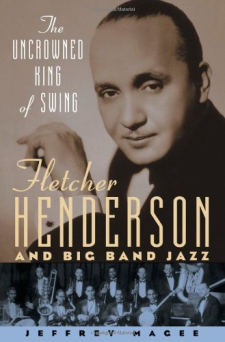
Fletcher Henderson and Big Band Jazz:
The Uncrowned King of Swing
by
Jeffrey Magee
.
.
About Jeffrey Magee
Jeffrey Magee is an Associate Professor of Musicology at Indiana University. His writings on jazz, ragtime, and American popular song have appeared in American Music, Lenox Avenue, International Dictionary of Black Composers, Musical Quarterly, the Cambridge History of American Music, and the Journal of the American Musicological Society.
.
.
JJM Who was your childhood hero?
JM I grew up near Pittsburgh in the seventies, which was a great decade for Pittsburgh sports. The Pirates won two World Series and the Steelers won four Super Bowls during this time. I was in the heart of my childhood, and in my prime of being a sports fan as well, so it was a magical time for me. Every time I hear the names of the great players of those teams — Willie Stargell, Roberto Clemente, Terry Bradshaw, Lynn Swann, “Mean” Joe Greene, Jack Ham, Jack Lambert, not to mention guys who aren’t remembered as well any more like, say, Richie Hebner and Rocky Bleier — it conjures up a whole range of feelings and memories.
I’d have to add at least two other people to my list, although I didn’t think of them as “heroes” at the time. One is my uncle Alan Magee, an artist. I look back and realize that I studied his illustrations and paintings — and his independent way of life — for clues about how I could live. The other is my father, Richard Magee, who read my early attempts at writing and, by making marginal comments, showed me that choosing the right word is a serious business, that writing is a painstaking process, a challenging craft. Also, my father — my whole family, really, including my mother Joyce and brother Rich — is liberal in a sense that seems to have been lost: open-minded, tolerant, generous, compassionate. I would say that my late-blooming interest in jazz — after growing up listening to seventies pop and learning classical piano — owes something to that background.
.
.
___
.
.
Book Reviews
“Magee has written an important book, illuminating an era too often reduced to its most familiar names. Goodman might have been the King of Swing, but Henderson here emerges as that kingdom’s chief architect, an innovative musician who played a crucial role in building music that, Magee maintains, achieved ‘a delicate consensus joining teenagers and adults, black and white, oral and written music, Tin Pan Alley and jazz.'” — Boston Globe
“Excellent…. Jazz fans have waited 30 years for a trained musicologist such as Mr. Magee…to create a book that evaluates Henderson’s strengths and weaknesses and attempts to place him in the history of American music.” — Will Friedwald, New York Sun
“Nobody — not Ellington, nor Basie, nor Goodman — was more thoroughly involved with the beginnings of the Swing Era than Fletcher Henderson. Jeff Magee’s book gives this jazz giant what he deserves: a sensitive and balanced examination of the pianist and arranger’s personal history as well as a judicious evaluation of his music.” — Scott K. Deveaux, author of The Birth of Bebop: A Social and Musical History
“Magee does an excellent job of placing his subject in the context of uncertain social changes in the African American community. Well researched and highly readable.” — Library Journal
“Magee paints a vivid portrait of the central figures of early jazz and swing (Louis Armstrong is a ‘strong streak of color in a crazy quilt’) as well as the business of recording and touring in the 1920s and ’30s. While Benny Goodman is lauded as the major force behind the Big Band sound, Magee argues convincingly that Henderson was equally important in ‘building the kingdom of swing.'” — Publishers Weekly
“Magee’s treatment of Henderson and jazz music here is a loving, erudite and welcome one on a giant of the form.” — Charleston Post & Courier
“Fletcher Henderson occupies such a vital role in the evolution of American music that it comes as a shock that we had to wait this long for a superlative biography such as this. Jeff Magee has not only discovered hitherto unknown connections between Henderson’s life and music, but has also linked them to the cultural scene in which they existed. The jazz world owes Jeff Magee a big thank-you for undertaking such a massive project and for doing it so well.” — Loren Schoenberg, Executive Director, The Jazz Museum in Harlem
“A good musical study of Henderson has been long needed, and this is well researched, thorough, and well written. Of particular value is Magee’s sensible and realistic view of the music business, which affords the reader a view into the lives of African-American musicians of the day. This is an important study of the jazz of the 1920s and 1930s.” — Lewis Porter, Professor of Music, Rutgers-Newark University, and author of John Coltrane: His Life and Music
.
.
___
.
.
This interview took place on January 17, 2005,and was hosted and produced by Jerry Jazz Musician editor/publisher Joe Maita
.
.
___
.
.
Click here to subscribe to the (free) Jerry Jazz Musician quarterly newsletter
Click here to help support the continuing publication of Jerry Jazz Musician (thank you!)
.
.
# Text from publisher
.
.
.


