
.
.
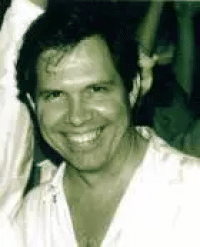
Thomas Brothers, author of Louis Armstrong’s New Orleans
.
.
___
.
.
…..New Orleans at the turn of the twentieth century was a complicated city, a rough and beautiful place bursting with energy and excitement. It was a city marked by racial tensions, where the volatile interactions between blacks and whites were further confounded by a substantial Creole population. Yet it was also a city of fervent religious beliefs, where salvation manifested itself in a number of ways. Perhaps abolve all else, New Orleans was a city of music: funeral bands marched through the streets; professional musicians played the popular tunes of the day in dance halls and cabarets; sanctified parishioners raised church roofs with their impassioned voices; and early blues musicians moaned their troubles on street corners and in honky-tonks, late into the night.
…..  And right in the middle of it all, stomping his feet in church, peeking through the windows of the dance halls, and marching in the second line that followed the parade bands up and down Canal Street, was a young boy named Louis Armstrong. In Louis Armstrong’s New Orleans, author and Armstrong scholar Thomas Brothers illustrates the indelible imprints left on Armstrong by New Orleans and its music.#
….. Brothers’ book draws from a wealth of autobiographies, memoirs, and interviews with family, friends, and fellow musicians. In a June, 2006 interview with Jerry Jazz Musician editor/publisher Joe Maita, Brothers discusses the city and musician whose impact on American culture is immense.
.
.
___
.
.
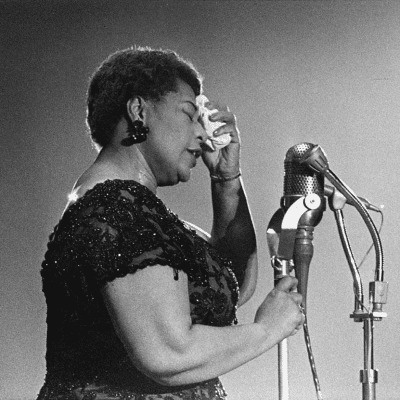
Maud Cuney-Hare, 1874-1936, Public domain, via Wikimedia Commons
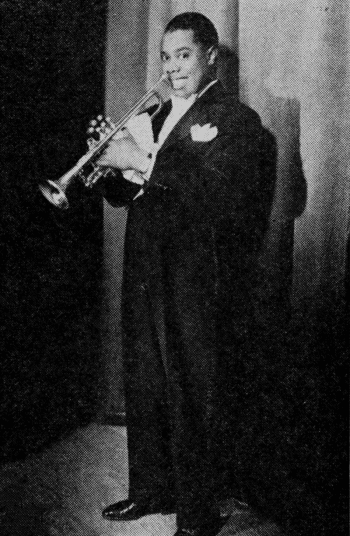
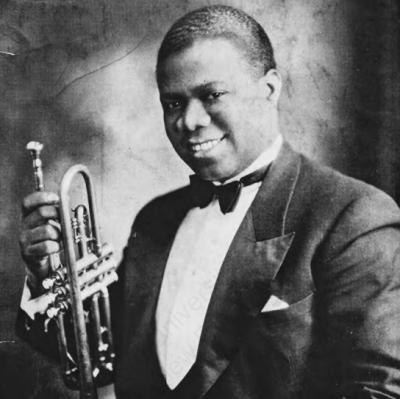
Louis Armstrong, 1936
.
“In the early twentieth century, New Orleans was a place of colliding identities and histories, and Louis Armstrong was a gifted young man of psychological nimbleness. The city and the musician were both extraordinary, their relationship unique, their impact on American culture incalculable.”
– Thomas Brothers
.
.
Listen to the 1923 recording of King Oliver (with Louis Armstrong) playing “Dippermouth Blues.”
.
JJM You wrote, “As I tried to contextualize what Armstrong was saying (while working with an edition of his unpublished writings), I realized how much American musicology had neglected the early period of jazz in New Orleans.” Why was this important period in American music neglected?
TB Probably because American musicology from its beginnings was very Euro-centered — it was founded by refugees from Germany who brought a tradition of German musicology to the United States, which was then farmed out to each major university. Each university had its own German-Jewish refugees, who instilled a tradition of scholarship that was fascinated by European classical music, which we still are. I love European classical music, but until recently, it was not acceptable to study American music of any kind. So, that is the large part of the reason why the study of early jazz of New Orleans was neglected. But the other part of the answer has to do with the absence of African Americans in musicology, which remains a problem in American musicology. As far as I know, this is the first book ever written on the early part of New Orleans jazz by a trained musicologist.
JJM What made you suited for this work?
TB People did not specialize in American music, much less African American music, and much less African American popular or vernacular music. So this kind of research was way off the radar screen of most writers. My dissertation field is actually fifteenth century medieval music — which I did in the eighties — but even in graduate school I was doing a lot with jazz. I worked quite a bit with Ollie Wilson at the University of California, Berkeley, a retired African American composer who had a really keen interest in African American music history. Studying with him got me into this work there, but, as I said, I did my dissertation on fifteenth century music, so this was a secondary field for me until about ten years ago, when I started doing most of my work in jazz and African American music.
JJM Are the research challenges posed by the study of New Orleans music less imposing than those faced during the study of fifteen century music?
TB Every field has its own research challenges, depending a lot upon what kinds of evidence are available. For this book both the positive and negative research challenges have a lot to do with the oral histories that I worked with. As I was getting into the project, I realized that vernacular music in New Orleans — especially jazz at this time — is generally well-documented in oral histories. This rich harvest of information from interviews that were conducted mostly in the fifties and sixties is what made this project work. However, the problems with that kind of information are substantial — people’s memories fail, they can supply misleading information, they may claim to report on something they don’t really know much about, and interviewers can ask leading questions that direct participants in a certain way.
JJM What were some of the ingredients that fostered the stylistic innovations of early jazz?
TB Before I answer that, I have to provide the caveat that, as you know, we don’t have this music recorded. It is not really recorded until the early twenties, when a lot of the musicians left the city and go out to the west coast and Chicago, which were the immigration patterns of African Americans during the great migration from the South to the North. That is another research challenge, obviously, because we don’t have any well-documented recorded history of the sound of this music, so we are relying on people’s accounts of it, and on their demonstrations of what musicians of the period played like. So, when I try to trace the stylistic innovations of this period, it is very sketchy. You just do the best you can, but it is hard to pin a lot of that down.
Having said that, something that makes this such a rich and wonderful period to study is the tremendous number of people who were making music at all levels — amateur, semi-professional and professional — within the African American community. That kind of diversity of practice in that kind of competitive environment has a lot to do with stylistic innovation. It is very rich in that regard.
JJM You indicate that a constant flow of low paying, unmonitored performances, steady movement between social levels, and a relaxed attitude were things that that helped inspire the development of jazz
TB Yes. When someone like Louis Armstrong is playing music at age fifteen, it is important to realize that, at that stage of his life, he didn’t know how to read music, he really didn’t have much of an understanding of his instrument, he didn’t know how to play in key, and may not have even known what a key is. He was playing mostly by ear, learning pieces while performing with small groups that he was often substituting in and out of. That is what I meant by unmonitored performance situations, where no one was standing outside with a paycheck, where no one was saying the music had to be played in a certain way, and so forth. This was very common. The famous advertising wagons and the low paying jobs in the dance halls were all over the place — it was very common for people to make music without expecting much money in return for it. While that is the downside, the positive side is that there were many people making music, and many people experimenting with music, so it was the kind of environment that fosters stylistic innovations.
JJM Your book goes into great detail about how Armstrong was shaped by the musical and social complexities of New Orleans. Who provided Armstrong with important early musical models?
TB The most important by far was Joe Oliver. Armstrong had already noticed Oliver when he was ten or eleven years old, which would have been about 1911 or 1912, a time when Oliver’s career was on the ascent. He was the man in Armstrong’s neighborhood, where Oliver was getting to be well known and admired. Armstrong often followed him around in parades all day long, and when he could, snuck into dance halls, or stood outside of them, listening to Oliver play. Then, within a year or two of getting out of the waif’s home, Oliver sort of mentors him, has him over to his house and gives him lessons. So there is no doubt that Oliver was the dominant stylistic model for Armstrong during his middle-teen years.
After Oliver leaves New Orleans in 1918, Armstrong still finds a lot of people to learn from — Buddy Petit is certainly one, Punch Miller is another, and Kid Rena is another. These musicians are a little older than Armstrong, and they are among the ones coming up after some of the older musicians left town as part of the great migration. Each of them had an impact on Armstrong in his own way.
JJM You point out that several musicians felt that Buddy Petit was twenty-five to thirty years ahead of his time. Did he exert much influence on Armstrong’s style?
TB I believe so, and a lot of people say that is the case. It is hard to know what to make of that twenty-five to thirty years part, but I think that has a lot to do with harmony, because Petit was very interested in harmony. He probably didn’t read music, but he had a really good ear and picked up on diminished chords and maybe augmented chords as well. That is probably what they were thinking when they said that. Petit’s impact on Armstrong was likely the harmonic precision and harmonic willingness to take on a language like that and mix it into his improvisation. Also, people talk about Armstrong connected to Petit in terms of his second playing — which is playing an obbligato line or counterpoint line to the main melody, which Petit did very well. He loved to play in the low range, actually, and loved to have somebody else take the lead and stay in the low range. He played this lovely little counterpoint to the melody, and, as we know from his 1923 recordings with Oliver, Armstrong did precisely that. Oliver would take the main melody and Armstrong would weave these beautiful polyphonies around it.
JJM You describe Armstrong’s singing in a vocal quartet as his “most important childhood hustle.” What do you mean by that?
TB I call a chapter in my book “Street Hustler,” and write about Armstrong at ages nine, ten and eleven — before he goes into the waif’s home — at a time he was basically trying to pick up change off the streets. It was a time when he sold newspapers illegally — it was a segregated job and you had to be white to sell newspapers — but he does it anyway and gets into trouble because of that. He is also seen doing other things to make himself a little change during this time, like reselling restaurant waste, for example. He called things like that his “hustles.”
This stretch with the vocal quartet is an important point because it really gets his ear going, thinking harmonically, which is something he probably hadn’t done much of until then. Church singing probably wouldn’t require much harmonic thinking, and there is not much interest in harmony in blues playing, at least not in the blues he was exposed to. Sources make it quite clear that these vocal quartets were interested in experimenting with harmony and delighted in experimenting with chords. That is the kind of situation that got him thinking harmonically.
JJM The expectation in these groups was unconventionality?
TB Yes, and that is where barbershop quartet singing comes from, apparently — not New Orleans, necessarily, but the African American South, which had a vernacular tradition of quartet singing in the late nineteenth and early twentieth century.
JJM You devote quite a bit of time writing about how New Orleans parades helped form Armstrong’s sense of what it meant to be a professional musician. What was the importance of outdoor music and parades?
TB These are more examples of what I spoke of earlier concerning performing situations that were not heavily monitored. The Mardi Gras parade is the crown jewel of New Orleans parades, but there are many other parades there. Any excuse would be given for having a parade — especially during Armstrong’s time there — and there were multiple parades on Sundays.
New Orleans had a tremendously vibrant outdoor culture that provided opportunities for performances at all levels. Very highly polished Creole marching bands were paid the best, and then there were the sort of funky uptown bands that came from Armstrong’s neighborhood who were not being paid very much but who were having a lot of fun playing music that was probably similar to what was played in church, at least in terms of heterophony. Some people think that funky kind heterophonic parade music was the source for the distinguishing texture of New Orleans jazz, which we know as the collective improvisation and polyphony I was referring to earlier.
JJM You wrote, “Parades thus offered disfranchised Negroes a chance to assertively move their culture through the city’s public spaces, the very spaces where African Americans were expected to confirm social inferiority by sitting in the rear of trolley cars and by stepping aside on sidewalks to allow whites to pass.” So, these kinds of bands allowed the African American musicians a certain kind of security
TB Yes. This is a period when African American people all across the United States were not able to move about freely. They can’t simply wander into any part of town they want to — in fact, there is real danger involved in moving through town. It is also quite clear that there was a lot of violence associated with the second-lining. We like to think of second-lining as people who follow a parade and participate, interact and dance with the musicians. While that may seem like a kind of joyous, happy thing, there was actually a lot of violence associated with it, which had to do with the restricted motion throughout the city.
Armstrong found a way to deal with that. He figured that if he could make friends with Joe Oliver and carry Oliver’s horn while he wasn’t playing during stretches of the parade, then Armstrong could accompany the band along the entire parade route — which was not something he could safely do otherwise. This allowed him to stay with the band.
I began this book with a recollection of Armstrong from 1954 or so, in which he remembers a moment from 1921 when he was playing with the Tuxedo Brass Band. By this time, he had really arrived in New Orleans and was becoming well known as a soloist, but he recalled that this moment, playing with the Tuxedo Brass Band, was very important to him. Why was it so important to him? Because, as a result of his success with this march, he was able to travel more freely, due to personal recognition. Suddenly everyone in town seemed to admire his music. It was a discovery that through his music he could accomplish something that was otherwise prohibited to him.
JJM It was a great antidote to the violence, and, as you say, it offered a great sense of freedom for him, which was clearly important to him.
TB As it was for the entire African American community. I make the point in my book that this had a lot to do with funeral music, which was a public ritual where African American culture was on display, especially the rejoicing during the burial, which was like a public broadcasting of a cultural autonomy. They seemed to be saying, “This was our music, and our culture. We own this performance tradition and we can broadcast it throughout the entire city.” I also attempt to relate that to Buddy Bolden, who people talk about as a musician who played his cornet so loud that he could be heard from two or three miles away. So, what was that all about? It is about this sense of assertion that we are talking about.
JJM And you suggest it may have been a way for him to shout out his masculinity…
TB One of the surprising things I discovered while writing this book is that the funeral music was controlled by fraternal clubs, not by a religious institution. Some previous writers tied funeral music to, for example, African religion and African American Christianity. There is a dimension of that, I am sure, but mainly this ritual was sponsored by groups that were not particularly religiously motivated.
The other thing I found surprising was the fact that only men were buried in what we know as a jazz funeral, so it was clearly a masculine thing. Also, because there was objection to it from preachers and Catholics, it indicates that it was not a religious ritual. So, my conclusion is that these funerals were expressions of masculine dignity, broadcasted in a public setting, when masculine dignity was under siege from all directions — Jim Crow laws were in place, voting rights were being taken away, and lynching’s were at an all time high in the South.
JJM Regarding this, you posed an interesting question in the book: “What does the loss of political freedom and its attendant blow to masculinity have to do with early jazz?”
TB The idea that music is a special area of expression for African Americans goes back to the days of slavery, when they were able to express a freedom that did not exist for them in any other realm. The freedom in some ways had to do with the non-materiality of music-making — you can make it with just your voice and a stick, basically.
JJM How did the waif’s home prepare Armstrong for the uptown musical world?
TB The point about where, when and how he got his first cornet is somewhat controversial. I don’t take that issue up too much in the book except to say that I believe he got his first cornet in the waif’s home. This is what he said for most of his life, until near the end of it, when he wrote a very controversial document that had a number of misleading things in it. While it contains a lot of emotional importance, it also has some mis-recollections of facts. The very consistent message we got from earlier writings is that he got his first cornet when he was in the home, which is where he got instruction on it, and where he probably learned the basics of musical notation, note tinkering, how to play the instrument, the armature, and so forth. That training basically gave him the tools to play the blues in a honky-tonk when he got out of the home, which did not require him to know any music, did not require him to know any pieces, did not require him to read music, and did not necessarily require him to fit into an ensemble. His playing in a honky-tonk night after night at age fourteen was very important. While today we may think of that kind of work as child abuse or child exploitation, it was the perfect thing for him at that time – to be able to play the horn in a public setting, and to be playing the blues. But without that training in the waif’s home, he wouldn’t have had that opportunity.
JJM Who were the Creoles who dominated music during Armstrong’s childhood?
TB Manual Perez, who played cornet in the Onward Brass Band, was probably the man he knew the most about. Perez brought Joe Oliver into that band, which was an important moment because before that there were not a lot of examples of uptown Negroes playing with uptown Creoles. As a result, Armstrong knew the Onward Brass Band really well, and as I said before, he followed them around whenever he could. Another important Creole player was Lorenzo Tio, who was perhaps the most famous Creole clarinetist at that time.
JJM Did Armstrong have much contact with them prior to 1921?
TB Just a little here and there — certainly not a lot. While he knew their music from parades and probably dance halls, it isn’t likely that he had a lot of interaction with them, and, in fact, I think they made him pretty nervous because Creoles displayed a lot of bigotry toward the uptown Negroes, especially those with darker skin like Armstrong. It was the kind of bigotry that was not spoken about often, but there are enough reports from the period that explicitly reveal what was going on. The positive from this is that, despite the bigotry and the fact that Creole bands are basically segregated bands — at least until the early nineteen-teens — someone like Joe Oliver was able to gain access into their world. So, it wasn’t a hopeless situation, but it was certainly an intimidating one.
JJM They were segregated not only by the color of their skin but also by their musical abilities. The Creoles were readers of music, whereas the African Americans were improvisers.
TB Yes, that was the general pattern, although there were exceptions to that in both communities.
JJM You wrote, “The first essential social movement that led to early jazz was the immigration of some forty thousand freedmen from the plantations into New Orleans. The second involved a handful of musicians from within that group, Oliver and Armstrong being the most famous, who found a way to cross Canal Street and play with the Creoles.” Were they trying to play like Creoles once they crossed Canal Street?
TB I think the answer to that is yes and no. They definitely wanted to capture the ability to play like them because they recognized the importance of reading music fluently, having the theoretical understanding of keys and chords and scales, and developing a musical agility on an instrument. At least some of the Creoles had these abilities as a result of a tradition that went back a period of over one hundred years of training that was directly connected to the Paris Conservatoire and to the opera house of New Orleans. Having access to this kind of knowledge and ability opened up so much in the way of jobs and range of expression. Armstrong eventually acknowledges this when he said that after he got on the riverboats and learned how to read music fluently, he became much more efficient on his instrument, which opened up new ways of expression and new ways of improvisation. So, they wanted to have it both ways — they wanted to excel in the kind of music that came out of their community, and they also wanted to have an understanding of this Eurocentric tradition.
JJM The economics of this had to be pretty powerful as well, because in order to make tips, as you say, “…the musicians had to play requests; to play requests they had to have lots of sheet music so they could perform on demand; and to perform on demand they had to read very well. Hence, the Creole advantage.” He was able to catch up in that regard when he went on the riverboat with Fate Marable…
TB Yes. I think it’s clear that is when he began to read fluently.
JJM There are those who claim he didn’t read music fluently in the twenties…
TB That is a funny thing. I knew an older professional jazz musician here in Durham, for example, who insisted that Armstrong never learned to read music. So there was this legend that you occasionally run across in books claiming that Armstrong never learned how to read music. He was doing some things throughout his career that gave people this impression, and it may be that he just preferred to learn music by ear, or that he preferred not to have sheet music in front of him. I think that that is probably the case. Another jazz musician told me this story about how, when confronted with the question of whether he knew how to read music, Armstrong answered he could, but not enough that it messes with his music. But the evidence is pretty clear that he had a chance to learn while he was on these riverboats.
Armstrong was brought into the band on these boats even though he didn’t know how to read music — although the expectations were that he would learn once he was on the boat. The people who ran the boats wanted good musicians with a great sound. Armstrong had a big, brassy, confident sound that we identify him with today, so they were willing to take Amrstrong in and mix him in with musicians who did know how to read music.
JJM Did Armstrong have much exposure to the white musicians of New Orleans who played music in the European tradition?
TB Cornet virtuosos would come through town occasionally, and there were a few in the Creole population. He talked about how much fun it was to get to know white musicians after he moved to Chicago. These musicians were in total admiration of him, by the way. But, he talks with regret that he didn’t really know any white musicians in New Orleans.
JJM You wrote, “He was driven not by the ideology of assimilation but by a desire to enter the white market. Had it been otherwise, had assimilation been part of his mindset, certainly his musical development would have turned out very differently than it did.” How would it have turned out?
TB Well, it would have had a lot less blues in it, that is for sure. More than one person has said that Armstrong infuses everything he does with blues — all of his life, all the way to its end, had blues in it. And that bluesy timing and bluesy phrasing that is so skillfully done is part of the beauty he accomplished in life.
.
___
.
“Jazz as Armstrong learned it was a creation of the ratty people, as Isidore Barbarin would have called them, the ‘roustabouts unloading banana boats on the wharves — all of my folks,’ which is how Armstrong once identified his community, the common laborers, domestics, hustlers, and prostitutes who found themselves confined by the color line to the economic bottom of society. His success was theirs too…People who looked forward to Sundays in church, where the music they made brought the sum of their community to a greater whole, who relied on music to proudly proclaim who they were in public events, who admired musicians with professional skills but could also appreciate music played by an amateur, as long as he showed willingness and heart. Out of their values and practices came the fruits of an expressive culture that are with us still.”
– Thomas Brothers
.
_____
.
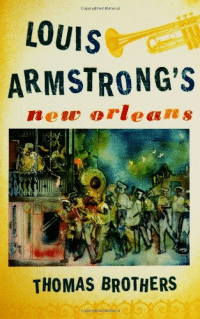
Louis Armstrong’s New Orleans
by Thomas Brothers
.
.
___
.
.
About Thomas Brothers
JJM Who was your childhood hero?
TB I think it would have to be Brooks and Frank Robinson.
JJM You’re not going to tell me you are an Orioles fan, are you?
TB Of course I am. I grew up in Pennsylvania, about an hour-and-a-half from Baltimore. We went to games once or twice a year, and I watched them on television. I was about eleven years old when they played in the 1966 World Series, the year they were a fantastic team. I grew up in the Appalachian Mountains of Pennsylvania, and was very naïve about race, so naïve, in fact, that I once asked my mother if Brooks and Frank were related. She explained to me that it wouldn’t be possible, but I said that it could be, couldn’t it?
.
Thomas Brothers is the author of Louis Armstrong: In His Own Words and Chromatic Beauty in the Late-Medieval Chanson. A professor of music at Duke University, he lives with his family in Durham, North Carolina.
.
.
___
.
.
This interview took place on June 12, 2006, and was hosted and produced by Jerry Jazz Musician editor/publisher Joe Maita
*
If you enjoyed this interview, you may want to read An Online Story of Jazz in New Orleans, with an introduction by Nat Hentoff
.
.
# Text from publisher
.
.
.