
.
.
.
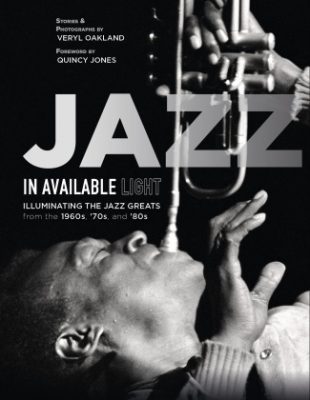
…..Jazz in Available Light, Illuminating the Jazz Greats from the 1960s, ’70s, and ’80s is one of the most impressive jazz photo books to be published in a long time. Featuring the brilliant photography of Veryl Oakland — much of which has never been published — it is also loaded with his often remarkable and always entertaining stories of his experience with his subjects.
…..With the gracious consent of Mr. Oakland — an active photojournalist who devoted nearly thirty years in search of the great jazz musicians — Jerry Jazz Musician regularly publishes a series of posts featuring excerpts of the photography and stories/captions found in this important book.
In this edition, Mr. Oakland’s photographs and stories feature Mal Waldron, Jackie McLean and Joe Henderson
.
.
All photographs copyright Veryl Oakland. All text excerpted from Jazz in Available Light, Illuminating the Jazz Greats from the 1960s, ’70s, and ’80s
.
You can read Mr. Oakland’s introduction to this series by clicking here
.
.
_____
.
.
© Veryl Oakland
.
Quality Exports [Take Two]
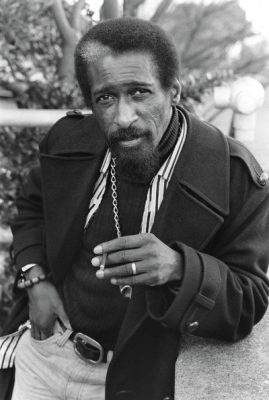
Mal Waldron
Munich, Germany
.
.
…..Easily one of the most intriguing artists I ever met was Mal Waldron. During our first get-togethers in San Francisco and later, New York, the soft-spoken pianist always appeared so calm and at ease.
…..It was only after visiting with Mal in his Munich third-floor apartment at Nietzschestrasse 26 that I realized his life was not at all as it appeared. Here was the true jazz world Renaissance Man: tireless, ever on the go, and always in search of fulfilling his next intellectual conquest, of which there were many.
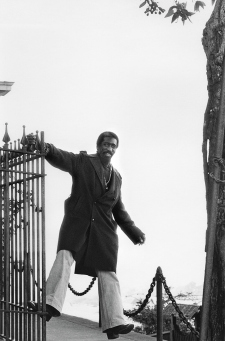
….. Mal Waldron personified the image of the inveterate international jazz figure, one constantly on the move across the globe doing festivals, club dates, and recording sessions. On the day of our meeting, he had just returned “home” from a date in London, but in less than 24 hours, would again be out the door and enroute by train to Paris to perform at a new club, Le Paname.
…..Looking back on that summer day, I consider myself lucky to have interacted with him.
…..A voracious reader who was conversant in five languages, Waldron made his initial trek to Europe in 1965, first residing in Paris, next Italy, then a brief stay in Holland, followed by several cities in Germany before settling in Munich. By the time co-founders Matthias Winckelmann and Horst Weber launched Enja Records in 1971 – selecting Mal Waldron for their first pressing – the expatriate pianist had already laid claim as that city’s modern music idol.
…..As a player and composer, his goal line was purposely never in plain sight. Classically trained, Waldron listened early to Bud Powell and Thelonious Monk, but throughout his career thrived as an innovator in virtually every musical style. If the music was new, exciting, and challenging, he was all in.
…..Waldron was committed to sharing his very special artistry with any and all who were interested in the experience. The ultimate testimony to this drive and devotion was made crystal clear when Mal described to me one of his most personally satisfying tours of Japan during which he played 86 concerts in 90 days, even reaching out to perform before audiences in small towns and fishing villages. It was no wonder his enduring base of Japanese fans held Mal Waldron in such high esteem.
…..Not surprisingly, Mal’s extended musical outreach to his many fans was always repaid in the form of personal, from-the-heart gifts and rewards. Displayed around his living room, for example – amidst stacks of books, record albums, and other media – was a variety of art pieces, wood carvings, photographs, and other mementos from dedicated followers of his music.
© Veryl Oakland
…..Some of his other personal gifts were substantial. In 1967, Waldron was presented with a brass sculpture from the Dutch artist, Jan Schoonhoven, while performing at a jazz club in Delft, The Netherlands. The piece was awarded to Mal for being “Best Jazz Artist of the Year” in Holland. Similarly, in November of 1970, he was presented with a marble statue on behalf of the people of Sondrio, Italy.
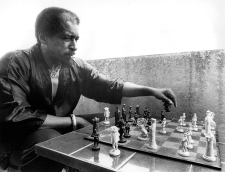
…..Besides his insatiable reading, composing, touring, and performing, Mal was also recognized as a chess master. The day of our visit, he had two separate games going with himself: a standard board set situated on his balcony and another electronic version in the living room.
…..Regarding southern Germany’s competition at that time, Mal told me, “Only one person (who he described as the Baron of Munchhof), can beat me regularly, and playing chess is all the man does.”
…..Toward the end of our visit, which at the time seemed to be coming to a close almost before we had even gotten started, I was checking out, and photographing, an assortment of the pianist’s memorabilia mounted on his living room walls. I stopped to study a baby picture of Mal Waldron in the buff.
…..When he saw me checking it out, he said, “Go ahead, you should shoot it. You never know, someone might want to publish that one day.”
.
.
© Veryl Oakland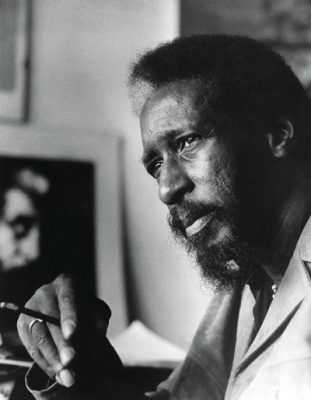
Malcomb Earl (Mal) Waldron – piano, composer
Born: August 16, 1926
Died: December 2, 2002
.
Listen to “La Gloire Du Noir,” from Maldron’s 1971 album Black Glory (Enja)
.
.
.
_____
.
.
.
© Veryl Oakland
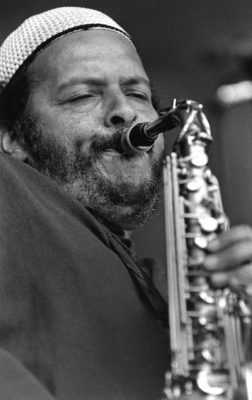
Closing the Circle
Jackie McLean
Telluride, Colorado
.
.
…..On this day, in this most remote, out-of-the-way retreat, I got to share the excitement first-hand. That’s what made it all so fulfilling.
…..For a multitude of reasons, I never had an earlier opportunity to catch one of the premier bop-inspired pioneers of the alto saxophone in the flesh. Who would have guessed that I would finally cross paths with Jackie McLean at an outdoor jazz festival in the “one-way-in, one-way-out” ski village of Telluride (population 2,500), nestled at the base of the 13,000-foot San Juan Mountain range in the Colorado Rockies?
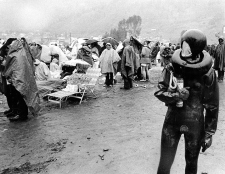
…..As jazz festivals go, I thought Telluride represented a kind of oddity. It was well off the beaten track, but the festival promoters nevertheless consistently booked a notable cross section of top-name players. There weren’t sufficient accommodations to accept the thousands who inevitably made the trip, so many camped out instead, rain or shine. The music was certainly worth it, even though – when the heavens opened – some of the fans looked pretty miserable.
© Veryl Oakland
…..Here it was, the summer of 1980, almost three decades removed from the young man’s historic breakthrough recording date featuring the all stars Miles Davis, Sonny Rollins, and Art Blakey. It was momentous for me to finally witness and photograph McLean in such fine form, now heading a quintet featuring trumpeter Woody Shaw and trombonist Steve Turre. But as solid as that group played together, capturing their performance did not prove to be my highlight of the weekend.
…..As the festivities were winding down, I learned that Jackie needed a ride to the airport. Getting to Denver and then back home to New York meant driving more than an hour to Montrose, where he could make his puddle-jumper connection to the Mile-High City. Just how great would it be, I thought, if I could spend some time up close with the man. I immediately offered to give him a lift.
…..Once on our way, I couldn’t help but notice McLean was in a great mood. He was upbeat, almost excitable. Right away, he began talking about having been named “Founder of the Department of African-American Music” for the Hartt School of Music in Hartford, Connecticut. The start of this new decade was pivotal for him because it signified a sort of official validation point for all of the years he had invested at the school as a jazz educator.
…..Long a champion of giving back when it came to preaching the jazz “gospel,” McLean had begun his association with Hartt as a teacher in 1968. During our ride, he filled me in on how meaningful his many experiences had been with both students and faculty over his years with the school. I understood the man had clearly paid his dues. He was now ready to take on greater responsibilities and to further expand his influence.
…..A thoroughly animated Jackie McLean made our trip just fly by.
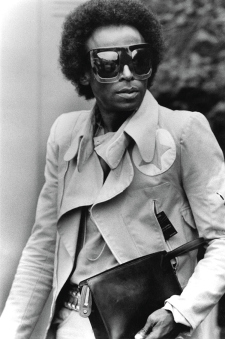
…..Through research of Jackie McLean’s life some time later, what stuck in my mind were all the hard knocks he had endured along the way. While just 20 years old when he gained the notoriety of performing with Miles and other such luminaries, that period in his life was hardly the “days of wine and roses.” His early leader was actually one of Jackie’s harshest critics. In his autobiography, Miles, the trumpeter told how he frequently upbraided Jackie for his laziness and not wanting to learn certain standards like “Yesterdays.”
…..Miles explained that all of his heavy criticism of McLean only made him that much better, an eventual master who could play anything. He wrote, “After awhile, when they asked him where he studied music, he’d tell them, ‘I studied at the University of Miles Davis.’”
…..Despite all of his early trials as a player – or maybe because of them – Jackie McLean only continued studying and improving. It did not go unnoticed. From fledging player, to understudy and woodshedder, to master performer and teacher, Jackie McLean had closed the circle.
.
…..Note: In 2000, the Hartt School of Music’s Department of African-American Studies was renamed the “Jackie McLean Institute of Jazz.” Recognized over the years as one of the nation’s top institutions, the program has featured master classes by a myriad of jazz greats, including pianists Hank Jones, Randy Weston, Barry Harris, and Cedar Walton; saxophonists Jimmy Heath, Yusef Lateef, and Cecil Payne; trombonists Curtis Fuller and Slide Hampton; and trumpeters Eddie Henderson and Wynton Marsalis.
.
.
© Veryl Oakland
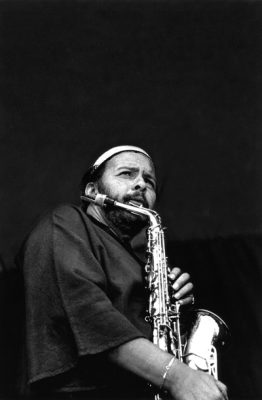
.
John Lenwood (Jackie) McLean – alto saxophone, flute, composer, educator
Born: May 17, 1931
Died: March 31, 2006
.
.
Watch a 1986 performance of Jackie McLean and Mal Waldron playing “Left Alone”
.
.
_____
.
.
.
.
© Veryl Oakland
.
Jazz’s Foremost Interpreter
Joe Henderson
San Francisco, California
.
.
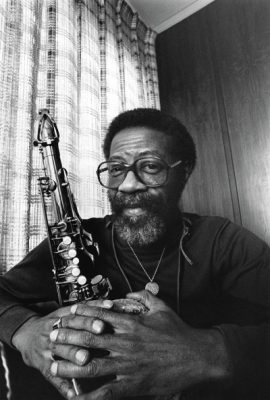
…..To my mind, he was one of the more complex creative artists I ever encountered. Yet, for every example I could offer of his complexity, he could have just as easily proved its simplicity. Because to Joe Henderson’s way of thinking, making the complex seem simple was, as much as anything, largely a matter of being prepared for whatever came his way.
…..Preparedness for Joe came early and often. Growing up in a family of 15 children, Henderson heard and listened to everything around him. Among his siblings, their personal choices in music ranged from opera to Bo Diddley, from country/western to Charlie Parker. His first tenor saxophone influences were Ben Webster, and especially, Lester Young. In school, if he wasn’t deciphering how the sounds of a John Philip Sousa march all fit together, Joe was studying the works of such classical composers as Bartok, Stravinsky, and Schoenberg.
…..All of these wide-ranging musical influences were paramount in his evolvement of becoming one of jazz’s most complete and well-rounded tenor saxophonists. Being fully at ease, playing in virtually any musical style with the most divergent of musical minds, was just as natural for Henderson as learning another language.
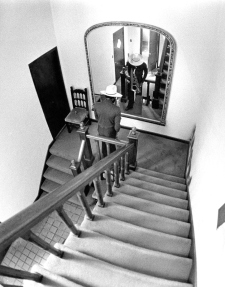
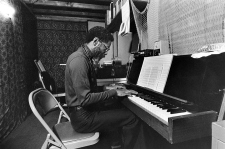
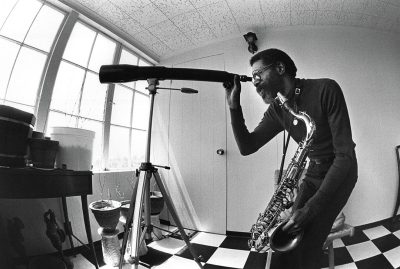
…..It was in May of 1981 that I met with Joe Henderson for a photo session in his home at 616 Los Palmos Drive near Mount Davidson in San Francisco. When not on tour, Joe was enjoying a period in his life where he was parlaying his many learned skills as a lifelong “jazz student” into that as an inspirational jazz teacher – giving private lessons at home, as well as conducting clinics at various universities.
…..If you were one of his fortunate students, forget charts. He taught improvisation. You learned everything by rote. Typically, he would play a few bars on the piano; your task was to commit it to memory and play it back on your horn. After another four bars, repeat until memorized. And so on.
© Veryl Oakland
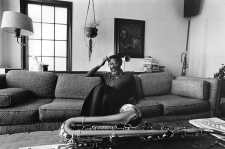
…..For Joe, sharing knowledge in his own special way became a source of great pride; many of his students would go on to land gigs with well-known bands, or become leaders of their own groups.
…..The word Henderson liked to use to describe what made him, his playing, and the way he led his life unique, was Interpreter. Among other things, I was intrigued by what I had heard about Joe’s multilingual capabilities (he was fluent in five languages, including being able to carry his own weight in Japanese) When I asked him about it, he said, “For me, it’s simple. You play it back, you interpret what you’re hearing, you form your words in response…suddenly, it all make complete sense.
…..“It’s like listening to new music that you haven’t heard before,” he continued. “You interpret how the sounds all fit together. What you play just becomes a natural extension of what you’ve already heard.”
…..Near the end of our shoot, Joe glanced out his front window and ran over to his telescope where he witnessed a dangerously low-flying aircraft over the South Bay whose pilot had appeared to have flown off-course.
…..Recalling that event sometime later, I thought how the pilot – in that single instance – did what my host that afternoon had to do each and every day of his career: Improvise to survive.
.
.
© Veryl Oakland
.
Joseph A. (Joe) Henderson – tenor saxophone, composer, educator; also flute, soprano saxophone
Born: April 24, 1937
Died: June 30, 2001
.
.
Joe Henderson on saxophone, in a filmed performance with McCoy Tyner and Freddie Hubbard
.
.
_____
.
.
.
Click here to read the edition featuring Stan Getz, Sun Ra and Carla Bley
Click here to read the edition featuring Art Pepper, Pat Martino and Joe Williams
Click here to read the edition featuring Yusef Lateef and Chet Baker
Click here to read the edition featuring Mal Waldron, Jackie McLean and Joe Henderson
Click here to read the edition featuring Dexter Gordon, Art Farmer and Johnny Griffin
Click here to read the edition featuring Thelonious Monk, Paul Bley and Cecil Taylor
Click here to read the edition featuring drummers Jo Jones, Art Blakey and Elvin Jones
.
Click here to read the edition featuring Monk Montgomery and the jazz musicians of Las Vegas
Click here to read the edition featuring Sarah Vaughan and Better Carter
.
.
.
All photographs copyright Veryl Oakland. All text and photographs excerpted with author’s permission from Jazz in Available Light, Illuminating the Jazz Greats from the 1960s, ’70s, and ’80s
.
You can read Mr. Oakland’s introduction to this series by clicking here
Visit his web page and Instagram
.
.
.