
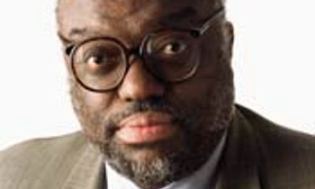
Stanley Crouch is an essayist, poet, former musician, jazz critic and author of the novel Don’t the Moon Look Lonesome. He is outspoken, controversial, clever, and right more often than many seem willing to admit.
He is also a very thoughtful admirer of Invisible Man author Ralph Ellison, whose work and friendship touched Crouch enough that, when asked if he considered Ellison a mentor, without hesitation answered “Yes!”
Crouch takes part in a very lively conversation about Ellison and a variety of associated topics, including Charlie Parker, and music’s place in American ritual.
Interview hosted by Jerry Jazz Musician publisher Joe Maita.
_________________________
JJM What is your background, Stanley?
SC I was born December 14, 1945 in Los Angeles. I grew up at 1239 E 28th St. My mother was a domestic worker, a maid. My father, James, was a criminal for the most part. He was in and out of the penitentiary a lot. I graduated from Thomas Jefferson High School, and attended East Los Angeles College for a while. I worked with the writer James Cortez in Studio Watts and the Watts Repertory Theatre workshop from 1965 – 1967. From 1968 – 1975 I taught at the Claremont Colleges in Southern California. I wrote and directed ten plays while I was there. I taught classes in African-American literature, the History of Jazz, American Lit, Theatre. Before that, in 1966 or 1967, I taught at Dominguez Hills College. In 1975, I moved to New York City and have been here ever since. Along the way, I took up the drums and led a band for a while, then I stopped playing in 1979.
JJM Was this a bebop band?
SC No, this was a post Ornette Coleman band. I played the drums from 1966 – 1979. I wrote for the Village Voice for 11 or 12 years.
JJM Did you write mostly about jazz at the Voice?
SC No, I wrote about a lot of things. Many of the writings are part of the collection Notes of a Hanging Judge. These writings reflect what I was dealing with during the ten years I was there. I did theatre writing, political essays, reporting material about American film, etc. I have been free-lancing here and there since about 1990. I published three books of essays, Notes of a Hanging Judge, The All American Skin Game, and Always in Pursuit. Last year, I published a novel, Don’t the Moon Look Lonesome.
JJM Who was your childhood hero?
SC I don’t know, different ones at different times. One time I was obsessed with Dizzy Gillespie and another time Thelonious Monk and Charles Mingus. They were mostly musicians as I recall. As for writers, I liked Yeats for a long time. During his pre black nationalist period I was really enamored with Leroi Jones as a writer, which I came to despise later, when, as far as I was concerned, he just sold out to clap-trap. I became excited about Ralph Ellison in the middle 60’s because James Cortez introduced me to both Shadow and Act and Invisible Man.
JJM So, it was the collection of essays you read first?
SC Yes, I think I read Shadow and Act first.
JJM Was that one of the books that inspired you to want to become a writer?
SC No, I had been writing since I was a kid of about 10 or 12.
JJM I see. Was there a book you read at that age that really turned you on that made you say, “Gee, I would love to write like this?”
SC No.
JJM It was just kind of a collection of, the way you felt about writing, basically
SC Yes, I read a lot of books. But, I can’t think of any one right now that I modeled myself after.
JJM You said you were a playwright also
SC Yes, I started writing plays when I was working with James Cortez. Writing for the stage, you have to get more in a smaller space.
JJM How would you characterize your friendship with Ralph Ellison? How did that begin?
SC I wrote him a letter from California, maybe around 1970 or so. I never heard back from him. I may have written him more than one letter, because Larry Hill, a friend of mine who introduced me to Albert Murray, told me that he mentioned me to Ellison and Ellison responded by saying, “Yes, he writes me very interesting letters.” The first time I saw Ellison in the flesh was near Washington Square Park, on the edge of New York University, maybe around 1976. I just stepped out of a phone booth and introduced myself to him. He was on his way to teaching a class. I met him again at a party, and we started talking on the telephone. We spoke by phone off and on until he died.
JJM He observed at one time that American life is “jazz-based.” What did he mean by that?
SC I think he meant that a lot of it is improvisational, that it pulls together a lot of different elements, that it finds its identity through an ongoing sentence of individual personalities, group efforts, varied cultural backgrounds coming together and creating new forms. I think that’s what he meant.
JJM Because freedom is basically improvisational
SC Yes.
JJM He had a career as an essayist, and many of them dealt with jazz. He seems to deals with the aesthetic of the culture in his criticism more so than musical criticism. He said at one time, “I am not particularly religious, but I am claimed by music.” His wife, Fanny, said “When he can’t find the words at the typewriter, he goes upstairs and plays the trumpet.” How was music a model or a deep influence on him as a writer?
SC I think it’s not just the music, but also the people. It’s the occasions, the ceremonial occasions of one sort or another. You have high ceremony and you have low ceremony, and I guess you could say you have middling ceremony as well. From the high ceremony of the church, of the baptism, of the wedding, of the wake, of the funeral, you discover whether or not there is something in both the human speaking voice and in music that achieves the level of eloquence necessary to celebrate the arrival of life, through the inducting into a religion, the coming together of a man and a woman, and the ways people gather together when one has died, and then the ceremonial send off of the funeral. All of those things have music attached to them. That is high ceremony. Now, middling ceremony I would say is all of the different situations in which the God of “Soirée de vie” is praised. Now that could be a house party, the barbecue, a family reunion, where people play cards and listen to music in recorded form or coming over the radio. I think Ellison was aware of all that too. Then, of course, you could say if you take our Puritanical roots seriously, you could say low ceremony is the music that is connected to the illicit trade of the sale of sex and of night life – strip shows, sex shows, prostitution – all of that. There is music that goes with that too. So, I think Ellison was somebody that was interested in music as it appeared in high, midldling and low ceremony. The gift of jazz is that jazz can build itself on the music and the moods that arise from all three forms of ceremony. I think that, as much as anything else, attracted him.
JJM He was certainly into the whole ritual of the music, and I recall reading something in one of his essays where he was concerned about Charlie Parker’s influence on jazz because he felt Parker brought music to a form where it was intellectualizing the music too much, personalizing it too much, therefore the ritual of the dance and the ritual of the gathering was changed dramatically by Parker’s influence.
SC Well, I don’t really buy that. That’s what he and Albert Murray and those guys may say Ellison and Murray and all those people, they grew up listening to dance bands, and dancing to bands. Charlie Parker grew up playing in those bands. Parker was six years younger than Ellison, and four years younger than Murray, so to some extent, they were contemporaries. But neither Ellison or Murray could be discussed as a writer on the level that Parker could be discussed as a saxophonist. You have to get that straight first.
JJM So, there are different rituals that came out of Parker …
SC I buy that, but what I am saying is, number one, we have to address one thing, neither of them, Ellison or Murray, is on a level as a writer that Charlie Parker was as a musician. They, Ellison and Murray, are both great in very different ways. Ellison is clearly the greatest fiction writer and both of them to some extent run neck and neck in terms of theoretical observations about American culture. But, what you say Ellison said about Parker, perhaps that is a misreading of Parker. Parker played dances anyway. One of his greatest performances is Bird at St. Nick’s where he played at St. Nicholas arena. There are photographs of him playing and the dance floor is packed with people dancing. So, all of that is bull The other thing is that Parker and Dizzy Gillespie were not going to stop the rise of Louis Jordan, and they were not going to stop the arrival of Little Richard and Elvis Presley and all of that. That was coming along in a separate line. That was going to happen anyway. That didn’t happen because guys were playing bebop.
JJM I think that is the case. There are many fans of the older school of jazz that believe Parker’s influence did accentuate the rise of Elvis because the dance went away. Elvis was going to be there no matter what
SC The other thing was that those kids who were dancing to Little Richard and Elvis and Jerry Lee Lewis and Fats Domino, they were ten years old when Parker was playing. By 13, they were doing something else, so they weren’t even the fans, necessarily. The kids that shot that out were 15 or 16 years old in 1956 or so, they weren’t dancing to Louis Jordan either. See, rock and roll is a simplification of Louis Jordan which is a simplification of a jazz band. You are in the second mode of simplification when you get to Little Richard and Chuck Berry and all of them.
JJM The change was also destined probably by economics. The big bands couldn’t make it anymore given the number of pieces in the orchestra.
SC Yes, they had those problems, but the only point I am trying to make is that rock and roll is not the result of Parker and other guys playing bop.
JJM The reading I have done on Ellison, and on his opinion about jazz, it does reflect some concern and anger about bebop. You have devoted much of your life to studying Parker. So, Ellison didn’t have much influence on you in terms of jazz and the type of artists you appreciate?
SC No.
JJM What sort of role did Ellison play in the civil rights movement?
SC I don’t know if he played a role in it at all. That wasn’t what he was doing. Understand, when Richard Wright was made a spokesman, when he came out with Native Son, Ralph Ellison was looked upon very differently. He was looked at as a guy who wrote not a protest novel but a major novel, which turns out nearly 50 years later to be an American classic – an international example of a high quality novel, regardless of where it derives from, or what color the writer is. Ellison was interested primarily in American identity and the ways in which race plays itself off inside of the culture of America and against the classic models that arose from the western tradition, plus those very things that came up out of the soil of the United States. Understand, most of his essays are not about politics. It’s not that he didn’t understand the significance of politics, and he didn’t comment on various things that took place politically in his letters with Albert Murray. But that was something that was more what James Baldwin went into. By no means are we saying that this was not as totally significant to him as it was to anybody else growing up in that period. But, he wasn’t in the political arena. He was a writer of fiction, and he was trying to understand the culture out of which America evolved, and the culture that evolved in America. He didn’t write anything like The Fire Next Time
JJM It seemed as though he was chastised by black Americans at that time because he wasn’t political, he was more interested in presenting his story from an individual American’s perspective – not as a black American, but as an American.
SC I don’t think that’s true. I think his perspective does come from his being a black American. But the point is, let’s get something straight. He wasn’t being attacked by black Americans because, neither while he was alive or now that he is dead, most black Americans don’t have any idea who Ralph Ellison was. So, in other words, Ralph Ellison wasn’t like Joe Frazier, whom Muhammed Ali turned into a villain before their fights – somebody who most all black Americans were aware that this guy that Ali said was a “bad guy” and a “Tom” now had the heavyweight title while Ali was the rightful champion and was coming back to get it. So there was never any mass perception of who Ellison was. In fact, Ellison said in one of his interviews that he was happy to be not well known because that allowed him to wander around in his thoughts, eavesdropping on people, standing next to people and talking to them in ways he couldn’t have done if he was known. So, because he wasn’t known, he wasn’t being criticized by black Americans, he was being criticized by people in that small, fundamentally irrelevant body of writers and would be political theorists and others who were writing for Negro Digest and Liberator and stuff like that. But, those people were irrelevant too. Black people didn’t know who they were either. It’s not as if Oprah Winfrey got up one day and said “Why is Ralph Ellison turning his back on his people?,” which would have meant that he was actually noted by a lot of black people. So that wasn’t what it was. There were these people who wanted him to write revolutionary materials, but he wasn’t doing it.
JJM What did he say about Louis Armstrong once? He said part of his success was because he was creating in obscurity. Maybe Ellison felt the same way about himself, that he was more effective as a creative force and make better observations by being invisible himself
SC Yes, I think that is true to some extent, but also, you have to remember that writers don’t usually join causes in order to compose the words for placards, or slogans for buttons. That’s not usually what writers do. You usually have a helluva time if you try to recruit writers to join your cause. They are not very good at that
JJM Plus, it puts their art in peril. John Grisham sells books because he writes a certain kind of fiction, but if he starts becoming political and taking on causes his readers may not understand, he runs the risk of losing an audience.
SC Also, John Grisham can probably walk fairly safely across the streets of America and not be noticed.
JJM I have a question about an essay that you wrote, called “The Measure of the Oklahoma Kid.” You refer to a theme in Ellison’s book Juneteenth, where you say, “In essence, Ellison was saying that Negroes, because of their charismatic relationship to American culture, have more responsibilities to use their gifts with as much integrity as possible. Otherwise they might unintentionally contribute to the disorder that always pushes at our culture’s borders.” You go on to say, “The only thing we can count on is the chaos that ever threatens our humanity and the willingness the best of us have to stand up to it.” In your opinion, are the gifts of today’s artists being used with integrity?
SC Sure, those who have integrity, and those who don’t are like they always are.
JJM Martha Bayles uses a term called “perverse modernism” to describe the state of much of today’s popular music culture. Are the artists and record company executives abusing the ir artist’s “gifts” and creating mediocrity?
SC Most people in popular entertainment have always just followed the trend. People today are following trends. If, for example, next week the trend was that people want to hear ironic readings of Dick and Jane or fairy tales with backbeats on them, then all these people who are cursing and singing about selling their bodies for money would be doing that! They are just trying to keep up with whatever is happening in the arena. The way you get a “golden age” in any time, is when the sights are aimed high. What has happened is that in the interest of supposedly being honest, they substitute self-denigration for honesty. You get all of these things in which people basically demonize and insult themselves and pretend that they are being honest. I don’t think that is the problem. I think the problem is what does the trend become?
JJM Sure, that and how much money is to be made from it
SC Right, that is what I am saying. If people could become millionaires reading the most mundane possible stuff you could read, with some kind of rhythm beat on the back of it, that is what they will do. They are not wedded to what they are doing.
JJM In the wake of the September 11 tragedy, do you think there will be a shift in the culture that is fed to us?
SC I don’t know, that is a hard one to call, because we are talking about so many billions of dollars in profits.
JJM If you had to pick an artist who had the greatest integrity in their work today, who would that be?
SC I don’t know if I would name one person. I could give you a list. I would say Wynton Marsalis has enormous integrity. I think (the late) Tommy Flanagan had great integrity. I think the actress Glenn Close has tremendous integrity. Martin Scorsese, though he deals in violence, doesn’t make a joke of it, has great integrity. Joyce Carol Oates is wonderful. The woman who wrote Caucasia, Danzy Senna, has tremendous integrity. I could give you a lot more people, but those are the ones who come to mind now .
JJM Let’s turn the clock back about 50 years or so. If you could put yourself in any jazz event in history, what event do you wish that you could have attended?
SC Wow, there are so many. Maybe go hear Coltrane play with Monk at the Five Spot. I know I would have enjoyed that.
JJM Sure, not only was the music incredible but the people in the crowd consisted of great artists, writers..
SC I would have also enjoyed being at the Five Spot the night Ornette Coleman opened. I heard that on opening night it was like a gallery of jazz. Anybody who was anybody was there, Miles Davis..the whole jazz community was in there when he was playing. That would have probably been something to see
JJM Albert Murray wrote that jazz is America’s most exportable aesthetic commodity. Do you believe jazz is still among America’s most uniquely exportable works of art?
SC It will be interesting to see what happens from this point on, because there has been this whole thing going on too, where people are now writing that new directions in jazz are no longer being set by Americans. Europeans have taken over the lead from America, etc.
JJM I have a final question…What is Ralph Ellison’s legacy?
SC I think first he wrote a major novel, one of the most important of the 20th Century. Very few people do anything on that scale. On top of that, he was a major cultural critic in America, during his era. That’s an awful lot! You can tell from his reading of books he was also a first class literary critic. He was a high quality reader
JJM Would you consider him a mentor?
SC Oh yes, definitely. He is definitely a model. I went on to do things I didn’t know him to do, but so what? That didn’t change the greatness of anything he did. When you are dealing with someone of that level of greatness, it doesn’t matter what he didn’t do. That’s like saying, so and so used harmony that Bob didn’t use, and Or someone used theatrical techniques that Shakespeare didn’t use so what? Shakespeare still was Shakespeare. Ellison is still, no matter how many extremely good or masterful or great writers come along, Ellison will never be less than who he was.
________________________________
Ralph Ellison products at Amazon.com
Stanley Crouch products at Amazon.com
_______________________________
This interview took place on September 14, 2001
*
If you enjoyed this interview, you may want to read our interview with Ralph Ellison’s literary executor John Callahan.