
When Stephanie Stein Crease was a child, and her older brother started bringing home records by Gil Evans and Miles Davis, her world turned. Fascinated by the colorful orchestrations found on Miles Ahead, Porgy and Bess and Sketches of Spain, recorded between 1957 and 1960, Crease began a life long affair with the music of Evans, a man noted critic Gary Giddins has called “one of the great figures in American music.” Gil Evans, Out of the Cool, is a culmination of her fascination of and appreciation for the work of Gil Evans.
Crease is a native New Yorker, whose early musical exposure and training has led to a career in the recording industry and music journalism. She has worked with a range of artists on various projects, including the late singer/songwriter Laura Nyro and the renowned classical flutist Paula Robison; she has also been involved in the production of many archival jazz recordings and reissue projects.
Over the years, she has written numerous articles and CD liner notes, and was the literary editor for the Grammy-awarded set, the Duke Ellington Centennial Edition (BMG/RCA). She is a contributor to the Biographical Encyclopedia of Jazz (Oxford University Press), and to the Oxford Companion Guide to Jazz.
In an interview with Jerry Jazz Musician publisher Joe Maita, Crease discusses Evans’ career and concisely brings to light the highs and lows of this eminent American arranger’s work.
_________________________________
JJM Who was your childhood hero?
SSC I have to say that music was a huge influence in my life and that’s what comes to mind more than a particular person. My parents had very eclectic tastes and there was always music on when you walked in the door– My Fair Lady, opera, Billy Holiday, Beethoven, anything. I remember seeing Porgy and Bess as a small child, and that had a huge impact on me. When I was a little older, my brother started bringing home these Miles Davis/Gil Evans records, and their Porgy and Bess just fascinated me. I was a big reader too.
JJM Was there a book that you read as a child that made you want to pursue a career in writing?
SSC Not specifically–I didn’t pursue writing until much later. I had many interests. One of the reasons I got involved with jazz journalism was because I felt there was still a need for writing about jazz by people who had musical training. I was very conscious of that when writing this book, but it was also a balancing act. I wanted to give people who were musically knowledgeable something substantial, but tried to keep the musical explanations comprehensible for everybody.
JJM What made you want to write a biography on Gil Evans?
SSC This project has been a long process, stemming from all that listening to Gil’s music I did as a child. I went to Berklee College of Music in Boston, and concentrated on arranging and orchestration. So, naturally I studied the music of Duke Ellington and Billy Strayhorn, Jelly Roll Morton, Charles Mingus, and Gil Evans. And of course we also studied the whole dance band lineage too, Fletcher Henderson, Basie, Fletcher’s writing for Benny Goodman, etc. But for me, the music of Duke and Strayhorn, Gil and Mingus stands a world apart. Largely because of the way they wrote for their musicians, their music is virtually inimitable.
But this book also came about because of circumstance. In the early 1980’s, I moved back to New York when Gil started leading his band at Sweet Basil in Greenwich Village. It was amazing to me that you could hear someone like Gil Evans every week in a small club. The music was very exciting, very theatrical. There was a lot more improvisation than in the work Gil did with Miles Davis. People didn’t always like it, either. But some nights, the music was so powerful–there was a fantastic whirl of sound and energy. I was able to interview Gil a few times, and wrote some articles about him, and liner notes. So, I started collecting this body of material. Although I didn’t know Gil all that well, I understood the level of his dedication.
JJM His career spanned three or four different styles, and he began as a bandleader. While he was greatly admired, for a variety of reasons he was often overlooked.
SSC Yes, Gil had a very unusual career. It had a lot of highs, and a lot of lows, and his music did not always mesh with market forces in the record business. He was born in 1912 and grew up when so many things were happening for the first time. He was a teenager when he first listened to Louis Armstrong, and the radio was just becoming the radio, and swing and dance music were enormous cultural forces. He was very influenced by the music he heard on the radio–remote broadcasts by Duke Ellington, the Casa Loma band, and Benny Goodman. He got this little band together in high school, and they actually did ok. Several of them ended up still working with Gil a few years later in Hollywood, when he worked for Skinnay Ennis on Bob Hope’s radio show, which was a very big deal in the late 1930s. He had to churn out a lot of different material in different styles. It was also during this time that he met Claude Thornhill, and that amounted to a fantastic apprenticeship.
JJM What facets of Claude Thornhill’s work were most influential to Gil Evans?
SSC When Thornhill started his own band in late 1939, he was very interested in getting a more orchestral sound, not just the standard sectional sound for brass and saxes. He was one of the first dance band leaders who had a real woodwind section. He introduced french horns into the orchestra, and later added tuba. There was a huge variety of orchestral color and Gil fell in love with that– Gil and Claude were similar in that way. Claude gave Gil a lot of freedom in that band, and Gil got his reputation in New York City with the writing he did for Claude’s band after World War II, when he lived in that famous 55th Street basement apartment…
JJM Didn’t Charlie Parker stay there?
SSC Yes. It was right near 52nd Street, so it was very convenient for all the musicians, and Gil literally had an open-door policy. A couple of people I interviewed about Gil during the late ’40s, said that whenever they saw Parker in Gil’s apartment, he was usually sleeping. I never talked enough to Gil about Parker. But I think Gil would have loved to write for Parker at that time, but Parker may not have been interested. Gil did end up writing a couple of amazing charts for Claude Thornhill, using Charlie Parker’s tunes,”Yardbird Suite” and “Anthropology.” And that’s how he met Miles Davis, who was working with Bird at that time. Gil wanted to write a score of Miles’ tune “Donna Lee.” Their friendship began with Miles giving him permission to use the tune. These Parker arrangements were really different. Gil really used the feeling of bebop. He would orchestrate part of a Parker solo, or someone else’s solo– and because of the instrumentation and the voicings, he played down the freneticism of bebop.
JJM Someone described his work as “smoothing out the edges of bebop.”
SSC Yes. The scores are fantastic! They are a different way of handling the material than, for instance, Dizzy Gillespie’s big band, which was so dramatic and fiery. That is how Gil got his reputation in New York, these bebop scores he wrote for Thornhill, and also some of the classically oriented pieces. One of my favorites is “Troubador,” based on “The Old Castle”, from Mussorgsky’s Pictures at an Exhibition. Gil’s textures on that piece are a blueprint for his work with Miles on Porgy and Bess.
JJM Miles Davis admired the boxer “Sugar” Ray Robinson. Robinson had a mentor he referred to as a “soldier.” In your book, you use a quote from Davis’ autobiography when he was trying to kick drugs, “I got myself a soldier just like ‘Sugar’ Ray had, and my man for talking to was Gil Evans.” What was their friendship like?
SSC From what I understand they got to be pretty close in the late 1940’s, when they developed the music heard on Birth of the Cool recordings. Then, Miles got hooked on drugs, and they didn’t see that much of each other for a while. He and Gil reconnected again in 1956, when they had the opportunity to work together on Miles Ahead for Columbia. Their friendship from that point became very solid. It lasted until Gil’s death in 1988.
JJM Yes, Gil named one of his sons Miles.
SSC They had a deep friendship. Because of Davis’s provocative remarks in the press or wherever, people thought of Miles as being anti-white. But in reality, Gil was his dear friend, and over the years Miles hired many white musicians, including Lee Kontiz for the Birth of the Cool recordings. Miles hired musicians because he liked their sound. The same was true for Gil. They were both very creative people, and very idiosyncratic. I think that they were able to be very comfortable with each other.
JJM Getting back to the Birth of the Cool sessions, what is the foremost legacy of the nonet’s work?
SSC One aspect is the use of unusual instrumentation in jazz. The combination of French horn, tuba, baritone, alto, trumpet, and the musicians playing with no vibrato. The main thing, though, was how that group envisioned the arrangements, and wanted to create an environment for the soloist. Miles was very interested in this, too. Another legacy of the Birth of the Cool recordings was that they stirred a new interest in jazz arranging and composition– not everything was completely left to the improvizer.
JJM How much did the advent of the LP in the mid-’50s affect Evans’ career?
SSC Quite a bit. Gil had done many 78s for Thornhill and then other people in the early 1950’s. The Birth of the Cool recordings first came out as singles. The first album that Gil wrote all the arrangements for was Helen Merrill’s Dream of You in 1956. You can hear how he thought of it all “of a piece.” And that was great for Gil, because he really conceived things in an expansive way–he was not a three-minute guy! And, according to his sons Noah and Miles, Gil loved new technology for music. He loved synthesizers. He was given a Moog by Robert Moog early on, he fooled around with ring modulators.
JJM Evans’ arrangements for Sketches of Spain were very challenging for Miles Davis, weren’t they?
SSC Apparently, according to Miles himself, they were very challenging. They are very dramatic and complex pieces, and Davis had to conjure up a huge range of expression to play the music. Evans based his Saetaon the flamenco form. This music was sometimes part of the music played in processions on Good Friday, sung by a woman standing on a balcony, aiming her song to the image of the crucified Christ passing below. You can hear Miles’s trumpet evoking a figure like that woman. I never stop being amazed by that album.
JJM In the late 1960s, jazz critic Leonard Feather wrote of a meeting he had with Miles Davis in a Hollywood hotel room. “I found strewn around the room records or tape cartridges by James Brown, Dionne Warwick, Tony Bennett, the Byrds, Aretha Franklin, and The Fifth Dimension. Not a single jazz instrumental.” Herbie Hancock called Evans the “father of jazz fusion.” How much did Evans have to do with Miles’ decision to take his music in the direction of jazz fusion?
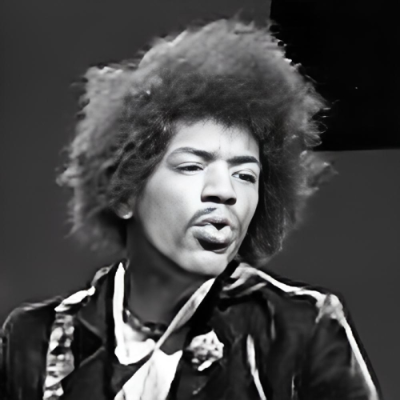
SSC I think both of them were really interested in similar things. But I found that Feather article very odd. I think critics do musicians a disservice by pigeon-holing their style, or who or what they are influenced by or listen to. Any artist is going to listen to whatever they need to to trigger something. Gil listened to an enormous range of music and so, I gather, did Miles Davis. They both really liked soul music, they were fascinated by Jimi Hendrix, they both started having electric instruments in their bands, and fooling around with them themselves. Gil was present at a lot of Miles’ recording sessions. I think he gave Miles a lot of ideas.
JJM There was also talk of a Jimi Hendrix/Gil Evans collaboration just months before Evans’ death in 1970. There was a real potential of that happening, wasn’t there?
SSC Absolutely. Gil was very much interested in working with Jimi, and then Jimi died. A few years later, Gil resurrected the idea. Gil was one of the founding members of the New York Repertory Jazz Orchestra and for his first concert, in June 1973, he decided to do a Hendrix tribute, and he and several band members wrote arrangements of Hendrix tunes. A few days later, his band recorded that music for RCA. There is now a new reissue of that album, they did a fantastic job on the sound. And, from then on, the Hendrix charts stayed in Gil’s repertoire. He always included one or two Hendrix songs in a set, and they took on a much more “Evansian” quality.
JJM You wrote that Gil once said, “Being an arranger is a loser’s game,” because arrangers do not get royalties the way composers do. What regrets do you suppose he had in his life?
SSCI had pondered that a lot, actually, and it’s hard to say. He was often broke, but he turned work down if he wasn’t interested in it. He was not a materialistic person. And there weren’t that many people in the record business who were willing to sponsor him, though everybody admired him so much. They weren’t willing to pay the bills for a 19-piece big band, especially without Miles Davis. But Gil was a person who lived life day to day and did his work, which was music. He was on a roll in the last few years of his life, and performed at many international festivals. He loved that, being able to perform with his band.
JJM If you could put yourself in a setting in jazz history as a spectator, where would that be?
SSC I would have loved to have been in Kansas City in the early ’30s, when somebody would go wake up Mary Lou Williams to play piano in the middle of the night because Count Basie or whoever couldn’t make it. I would have enjoyed that a lot. But I also surely would have loved to be at any number of Gil Evans’ recording sessions. I would have been really happy to have been there.
_____________________________
by
Stephanie Stein Crease
Some of the author’s favorite Gil Evans recordings:
Evans’s Arrangements for the Claude Thornhill Orchestra
Buster’s Last Stand
Arab Dance
Anthropology
Troubador
Miles Ahead
Porgy and Bess
Sketches of Spain
_____
Gil Evans as leader
Gil Evans & Ten, featuring Steve Lacy
New Bottle, Old Wine, featuring Cannonball Adderley
Out of the Cool
The Individualism of Gil Evans
Svengali
Live at the Public Theater, Vol. 2
Live at Sweet Basil, Vol. 2
Paris Blues, Gil Evans and Steve Lacy
________________________________
Stephanie Stein Crease products at Amazon.com
Gil Evans products at Amazon.com
_______________________________
Interview took place on December 17, 2001
*
If you enjoyed this interview, you may want to read our interview about Miles Davis with cultural critic Gerald Early.