



.
.
New Short Fiction Award
Three times a year, we award a writer who submits, in our opinion, the best original, previously unpublished work.
Jeff Dingler, a resident of Atlanta, Georgia, is the winner of the 66th Jerry Jazz Musician New Short Fiction Award, announced and published for the first time on August 9, 2024.
.
.
___
.
.
Impulse! Records and ABC/Dunhill Records. Photographer uncredited/via Wikimedia Commons
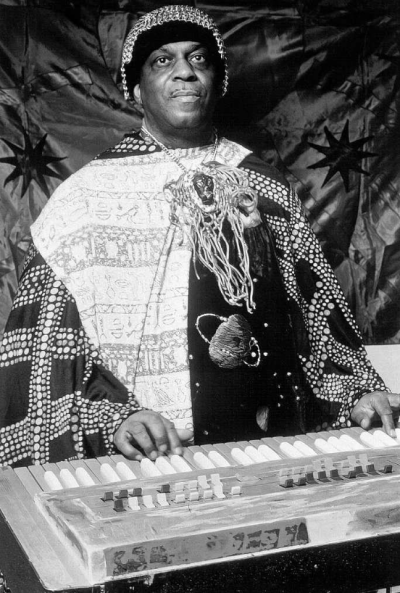
Sun Ra, 1973
.
___
.
.
Not From Around Here
by Jeff Dingler
.
Freshman classmate:
…..You ain’t from around here, are you, Ash? I could tell by the way you talk, even the way you move your hands so much when you speak, as if the telling’s in the motion. I noticed your brother did it too, before he left school in 8th grade. You might be born in Birmingham, but you ain’t from here, you ain’t rooted like me. Your mama and papa are Jewish—worse, Yankees! So what your dad plays with Black musicians down in the ‘Ham, and so what Mr. Blythers gave you second trumpet your freshman year. You could hermit yourself underground like a cicada for a century and still not be rooted like me and my daddy and his folks. Because the rootedness is not in the ground. It’s about what you say or don’t say and how you don’t say it with just a look. You ain’t got the rooted look in your eyes. And that’s what you and your folks don’t understand, that just because you live here, just because you were born here, don’t mean you’re from here.
.
Lunch lady:
…..What can I get you, hon? Oh my god, you can’t eat pork. I keep forgetting you’re Jewish. What’s that like? No ham. Gosh, you’re not a Southerner if you don’t like a good honey-baked ham on Thanksgiving or Christmas. What’s that? You don’t celebrate Christmas? Gosh, I hope the lord didn’t hear that. But Ash, very important question: What about really thinly sliced ham, does that count?
.
Sophomore English paper:
Native Jazz Star: Sun Ra
By Ash Blackstone
…..When I drew Sun Ra’s name out of a hat for our essay assignments, I had no idea who he was. When I learned he was a jazz musician from Birmingham, I was disappointed. I don’t know anything about jazz, and when I listened to Sun Ra’s most highly recommended album Lanquidity, I felt like my ears were being assaulted. However, I did like the name of the album. I tried finding the word in the dictionary and realized Sun Ra had made it up, likely a mix of languid and liquidity, like that heavy hanging feeling of living in the humid South or any place where the powers that be won’t let you be.
…..Sun Ra was born Herman Poole Blount in 1914 in Birmingham, city of my birth. Ra was a child prodigy, becoming a proficient piano player by his early teens. In 1936 or ’37, he claimed to have a spiritual visionary journey to Saturn where aliens instructed him to communicate to the world through his music, and after that he became Sun Ra.
…..They joke that jazz musicians can mash together any number of notes, play any random scale, and it’s acceptable. This is the exact opposite of marching band with its strict patterns, printed sheet music, and sharp, shining medals. After listening, I can’t say I understand Ra’s music, but I understand his persona, his need to escape from this oppressive planet and, to self-liberate, become someone so different and free-thinking that he had to label himself as “traveling spaceways from another world.” It’s like the overlapping, shadowy voices at the end of Lanquidity eerily repeating the only lyrics on the album: There are other worlds they have not told you of…they wish to speak to you.
…..Maybe it’s strange for me, a Jewish trumpet player in the school marching band, to relate to a Black jazz musician, but Ra’s music reverberates and vibes with a universal interconnectedness. I can never know what it’s like to be Black in America, but that alienation of being a singularity somewhere—me being the only Jewish person at Jemison High—my older brother being so bullied that he chose to homeschool—my family being the sole Semitic household in this community—that, I understand. Being Jewish in America is almost like being a shade of grey, liminal and murky, much like Ra’s music, which is not random chaos at all but rather a prepared cacophony of the pain, joy, confusion, dread and ecstasy of existence.
…..Ra and I are both foreigners in the land of our birth, both echoes of others’ lost footprints. His music and story got me thinking: maybe things would be different if I weren’t a lonely Jew in Alabama. Maybe I would feel more at home if I were born in New York City or LA. Or maybe if I were born in Jerusalem, I would support the walling off of Palestinians. I hope not.
…..The Harlem Renaissance poet Langston Hughes once wrote, “The two problems have much in common—Berlin and Birmingham. The Jewish people and the Negro people both know the meaning of Nordic supremacy. We have both looked into the eyes of terror.” These are interesting lines considering Hughes’ great-grandfather was Jewish-American, a Kentucky slave trader who raped his slaves and sold his own children. I suppose any kind of hate can be twisted around any kind of heart depending on the time and place. Maybe that’s why Ra tried to escape from Earth for a little while. Maybe that’s why he made so much crazy music.
.
Marching band teacher:
…..Hey, young man, I heard you playing those keys before class. Sounded smooth, real smooth. Who taught you to do that, Mr. Blackstone? Your dad’s a pretty hot guitarist around town, I know that. Really, you just picked that up by ear? The piano’s a lot different from trumpet. Hah, you say you want to be the next Sun Ra? Of course I’ve heard of him. Mad respect for Sun Ra, he’s wild. He’ll have you bopping along and then do something that just ruins your whole day. He loves to mess with your head like that. But for real, if you’re already playing stuff like that by ear, you oughta sit in with this local jazz fiend, Herb. He’s on the north side of town. He’ll show you how to turn music into a language that communicates with everyone. You already know there are black and white keys. Some people like to call those naturals and accidentals, but that’s just a bunch of old, white nonsense. The truth is, it’s all just sound, and it can be rhythmic or melodic or harmonic. That’s the beauty of jazz: pick any of it, or all of it. Now take that loneliness I see gathered up in your eyes, and let me hear how it sounds.
.
First crush:
….. My moody, little Jewppie. I don’t care what the others say. I like your curly hair and big lips. So what church? So what Jesus with his six-pack abs nailed and dying on the cross for my sins? I didn’t ask for any of that. Who cares about all that old dogma stuck in the mud? I just wanted you, Ash. You looked at me that day, and I followed you into the empty percussion closet where you gave me the sloppiest kisses and squeezed me so close I could feel every inch of you. After that you had me wrapped around your little finger. You played me whole albums, not just the hits, and ranted about the digitization of modern music, or how jazz was an acquired taste but, once acquired, it became as necessary as bread or coffee. Everywhere you went, your music followed, blaring out of your phone or car speakers, as natural to you as your scent. And you were always barefoot, walking on grass and mud, which shocked me. I asked once if that was a country or hippie attribute—or a Jewish thing—and you wrinkled your nose at me. I liked to call you my little Jewppie (Jew + hippie). Did you secretly hate that pet name? I know my Mom slipped up that night at dinner and said some guy at the flea market had tried to “Jew” her down, but she apologized, like a dozen times. She didn’t know what that word meant until we started dating. I swear. Ash…I love you.
.
The Jemison Chronicle:
“Junior Ash Blackstone Wins Prestigious Southeast Music Competition”
By Madeline Faulkner
…..“It was just a matter of stitching together the loose pieces,” said Jemison Junior Ash Blackstone about his first original composition “Bible Belt Blues.” In January, “Bible Belt Blues” won first place in the Southeast Music Institute’s annual “Sounds of the South” song contest. “I mined a bunch of loose musical snippets and ideas for about three months,” said Blackstone about the instrumental piece. “Then it was just a matter of figuring out how to jigsaw it together.”
…..“Bible Belt Blues” for solo piano captures the history and sonic progression of Birmingham jazz in a wild ride of a song that lasts six minutes and includes “spoken word history” from the composer. Blackstone traveled to Atlanta to perform the piece live in front of three judges, who selected his song out of nearly 100 others.
…..The Jemison junior will receive a $1,000 cash prize and a recital opportunity later this year at Atlanta’s historic Fox Theatre. “It’s vindicating,” said Blackstone, who lists his influences as Thelonious Monk, Dave Brubeck, Sun Ra, and Chopin. “The band teacher Mr. Blythers really encouraged my creativity. He said don’t think about the music, just sit back and let the music do the thinking for you.”
…..Just seventeen, Blackstone has already been spotted around town performing with his father in Birmingham nightclubs like the Blue Monkey Lounge and The Ham 205. The junior also invited fellow Jemison bandmate Petey Druthers to jam on saxophone for a few performances. As for the future, Blackstone wants to be a famous composer and instead of going to college is planning a gap year to write more music. Watch out for this one, Jemison High!
.
Notes for piece commemorating Civil Rights anniversary:
- Badass bassist Esperanza Spalding gave a free concert in the ‘Ham for the Civil Rights Act’s 60th anniversary. Onstage, Esperanza looked like an afroed angel and said, “Just because it’s a free concert doesn’t mean we’re not going to play our brains out up here,” and that’s exactly what they did, brains and spirits spilled out onto percussion, piano, and the upright. This got me thinking about writing some new pieces about my hometown.
- Petey ribbed me yesterday in practice about all the dust on my trumpet. He said with that big boisterous smile, “Does that thing even see the light anymore?” He’s right. Need to incorporate more trumpet parts into my music. Also, incorporate oral histories over instrumental lines.
- Some Jewish people supported the Civil Rights movement. In May 1963, twenty New York rabbis visited Birmingham to support Civil Rights demonstrations led by Dr. Martin Luther King Jr. and Alabama Reverend Fred Shuttlesworth. A year later, Dr. King wrote: “It would be impossible to record the contribution that the Jewish people have made toward the Negro’s struggle for freedom—it has been so great.”
- Some Jews…not so much. One of the eight clergymen chastised in Dr. King’s famous “Letter from a Birmingham Jail” was Birmingham’s own Rabbi Milton Grafman of Temple Emanu-El. Though Grafman opposed racial segregation, he’d criticized King’s demonstrations and the timing of the protests. For this, Grafman received hate mail for the rest of his life.
- Interviewed “Colonel” Stone Johnson, an activist and personal bodyguard for Reverend Shuttlesworth during Civil Rights. Colonel was 91, topped with a beige cowboy hat, a meandering but entertaining storyteller. I don’t know how much musical material I got out of it, but he talked about protecting the nonviolent Shuttlesworth with his “non-violent .38 special,” about waddling a barrel full of fizzling explosives out from Shuttlesworth’s driveway and onto the street just seconds before it blew, about how the white folks taught their kids to hate. “Teach ‘em to hate,” his refrain went. “Teach ‘em to hate.”
- Students bullied my brother so much that he left in 8th grade and homeschooled instead. He says he doesn’t miss it because there was no one to socialize with anyway. Students have started asking me if I support Israel bombing Palestinians and the answer is: No. I’ve never even been to Israel. I worry about my younger sister who’s still in grade school. She hasn’t started telling anyone that she’s Jewish.
- All these outside pressures to put ourselves in little predefined boxes: White, Jewish, Southerner, middleclass, musician. I guess it’s true, but it’s also reductive. Sun Ra said that he was born on Saturn and invented his own interstellar, spacy sound to prove it—and created his own family, his “Arkestra,” of eccentric, colorful musicians, who toured and ate and fought and lived and made music together and (just like their saturnine leader) wore shimmering gold, Egyptian-and-Space-Age-inspired garb. Ra is gone, but his Arkestra is still around, keeping his music alive.
.
Senior band trip
…..When you opened the hotel room door and saw us, me and big Petey, there was a frozen moment of silence, and then we all laughed. Of course, Mr. Blythers put the one Jewish student and the only two Black kids in band in the same room together. Blythers was like, “You know how many Bubbas there are in this school, just playing it safe.” I was excited about this year’s senior trip, but I found D.C. a strange town, like it doesn’t quite belong anywhere and it knows it, like it’s a place that can only exist between the lines. And that two-hour ride down to Monticello…phew, Jefferson owned and raped all those slaves, and the tour guide didn’t say one word about it. You were the only one who spoke up, saying, “This is fucked with a capital F. This is a plantation!” Mr. Blythers coughed over his laugh. The next day the whole band went to the Holocaust Museum on the National Mall, and everyone was hovering around you and constantly asking if you were alright. It was like they didn’t want you to breathe it in and be alone with it—like they knew something that they didn’t want you to know. But they didn’t say shit to me and Petey while we were walking around Jefferson’s white-columned concentration camp. That night, before we headed back to Alabama, you, me and Petey stayed up talking about the music, where it was going to take us—if it was going to take us anywhere. We talked about the weird, ignorant, well-intentioned-but-misguided, but mostly downright racist shit people had said to us. I remember the moist, blue marbles of your eyes when we told you what the others had said about us few Black students at Jemison. You said, “Shit, I knew it was bad…I didn’t know it was that bad.” I said you would never really know. We all cried then. We weren’t high or drunk or nothing. Then Petey broke out his saxophone—we took out our trumpets—and the three of us jammed with the silliest lines till the moon shined with our laughter.
.
Yearbook entries:
– Stay cool, you crazy Jew. I’ll eat a big juicy pork chop for you! –Rex
-I’ve had many gifted students over the years but none could’ve written something like your “Civil Rights 2023,” and for a senior recital no less! Your talent is meteoric. –Blythers
-Jewppie, I ♥ U like a fat kid loves cake! Remember, this school is a business, not a social club. Don’t be a stranger this summer! –Leslie
-Ash, you’re the coolest white dude I know. I’ll never forget jamming with you in DC. You’ll get out of the ‘Ham one day. Stay fresh. –Petey
-It’s been great getting to know you these past two years. I’m so proud of that piece I wrote about you in The Jemison Chronicle. I know you’ll succeed in whatever you do. Jeremiah 29:11 –Madeline
-Ash, it’s me, yourself. I wanted to do something unconventional and write a note in my own yearbook. It’s a weird feeling—following this sound, not knowing where it’s going. But I can’t imagine ever going back to school. Every day for the last thirteen years, I’ve had to stand and pledge my allegiance to a piece of red, white and blue cloth. But allegiance? I don’t know what that means. Am I not, as my “Yankee” parents say, just an eco-tourist on this planet? America forces you to act and talk a certain way so America can understand what it thinks you should be—so it can fit you neatly into one of its magic distraction boxes—but America doesn’t understand itself. Over the years, many names in this book have asked me where I’m from. A transcendental Jazz musician once said, “We are all citizens of the cosmos, not just of this planet.” It’s true—through music we can speak the universal. If I practice a song long enough, I can begin to practice it entirely in my mind without the instrument. I can close my eyes and disappear into a sound, have no identity except that sound and what it says. I can send a song on a wave across a galaxy, and that’s still me, my voice. Maybe it will spread out across all time and space forever. Or maybe one day all the sound is going to bounce back in a great cosmic echo, reminding us where we’re from.
.
.
___
.
.
photo by Lessie Dingler

Jeff Dingler is an Atlanta-based author and entertainer. A graduate of Skidmore College with an MFA in creative writing from Hollins University, he’s written for New York Magazine, Washington Post, Newsweek, WIRED, Salmagundi, Flash Fiction Magazine and Maudlin House. He’s working on his debut novel Mother of Exiles about detention and deportation in America.
Click here to visit his website
.
___
.
.
Click here to help support the continuing publication of Jerry Jazz Musician, and to keep it ad and commercial-free (thank you!)
.
Click here to read more short fiction published on Jerry Jazz Musician
Click here to read The Sunday Poem
Click here for information about how to submit your poetry or short fiction
Click here for details about the upcoming 67th Jerry Jazz Musician Short Fiction Contest
Click here to subscribe to the Jerry Jazz Musician quarterly newsletter (it’s free)
.
.
.
___
.
.

Jerry Jazz Musician…human produced (and AI-free) since 1999
.
.
.






















.jpg)