
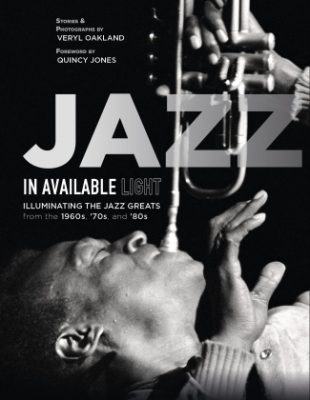
“Jazz in Available Light” — photos by Veryl Oakland, Vol. 1

March 27th, 2019

.

.


.

Jazz in Available Light: Illuminating the Jazz Greats by Veryl Oakland is the most impressive book of jazz photography published in years.  The book features over 300 spectacular photos – many of which previously unseen – of iconic artists of the 1960’s to 1980’s.  You will discover great photos of Thelonious Monk, Dizzy Gillespie, Dexter Gordon, Duke Ellington and Stan Getz, for sure, but also artists like Shorty Rogers, Paul Bley, Phil Woods, Buddy Rich and Sun Ra.   The book is also filled with entertaining and smart firsthand accounts of Mr. Oakland’s experience with the artists he photographed.

With the cooperation of Mr. Oakland, beginning with this issue, Jerry Jazz Musician will regularly publish a series of posts featuring examples of the photography and stories/captions found in this important book.

In this edition, following Mr. Oakland’s introduction, a sampling of his photographs of Red Garland, Dizzy Gillespie and Rahsaan Roland Kirk are featured.

.

.

*

.

.
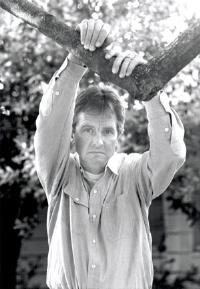
 

Veryl Oakland

.

___

.

.

Growing up in South Dakota during the 1940s, music was a big part of my household – my grandfather even toured with the John Philip Sousa Marching Band. So, it was only natural that music would be a big part of my life, and my parents decided to buy me a cornet early on. After seven years of private lessons, I can honestly say I could pretty much play anything that was written.

One night while listening to the radio, a most unlikely event occurred. I stumbled onto the 50,000-watt station KSL in Salt Lake City just in time to hear all-night host Wes Bowen playing the theme song for his program, “All That Jazz.” It was Red Garland and his Trio playing “Blue Red.”

I stayed up well into the early morning hours – and at every opportunity thereafter – listening to those great sounds being played by jazz giants I’d never heard before. I was totally hooked.


Whatever future plans I might have made in music were dashed the night I heard Dizzy Gillespie’s solo on “Hot House,” from the Jazz At Massey Hall album with Charlie Parker. After that, I never picked up my horn again. I just knew that I would never be able to improvise, to create like Gillespie. But I also knew I’d be a jazz fanatic for life.

After heading west to college, a couple of friends joined me on a trip to my first Monterey Jazz Festival. That was where I noticed photographers down in front filming all the greats in performance….How cool is that, I thought.

Not until graduating from college and fulfilling my military obligation did I buy my first camera at age 25, and begin learning on my own. Having been immersed in music, I gravitated toward the entertainment business, landing my first real job as publicity manager for The Nugget Casino near Reno, Nevada. It was there, while working with the featured stars – as well as taking in late night shows in the other major hotels – that I started to connect with people in the music industry. And on weekends, I would also drive to San Francisco, catching different acts and photographing musicians at a variety of jazz clubs.

On one of those SF trips in 1967, something happened that would change my course with photography: I drove in to catch Roland Kirk at a Sunday afternoon matinee performance at The Jazz Workshop, spending more than four hours photographing him, taking my time practicing my craft.

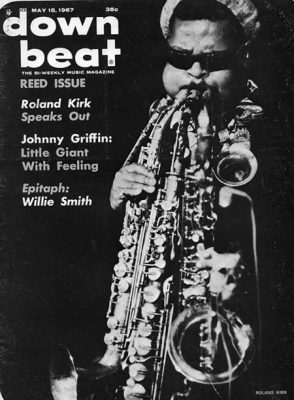
After, on a whim, I sent contact sheets of the photos I took that day to Down Beat. Soon after, the editors wrote back asking for several enlargements. And, one of those images graced the cover of their May 18, 1967 issue, becoming my first photograph ever sold.

And that’s how it all began for me.

My book title, Jazz In Available Light, was chosen because I never wanted to disrupt either the musicians or their audiences with annoying strobe lights. Plus, I didn’t want to impose on the artists’ time by setting up all kinds of equipment and taking forced poses.  Instead, I opted for more natural, informal portraits. 

You might wonder, why only the 1960s through ‘80s? I had planned to stay active as a jazz photojournalist well past my 50th birthday, but in 1990 our home flooded. My negatives and many photographs had been stored downstairs, so the better part of three decades of work was severely damaged. I stopped shooting, withdrew from the scene, and avoided the many boxes of negatives.

But in 2010, I decided to tackle everything head-on, and I got an assessment of the damage from a photographic curator. Shockingly, I found out that much of my collection was still salvageable, albeit with a lot of work – not a total loss. That’s when I began seriously working on writing my book.

I consider myself supremely fortunate to have had the opportunity to be in the midst of, interact with, and get to know, so many of our jazz giants, virtually all of whom have left a treasure trove of critically important recorded works of lasting value. The contributions of these great artists, their like-minded musical brothers and sisters, and the masters who came before them, are truly incalculable.

I hope you enjoy a sampling of excerpts from the book – I’ve continued sharing more stories on my site and on social media too, as the book could never fit all I wanted to include.

In this edition, I will share some photographs taken of Rahsaan Roland Kirk, Red Garland, and Dizzy Gillespie.__

.

.

______

.

.

Rahsaan Roland Kirk

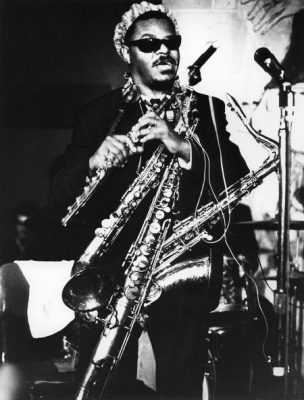
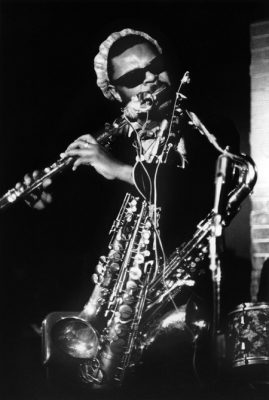
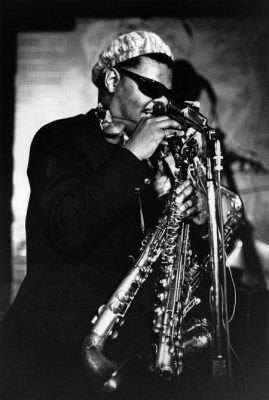
Seeing Roland Kirk for the first time in 1967 was like witnessing an unexpected, one-man performance extravaganza. On flute, there was nothing simple once he finished the theme and opening choruses. While playing, he soon began humming and simultaneously adding vocalizing to the mix before interjecting an accompanying chorus on nose flute, and then for the finale, launched into a series of double-tongue passages just before ending in a flourish and blowing his siren whistle.

.
.
.
 

.

.
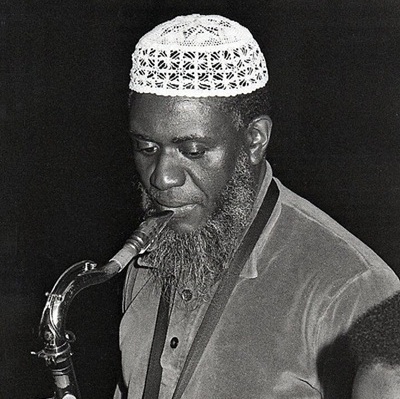
This is the photo Down Beat chose for their 1967 cover, and the one that launched my photography career. Kirk’s phenomenal circular breathing ability on all three instruments – being able to so smoothly and seamlessly play extended choruses for up to minutes at a time without removing his horns from his mouth – was mind-blowing.

.
.

.

.

Red Garland

.

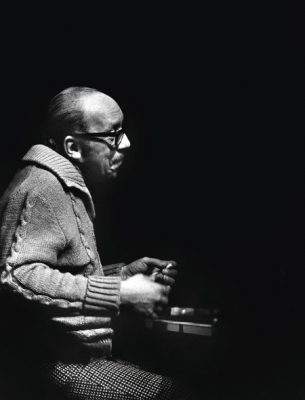
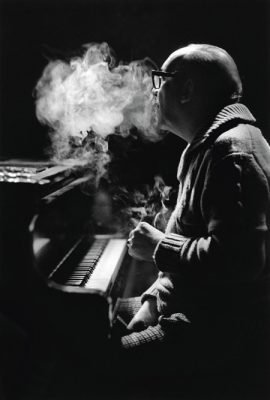
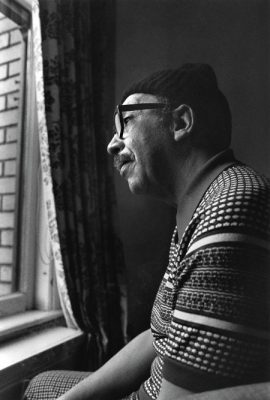
In the darkened confines of San Francisco’s Keystone Korner, Red Garland was right at home. It was 1977, and after having been away from the scene for many years, Red was rejuvenated to be in the company of two stalwarts, bassist Leroy Vinnegar and his drummer from the glorious Miles Davis/John Coltrane days, Philly Joe Jones.

.

.
.
.
.
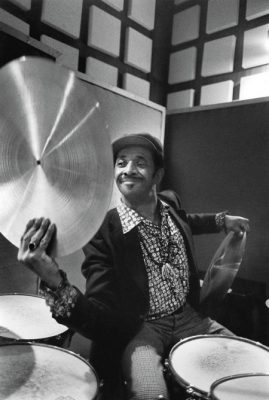
Philly Joe Jones


.

.

.


Dizzy Gillespie

.
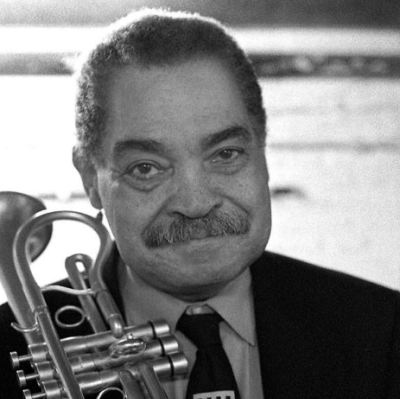
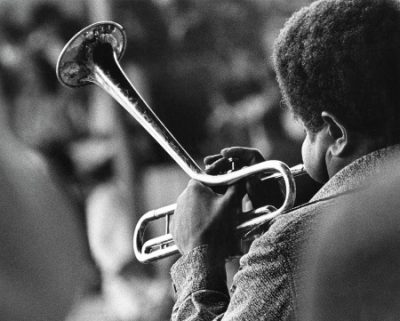
Just witnessing his puffy cheeks and the upturned bell of his trumpet was all that jazz aficionados needed to see to know that Dizzy Gillespie was in the house. No other trumpeter had a more direct impact on my own personal career in music.


.

.
.

.

Click here to read the edition featuring Stan Getz, Sun Ra and Carla Bley

Click here to read the edition featuring Art Pepper, Pat Martino and Joe Williams

Click here to read the edition featuring Yusef Lateef and Chet Baker

Click here to read the edition featuring Mal Waldron, Jackie McLean and Joe Henderson

Click here to read the edition featuring violinists Joe Venuti, Stephane Grappelli, Jean-Luc Ponty, Zbigniew Seifert, and Leroy Jenkins

Click here to read the edition featuring Frank Morgan, Charles Lloyd/Michel Petrucciani and Emily Remler

Click here to read the edition featuring Dexter Gordon, Art Farmer and Johnny Griffin

Click here to read the edition featuring Thelonious Monk, Paul Bley and Cecil Taylor

Click here to read the edition featuring drummers Jo Jones, Art Blakey and Elvin Jones


Click here to read the edition featuring Monk Montgomery and the jazz musicians of Las Vegas

Click here to read the edition featuring Sarah Vaughan and Better Carter

.

.


___

.

.

.
 

Jazz in Available Light: Illuminating the Jazz Greats by Veryl Oakland

.

“…a truly invaluable work that features some of our most revered music icons, from their strongest to their most vulnerable states as human beings. The pictures and stories pierce the soul in a manner that can only be understood through a personal journey – one in which I urge you to embark on and discover for yourself as you read through the contents of this book.”

-Quincy Jones, from the introduction to Jazz in Available Light

.

Click here for more information about the book

.

All photos and text used with permission of the author

.

.
Share this:

Comment on this article:

Your email address will not be published. Required fields are marked *
Site Archive

Your Support is Appreciated

Jerry Jazz Musician has been commercial-free since its inception in 1999. Your generous donation helps it remain that way. Thanks very much for your kind consideration.

Click here to read about plans for the future of Jerry Jazz Musician.

In this Issue

A collection of poetic responses to the events of 2025...Forty poets describe their experiences with the tumultuous events of 2025, resulting in a remarkable collection of work made up of writers who may differ on what inspired them to participate, but who universally share a desire for their voice to be heard amid a changing America.

Poetry

photo by William Gottlieb/Library of Congress
21 jazz poems on the 21st of January, 2026...An ongoing series designed to share the quality of jazz poetry continuously submitted to Jerry Jazz Musician. This edition features poets – several new to readers of this website – writing about their relationship with the music and its historic figures, including Chuck Mangione, John Coltrane, Barney Kessel, Count Basie, Bill Evans, Hubert Laws, and Steve Lacy.

The Sunday Poem

Wojciech Soporek, CC BY 3.0 , via Wikimedia Commons

”Pyramids” by John Menaghan

The Sunday Poem is published weekly, and strives to include the poet reading their work...

John Menaghan reads his poem at its conclusion


Click here to read previous editions of The Sunday Poem

Feature

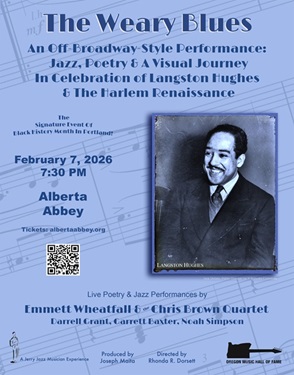
Press Release for “The Weary Blues: Celebrating The Harlem Renaissance and Langston Hughes...I recently wrote about a new endeavor of mine – producing a show in Portland celebrating the poetry of Langston Hughes and the Harlem Renaissance. What follows is the complete press release for the February 7 performance at the Alberta Abbey in Portland, Oregon.

Short Fiction

photo via Freerange/CCO
Short Fiction Contest-winning story #70 – “The Sound of Becoming,” by J.C. Michaels...The story explores the inner life of a young Southeast Asian man as he navigates the tension between Eastern tradition and Western modernity.

Feature

Linnaea Mallette/publicdomainpictures.net
A 2026 jazz poetry calendar...12 individual poets contribute a jazz-themed poem dedicated to a particular month, resulting in a 2026 calendar of jazz poetry that winds through the year with a variety of poetic styles and voices who share their journeys with the music, tying it into the month they were tasked to interpret. Along the way you will encounter the likes of Sonny Stitt, Charles Mingus, Jaco Pastorius, Wynton Kelly, John Coltrane, and Nina Simone.

Poetry

“To Renee Nicole Good, a poet” – a poem by Erren Geraud Kelly

Feature

Boris Yaro, CC BY 4.0, via Wikimedia Commons
“The Bowie Summer” – a personal memory, and how art can fundamentally reshape identity, by G.D. Newton-Wade

Poetry

photo via Shutterstock
“The Music of Lana’i Lookout” – a poem by Robert Alan Felt...The 17th anniversary of president-elect Barack Obama's scattering of his beloved grandmother's ashes is at the center of the poem, and serves as a reminder that moral personal character of leadership is what makes a country great.

Poetry

Poems on Charlie “Bird” Parker (inspired by a painting by Al Summ) – an ekphrastic poetry collection...A collection of 25 poems inspired by the painting of Charlie Parker by the artist Al Summ.

Community

Letter from the Editor: “A Jerry Jazz Musician Experience”...Sharing a bit of what I’ve been up to of late, and make you aware of a new endeavor of mine…

Poetry

National Archives of Norway, CC BY 4.0 , via Wikimedia Commons
“Wonderful World” – a poem by Dan Thompson

A Letter from the Publisher

The gate at Buchenwald. Photo by Rhonda R Dorsett
War. Remembrance. Walls.
The High Price of Authoritarianism– by editor/publisher Joe Maita
...An essay inspired by my recent experiences witnessing the ceremonies commemorating the 80th anniversary of liberation of several World War II concentration camps in Germany.

Poetry

Wikimedia Commons
“Dorothy Parker, an Icon of the Jazz Age” – a poem by Jane McCarthy

Short Fiction

photo via publicdomainimages.net
“Welcome to America” – a short story by John Tures...The story – a short-listed entry in the recently concluded 70th Short Fiction Contest – is a combination of two true linked stories, both of which involved the same person. In one, he’s a witness to history. In the second, he’s an active participant in history, even becoming a hero. But one can’t understand the second until they know the first.

Feature

photo via Wikimedia Commons
Memorable Quotes – Lawrence Ferlinghetti, on a pitiable nation

Short Fiction

“Frusick: Making Sweeter Music” – a short story by J. W. Wood...In the 22nd century, a medical professional takes a bunch of kids to meet one of the last musicians left in England, and has an epiphany when he hears live music for the first time …

Community

Nominations for the Pushcart Prize L (50)...Announcing the six writers nominated for the Pushcart Prize v. L (50), whose work appeared on the web pages of Jerry Jazz Musician or within print anthologies I edited during 2025.

Interview

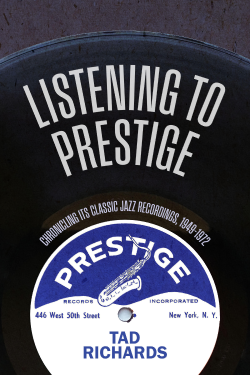
Interview with Tad Richards, author of Listening to Prestige: Chronicling its Classic Jazz Recordings, 1949 – 1972...Richards discusses his book – a long overdue history of Prestige Records that draws readers into stories involving its visionary founder Bob Weinstock, the classic recording sessions he assembled, and the brilliant jazz musicians whose work on Prestige helped shape the direction of post-war music.

Poetry

"Swing Landscape" by Stuart Davis
“Swing Landscape” – a poem by Kenneth Boyd....Kenneth Boyd writes poetry based on jazz paintings. “Swing Landscape” is written for a Stuart Davis painting of the same name.

Playlist

“A Perfect 10” – a playlist of tentets by Bob Hecht...Bob adds another instrument to his progressive playlist feature, and shares what a variety of arrangers have been able to accomplish writing for a tentet.

Jazz History Quiz

Jazz History Quiz #185...This posthumously-awarded Grammy winning musician/composer was the pianist and arranger for the vocal group The Hi-Lo’s (pictured) in the late 1950’s, and after working with Donald Byrd and Dizzy Gillespie became known for his Latin and bossa nova recordings in the 1960’s. He was also frequently cited by Herbie Hancock as a “major influence.” Who is he?

Poetry

photo via Wikimedia Commons
Jimi Hendrix - in four poems

Playlist

A sampling of jazz recordings by artists nominated for 2026 Grammy Awards – a playlist by Martin Mueller...A playlist of 14 songs by the likes of Samara Joy, Brad Mehldau, Dee Dee Bridgewater, Branford Marsalis, the Yellowjackets and other Grammy Award nominees, assembled by Martin Mueller, the former Dean of the New School of Jazz and Contemporary Music in New York.

Poetry

Ukberri.net/Uribe Kosta eta Erandioko agerkari digitala, CC BY 2.0, via Wikimedia Commons
In Memoriam: “Color Wheels” – a poem (for Jack DeJohnette) by Mary O’Melveny

Essay

“Escalator Over the Hill – Then and Now” – by Joel Lewis...Remembering the essential 1971 album by Carla Bley/Paul Haines, inspired by the writer’s experience attending the New School’s recent performance of it

Poetry

“Still Wild” – a collection of poems by Connie Johnson...Connie Johnson’s unique and warm vernacular is the framework in which she reminds readers of the foremost contributors of jazz music, while peeling back the layers on the lesser known and of those who find themselves engaged by it, and affected by it. I have proudly published Connie’s poems for over two years and felt the consistency and excellence of her work deserved this 15 poem showcase.

Feature

photo of Barry Harris by Mirko Caserta
“With Barry Harris at the 11th Street Bar” – a true jazz story by Henry Blanke...The writer - a lifelong admirer of the pianist Barry Harris - recalls a special experience he had with him in 2015

Interview

Interview with Sascha Feinstein, author of Writing Jazz: Conversations with Critics and Biographers...The collection of 14 interviews is an impressive and determined effort, one that contributes mightily to the deepening of our understanding for the music’s past impact, and fans optimism for more.

Feature

Trading Fours, with Douglas Cole, No. 27: “California Suite”...Trading Fours with Douglas Cole is an occasional series of the writer’s poetic interpretations of jazz recordings and film. This edition is dedicated to saxophone players and the mood scenes that instrument creates.

Essay

“J.A. Rogers’ ‘Jazz at Home’: A Centennial Reflection on Jazz Representation Through the Lens of Stormy Weather and Everyday Life – an essay by Jasmine M. Taylor...The writer opines that jazz continues to survive – 100 years after J.A. Rogers’ own essay that highlighted the artistic freedom of jazz – and has “become a fundamental core in American culture and modern Americanism; not solely because of its artistic craftsmanship, but because of the spirit that jazz music embodies.”

Community

photo of Dwike Mitchell/Willie Ruff via Bandcamp
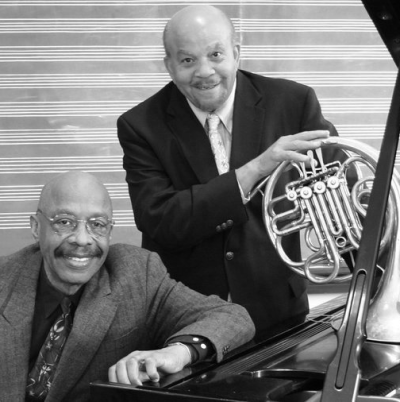
“Tell a Story: Mitchell and Ruff’s Army Service” – an essay by Dale Davis....The author writes about how Dwike Mitchell and Willie Ruff’s U.S. Army service helped them learn to understand the fusion of different musical influences that tell the story of jazz.

Feature

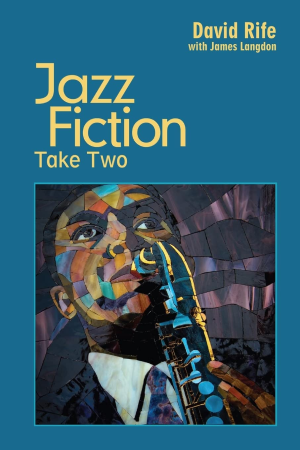
Excerpts from David Rife’s Jazz Fiction: Take Two– Vol. 16: Halloween on Mars? Or…speculative jazz fiction...A substantial number of novels and stories with jazz music as a component of the story have been published over the years, and the scholar David J. Rife has written short essay/reviews of them. In this 16th edition featuring excerpts from his outstanding literary resource, Rife writes about azz-inflected speculative fiction stories (sci-fi, fantasy and horror)

Poetry

“With Ease in Mind” – poems by Terrance Underwood...It’s no secret that I’m a fan of Terrance Underwood’s poetry. I am also quite jealous of his ease with words, and of his graceful way of living, which shows up in this collection of 12 poems.

Poetry

What is This Path – a collection of poems by Michael L. Newell...A contributor of significance to Jerry Jazz Musician, the poet Michael L. Newell shares poems he has written since being diagnosed with a concerning illness.

Art

photo by Giovanni Piesco
The Photographs of Giovanni Piesco: Art Farmer and Benny Golson...Beginning in 1990, the noted photographer Giovanni Piesco began taking backstage photographs of many of the great musicians who played in Amsterdam’s Bimhuis, that city’s main jazz venue which is considered one of the finest in the world. Jerry Jazz Musician will occasionally publish portraits of jazz musicians that Giovanni has taken over the years. This edition features the May 10, 1996 photos of the tenor saxophonist, composer and arranger Benny Golson, and the February 13, 1997 photos of trumpet and flugelhorn player Art Farmer.

Community

Community Bookshelf #5...“Community Bookshelf” is a twice-yearly space where writers who have been published on Jerry Jazz Musician can share news about their recently authored books and/or recordings. This edition includes information about books published within the last six months or so (March, 2025 – September, 2025)

Contributing Writers

Click the image to view the writers, poets and artists whose work has been published on Jerry Jazz Musician, and find links to their work

Coming Soon

Interview with John Gennari, author of The Jazz Barn:  Music Inn, the Berkshires, and the Place of Jazz in American Life; Also, a new Jazz History Quiz, and lots of short fiction; poetry; photography; interviews; playlists; and much more in the works...

Interview Archive

Ella Fitzgerald/IISG, CC BY-SA 2.0 , via Wikimedia Commons
Click to view the complete 25-year archive of Jerry Jazz Musician interviews, including those recently published with Judith Tick on Ella Fitzgerald (pictured),; Laura Flam and Emily Sieu Liebowitz on the Girl Groups of the 60's; Tad Richards on Small Group Swing; Stephanie Stein Crease on Chick Webb; Brent Hayes Edwards on Henry Threadgill; Richard Koloda on Albert Ayler; Glenn Mott on Stanley Crouch; Richard Carlin and Ken Bloom on Eubie Blake; Richard Brent Turner on jazz and Islam; Alyn Shipton on the art of jazz; Shawn Levy on the original queens of standup comedy; Travis Atria on the expatriate trumpeter Arthur Briggs; Kitt Shapiro on her life with her mother, Eartha Kitt; Will Friedwald on Nat King Cole; Wayne Enstice on the drummer Dottie Dodgion; the drummer Joe La Barbera on Bill Evans; Philip Clark on Dave Brubeck; Nicholas Buccola on James Baldwin and William F. Buckley; Ricky Riccardi on Louis Armstrong; Dan Morgenstern and Christian Sands on Erroll Garner; Maria Golia on Ornette Coleman.