
“Intergalactic Language” — a short story by James E. Guin

July 20th, 2016

“Intergalactic Language,” a short story by James E. Guin, was a finalist in our recently concluded 42nd Short Fiction Contest.  It is published with the permission of the author.


Intergalactic Language

by James E. Guin

_____

      I was playing my weekly gig at Café Reinhardt when Bella, one of the waitresses, whispered in my ear, “They want you out back.”

She had disturbed me from a zone. I had been through all of my arrangements and was improving on the chords to “Minor Swing.”

“They?” I asked.

She shrugged her shoulders. Straight to the point, no small talk, Bella was my kind of gal. In the second it took to place my guitar on my guitar stand a million thoughts circled around in my mind. Did Chad, the drummer, want to borrow money again? Had the musician’s union caught on to the fact I wasn’t paying my dues? Another one of the agent Jimmy’s scams? Groupies? Oh yeah, jazz musicians haven’t had groupies under the age of forty-five since the 1940s.

I stood up, and as Bella was strolling to a table near the front door, she said, “Take your guitar.”

Ah, nothing complicated just someone wanting to test out my chops before a gig. People can be peculiar when it comes to inviting musicians into their home. They want to meet you, form a relationship, and get the feel for the atmosphere you create. They like to know what they are paying for. I placed my guitar in its case and walked through the kitchen.

I opened the back door to the cafe and a tour bus with the engine running was parked across the street. All these eco-friendly vehicles and so many are still running on fossil fuel. With a generic mountain scene painted on the side, it looked like something one of those old bluegrass bands would have toured in. I’ve seen vintage pictures on the Internet. The door opened and a man in a black Armani suite and shades — the whole nine yards — stepped down onto the street. His suit was too new, too nice, and too expensive for him to be a musician. He motioned for me to cross the street.

     This must be something big, I thought.

“Taking me on a tour?” I asked.

“Something like that,” he said.

As I was stepping onto the bus, he said, “After tonight, you will be the most famous musician in the galaxy.”

That was a lame yarn, man. Ever since the Nuages landed people were making space jokes. Nuages — they were from a planet in the Sagittarius Star Cloud, so that was what we called them.

Two suits waited at the top of the stairs. The one on the right motioned for me to follow him and the other one trailed behind. They were making me nervous. I didn’t have anything valuable and no one would go to all of that trouble for a 40,000 credits antique Gitane DG-310 that I got for at a pawnshop for 500 credits. The pawnshop owner had no clue. To me it was priceless, but to the rest of the world holo-screens and virtual sets are current treasures.

The hallway felt like it stretched to about the center of the bus. The suit in front knocked on the door. Someone on the inside opened it. He moved out of the way, motioned for me to step through, and what I saw next was unlike anything I had ever imagined. Two Nuages were levitating about half a meter off of the floor in the back of the room. I had read about them on the Internet, media streams were blowing up about them, and I had watched shows and documentaries on them. Everyone on Earth had. There were three different spacecraft that had landed on Earth passing by on an exploration of the Milky Way.

Like some of the videos I had seen, they sat crossed-legged on some flat, clear glass type of floating plane, but I couldn’t see any equipment that made it levitate. Their skin had a dark pinkish color to it. They had head-tentacles, but the rest of their body was like a female human body — a nice female specimen from our species.

Something was floating in the center of the room. I noticed it only because everything in the room reflected off it.

The one stage-right started humming a melody in major and minor thirds.

“Please sit,” the one stage-left said in perfect anchor-babe English.

She pointed at the floating plane in the center of the room. I laid my guitar case on the floor. Half expecting to fall on my buttocks, I sat on it like you would sit on a ledge or the high rise next to a sidewalk. After I felt I was in a firm sitting position, it adjusted to a comfortable height. An ideal comfortable height like it was reading my mind.

“This is —–,” the one stage-left said.

Trying to repeat the sounds in my mind, I squinted my eyes.

She sensed my confusion and said, “After much training some English speakers could reproduce and recall most of the sounds of my owner’s native language, and yes it is a tonal language.”

“My owner? Are you a slave?” I asked.

“I am equivalent to Artificial Intelligence on Earth,” she said.

As if rehearsed, the A. I. held her arm out and said, “My owner, —–, is female of the species from planet——which is in the Sagittarius Star Cloud near the center of our galaxy which you call the Milky Way. She has traveled 10,400 light years exploring and gathering data on life forms in this galaxy that we share. You have been recommended to us, and we would love to hear your music.”

     Recommended by whom? I thought as I took out my guitar and tuned it.

I have played for governors, the pope, various members of congress, and the speaker of the House of Representatives, and they’re the only ones who would have connections so high up.

What should I play for beings who have traveled 10, 400 light years across the Milky Way: “Nuages” (That would be ironic.), “Night and Day”, “All The Things You Are”, “St. Louis Blues”…Yeah, everyone in the galaxy should know “St. Louis Blues.”  It wasn’t as wild as Django’s, but I began an arrangement of “St. Louis Blues” that I had learned many years ago. I wasn’t nervous. I was freaking out, and I needed a comfort tune. It was straight and stiff, and I kept playing dead notes and making the strings scratch and buzz.

I stopped and all I could cough up was, “I’m sorry.”

The Nuage and the A. I. conversed in their musical language.

“Perhaps you are tired,” the A. I. said.

“No, this is too much for me. I’m just nervous,” I said.

The owner said something that covered at least two octaves.

“It might be helpful to perform music that is meaningful to you,” the A. I. translated.

I thought for a few minutes and then said, “I will improvise for you. That might calm my nerves.”

Faking it has always been my thing.

“In Earth music, what is improvise?” the A. I. asked.

Earthlings have asked me that many times.

“I will make up, create, invent, compose music on the spot.  Right now, I mean,” I said.

The owner said something, but this time the pitches were back to major and minor thirds.

“In our culture only those who are gifted can compose music,” the A. I. translated.

“Well, you could say the same about Earth,” I said and began to collect my thoughts so that I could redeem my prior performance.

After the mess I had just created, my right hand thumb brushing across the strings felt triumphant. So much power in such a small stroke — to most it would appear insignificant, but the precision of the manipulation of sound felt like a miniature universe contained in a sixteenth of a beat. The scale leading from the first chord to the second chord was only a scale, but it fit. An up stroke on the second chord sounded backwards, but would it sound backwards to the Nuages. Maybe their music sounds backwards to us. Their music and our music may be as different as Cecil Taylor and Django Reindhardt. But considering all of the jazz that’s exploded into existence since those two giants, how different are Cecil and Django?

I looked up and saw that she had her eyes closed, listening. The A. I. was staring at me, but her gaze gave me the sense she was listening and enjoying my music. The next three for four minutes were lost in the moment. Scales, chords, melody and accompaniment lost to space and time. All of the fears of this mystifying environment dissipated into music that emerged from an unidentifiable place in my subconscious.

I ended on “the one” and let it ring a full twelve beats. But would that even mean anything to her? Would she feel disjointed or strange?

As soon as I placed my right hand on the strings to finalize the scarcely audible sound to my human ears, she opened her eyes.

With more excitement in her voice than before, a series of pitches rose and fell, crescendo and decrescendo, she made music that was more beautiful than anything I had ever created.

“This music demonstrates a fundamental grasp of physics as well as evoking a wide spectrum of human emotions,” the A. I. translated.

“Thank you. Do you want me to play again so that you can record?” I asked.

“Everything that I see and hear is recorded. It will be viewed when we return,” the A. I. said.

That was an unfathomable thought: my music traveling across the galaxy.

“May I hear music from your planet or other planets where you have traveled?” I asked.

“As unfair as it may seem, we have decided not to share our findings with other species. We do not know what consequences that may convey,” the A. I. said.

She began her musical speech.

“We thank you for your gift and for your time,” the A. I. translated.

From the side, one of the suits appeared in my vision and motioned for me to stand up and leave. The next thing I knew I was rushing through the door and down the hallway. The two suits who had escorted me in were leading me out.

I looked at the original suit and said, “Most famous musician in the galaxy, huh.”

“There will be a sufficient amount of credits in your account for confidentiality and time,” he said.

“Thanks,” I said, not really understanding the full weight of that statement.

He turned around, stepped onto the bus, and a few seconds later they drove off. It was only then that I noticed I had gotten off on the opposite side of the street facing the café. We had driven around the city.

Dazed, I walked though the kitchen of Café Reinhardt and into the front. The place was empty except for a slick couple walking out the front door.  I started gathering my equipment.

“You disappear like that again and Django’s going to call Jean,” Bella said.

Django was the owner, and Jean was this Gypsy Jazz poser who couldn’t play his way out of a paper bag.

“Bella, look, tell Django I’m sorry. That was a huge gig. I don’t expect that type of opportunity to come along again in my lifetime,” I said.

“Well, I hope it was worth it. Django’s furious, but I told him if you go I go,” she said and started stacking chairs on top of the tables.

That Bella’s always looking out for me. My kind of gal.


__________
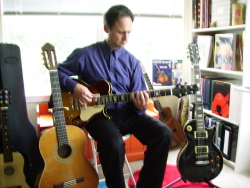


guin

James E. Guin’s fiction has appeared in Daily Science Fiction, Perihelion Online Science Fiction Magazine, T. Gene Davis’s Speculative Blog, MetroMoms: Metro Fiction, Untied Shoelaces of the Mind, and Alternate Hilarities Anthology Volume 1. He received an Honorable Mention in the 2nd Quarter of the 2014 L. Ron Hubbard’s Writers of the Future contest and second place in Jenny Magazine Speculative Fiction Contest 008. For more about James E. Guin please visit  jameseguin.wordpress.com
Share this:

Comment on this article:

Your email address will not be published. Required fields are marked *

Site Archive

Your Support is Appreciated

Jerry Jazz Musician has been commercial-free since its inception in 1999. Your generous donation helps it remain that way. Thanks very much for your kind consideration.

Click here to read about plans for the future of Jerry Jazz Musician.

In This Issue

photo by William Gottlieb/design by Rhonda R. Dorsett
21 jazz poems on the 21st of November, 2025...An ongoing series designed to share the quality of jazz poetry continuously submitted to Jerry Jazz Musician. This edition features poems communicating the emotional appeal of jazz music, as well as nods to the likes of Miles Davis, Regina Carter, Maynard Ferguson, Ornette Coleman, and Max Roach.

The Sunday Poem

photo by Carol Highsmith/Library of Congress

”One Night in New Orleans,” by Rebecca Watkins

The Sunday Poem is published weekly, and strives to include the poet reading their work.... Rebecca Watkins reads her poem at its conclusion


Click here to read previous editions of The Sunday Poem

Poetry

“Prayer” – a poem by Jianqing Zheng (after a photo by William Ferris)

Essay

"Grace" by Erik Enstrom
Letter from the Editor/Happy Thanksgiving (a redux)...Connecting an old photograph owned since the 1970’s to gratitude for friends, family, artists, creators, website readers and contributors – (a redux)

Community

Calling All Poets…Submissions guidelines for the anthology “Black History in Poetry”...We are currently seeking poetry from writers of all backgrounds for Black History in Poetry, an anthology scheduled for publication in the Summer of 2026. The anthology will be a means of celebrating and honoring notable Black Americans by offering poetry that teems with imagery, observation, emotion, memory, testimony, insight, impact, and humanity. Our aim is to give readers a way to visualize Black history from a fresh perspective.

Poetry

Poems on Charlie “Bird” Parker (inspired by a painting by Al Summ) – an ekphrastic poetry collection...A collection of 25 poems inspired by the painting of Charlie Parker by the artist Al Summ.

Publisher’s Notes

A dispatch from Portland, 2025 – and Boston, 1969...Peaceful protest is nothing new to America. It is happening every day in Portland, where I live. It is what makes our country great. And those of us who grew up in the 1960’s probably have a history of protest – some turning violent – ourselves. The poet Russell Dupont shares text and photos from his experience while photographing the October, 1969 March against the [Vietnam] War in Boston, when plainclothes Federal officers attempted to confiscate his camera.

A Letter from the Publisher

The gate at Buchenwald. Photo by Rhonda R Dorsett
War. Remembrance. Walls.
The High Price of Authoritarianism– by editor/publisher Joe Maita
...An essay inspired by my recent experiences witnessing the ceremonies commemorating the 80th anniversary of liberation of several World War II concentration camps in Germany.

Feature

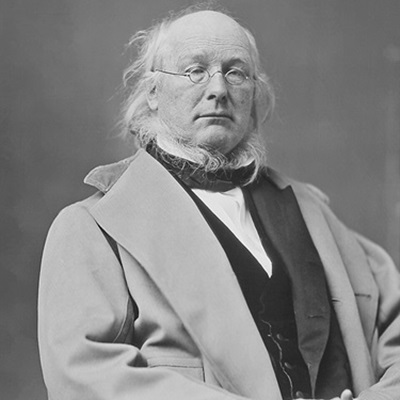
Memorable Quotes: Horace Greeley, on character...“Fame is a vapor, popularity an accident, and riches..."

Community

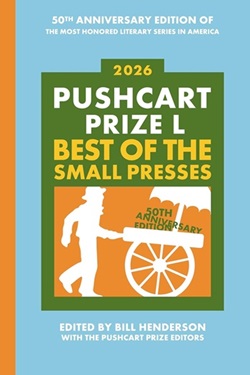
Nominations for the Pushcart Prize L (50)...Announcing the six writers nominated for the Pushcart Prize v. L (50), whose work appeared on the web pages of Jerry Jazz Musician or within print anthologies I edited during 2025.

Interview

Interview with Tad Richards, author of Listening to Prestige: Chronicling its Classic Jazz Recordings, 1949 – 1972...Richards discusses his book – a long overdue history of Prestige Records that draws readers into stories involving its visionary founder Bob Weinstock, the classic recording sessions he assembled, and the brilliant jazz musicians whose work on Prestige helped shape the direction of post-war music.

Poetry

"Swing Landscape" by Stuart Davis
“Swing Landscape” – a poem by Kenneth Boyd....Kenneth Boyd writes poetry based on jazz paintings. “Swing Landscape” is written for a Stuart Davis painting of the same name.

Jazz History Quiz

Jazz History Quiz #185...This posthumously-awarded Grammy winning musician/composer was the pianist and arranger for the vocal group The Hi-Lo’s (pictured) in the late 1950’s, and after working with Donald Byrd and Dizzy Gillespie became known for his Latin and bossa nova recordings in the 1960’s. He was also frequently cited by Herbie Hancock as a “major influence.” Who is he?

Short Fiction

Short Fiction Contest-winning story #69 – “My Vertical Landscape,” by Felicia A. Rivers...Touched by the stories of the Philadelphia jazz clubs of the 1960s, a graffiti artist transforms an ugly wall into something beautiful – meaningful, even.

Poetry

photo via Wikimedia Commons
Jimi Hendrix - in four poems

Playlist

A sampling of jazz recordings by artists nominated for 2026 Grammy Awards – a playlist by Martin Mueller...A playlist of 14 songs by the likes of Samara Joy, Brad Mehldau, Dee Dee Bridgewater, Branford Marsalis, the Yellowjackets and other Grammy Award nominees, assembled by Martin Mueller, the former Dean of the New School of Jazz and Contemporary Music in New York.

Poetry

Ukberri.net/Uribe Kosta eta Erandioko agerkari digitala, CC BY 2.0, via Wikimedia Commons
In Memoriam: “Color Wheels” – a poem (for Jack DeJohnette) by Mary O’Melveny

Short Fiction

“Alas, for My Poor Heart” – a short story by Daryl Rothman...The story – a short-listed entry in the recently concluded 69th Short Fiction Contest – concerns art and its truest meanings—where you just might have to look twice at what the shadow and light of a piece says about that within your soul.

Essay

“Escalator Over the Hill – Then and Now” – by Joel Lewis...Remembering the essential 1971 album by Carla Bley/Paul Haines, inspired by the writer’s experience attending the New School’s recent performance of it

Poetry

“Still Wild” – a collection of poems by Connie Johnson...Connie Johnson’s unique and warm vernacular is the framework in which she reminds readers of the foremost contributors of jazz music, while peeling back the layers on the lesser known and of those who find themselves engaged by it, and affected by it. I have proudly published Connie’s poems for over two years and felt the consistency and excellence of her work deserved this 15 poem showcase.

Feature

photo of Barry Harris by Mirko Caserta
“With Barry Harris at the 11th Street Bar” – a true jazz story by Henry Blanke...The writer - a lifelong admirer of the pianist Barry Harris - recalls a special experience he had with him in 2015

Short Fiction

publicdomainpictures.net
“Corkscrew” – a short story by Mike Wilson...The story – a short-listed entry in the recently concluded 69th Short Fiction Contest – is about a night when everything goes wrong and everyone is annoying, an unexpected turn of events teaches a sarcastic lawyer that the old adage is true – a cynic is just a disappointed romantic.

Interview

Interview with Sascha Feinstein, author of Writing Jazz: Conversations with Critics and Biographers...The collection of 14 interviews is an impressive and determined effort, one that contributes mightily to the deepening of our understanding for the music’s past impact, and fans optimism for more.

Feature

Trading Fours, with Douglas Cole, No. 27: “California Suite”...Trading Fours with Douglas Cole is an occasional series of the writer’s poetic interpretations of jazz recordings and film. This edition is dedicated to saxophone players and the mood scenes that instrument creates.

Short Fiction

photo by Simon Webster
“Smoke Rings and Minor Things” – a short story by Jane McCarthy...The story – a short-listed entry in the recently concluded 69th Short Fiction Contest – is a meditation on missed chances, minor keys, and the music that outlives the room it was played in.

Essay

“J.A. Rogers’ ‘Jazz at Home’: A Centennial Reflection on Jazz Representation Through the Lens of Stormy Weather and Everyday Life – an essay by Jasmine M. Taylor...The writer opines that jazz continues to survive – 100 years after J.A. Rogers’ own essay that highlighted the artistic freedom of jazz – and has “become a fundamental core in American culture and modern Americanism; not solely because of its artistic craftsmanship, but because of the spirit that jazz music embodies.”

Community

photo of Dwike Mitchell/Willie Ruff via Bandcamp
“Tell a Story: Mitchell and Ruff’s Army Service” – an essay by Dale Davis....The author writes about how Dwike Mitchell and Willie Ruff’s U.S. Army service helped them learn to understand the fusion of different musical influences that tell the story of jazz.

Feature

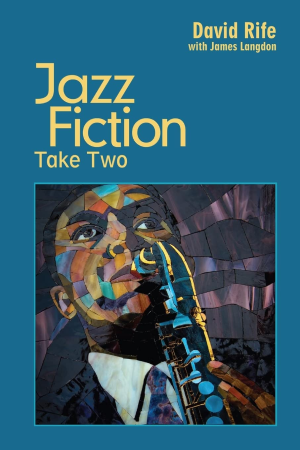
Excerpts from David Rife’s Jazz Fiction: Take Two– Vol. 16: Halloween on Mars? Or…speculative jazz fiction...A substantial number of novels and stories with jazz music as a component of the story have been published over the years, and the scholar David J. Rife has written short essay/reviews of them. In this 16th edition featuring excerpts from his outstanding literary resource, Rife writes about azz-inflected speculative fiction stories (sci-fi, fantasy and horror)

Poetry

“With Ease in Mind” – poems by Terrance Underwood...It’s no secret that I’m a fan of Terrance Underwood’s poetry. I am also quite jealous of his ease with words, and of his graceful way of living, which shows up in this collection of 12 poems.

Poetry

What is This Path – a collection of poems by Michael L. Newell...A contributor of significance to Jerry Jazz Musician, the poet Michael L. Newell shares poems he has written since being diagnosed with a concerning illness.

Playlist

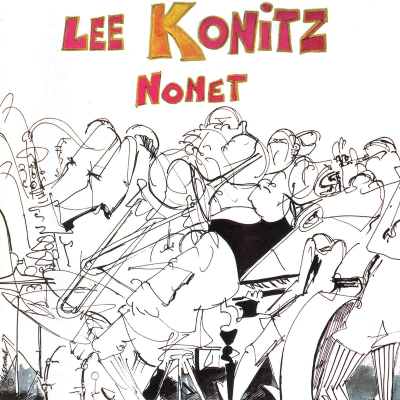
“Look Ma, No Net!” – a playlist of nonets, by Bob Hecht...In this episode of our progressive instrumentation playlists, we add a ninth instrument to the mix to form a Nonet!

Art

photo by Giovanni Piesco
The Photographs of Giovanni Piesco: Art Farmer and Benny Golson...Beginning in 1990, the noted photographer Giovanni Piesco began taking backstage photographs of many of the great musicians who played in Amsterdam’s Bimhuis, that city’s main jazz venue which is considered one of the finest in the world. Jerry Jazz Musician will occasionally publish portraits of jazz musicians that Giovanni has taken over the years. This edition features the May 10, 1996 photos of the tenor saxophonist, composer and arranger Benny Golson, and the February 13, 1997 photos of trumpet and flugelhorn player Art Farmer.

Community

Community Bookshelf #5...“Community Bookshelf” is a twice-yearly space where writers who have been published on Jerry Jazz Musician can share news about their recently authored books and/or recordings. This edition includes information about books published within the last six months or so (March, 2025 – September, 2025)

Contributing Writers

Click the image to view the writers, poets and artists whose work has been published on Jerry Jazz Musician, and find links to their work

Coming Soon

Interview with John Gennari, author of The Jazz Barn:  Music Inn, the Berkshires, and the Place of Jazz in American Life; Also, a new Jazz History Quiz, and lots of short fiction; poetry; photography; interviews; playlists; and much more in the works......  Also, a new Jazz History Quiz, and lots of short fiction; poetry; photography; interviews; playlists; and much more in the works...

Interview Archive

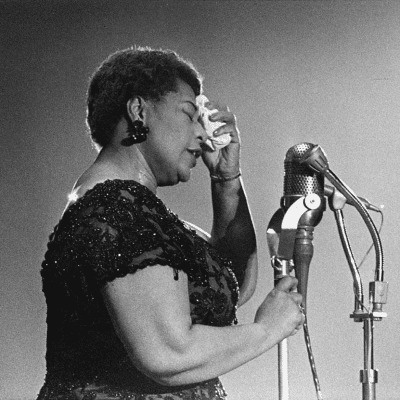
Ella Fitzgerald/IISG, CC BY-SA 2.0 , via Wikimedia Commons
Click to view the complete 25-year archive of Jerry Jazz Musician interviews, including those recently published with Judith Tick on Ella Fitzgerald (pictured),; Laura Flam and Emily Sieu Liebowitz on the Girl Groups of the 60's; Tad Richards on Small Group Swing; Stephanie Stein Crease on Chick Webb; Brent Hayes Edwards on Henry Threadgill; Richard Koloda on Albert Ayler; Glenn Mott on Stanley Crouch; Richard Carlin and Ken Bloom on Eubie Blake; Richard Brent Turner on jazz and Islam; Alyn Shipton on the art of jazz; Shawn Levy on the original queens of standup comedy; Travis Atria on the expatriate trumpeter Arthur Briggs; Kitt Shapiro on her life with her mother, Eartha Kitt; Will Friedwald on Nat King Cole; Wayne Enstice on the drummer Dottie Dodgion; the drummer Joe La Barbera on Bill Evans; Philip Clark on Dave Brubeck; Nicholas Buccola on James Baldwin and William F. Buckley; Ricky Riccardi on Louis Armstrong; Dan Morgenstern and Christian Sands on Erroll Garner; Maria Golia on Ornette Coleman.