
.
.
“Improvised: A life in 7ths, 9ths and Suspended 4ths,” a short story by Vikki C., was a short-listed entry in our recently concluded 63rd Short Fiction Contest, and is published with the consent of the author.
.
.
___
.
.
.
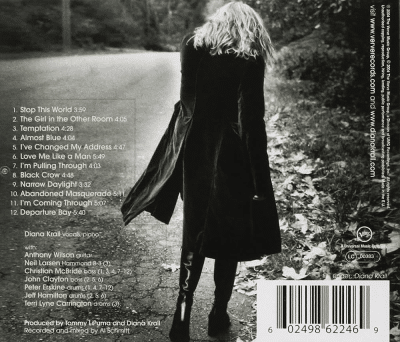
The back cover of Diana Krall’s 2004 CD, The Girl in the Other Room [Verve Records]
Improvised: A life in 7ths, 9ths and suspended 4ths
By Vikki C.
.
…..A man once asked me about ambition, not in a typical sense of family and lifetime accomplishments, more of a rhetorical artistic conversation. To me, it wasn’t a topic which warranted a structured answer let alone a real plan, God forbid life would be linear and predictable. Now, over two decades later, I am found in Notting Hill’s Rooftop Cafe, writing a story which could possibly address the subject unintentionally.
…..As always, my timing is a little off, especially when distracted by the rain and the hypnotic movement of umbrellas along the way to Portobello. I am late for an appointment which I’ve kept secret from my girls. It is too complicated to explain to a 13 and 10-year-old who find safety in routine and who are reluctant to practise their violins and piano, sadly opting for the instant gratification of gaming and apps designed to make you feel beautiful and complete in every sense. Their habitual cocoon is one of familiarity. My own are left out to dry in yesteryear’s fading sun, having metamorphosed in more than one past life. In short, their rhythms and mine are trapped between staves of two different musical scores, and somehow, it is a profound blessing.
…..I am walking past the guitar shops on Denmark Street, eyeing attractive Fender Stratocasters and Gibson Les Pauls. Their sleek bodies seem to call out to me in broody rock ballads of the ’80s and ’90s. How I once learnt to play Led Zeppelin’s “Stairway to Heaven ” from my American doormates at international school in Singapore. A chapter of my life which woke me a little to my long dormant Asian side, whilst extending the wildchild spirit of western culture I had been raised on in the West. I had completed all my piano grades out of Asian parents’ expectations, neither loving nor disliking the piano for a good ten years, never knowing how it would save me from my own calamities and a pandemic decades later. How music had kept me immune from absolute cynicism – an antidote to the relentless isolation of being “different from the rest”.
…..Here I am, outside Regent Sounds, entranced by a sunburst Gibson Les Paul shimmering in the window like sunrise itself. How it would make good a life of untimely mistakes. I stood admiring its elegant form, imagining a man playing it at a small London venue, a man who through melancholic ballads would understand the wreck I had become, better than any doctor paid to dissect my life with empathetic words.
…..The hour idles by in an amorphous cloud, suspended above the glassy puddles of yellow leaves spread across the famous guitar street. I check my tarnished vintage watch, a piece which I cherish more for its quaint aesthetics than its idiosyncratic functionality. Nobody has a timepiece quite like it. A gift handed down from my great-grandmother whose piano apparently fell into disuse when the fighter jets cast their shadows over the motherland.
…..Decades later, I stare at the reflection of a 45-year-old woman who is “wartorn” by the glint of consumerism, kitsch and addiction to ethernets. She is fully aware that there are pianos which need tuning on Sundays, a day when mist dresses the streets of London’s Portobello market. It lays heavy on my lashes, ousting another season of introspection and self-etudes. I am not here to purchase flowers or secondhand books, not even for tea and journaling at the Orangerie, or anything a female writer is expected to do in a classic 21st century story about writers with time on their hands.
…..My indolence lags behind a nascent March whose lilacs are already interrupting the city’s stonewashed personality – I blame climate change and a world crisis for the confused early bloomers, something elusive to my own timeline. I had only just packed away the humdrum woollens of winter with the other “still life” collectibles, leaving out just the bohemian tapestry rugs and blankets I bought in Shanghai at some cultural heritage store next to the House of Blues & Jazz on the Bund. Bright lucid patterns whose threads are now fraying, catching on the warp of my own failing artistry. Yet, these vivid blankets still swaddle a distant memory – one of a sensational night of jazz.
***
…..I was privileged to catch the inimitable Diana Krall performing live in the “Pearl of the Orient” in 2002, during my roaring 20’s. A short cultural exchange in Shanghai before I set out on a full time career and associated travel that saw me returning to the same city five years later after a call from a headhunter. It was, at the time, a metropolis of rapid change, modern infrastructures, iconic architecture, financial reform and mass consumerism quickly engulfing the traditions of a nation held under decades of communism. As an expatriate finance professional, I was witnessing a foreign country racing to catch up and compete on an international circuit. One that would leave me striving for something elusive, in turn facing the inevitable burnout of my own fuse.
…..Regardless, seeing Krall live as part of her world tour in 2002, was an event that epitomised the tenor of society as well as my own digressions. Today, whenever I hear Krall’s haunting number “Departure Bay”, I break like fine china into irrecoverable pieces, in what is an act of catharsis.
…..I myself haunted many jazz lounges during the mid 2000’s – an escape from the then corporate rote of career, but also a quiet reckoning. A faith beyond ordinary acts of prayer. To be both filled and emptied out by intoxicating sets of complicated riffs in a low lit bar of strangers with equally complex issues – like confessing at therapy with heavy cigar smoke wafting over each other’s grief. The lingering smoke of a burnt out pipe-dream anaesthetising the body from its own destruction.
…..Maybe it is how jazz echoes not just in a state-of-the-art modern auditorium in 2002 at the Portman Ritz-Carlton, but also how it once lilted through those alleys and districts of old 1930’s Shanghai, a major port city enjoying a brief halcyon party before the imminence of WWII. A thriving odd affair of merchant ships and concessions, a centrepiece of international commerce and verve juxtaposed with a shady underworld of mafia’s prerogatives and the stigma of real poverty.
…..There is something arresting about how sophisticated riffs and syncopations can temporarily glaze over the dissonance of a nation at war, its deaths and its revolutions in the making thrumming the side alleys of conflict. How occupation of a land is ultimately a reflection of the occupant’s own lack of belonging, much like imposter syndrome or addiction – or just a great depression.
…..Jazz was like an alluring window display to keep the spirit alive in a body riddled with machinations of its own. On a balmy 1930s afternoon, the image of Shanghai’s sepia heyday is cast against a paisley wall in a saloon of the French Concession. A cigarette poster of upper echelon women in silk cheongsams, playing pipas, holding the hidden social quagmires of the zeitgeist at bay. The same window dressing can be said when you look out ninety years later from a bar on the Bund at night, to an ultramodern neon skyline, a pearlescent moon dissolving into your bourbon glass, like a sleeping pill or a panacea for the privileged. Conveniently, one forgets the keening of political and social unrest that preceded this age of sophistication, instead, sleepwalking into a state of romanticism, high-culture and liberation.
…..To me, Krall’s poignant “Departure Bay” is about leaving places behind and never fully settling in a homeland of any kind. It is a cameo of my life and that of my forefathers who had moved between continents for better or worse. It is a melody that leads you to meet yourself in an unknown land. Notably, there is a musical transition about one minute into the song which feels like a summoning, when the piano accompanies the lyrics “I just get home and then I leave again”. The shift in tone and mood is both isolating and unsettling but in a bizarre sense, the tension also evokes a promise of freedom from whatever is holding the subject back from a better future.
…..I had learnt about similar transitions and progressions of basic jazz, often involving jazzy chords like 7ths, 9ths and suspended 4ths. Their sounds allude to a sense of openness and mystery and in many instances, the “hanging note” does not fully resolve to a root or tonic chord the way it would in popular music or classical counterparts. It is more than a motif for comfort’s sake. It is ambitious and free-spirited, often taking chances beyond the conventional rhythms we distil in our desultory minds. It is its own quaint apothecary, yet jazz has been praised for its vigour and heady celebration of societal flourish, its form often improvised and syncopated – mirroring the unplanned vagaries of life itself.
…..Coincidentally the number “four” is often shunned by the Chinese for superstitious reasons; the Chinese character for “four” sounds similar to that of the word “death”. The idea of death suspended above is perhaps a remote and somewhat romanticised connection, but given the common use of “sus 4” chords in jazz, it certainly brings home a sense of urgency and introspection. A profound inquiry into my own existential crisis.
…..Having mostly played classical and popular piano scores, jazz still feels somewhat of an awakening – transformative on many levels, from individual to societal, crisis to victory. Watching Krall from the front row that night twenty years ago, in a way made one feel as if her song was personally written for you: engaging and inventive with a much needed healing finesse. Moreover, the “unsettling” phrases felt like an essential purging of self doubts, before the quiet reclamation of one’s life.
***
…..It is March 2023 and I am leaving the doctor’s clinic after what felt like a two hour consultation. I surely must have talked to her about the decades of moving, seeking a home to occupy, about strange people who had touched my life and those who had left it in disarray. The usual discussions that make a professional opinion feel well worth your hard-earned money. It is raining still, harder than before my appointment. I walk through the same greyscale London and detour down a lane near Covent Garden. Couples are gathering at bistros, expensive oysters and Pinot Noir on the evening menu, under huge white parasols. Nothing has changed along this lane except the hanging baskets of crocuses, bright heads welcoming me like a homecoming after the war. Dusk light is fracturing over the murmur of conversation outside a casual jazz bar named “Anonymous”. Peering in halfheartedly, I notice the silhouettes of life’s “tableau vivant” wavering against bronze-tinted bar mirrors. Sophisticated gestures and the low hum of privilege.
…..I enter the establishment, underdressed in jeans, black cashmere sweater and ankle boots. Every other lady came wearing elegance, perfume and a partner to match. In one corner, an attractive female singer checks the sound system. Beside her, a man in his mid-fifties is tuning his electric guitar – an eye-catching cherry burst Les Paul, exuding deep shades of ruby like an evening sky just before the sun slips away. The guitar seemed pretty unusual for jazz. In my mind, I associated such types with rock bands that had accompanied me through years of angst and identity crisis. It echoed the timeless guitar solos of Slash of Guns ‘n Roses or Pink Floyd’s David Gilmour. I always felt the piano was the main harmonic instrument but was aware that electric guitars were also part of the ensemble, an instrument providing rhythm, chords and melody. I had always loved Northern Irish musician Gary Moore’s electric blues guitar reminiscent of his song “Still Got The Blues”, the title track of his 1990’s album of the same name, as much as his earlier grittier hard rock and metal guitar with Thin Lizzy back in 1974.
…..The guitarist smiles as if inviting me to take a seat near the stage. He introduces himself as Steve and asks if I’m from around town. I explain that I am, my mellow West London accent quickly confirming that it is possible to sound local after travelling between continents for a decade. He was easy to talk to, and noticing my acute interest in his guitar, keen to tell me its legendary story. How the iconic guitarist Les Paul himself, was a great influence on electric guitar and a visionary in the history of music recording. How he experimented with overdubbing and played a pioneering role in designing the first multi-track tape-recording deck. Steve went on enthusiastically about a famous jazz track called “Lover” in 1948 that took Paul numerous attempts and 500 discs to get the recording right. “It must have been monumental listening to the final track in all its glory, I would have given up at 50 attempts”, Steve joked.
…..I listened intently, convinced that this guy’s passionate and humoured explanations were about something far greater than the history of multi-track tape-recording. I was transfixed by his hazel eyes and dexterous hands cradling the beautiful guitar he was tuning. It must have been the dim lighting or my general fatigue, but I felt a sense of déja-vu, that we had shared stories and a few glasses of hard liquor in another time and place. Perhaps met in a state of artistic rebellion and after that, peaceful resolution. His accent was distinctly south western – maybe Richmond or a neighbouring suburb. Somewhere close to Cobham in Surrey where my family’s home was nestled in a cul-de-sac of neighbours who kept porch swings, labradors and trays of herbs and lavender growing under hanging baskets of hope. Where joy remains unaged in fields of wild grass up to your waist, as you maintain the perfect height of a child for as long as memory persists.
…..“Oh goodness, it’s almost 8.30. I’m on soon…would you like a drink?” Steve asked, as if feeling guilty for his long rambling explanations about the Les Paul. “I’m ok, really…I’d love to know more. Um, maybe one day when you’re not gigging?” I replied, impromptu, surprised at my own boldness and rapid recovery from a drowsy and rather personal dream of childhood. “Sure, anytime is good…even on gig nights”, he replied with a mildly suggestive smile. I did not read into the tone of his voice, but there was a good kind of tension between us, something I hadn’t experienced for at least a decade or so. It was unexpected, unsettling and perhaps even liberating if one ever saw through the uncertainty of such a feeling. I still had three sets to summon up the courage. Three sets to write my number on a song request sheet and pass it to him. This is not the kind of thing one does when wearing unalluring attire. This is not the plan I had in mind. Nor the plan in my beating chest, which suddenly contained a different kind of rhythm. It wasn’t the usual war drum, but something improvised, like rain. A cleansing kind of euphoria.
…..The gin and tonic he had bought in a hurry before readying for the first set, was strong. It tasted like revolution. The kind you can’t explain in a night to a stranger without a few stories about foreign cities and at least one not-so-subtle song request. I sank conspicuously into the shadows of a corner settee beside a green side lamp whose soft radiance perhaps made me look better than a rootless English rose or wallflower hibiscus of the east. Tonight, my body is planted deep in this dark Georgian leather settee in a boutique jazz lounge, as my mind surrenders like Kosma’s “Autumn Leaves”, drifting across oceans and generations. An irrevocable ache searching for its swansong in a less than pragmatic fashion, floating far from the common paths, never quite “resolving to my roots” – but always close enough for jazz.
.
.
___
.
.

Vikki C., is a British-born writer, poet and musician from London whose literary works are inspired by science, art, ecology, existentialism and the human condition. She is the author of The Art of Glass Houses (Alien Buddha Press, 2022) – a chapbook of prose poems exploring the liminal landscapes of memory, heritage, art and the metaphysical.
Vikki’s recent poetry and prose appears in places such as EcoTheo Review, Ice Floe Press, Nightingale & Sparrow, Black Bough Poetry, Acropolis Journal, Fevers Of The Mind Poetry & Art, Ellipsis Zine, DarkWinter Literary Magazine, Across The Margin, The Write-In (National Flash Fiction Day), Literary Revelations, Loft Books, Lazuli Literary Group and other venues.
.
.
Listen to 2004 recording of Diana Krall performing her and Elvis Costello’s composition, “Departure Bay,” with Krall (piano and vocals); Anthony H. Wilson (guitar); Christian McBride (bass); and Peter Erskine (drums). [Universal Music Group]
.
.
___
.
.
Click here to read “Company,” Anastasia Jill’s winning story in the 63rd Jerry Jazz Musician Short Fiction Contest
Click here for details about the upcoming 64th Jerry Jazz Musician Short Fiction Contest
Click here to subscribe to the Jerry Jazz Musician quarterly newsletter (it’s free)
Click here to help support the continuing publication of Jerry Jazz Musician, and to keep it commercial and ad-free (thank you!)
.
.
___
.
.

Jerry Jazz Musician…human produced (and AI-free) since 1999
.
.
.