




Rick Coleman,
author of
Blue Monday:
Fats Domino and the Lost Dawn of Rock ‘n’ Roll
_____________________________________
While many think of Elvis Presley as rock n rolls driving force, the truth is that Fats Domino, whose records have sold more than 100 million copies, was the first to put it on the map with such hits as Aint That a Shame and Blueberry Hill.
In Blue Monday, acclaimed R&B scholar Rick Coleman draws on a multitude of new interviews with Fats Domino and many other early musical legends to create a definitive biography of not just an extraordinary man but also a unique time and place: New Orleans at the birth of rock n roll. Coleman’s groundbreaking research makes for an immense cultural biography, and is the first to convey the full scope of Fats Dominos impact on the popular music of the twentieth century.#
Coleman joins Jerry Jazz Musician contributor Adrienne Wartts in an October, 2006 interview.
___________________________
“‘The Fat Man’ jettisoned the despair of the original junker lyric. There was a touch of blues braggadocio, though bragging about being fat was hardly the stuff of ego. Fats disarmingly introduced himself and his world. But his thundering piano and his worldless cries — “waah-waah-waah” — said more about him. The piercing mouth harp turned another blues convention inside out, expressing feelings so boundless and new that — like Louis Armstrong with his scat and Jimmy Rodgers with his yodel — words weren’t enough. Fats didn’t care about artifice, he was crowing to wake the world. ‘The Fat Man’ contained radically puzzling and pulsating sounds — the raucous musical cadence, emotion, and distortion that would echo through popular music for the rest of the century as ‘rock ‘n’ roll.'”
– Rick Coleman
_____
_______________________
AW You began writing this book 20 years ago?
RC That’s right.
AW Why did you pick Fats Domino as a subject you would ultimately spend 20 years writing about?
RC In 1985, I was writing an article about New Orleans roots in rock ‘n’ roll music. At the time, discussion was taking place about the 30th anniversary of Bill Haley’s “Rock Around The Clock” hitting number one, and I wanted to emphasize the fact that New Orleans actually had roots in rock ‘n’ roll and rhythm ‘n’ blues music that went back many years before that. Since Fats Domino started in 1949, the article featured him rather prominently. I contacted Fats’ brother-in-law, Reggie Hall, to ask if he had seen the article and if they liked what I wrote, which led to me asking to speak to Fats personally, and ultimately to going back stage to meet him at a local concert. He took a liking to me from the start — I began going to his house, and, about three months later, I did a substantial interview with him which led me to realize that no one else was getting that kind of time with him and that maybe I should consider writing a biography. At the time, I had no idea it would take me 20 years to finish the book, but this was a labor-of-love project — I loved New Orleans music and felt that, because Fats Domino was left out of many rock history books, his story needed to be told. I was lucky that he liked me, and also very lucky that he was willing to do an occasional interview since he hated doing interviews — so much so that at times there were years in between them.
AWWhat was it like to interview him?
RC I felt honored to be in his presence, and I always tried to appreciate the experience as much as I possibly could. He would often serve me his very spicy New Orleans cooking — red beans and rice, Hog’s Head Cheese and other dishes he may have been cooking that day. He would even play the piano for me at times, which made spending time with him a very special experience. The more I learned about him, the more I came to realize what an incredible influence he had on so many of the people we now consider to be legends of popular music.
I have to add that he wasn’t a great person to interview because his memory was not particularly clear — his career spanned 50 years, so dates can be difficult for him, and he had a tendency to give very short answers. I would always have to flush out interviews with him by talking with others, looking over other interviews, and doing hard-core research. Even with these challenges, I was able to get more in-depth material during my interviews with him than anyone else, and he has told me that he did more interviews with me than anyone else.
AW You talked about his influence When did you first understand the impact he had on American music?
RC The more research I did, the scope of his influence became obviously apparent. When I first interviewed him, I didn’t know some of the things about the technical aspects of his music — I didn’t even know what piano triplets are, which are basic components of his musical style. The repetitive ding-ding-ding sound on the piano sounds simple enough, and it is, but it is what made people get up and dance. Many of the doo-wop groups adopted it, and it eventually made its way into pop music, with artists like Brenda Lee, Dean Martin and Percy Faith performing songs in triplets, and later on, Sly and the Family Stone and the Beatles did as well.
Bob Marley said that Fats Domino was his first major musical influence, so it is easy to conclude that he had an impact on ska and reggae. And, Elvis Presley once said that he could never sing like Fats, and even went so far to say that Fats Domino is the real “King of Roll ‘n’ Roll!” Within the Beatles, John Lennon said the first song he ever learned to play was “I’m in Love Again,” which was also the first rock ‘n’ roll song George Harrison said he ever heard, and Paul McCartney has recorded several Fats Domino songs, most notably “Ain’t That A Shame?.” Little Richard was basically in awe of Fats Domino, and was honored to even touch the man’s hand.
The list of people who Fats Domino influenced goes on and on, but strangely enough I didn’t see any reverence reflected toward him in the thousands upon thousands of pages of history written about popular music. I felt there was a big discrepancy, which I aimed to fill, and it became more of a passion as I did more and more research.
AWAs an originator of rock ‘n’ roll, why do you think Fats received less notoriety than artists like Elvis Presley, Little Richard, Ray Charles and Chuck Berry?
RC The fact that he didn’t receive this notoriety is made all the more bizarre since he was second only to Elvis in record sales during the 1950’s and early 1960’s. There are several reasons, and they are hard to pinpoint exactly, but one fairly obvious reason is that he didn’t have any more real Top 40 hits after 1963. During the late 1960’s, fans viewed rock ‘n’ roll as revolutionary, “in-your-face” music and, of course, Fats Domino had never been an “in-your-face” kind of guy. He was a very subtle and seemingly inoffensive man who possessed a demeanor similar to that of Martin Luther King, who helped bring about change in American society because he felt society can’t be changed with an “in-your-face” philosophy. He felt peaceful revolution was the way to tear down the walls, and Fats Domino was tearing down the walls that prevented African American music from becoming popular music in a way artists like Nat King Cole did not. Few recordings had as emphatic a beat as “Ain’t That a Shame” did — it was booming and shocking to adults, but the kids loved to dance to it.
AW What impact did rock ‘n’ roll — and artists like Fats Domino — have on integration?
RC There isn’t an obvious time or place when rock ‘n’ roll integrated into society, but Fats Domino was the artist who introduced the heavy African American beat to the pop charts. While Bill Haley had hits with this sound, the fact that a black man did as well was revolutionary for its time. Fats was then followed by Chuck Berry and Little Richard. It should be noted that this was taking place almost simultaneous with the beginnings of the civil rights movement. In 1954, the Brown vs. Board of Education Supreme Court decision had been made, and “Ain’t That a Shame” — a major musical statement — was recorded a year later. With this song’s popularity, Fats began attracting a large white audience who attended his shows, which was kind of shocking to the promoters because they had no idea what was going on. As a matter of fact, while most of Fats Domino’s concerts were peaceful, there were more riots at his concerts than at any other rock artist’s largely because his shows were integrated. So, in essence, his audiences were integrated before many of the schools were, especially in the South, and that basically continued for the next decade.
AW Was he successful in making money from his music?
RC There’s no question that he didn’t earn as much money as he should have, and one reason is that he had a pretty shady lawyer who took an unsubstantiated amount of Domino’s earnings. However, the good news is that Lew Chudd of Imperial Records paid royalties on recordings, and actually paid Domino substantial sums. So, unlike a lot of the other artists from that era, Fats retained songwriting credit for his music, and songwriting and record royalties remain the substantial sources of his income to this day. He’s pretty lucky in that regard. While he had other money problems — he lost lots of money from gambling during the 1960’s and 1970’s — he actually did better receiving and retaining his money earned from music than many of the white rock and roll artists did during the same period of time.
AW How did the “Motown Sound” and the music of the “British Invasion” affect Domino and other rock ‘n’ roll artists of his time?
RC Motown didn’t affect them nearly as much as the “British Invasion,” which really marked the official change in music. In some ways that was a good thing because they invigorated music, and the irony is that they were performing many old New Orleans rhythm ‘n’ blues songs, including some recorded by Fats. So the kids growing up during the 1960’s listened to all the British groups playing guitar-oriented versions of these songs and heard it as being a brand new sound, not connecting them to the rhythm ‘n’ blues of the 1950’s and 1960’s. Many of the older artists — especially the black artists — got lost in the shuffle, which is one of the reasons Fats had difficulty making a comeback. After the Beatles recorded “Lady Madonna” — which was basically a tribute to Fats’ sound — he recorded it and had a hit with it, which led to a minor comeback in 1968. It was difficult for him to get back on to the charts after he left Imperial Records and his producer Dave Bartholomew in 1963, but there were the occasional great recordings — “Whiskey Heaven” in 1980 actually made it to the country charts, and “Any Which Way You Can” from a Clint Eastwood film was quite successful due to the movie’s popularity. He just recently recorded an album that has a handful of good songs on it, one of which, “I’ll Love You ’til the Day I Die,” is a beautiful ballad that could become a new standard for him.
AW Who were some of his earliest musical influences?
RC There were many, but the most notable influence was his brother-in-law, Harrison Verrett, a jazz musician who was 20 years older than Fats. He played the banjo and guitar in several jazz bands, among them being Papa Celestin’s. His other brother-in-law taught Fats how to play notes on the piano, and ultimately taught him some songs, one of which was “The Junker’s Blues,” a song originally about drug use. A line in the song was changed from “They called me a Junker” to “They called me the Fat Man,” and this tune, changed to “The Fat Man,” became Fats Domino’s first hit record — arguably the first rock ‘n’ roll record, recorded in 1949.
Fats listened to a lot of records as a teenager in the 1940s, patterning his blues songs after Amos Milburn, who also played lots of boogie-woogie piano, which Fats did as well. Other influences included artists like Charles Brown, Louis Jordan and pianist Albert Ammons, who played “The Swanee River Boogie,” a version of which Fats played that drew people into the clubs he played.
AW Can you talk a little about his earliest performances and how he was discovered?
RC He used to bang out tunes on the piano in his parents’ house, and when they tired of hearing him, they put the piano in the garage, where he continued to play. His sister said that Fats’ piano playing was the entertainment during their Saturday night parties. People would dance to his music, eat fish sandwiches, and drink home brew. After that, he started playing little black clubs in the upper Ninth Ward neighborhood he grew up in and lived virtually all of his life. He played in one across the street from the Club Desire for several months, always drawing a good crowd, and it was where Dave Bartholomew and Lew Chudd discovered him in 1949.
When “The Fat Man” became a hit, he didn’t want to go out on the road — he was very shy and quite scared of leaving New Orleans — and Bartholomew and Chudd basically had to threaten him to tour, telling him that he would never be a successful musician if he didn’t go out on the road, to the point of even telling him that the musician’s union would black list him. He wound up going out on the road with Bartholomew’s band, touring twice during 1950, both of which were more or less disastrous — although the second tour was fortuitous because it inspired the song “Blue Monday,” which later on became a big hit for Fats in the movie, The Girl Can’t Help It, with Jane Mansfield. That song expressed Fats Domino’s philosophy about how a working man deserves to get a little loaded at the end of the week. He played his music for the people — for the workingman — and “Blue Monday” was his favorite song. It was also the favorite of Bartholomew, Chudd, and many of the executives at Imperial Records.
From that point forward, Fats formed his own band and began touring the country, playing the black clubs pretty exclusively for the first three or four years, and then a white audience started coming as well. He gradually made the change from playing majority black to majority white clubs, and then the large concert tours that he performed all the country followed — most notably the tour he did in 1957, when he headlined shows that featured Chuck Berry, Frankie Lymon, Buddy Holly, Paul Anka, the Everly Brothers and LaVerne Baker. This was basically a tour full of future rock ‘n’ roll greats, and Fats Domino was the star of that show.
AW He was associated with so many musical legends, people like Lloyd Price, Charles Brown, and members of Buddy Holly’s group The Crickets
RC That’s right. Dave Bartholomew was the most popular band leader in New Orleans in the mid-1940’s, and subsequently became Fats Domino’s producer, co-writer, and band leader. In 1952, Fats happened to stop by the New Orleans studio in which the 19-year-old Lloyd Price was recording, and agreed to sit in on the piano on his first ever session — a recording of “Lawdy Miss Clawdy,” a song that became a classic hit later recorded by Elvis Presley, as well as the Beatles. That recording was a major turning point in rock ‘n’ roll that established the New Orleans sound, probably more so than any other record at that time. Fats’ rolling piano and the triplets he played really helped popularize that record.
Fats loved Charles Brown’s piano style, and was very much influenced by his late 1940’s recordings. I don’t know when they met, but I know that Brown toured with Fats during one of the shows of 1957. He appreciated what Charles played even though Charles was at a low point in his career at the time, and they remained friends for many years after. In fact, Brown played at Fats’ 1969 birthday in New Orleans, and when I invited Fats to come to a New Orleans hotel to meet with Brown, it was the only time I ever got Fats out of his house to do anything! He met with Charles at the hotel and got him to play the piano for him there.
I can’t really say whether or not Fats had much of a relationship with Buddy Holly and the Crickets, who were just teenagers at the time. Four of the Crickets are still living, and they were a major source for my book, particularly about that 1957 tour, and also the Alan Freed Show they played on that Christmas season. It was interesting to interview them because they idolized Fats, and talked about how Buddy loved one of Fats’ songs called “I Want You to Know,” and that he would like to play that song.
AWElvis Presley referred to Fats as “The King of Rock ‘n’ Roll”
RC Yes. I wouldn’t call him that myself, but apparently Elvis did, at least according to Peter Guaralnick, author of Careless Love: The Unmaking of Elvis Presley. At the time, Fats was idolized by many of the musicians
AW You wrote about the importance of the piano triplets as a stylistic innovation of Fats Domino’s. What other crucial innovations did he contribute to rock ‘n’ roll?
RC “The Fat Man” in 1949 was an important record. It had a thoroughly throbbing beat, but it was not the legendary drummer Earl Palmer who provided the beat — it was more from the contributions of Fats Domino, who you hear driving the rhythm on the back beat throughout the record. That was only one of the aspects of the recording that would come to influence rock ‘n’ roll. Another was the horn riffs, which was repeated a year later in “Rocket 88″ (by Bill Haley and His Comets), a song that is often referred to as the first rock ‘n’ roll record. It featured a long piano introduction similar to “The Fat Man” as well. The theme of “The Fat Man” — about a guy basically standing on the street corner, trash-talking about women — is basically the same theme as “Rocket 88,” which talks about having the girls come over to his Rocket 88 Oldsmobile. And it also has Fats singing a mouth harp part along with his vocal, which preceded the nonsense solos that would soon appear in doo-wop songs. So “The Fat Man” was a precursor in many ways, and it may well justifiably be called the first rock ‘n’ roll record.
AW Fats Domino may best be known for “Blueberry Hill”
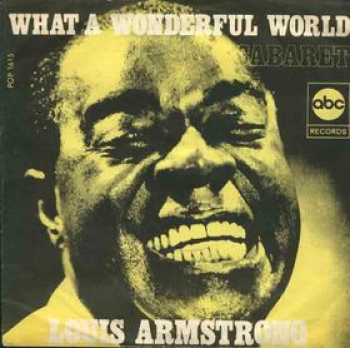
RC That’s right. Fats first heard Louis Armstrong’s 1949 recording of ‘Blueberry Hill” and he loved it. The song had been recorded earlier by Glenn Miller — who had a number one hit with it in 1940 — and Gene Autryin one his singing cowboy films. Fats didn’t really know the whole song, so he came back to his brother-in-law Harrison Verrett, who helped teach it to him. They went into the studio and never quite got a full recording of it, which upset Dave Bartholomew, the producer, who didn’t think they had completed it. But Imperial Records pieced it together so effectively that it became a huge hit and, as you say, it is the song Fats is most identified with. “Blueberry Hill” was a turning point in his music because until that time he had been known for recording up-beat, up-tempo records, and this was a standard ballad that represented a shift in his music. People who didn’t know Fats for recordings other than “Blueberry Hill” thought he was a singer of ballads like Nat King Cole, but of course that wasn’t true because he always had a strong rhythm underneath his ballads. Everyone recorded the song — Johnny Cash, Elvis Presley, the Beach Boys, and even Led Zeppelin — it represented a landmark to so many people. It can be argued that “Blueberry Hill” took Fats to a place where everyone accepted him, whether young or old, black or white, rock ‘n’ roll or country music fan. Elvis loved to hear Fats play it — he’d catch Fats in his dressing room or his hotel room and have him play it for him personally — and would play it himself in concert until the year he died.
AWYou mentioned earlier that he was incredibly comfortable in New Orleans and rarely toured outside of the city…
RC He played on the road until 1995, which was the last year he toured. By that time he was 70-years-old and didn’t like the pressure of touring anymore, so he stayed in New Orleans from that time forward. Unlike Chuck Berry and many other artists, he always kept his own band that he employed on a semi-regular basis from the early 1950’s until 1995. Many of the trusted members of his band and his traveling entourage had died by 1995, so he felt it was time to stop touring.
When he was touring he loved to cook, and would often find some way to cook in his hotel room. There are so many great stories about how he would stuff towels under the doors to keep the spicy New Orleans scents from seeping through to the other hotel guests. The fact that he loved to cook — and that everyone loved his cooking — is one of the wonderful aspects of his legend.
AW Fats Domino may have been the most famous person mission following Hurricane Katrina…
RC That’s right. No one knew where he was for three days. He was rescued on the Monday following the hurricane, taken to the LSU Assembly Center in Baton Rouge, and then eventually to Texas. His homes were all flooded, and he and 14 other people were rescued from the second story of his house by boat. He lost 20 of his 23 gold records to the flood, and most of the homes in his neighborhood are now gutted, but he hopes to be able to rebuild someday. He’s now living across the river from New Orleans in a suburb called Harvey, and seems to be in decent health at 78 years-of-age.
_________________________________________
“I never thought about no music. It’s just something I guess the Lord gave me. A lot of people went to a conservatory school of music and say they can’t play the simple things I play. I don’t know if I changed music or not, but that’s how I liked it, and that’s what I’m stuck with. People don’t know what they’ve done for me. They always tell me, ‘Oh, Fats, thanks for so many years of good music.’ And I’d be thankin’ them before they’re thankin’ me!”
– Fats Domino
*
*
Blue Monday:
Fats Domino and the Lost Dawn of Rock ‘n’ Roll
by
Rick Coleman
*
About Rick Coleman
Rick Coleman’s work has appeared in Offbeat, Goldmine, Billboard, and Rolling Stone, and in liner notes for the likes of Fats Domino and Little Richard. He lives outside New Orleans.
Fats Domino products at Amazon.com
Rick Coleman products at Amazon.com
_______________________________
This interview took place on October 20, 2006
*
If you enjoyed this interview, you may want to read our interview with Arthur Kempton, author of Boogaloo, and Dixie Hummingbirds biographer Jerry Zolten
_______________________________
Other Jerry Jazz Musician interviews
# Text from publisher.











I would like very much to know if you were present during a performance by Fat’s when there was a stage collasp? If so what year was it in? Please write me back, I will check in soon to see if you respond.
Sorry. Wasn’t there.
I had the pleasure of meeting Rick and attending three of his lectures on a Malt Shop Memories Cruise out of Tampa,FL in October of 2011. It was three of the most enlightening and enjoyable hours I’ve ever had and I bought his book which he autographed for me. As an added highlight,Little Anthony sat next to me for one of the presentations. He was very approachable and friendly. I’m going to New Orleans for a weekend visit in two weeks and hope to look up Rick.
flirty, easy and fun: that was Fats …