




Doug Ramsey,
author of
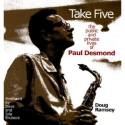
Take Five: The Public and Private Lives of Paul Desmond
______________________
Take Five: The Public and Private Lives of Paul Desmond is the story of a jazz artist who transcended genres to establish one of the most immediately recognizable sounds in all of music. Long before his success as the alto saxophonist with the Dave Brubeck Quartet, decades before he wrote “Take Five ,” Desmond determined that he would be himself, never a disciple or an imitator, whatever the cost.
The only son of a doting musical father and an emotionally troubled mother, as a young boy in San Francisco he was separated from his parents and sent to live for years with relatives three thousand miles away. Desmond came out of the Army after World War Two to struggle with uncertainty and indecision as he developed his individuality against the prevailing jazz winds of the day. He eventually became a friend and admirer of the bebop genius Charlie Parker, but early on he swore that he would never be just another horn in the crowd of Parker acolytes. Desmond was torn for a time between a career as a writer and one as a musician. Though he never abandoned his gift for writing, music won, and he concentrated on clarinet, then the saxophone. He worked in dance bands and dixieland groups, entertained in amusement parks and resorts. He took whatever work he could get as a player.
 In 1947, Desmond and Brubeck discovered that, despite their stylistic differences, they had an uncanny musical empathy. Finally, in 1951 they formed the Quartet. After three years of travail and near poverty, the band became one of the most successful jazz groups in history and Desmond one of the music’s most celebrated figures. The classic Dave Brubeck Quartet with Desmond, bassist Eugene Wright and drummer Joe Morello traveled the world, won polls, sold records in the hundreds of thousands, opened a market for jazz concerts on college campuses and became the only jazz band since the Swing Era to be a fixture in popular music. With the immense success of Desmond’s “Take Five,” the Brubeck Quartet became the first million-selling jazz group.
Casual, urbane, an intellectual noted for his wit, he married for a short time, then for the rest of his life remained single and immensely attractive to women. He had many acquaintances but few intimate friends, and he went to lengths to keep his close relationships in separate compartments. Desmond never conquered his basic shyness or the lack of confidence that made him a lonely man in spite of his success and acclaim.
Long before he became a leading jazz critic, Doug Ramsey met Desmond, became his friend and remained close for more than twenty years. They shared many interests in addition to music and spent hours at a time in a conversation that continued until shortly before Desmond died in 1977. Preparing to write Paul’s story, Ramsey marshaled his skills as a veteran print and broadcast journalist. He interviewed scores of people from all periods of Desmond’s life, grade school through his lonely final days. He talked with women who were romantically involved with Paul, Gloria Steinem among them. He discovered a cache of correspondence and documents that helped disclose the hidden story of Paul’s early years. After a long search, he found Duane, Paul’s former wife and intellectual sparring partner, who remained Desmond’s friend long after they parted but was a figure of mystery even to Brubeck and other colleagues. He talked with leading musicians who were contemporaries, and combed through dozens of publications for reviews, articles and interviews. As Ramsey did his work, Desmond the private man with great joys and great troubles began to emerge from the shadows to fill out the public image of a blithely self-contained star soloist spinning out seamlessly inventive musical stories. #
The result is Take Five: The Public and Private Lives of Paul Desmond, a book the critic Gary Giddins calls “…the book Doug Ramsey was born to write; a love letter from one friend to another; an appreciation by a gifted critic for a great artist…The telling is lyrical, funny, nostalgic, provocative, and allusive — just like a Paul Desmond solo.”
In our May 9, 2005 interview, Ramsey joins us in a conversation about the life of one of the most accomplished and popular artists in the history of jazz.
__________
photo Breitenfeld Family Collection
Paul Desmond’s first publicity photograph, c. 1951
*
“The qualities in music which I considered most important — and still do — were beauty, simplicity, originality, discrimination, and sincerity.”
– Paul Desmond
_____________________
JJM Your book, Take Five: The Public and Private Lives of Paul Desmond, is a detailed biography filled with one hundred fifty photos in a coffee table sized book. How were you able to convince the book’s publisher that Desmond was worthy of such a biographical treatment?
DR It worked the other way. The publisher actually approached me and asked me to write the book. No convincing was needed.
JJM What was their interest in Desmond? Was there a personal friendship?
DR The publisher of the book, Parkside Publications, is headed by Malcolm Harris, who is a Renaissance man of sorts; he owns his own publishing company, law firm, and is himself a clarinetist and baritone saxophonist. He published a book previously about the life of Buddy DeFranco — which was authored by a couple of French writers — and decided he wanted to next do a biography of Desmond. At first he thought about writing it himself but concluded it would be too overwhelming, so he asked people for author recommendations, and enough suggested that he talk to me.
JJM You had a personal friendship with Desmond spanning many years
DR Yes, I did. We met in 1955, and he died in 1977. For the first five or six of those years, we were merely acquaintances, but we became good friends in the early sixties and remained so until he died.
JJM When you set out to write this biography, did you know anything about all the source material that was available in the way of his letters?
DR No, and in fact, other than Paul’s cousin Rick Breitenfeld, nobody did. I had this book in the back of my mind for many years but had never begun the research, in part because Paul was such a private person. He never discussed his early life or his family with anybody other than Dave Brubeck, and only tangentially with him. He kept his life very compartmentalized. Because of this, and because I didn’t believe there would be much material available on his life, I had pretty much persuaded myself that it would be a very thin book.
However, after having agreed to write the book, I did a research trip to New York, where I met Rick Breitenfeld, who came down from his home in Pennsylvania. We met for lunch and had a nice conversation, in which he gave me some wonderful information about Paul I had never heard before, particularly about his grandfather and other family members. Two or three days after I returned home, I received an email message from Rick saying that our talk had inspired him to go down into his basement to find out what was in all those boxes he got after Paul’s death. During his search, he discovered written correspondence between Paul and his father Emil that took place between the time Paul was eight-years-old until Emil’s death in the mid-sixties — correspondence that was more like that of two intellectual equals rather than that typical of father and son. They shared the same interests in things like literature, music, and chess, and carried on very open discussions about women and relationships.
JJM Yes, it seemed to be an incredible relationship, one that anchored a childhood made pretty complex when, due to his mother’s mental illness, he was sent to an uncle’s home in upstate New York. Did Paul know of his mother’s illness prior to his moving to New York?
DR Yes. It is unclear if her condition could be termed a “mental illness,” but it certainly could be said that she was emotionally disturbed. She had a fear of touching anything or anyone that included her not wanting to lay her hands on her infant son — for instance, she always wore rubber dishwashing gloves when she bathed him. Now, while I can imagine that would have had to have an affect on Paul, he never talked about it, and since he was never in psychiatric analysis, we will never know. The important thing about that is that Emil taught him to be sensitive to her and accept that his mother had problems, so he grew up viewing her condition with a certain amount of equanimity and was even able to occasionally kid her about it in some of the letters. So, while he had this difficult relationship with his mother, it was balanced by a wonderful, loving, emotionally rewarding relationship with his father.
JJM What characteristics did he inherit from his father?
DR A deep intellect and a wonderful, subtle, wry sense of humor that comes out in his letters and in his “Desmondisms.” His father also had a somber, brooding, and melancholy side that was a part of Paul’s character as well.
JJM How did Desmond’s jazz career begin?
DR It began with his study of the clarinet in high school, which he played after his father dissuaded him from studying the violin. His father told him to take the violin back because violinists don’t make any money, but clarinetists do. At this time — the late thirties — the clarinet was the hottest instrument in jazz. Since his dad was not a jazz musician, it is doubtful that Paul had an inclination about being a jazz musician at this point. His father was an arranger for the legitimate theater, for stage shows, and he was a silent film organist, so he knew thousands and thousands of tunes. Dick Collins, a trumpet player who played with Desmond in the Brubeck Octet, was one of the few people who ever visited the Breitenfeld home in San Francisco, and he remembers that Paul showed him file cabinet after file cabinet of popular song sheet music. So when you hear all of those quotes from popular songs of the era that Paul plays in his solos, it is because he knew them from the time he was a little boy.
JJM Emil’s work must have stimulated Desmond’s curiosity about modern music.
DR Unquestionably.
JJM Why did he choose to play alto rather than tenor sax?
DR His dad probably had something to do with that as well, although his friend Hal Strack may have also advised him. At the time, the country was alive with tenor sax bands, and at first, that is what Paul played because he could get work with it. The reed section in those bands usually consisted of three tenor saxophones. While there was a lot of work for tenor players, once Paul decided he wanted to be a jazz musician Strack encouraged him to play alto. Strack felt that if Desmond played tenor he would be competing with the likes of Lester Young, Coleman Hawkins and dozens of others, but if he played alto, the competition wouldn’t be as stiff — primarily Willie Smith, Benny Carter, and Johnny Hodges. Basically, Paul was a clarinet player for many years, but he started playing alto after high school and more during the time he was in the Army band at the Presidio in San Francisco.
JJM Strack said that Desmond’s two influences were most likely Lester Young for his soft palette, and Artie Shaw for his lyricism.
DR. Yes, I think that is a good assessment.
JJM Why did Desmond feel he needed to change his name?
DR This is one of Desmond’s compartments there isn’t a lot of information about, so I don’t really know for certain. His fiancée’s mother once asked him that question, and he told her that Breitenfeld was too long to fit on a 78 rpm record label, but that was just one of his many jokes about that. He also told people he got the name out of the phone book, from the musician’s union directory, or from an old girlfriend — I can’t be certain about how many versions of that story he told. According to Strack, in 1941 he and Desmond went to Sweets Ballroom in Oakland — the major dance emporium in the Bay area where all the big bands came to play — to hear Gene Krupa’s band. A singer named Howard Dulany had just left the band, replaced by a fellow who previously had a long, unpronounceable Italian name, but who now used the name Johnny Desmond. Paul told Strack that he liked the name Desmond because it was interesting, unusual, and easy to pronounce, and that if he were to ever change his name, it would be to Desmond. He didn’t actually change his name for five or six years after that — in 1946 — and when he did, he went to City Hall and had it changed legally, and became Desmond from then on.
JJM I guess it could be said that someone who imagines himself needing a name change has pretty large aspirations
DR Yes, he did, although he certainly hadn’t decided at that point to make a career of being a full time musician, because he was torn equally between being a writer and a musician. Memos that he wrote to himself concerning this struggle are in the book. In them, he often questions himself about his writing ability and what he had to do to become a first class writer. He mapped out elaborate plans for selling stories to pulp magazines, drama and mystery scripts to network radio. It is fascinating reading. He mapped out campaigns he was going to launch in order to convert himself into being a writer, but he never used them. And, as I say in one the chapters, I think he chose to be a musician because something inside him told him it was the right thing for him to do.
Writing is really tough work that takes a lot of commitment. Paul had the great gift of being able to express himself by improvising jazz choruses on harmonic structures, then moving on to the next solo. It was creative work that, unlike writing, didn’t require him to go back and revise and polish and think about it again. He was finished with what he was working on the minute he finished the solo. So, no matter how much preparation a jazz soloist has done, once his individual solo is done, it’s done. Eric Dolphy said something to the effect that once it is over, it is gone into the air. In that sense, being a jazz soloist was the perfect thing for Paul to be. It was relatively easy for him, he could be intensely creative in doing it, he got satisfaction from it, and he didn’t have to worry about polishing and revising. The work fit his temperament.
JJM Shortly after Desmond and Brubeck met, Brubeck said, “I was using a lot of wild things in polytonality, playing in two keys at once, and Paul said, ‘He’s stark raving mad.’ But it was more – or less – a joke. He knew I could really play.” What was their early relationship like?
DR That statement concerned their very brief first meeting. At the time, Desmond was playing in the Army band at the Presidio in San Francisco, and Brubeck was in the Army band at Camp Haan near Los Angeles — on the verge of being shipped overseas as a rifleman. But he had one chance to avoid that fate, auditioning for the Presidio band, which their mutual friend Dave von Kriedt helped arrange. The audition was basically a jam session, during which Desmond and Brubeck met and played together for the first time. It was about that session that Desmond made the “stark-raving mad” observation, which was, of course, said in jest. Brubeck, by the way, didn’t make the band. He went to Europe and was in the Battle of the Bulge.
They didn’t get together again until 1946, when the Brubeck Octet — an experimental group at Mills College studying with the French composer Darius Milhaud — needed an alto player. Desmond was recommended. He fit right into that band, and that’s where Dave and Paul began to regularly play together in a rather formalized setting. They never got into freewheeling jazz playing until he sat in at the Geary Cellar in San Francisco with a group known as The Three D’s. That was where they discovered the astounding extra-sensory perception in their playing together, and melded the concepts that we hear in their earlier recordings. Shortly after that is when Desmond decided he would work toward a career in music rather than writing.
JJM And Desmond subsequently led the group at the Band Box?
DR Yes. Desmond got the gig at the Band Box and he needed a rhythm section, so he stole the one from the Three D’s Group at the Geary Cellar. The group at the Band Box was made up of Brubeck, Desmond, bassist Norman Bates, and the singer Francis Lynne. The experience of working with Brubeck at the Band Box is what led Desmond to tell Marian McPartland in a Down Beat article, “If you think Dave is far out now, you should have heard him then. He made Cecil Taylor sound like Lester Lanin.”
JJM He reflected that he wished he had a tape of one of those nights just to hear what was going on.
DR So do I.
JJM I am sure their work together at the Band Box was a real highlight of Desmond’s career. This job didn’t come without a cost, however. As a result of a decision Desmond made, their relationship as friends and musicians was severely tested. Brubeck truly despised him for a while
DR Yes. Desmond accepted a job at a Northern California resort called the Feather River Inn, and Dave said he would take over the Band Box gig. However, Desmond felt he would be coming back to it, and refused to give up the job. That left Brubeck high and dry. Norman Bates got work right away because there was a need for bass players, but there wasn’t all that much work for piano players — particularly for those as adventurous as Brubeck. So he ended up really scuffling for a while, making sandwiches in office buildings and living on fruits and vegetables Dave and his wife Iola would get after the market closed. It was a tough time for him. He wound up getting a job in a little place in Clear Lake, and eventually through connections with the disc jockey Jimmy Lyons, he worked a job at the Burma Lounge in Oakland.
At about this same time, Desmond was just coming off the road with Jack Fina’s band. He had been in New York and other big cities, and showed up at the Brubeck house on 18th Street in San Francisco, beaming, charming as he could be. Brubeck had previously told hnis wife Iola that he never wanted to see Paul Desmond again, and that if he ever came to the house, not to let him in. Well, she let him in, and he charmed her. Iola told Dave that he just had to see Paul. Dave relented and after a tense few minutes, things relaxed to the point where a reconciliation was underway.
JJM Prior to that visit to Brubeck’s house, Desmond wrote out a master plan for rejoining Brubeck. He wrote, “From now on until you either make it or don’t, try for once in your life to do something with consistent, unremitting, furious singleness of purpose, determination, and cheerful, optimistic drive. See how it works. Personally, I think you’ll make it. Nothing is even remotely near as vital as getting with Dave. Not writing, schoolwork, money, women, leisure, certainly not mulling over books, magazines, correspondence, records, etc. Forget the tape recorder has any other uses than to play Brubeck.” How did Desmond get back into Brubeck’s good graces?
DR All Dave can remember is that he was hanging diapers out on the back porch when Paul came out. Their visit was very chilly there for a few minutes, but once they got to talking, Dave simply relented. It may have been at that point that Paul asked if he could come sit in at the Burma Lounge, which he and Dick Collins both did fairly often.
This raises the interesting point that critics and musicians have dogged Brubeck about all of his life, which has to do with this theory that Brubeck never would have made it without Desmond because, in their estimataion, Desmond was the secret to the success of the quartet. I must say that I strongly disagree with that, because what made their success was the combination of their playing, and a magical ability to be on the same wavelength.
JJM Seconding that opinion, George Wein said, “Brubeck’s playing was, in a sense, the holding power. That’s what gave the group its personality, but it was Desmond’s sound that gave it the commercial appeal.” Clearly, they gave a lot to each other, and while that question about Brubeck not making it without Desmond has been asked for years, it can just as easily be asked if Desmond could have made it without Brubeck?
DR Well, this is all speculation, of course. Desmond played with a lot of people before Brubeck, and he was a young legend in San Francisco among jazz musicians due to his ability to improvise — people were in awe of his creative abilities. So, I would have to say that without Brubeck, Desmond certainly would have had a successful career as a jazz player. However, if lightning hadn’t struck in the mid-fifties, when Time magazine put Brubeck on the cover, Desmond might have never achieved the fame and renown he ultimately did, but he certainly would have been a highly employable, successful jazz musician.
JJM The Blackhawk, the San Francisco night club where Brubeck’s group played in the early fifties, had a policy of allowing underage listeners into the club. How important was that to Brubeck’s success?
DR It was quite important. The Blackhawk wanted to have an area within the club where underage kids could come hear the music without having to drink. There was a certain amount of opposition to that in the community. However, Mayor George Christopher took the club’s side and the plan was ultimately approved. They created a peanut gallery of sorts which, if I recall, was separated from the main club by chicken wire, and the kids would come in and sit down and listen to the music while having a Coke. This had a great deal to do with the Brubeck Quartet’s popularity in the Bay area — high school and college kids came in to listen and got hooked on them, and remained fans all their lives.
JJM And then they took their music to the kids, playing at the local college, which proved to be pretty ingenious marketing
DR That had never been done before, and it was Iola Brubeck’s master stroke. While there had been instances as far back as the twenties of jazz groups playing on colleges, most often it would be something like Bix Beiderbecke and the Wolverines playing at a fraternity dance at the University of Indiana, or someone else playing for a sorority dance at Harvard. Prior to Brubeck playing on campus, there had never been general admission concerts for jazz groups. Iola came up with the idea, wrote to dozens of colleges about the Brubeck Quartet, and suggested that they hire the band. Enough colleges did that these appearances ultimately became a phenomenon. The “Jazz Goes to College” concept was totally initiated by Brubeck’s group.
JJM Why did Desmond have some trouble with the hiring of Joe Morello as the group’s drummer?
DR Actually, the hiring of Morello was Desmond’s idea in the first place. He had heard Marian McPartland’s trio at the Hickory House several times, liked it very much, and loved the way Morello used his brushes and played quietly in the background. So, when Joe Dodge decided to leave the road, and they were contemplating who the next drummer might be, Paul recommended Morello. Brubeck went by the Hickory House, listened, agreed with Desmond’s assessment, and hired Morello. On the first date — a television show in Chicago — Dave introduced Morello, gave him a solo, and as Morello said, “I got a little bit of a standing ovation.” Desmond stalked off the stage to the dressing room, and ultimately told Brubeck, “Either Morello goes or I go.”
Desmond’s ideal drummer might have been Jo Jones of the Basie band because he was quiet but strong. Later on, his favorite drummer became Connie Kay, so you can see the kind of drummer he appreciated. Morello could play that way, but he could also be rambunctious and very loud. He used to play things behind Paul’s solos that he thought would compliment Paul, but Paul thought of it as getting in the way. It is an understatement to say that Paul was bugged by Morello for a long time. They eventually worked it out and became extremely close friends, and if you listen to some of their work from the late-fifties through the mid-sixties, you can hear a terrific rapport between them. But, before that, it was more than touch and go. It was warfare.
JJM When their most famous album, Time Out, was released, Columbia had no idea what they had on their hands, and they basically ignored it
DR They hated the album, and in fact, they didn’t want the album to be done in the first place. Brubeck wanted to do an album of pieces with unusual time signatures, which from Columbia’s standpoint was bad enough. Adding insult to injury, they were all originals. Columbia wanted another album of standards. But, they did it Brubeck’s way, and a year-and-a-half after the record’s release, Goddard Lieberson, the president of Columbia Records, said that something needed to happen with the album, and decided to release a single. Brubeck wanted the “A” side of the single to be “Blue Rondo A La Turk,” but Columbia felt that the title was too long, so they just randomly picked “Take Five.” It became a monster hit that sold well more than a million copies, but its success was strictly an accident. A memorable quote of Brubeck’s about this was, “We were innocent of trying to make a hit record.”
JJM Was there anyone in particular — like a disc jockey, for instance — who championed this record?
DR Not that I know of. The momentum for the piece seemed to have happened all at once. In the early sixties, disc jockeys generally had control over their own programs and could play what they liked, and what they thought their listeners would like. Disc jockeys in various places picked up on the recording, and it just seemed to happen all at once. People loved it. It was a catchy tune, with that vamp that Brubeck keeps going behind everything throughout the whole piece, and even though it was in a weird time signature and much of it was a drum solo — a terrific drum solo — it became a major hit. Nothing like that can happen in radio today, because everything is so tightly controlled.
JJM You wrote that the bridge on “Take Five” is a chromatic reduction of the opening phrase of the Johnny Burke-Jimmy Van Heusen popular song “Sunday, Monday Or Always ,” a 1943 hit for Bing Crosby that Desmond frequently quoted in solos. What other solos was this used on?
DR I have heard allusions to that piece on several things. I would have to go listen to a lot of Desmond solos to make a list.
JJM What was it about that phrase that struck him?
DR For one thing, it is a definite contrast to the main theme, but beyond that I am not sure. When I first interviewed Brubeck for the book, I asked him how Paul settled on that theme, and I mentioned how it was so much like “Sunday, Monday, or Always.” Brubeck sort of sat up and said, “My God, it is! You’re right!” He had never thought of that.
JJM Other than the obvious, what are some of the supreme moments of their discography?
DR The entire Jazz at Oberlin album, virtually every minute of it, and I would like to share a story with you about its influence. When Bill Charlap came to Seattle recently and played Jazz Alley, I hand-delivered him the copy of Take Five he had ordered from Parkside Publications. He was leafing through the book and asked me and my friend Jack Brownlow if we remembered what Desmond played on the turnaround coming out of the bridge on the Jazz at Oberlin recording of “These Foolish Things.” We didn’t know how to reply, and Charlap proceeded to sing about sixteen bars of Desmond’s solo, including all of the little dimunitions in it. We were just blown away by that. Later, I checked it against the record and found that Charlap had nailed it perfectly. That is an example of the kind of influence Jazz at Oberlin still has on people. Another suggestion would be Jazz Impressions of Japan, which is lovely, particularly “Koto Song .” “Audrey ” from the Brubeck Time album certainly belongs there, as do many of the pieces in the collaboration of Desmond and Jim Hall on RCA Victor — the best of that bunch is the Take Ten album, which Desmond had hoped would be a hit, but wasn’t. Let’s add Paul’s work with Gerry Mulligan on the two pianoless quartet albums they did together, and something of the quartet Paul called his Canadian group, “Wendy ,” at least.
JJM What do you say to critics who feel that Brubeck’s group diluted jazz music’s black heritage?
DR I would have to be persuaded by an analysis proving that. I just don’t believe it. How could it have diluted the black heritage of jazz? The black heritage is the core of their music, and I don’t see it as having been damaged, do you?
JJM Brubeck’s bassist Eugene Wright — himself African-American — may have the best answer for that question. “When musicians used to ask me how I could play with that band, I told them they weren’t listening. I told them I was the bottom, the foundation; Joe was the master of time; Dave handled the polytonality and polyrhythms; we all freed Paul to be lyrical. Everybody was listening to everybody. It was beautiful. Those people who couldn’t accept it were looking, not listening.”
DR Yes, I think you’re right. That says it all. Another element to that question is, of course, success. Success tends to breed jealousy, and Brubeck’s was an enormously successful group — maybe the most financially successful in the history of jazz. But the jealousy factor is there not only with the white groups that make it; when Cannonball Adderley became successful, he took a lot of heat and was accused of selling out by reaching for the lowest common denominator through those funky recordings he made. It was the same for the Modern Jazz Quartet. You can name almost any successful jazz groups, and you will see there was a backdrop of jealousy and sniping.
JJM A Desmond friend, the feminist activist Gloria Steinham, said, “I remember a couple of times going with him to hear the Modern Jazz Quartet. Somehow that led to a discussion of the degree to which black musicians were ripped off by white musicians. And my impression of what he said was that he had always gone to great lengths not to imitate, not just musically but personally. He said, ‘I’ve become the whitest white musician,’ because he must have felt deeply how unfair it was.” Did he go out of his way not to imitate black musicians?
DR Well, he certainly went out of his way not to imitate Charlie Parker, who was the gold standard of alto playing — in fact of all jazz playing — when his own playing was developing. In a long letter from Paul to his father, he lays out in very logical fashion reasons why he did not want to be a Charlie Parker imitator — even as much as he admired him, and he loved Charlie Parker. More powerful in his decision to not imitate Parker was his conviction that if a musician isn’t going to be an individualist, why bother playing jazz? You may as well go into some other kind of music. In the letter that he sent to his father, he basically said that writers wrote tunes as if they Charlie Parker writing them, rather than what they would write for themselves.
JJM Getting back for a minute to his abilities as a writer, you wrote, “If he had spent as much time writing as he did beating himself up on paper for not writing, and concocting schemes to force it, Desmond might have published more than one preview chapter of a book and the witty liner notes that graced some of his albums.” If he had made the necessary commitment, was he truly talented enough to have had any success as a writer?
DR If he had completed his book, and if it was as witty and wry and insightful throughout as the one chapter originally published in Punch, then absolutely, that book would have found success. It’s impossible to speculate about whether it would have been a New York Times best seller, but I do think it would have had a long life. Yes, he was a very talented writer.
JJM His talent certainly comes out in his letters, and I am left with the impression that he wrote pretty effortlessly. Reading his writing is not unlike listening to his solos — the ideas just flow out of him.
DR And, when he wasn’t being excessively shy, conversation could flow just the way his writing did, and just the way his soloing did.
JJM Another interesting aspect of his life was his success with women, of which record producer George Avakian said, “I’d seen photographs of him, but he was scrawnier than I’d envisioned, and not as good looking, either. To me, the most astonishing thing was Paul’s enormous success with women. They threw themselves at him. The extent of women chasing after Paul was beyond belief.” He went on to say, “All he had to do was smile at girls and the fell all over him.” Why was he so seemingly irresistible to women?
DR I think because when he had a conversation with a woman, he gave her his absolute attention and didn’t leave her with the feeling that he was on the make. He didn’t have pick-up lines or tricks, he just adored and treasured women, and they liked him very much in return. I don’t think his appeal necessarily had a lot to do with physical attractiveness, but I do disagree with George’s evaluation because Paul was anything but scrawny — he was extremely well developed through his chest and shoulders, for instance. So, I am a little puzzled by George’s evaluation of Paul’s physical person.
JJM Iola Brubeck had a little different take on him than Avakian. She said, “All the girls were swooning when he was playing. They loved the music, he was playing very lyrically, and he was good looking and that was nice, too. He was slender, with glasses, dimples, hair combed straight back with lots of curls. And he was enjoying it thoroughly, naturally.” Paul seemed to have a lot of characteristics that attracted women, and was the epitome of a musician who demonstrated the sexual appeal of the saxophone, and what he was able to communicate to women through it. You said that he serenaded the person he was attracted to with his saxophone.
DR Yes, I said that about Peggy Bates, who, before marrying Norman Bates, was being courted at the same time by Bates and Desmond. Peggy told me she used to love going to after-hours places where Paul sat in because that was where you really heard the great beauty in his playing. What she didn’t realize is that Paul was courting her with his horn.
JJM He had a friendship with the comedian Mort Sahl, and ultimately had an affair with his wife that caused the end of their friendship. This attraction Desmond showed to other men’s wives was a pretty frequent occurrence. Why?
DR With the exception of Sue Sahl, he never acted on his attraction, as far as I know. The writer Gene Lees and I have talked about this. Gene knew Paul as well as I did, and we concluded that it was safe for him to fall in love with a friend’s wife because he knew he couldn’t do anything about it. Since he didn’t want to be married again, there was no danger of being ensnared in marriage, and I think his attraction to married women was that simple.
JJM He didn’t want to remarry because he didn’t want to get hurt again?
DR I don’t think he got hurt in his first marriage, not in the sense that he was jilted or disappointed. At the time of his divorce, he and his wife Duane just decided their marriage wasn’t quite working, and that they should each go their own way. Brubeck felt that they would get back together after their careers got settled — Duane was an actress — but it never happened, and they stayed friends for the rest of their lives. So, I don’t think he necessarily got hurt romantically with Duane; I just think that after that one experience with marriage, he decided he didn’t want to do it again. It is possible that at the end of his life he wanted to marry Jenna Whidden, but by that time he was dying, and it couldn’t happen.
JJM It’s safe to say he looked at life a lot differently at that point
DR Yes, of course.
JJM In a 1951 memo to himself, he wrote, “You might also reflect upon the many times recently that you’ve been on the verge of suicide.” Other than at the very last hours of his life, did he ever attempt suicide?
DR In 1951, he met Dick Collins at a cafeteria in downtown San Francisco, where he told Collins that he had decided to take his own life. Dick assumed that because he was taking a psychology course at San Francisco State at the time, Desmond felt he would be the guy to talk to about this. But Dick said they just talked over cup after cup of coffee, and that was the end of it — he never heard anything about it again. Desmond told Herb Geller, his section-mate in the Jack Fina Band, that his plan was to drink as much as he could until his liver gave out. I guess that could be considered a kind of suicide, although it didn’t work; instead, he smoked himself to death, which was probably not the way he planned to die. So, was there a lifelong pattern of attempted suicide? I don’t think so. I think he talked about it a lot, because he could be melancholy and depressed and very dark.
JJM Concerning the issue of money, Paul wrote to his father at one point, “If it’s any consolation, we’re making more money than ever before and it shows no sign of letting up. Which of course is the whole idea.” Was that just a sarcastic remark, or was money important to him?
DR I think it was a sardonic observation. As well as I knew Paul, I never got the impression that money meant a lot to him. He liked to have high quality things, although God knows clothing wasn’t very important to him — he wore what appeared to be the same suit non-stop for years and years.
JJM Do I understand that you inherited his record collection?
DR John Snyder and I inherited about ten cartons of reel to reel tape, which I am going through now. John got most of his LP’s.
JJM What have you discovered in the tapes?
DR There are some fascinating things in there. For example, I came across music written by a fellow named Stanley Walden that Paul recorded for use in a Bruce Jay Friedman play. The band was essentially a Paul Desmond/Jim Hall style quartet, with Paul, Jay Berliner on guitar, Richard Davis on bass, and Steve Little on drums. While some of the recordings are just cues and set-ups, there are three or four complete pieces in there, so that was quite a surprise. I would sure like to see that released someday. There are also a lot of five-inch tape reels of him sitting in with the Brubeck trio at the Burma Lounge in 1950. Dick Collins is on some of those too. The quality is terrible, but, there is no question who is playing alto saxophone, and Collins sounds marvelous on these things. Cal Tjader sounds wonderful on drums as well. So those were some of the surprises. There are also a lot of tapes of outtakes from the RCA sessions, as well as many classical music tapes. He loved to listen to Bartok and Stravinsky and Debussy and other modern twentieth century composers.
JJM He also liked to listen to Zoot Sims a lot
DR Oh yes, he loved Zoot.
JJM Jim Hall’s wife Jane said of Desmond, “I have very mixed feelings about writing about his drugs and drinking and all of that. I don’t think that’s what made him the person he was. It was a part of him that some people saw and some people chose to talk about. And I kind of resent that it becomes so much a part of a person’s life.” You had access to tons of personal letters, and of course were a close personal friend of his. Did you leave anything potentially embarrassing about Desmond out of this book because of your friendship?
DR I don’t think so, no. I certainly made it clear that he drank too much, and he suffered the consequences of that. He was not a drug addict, although I do mention that he fooled around a little with cocaine when he hung out at Elaine’s — but I think that nearly everyone who hung out at Elaine’s fooled around with cocaine in those days. He used Benzedrine a little while he was a student and in the Army, but at the time it was a legal over-the-counter drug that the Army Air Corps distributed to pilots to keep them awake on missions. He didn’t use heroin or speed or that sort of thing. While he used substances, they were not in control of his life, not even the booze. He drank a lot — he drank too much — but I think that he was always in control of his life.
JJM I guess the overriding question is that when a biographer is as close to his subject as you were to Desmond, is there a temptation to sweep something away that may present him in an unflattering light?
DR I tried to be as objective as I could. I am conditioned by a long life in journalism, and I put that into play. Aside from the fact that the book was about a friend, it required a lot of working with facts, and I tried to keep them in front of me at all times. While I hope that our friendship and my admiration of him comes through in the writing, I believe I did a balanced job in presenting the whole man. I am not claiming that I discovered the whole man, and because he kept his life so compartmentalized, I don’t think anyone ever will, but I got a pretty good chunk of it.
JJM After having read this book, I discovered a lot of different Paul Desmonds — Desmond the musician; Desmond the writer; Desmond the friend; Desmond the lover of many women; Desmond the addict; Desmond the son; Desmond the humorist; Desmond the humanitarian. I have to say my favorite aspect of him remains his music, and my least favorite the relationships he had with married women, and particularly the affair he had with Mort Sahl’s wife. What are your favorite and least favorite Paul Desmonds?
DR Detaching our friendship, my favorite was his playing. He is one of the most satisfying jazz soloists we have ever had. I would put him up there with Lester Young in his ability to control the time and to spin out the melody line in a logical way that captivates the mind. That is my favorite part of him. But I was discouraged about Paul’s drinking because he sometimes put himself in physical danger by being so inebriated and out of control of his faculties. That disappointed me, as did the business with Mort Sahl, which I will never fully understand because Sahl refused to talk to me about this for the book. But I will always treasure my friendship with Desmond, and often think of the terrific conversations we had. That is what I remember the most, that he was a marvelous conversation partner who could talk about anything — books, politics, even military defense issues. He was a fascinating man.
________
photo Breitenfeld Family Collection
Paul Desmond, 1962
“Certainly there have been more original and more searing alto saxophonists in jazz, but Paul had this particular turf to himself. He could put you in a trance, catch you in a memory and desire make you forget the garlic and sapphires in the mud. And there was more. At times Paul was the wittiest of improvisers. His ear was extraordinarily quick and true, his mind moved with eerie swiftness. He could take a phrase that someone had played earlier or a musical reference that a friend in the audience would understand and insert it into his solo. He’d build on that phrase until he had turned it inside out and seven other ways. Usually the kind of quoting is trickery, but Paul made it cohere. In his music, as in his life, the absurd cohabited with the familiar.”
– Nat Hentoff
*
Take Five: The Public and Private Lives of Paul Desmond
by
Doug Ramsey
*
About Doug Ramsey
JJM Who was your childhood hero?
DR Off the top of my head I would have to say Douglas MacArthur.
JJM Why?
DR Because at the time I became a conscious, sentient human being, World War II was in full swing, and MacArthur was leading the forces in the South Pacific. I was seven or eight years old then, just beginning to read the newspaper, and I diligently followed what was happening in the Pacific. Additionally, as silly as this may sound, since both our first names are Douglas, I felt some sort of connection. I’m not sure that he lasted as my hero forever, but he was the first person outside my family and immediate circle of friends whom I admired.
*
Doug Ramsey is the author of Jazz Matters: Reflections on the Music and Some of its Makers and winner of an ASCAP Deems Taylor Award. He is a regular contributor to Jazz Times and earlier in his career wrote for Down Beat. He was a contributing editor of Texas Monthly for twenty years and wrote a jazz column for The Dallas Morning News. Ramsey contributed the chapter on big bands and jazz composing and arranging after World War II in The Oxford Companion to Jazz (2000). His writing about music and about free press issues has appeared in the The Los Angeles Times, The Washington Post, The Seattle Times, Congressional Quarterly and other publications. His liner essays appear on hundreds of albums. He is at work on two novels. Doug and his wife Charlene live in Yakima, Washington.
Praise for the book
“Take Five is a paragon of the bookmaker’s art, but don’t let its physical beauty fool you. This is the book Doug Ramsey was born to write: a love letter from one friend to another; an appreciation by a gifted critic for a great artist; a biography of a man who so methodically compartmentalized his music, life, and loves (many loves) that only a dedicated detective could tie up the strands; and a history of a recent yet largely vanished musical era. The telling is lyrical, funny, nostalgic, provocative, and allusive just like a Paul Desmond solo.”
Gary Giddins, author of Weather Bird: Jazz at the Dawn of its Second Century
_____
“When I learned that Doug Ramsey was writing a biography of Paul Desmond, I was pleased and relieved, because I can think of no one better qualified to do so. Ramsey has the distinct advantage of being a musician, someone who understands how a jazz musician thinks and how amazing Pauls talent really was ”
Dave Brubeck (from the Foreword to Take Five)
_____
“Doug Ramsey’s Take Five is an invaluable addition to jazz literatureby an especially enduring writer on the music. I knew Paul Desmond, but I found so much more I did not know.”
Nat Hentoff, author of American Music Is
_____
“This is a fascinating portrait of a remarkable artist who turns out to have been not at all easy to know. It is a rare and valuable book largely because Doug Ramsey (who began with the advantage of having known Desmond about as well as anyone ever did) has approached his subject with skill, sensitivity and above all the ability to thoroughly involve himself in the project. When Ramsey lets us share his conversations with people who played important roles in Paul’s life, it is as if we were there with them, not just reading, but listening and learning.”
Orrin Keepnews, veteran music producer and author; founder of Riverside and Milestone Records
_____
“The detail of the research is astonishing. The writing is exquisite. I’ve never seen a biography like it.”
Gene Lees, author of Portrait of Johnny: The Life of John Herndon Mercer, and publisher of The Jazzletter
_____
“Doug Ramsey has illuminated Paul Desmond’s life and music with insight and compassion, gleaned from diligent research and genuine friendship, and offered with the touch of a true storyteller. This is the finest biography we’ve had of an important jazz figure.”
Dan Morgenstern, Director, Rutgers Institute of Jazz Studies;
author, Living with Jazz
*
Paul Desmond products at Amazon.com
Dave Brubeck products at Amazon.com
Doug Ramsey products at Amazon.com
Order the book from Parkside Publications
Rifftides, Doug Ramsey’s blog
Pure Desmond web site
Paul Desmond: A Life Told in Pictures, Music and Memories
_______________________________
This interview took place on May 9, 2005
*
If you enjoyed this interview, you may want to read our interview with Lester Young biographer Douglas Daniels.
_________________
# Text from publisher.
















A wonderful book about my favorite alto player. Thanks, Mr. Ramsey! Great job. I especially enjoyed reading that Miles Davis didn’t care for Desmond’s playing, but that Charlie Parker said more than once that Paul Desmond was his favorite alto player.
A wonderful book about my favorite alto player. Thanks, Mr. Ramsey! Great job. I especially enjoyed reading that Miles Davis didn’t care for Desmond’s playing, but that Charlie Parker said more than once that Paul Desmond was his favorite alto player.
Very interesting Desmonds tone and lines played were stunning my favourite recordings are post Bruebeck.
Very interesting Desmonds tone and lines played were stunning my favourite recordings are post Bruebeck.
I purchased the book as an Kindle version, and read it in a day. I learned a lot about Desmond whom I only knew from his music. A wonderful book about a wonderful man!
Thanks to the author for writing it,
Bill