
.
.
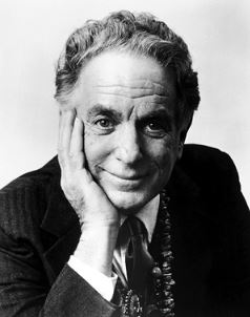
…..The composer David Amram has been hailed by the Washington Post as “one of the most versatile and skilled musicians America has ever produced.” Since Leonard Bernstein appointed Amram as first composer-in-residence with the New York Philharmonic in 1966-67, he has become one of the most acclaimed composers of his generation, listed by BMI as one of the Twenty Most Performed Composers of Concert Music in the United States since 1974.
…..Amram is also known as the musical collaborator of the great mid-century American author Jack Kerouac, whose book On the Road is considered to be the artistic soul of the 1950’s. Their work together blended poetry, jazz, blues, theatre and what is now considered performance art into an unforgettably intoxicating stew that became a life-changing experience for the many thousands of people who witnessed it.
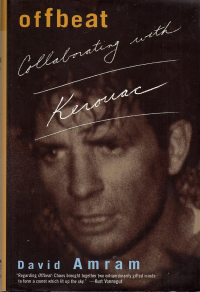
…..David Amram celebrates his friendship with Kerouac in Offbeat: Collaborating with Kerouac, and discusses their life and times with Jerry Jazz Musician publisher Joe Maita in a July 17, 2002 interview.
.
.
_____
.
.
JJM I appreciate your participation. I can’t say that I am an expert on your era, but I have followed it as a casual observer for most of my life.
DA I wouldn’t consider myself to be an expert either, but I was there. I was part of it, and I am still part of it today in terms of what it means to a whole new generation of people who are interested in the enduring energy, achievements, spirit and creativity that exemplified our era. I wish to share and pass down some of my generation’s traits, and encourage young people to create their own art, music, and literature.
JJM Who were your childhood heroes?
DA One of my first heroes was Leopold Stokowski, the conductor of the Philadelphia Orchestra. In 1937, when I was six years old, I was taken to hear them, and I fell in love with that whole group of musicians and all the music I heard, including the performance of Peter and the Wolf. A few years later, my Uncle David took me to the Earle Theatre to hear Duke Ellington. I learned from my uncle that jazz, like symphony music, was built to last. So, I was introduced to the idea of making music by these two men, who were among my early heroes. I also admired the first oboist in the Philadelphia Orchestra, Marcel Tabiteau. In 1976, I wrote a piece in his memory for the Philadelphia Orchestra, Trail of Beauty, based on American Indian music. I just wrote a new piece for the flutist James Galway, Giants of the Night Flute Concerto, which was written in memory of Charlie Parker, Jack Kerouac and Dizzy Gillespie. I was lucky enough to play with all three of them, and they all knew one another. What I have tried to do during the course of my lifetime is honor many of the people who influenced and inspired me, and in the process of honoring them it will hopefully create even more interest in their work, as well as being a thank you letter from me for their support when I was very young.
JJM You wrote in your book, “I knew the time I spent with Jack (Kerouac) was always precious. Regardless of who we were with or what we did, not a moment was ever wasted.” How would you characterize your friendship with Jack Kerouac?
DA He heard me play with Charles Mingus before we met and knew Charlie Parker and Dizzy Gillespie — a lot of the same people I did — all of whom appreciated him as much as I did because he was such a down-home, egalitarian person. We had common interests in the beauty of the French language. We both had a tremendous love of jazz. We shared dreams of getting married and having a family, living in the country, leading an idyllic life. We used to talk constantly about that, even though we were running around all over the world, not quite getting to that point. Jack almost did. I was fortunate to, later in life. We both had that strong sense of family and heritage and tradition, and we both shared a love of being with people and paying attention to every single person that was there.
Even before he had one book published, Jack was one of those people you could feel was very special. He was a great listener and story teller. It was also fun to play music with him because he would on occasion improvise words and rhymes, and I did the same thing. Sometimes he would play the piano and I would do the rapping of lines, and other times he would play the bongo drums I had lying around my apartment, and we would play together. He was a very good natural jazz singer — a scat singer. This was something he wouldn’t do much publicly. He mostly read, including other people’s work in addition to his own. He was very generous in that way. Being with Jack was like being with all the great musicians I knew We were master “hang-out-ologists!”
JJM What was the artistic atmosphere of the 1950’s prior to the jazz-poetry readings?
DA The atmosphere was wide open in those circles that we traveled in. To an extent, we opened them up ourselves by walking into places and spontaneously doing something together. In a jazz atmosphere, the audience members were so quiet and respectful of the musicians that you felt you were almost part of a meeting at a church or a temple, where everyone was completely in tune with the sermon and what the whole event was about. It was a wonderful communal feeling that was largely unspoken, and very strong and very warm. I jammed with Monk and Bird and played and recorded with the bands of Mingus, Oscar Pettiford, Lionel Hampton, Mary Lou Williams, Dizzy Gillespie, Kenny Dorham and many great players at venues that were often attended by just a handful of people. At places like the Cedar Tavern, the painters were really the center of what you might you call the social scene. They would have “bring your own bottle” parties, and people would bring something with them, whether it be a drink, a poem they had written, or a musical instrument — or just come to hang out. They were basically informal get-togethers that were open to anybody who happened to come by and walk in, from a street person to a potential art collector who would hear through the grapevine that artists were having a party.
Esquire, in a July, 1957 issue, has a photograph of me playing the French horn at the Five Spot. The photo shows the sculptor David Smith, the painter Larry Rivers, the poet Frank O’Hara, and others as well. This picture wasn’t taken in an elegant setting like Elaine’s Restaurant, but rather a club where people like that were hanging out all the time. The Esquire article associated with the photo was called “Upper and Lower Bohemia.” The Upper Bohemia people wore tuxedos in an art gallery, and Lower Bohemia was all of us. The people of Upper Bohemia would come down and check out what was happening downtown. There was no such discussion of a “cutting edge.” It was just all this wonderful stuff going on.
JJM What are your memories of the first ever jazz-poetry reading at New York’s Brata Art Gallery in 1957?
DA The fact that we even did it is a miracle, because we used to do our readings on park benches or in people’s apartments, or in the Café Figaro or some bar at 3:00 AM — whatever we felt like doing. Howard Hart and Philip Lamentia thought we should try to do it in a better setting. We met with the poet Frank O’Hara, who was a link between Upper and Lower Bohemia, and who worked at the Museum of Modern Art, where we had hoped to do the readings. The people at the Museum were horrified at the idea of having any of us there. They were not about to open up their museum to a bunch of “ruffians.” So, having been turned down there, we decided to do it at the Brata Art Gallery, where I was known. On occasion they would ask me to play the horn or bring some musicians to play. In exchange for playing, we would get wine, crackers, and the chance to meet a variety of fantastic artists, and perhaps even pursue romance with a young woman who was interested in art.
So, we went to the Brata Gallery and they welcomed us there. I remember the day of the reading being quite rainy. In anticipation of the reading, we had a few mimeographed announcements that were handed out in the different coffee houses, bars and park benches, because that was the way everything was advertised then — by word of mouth. To our amazement, the Brata was packed with people. There was no microphone, and nothing was planned. Jack was the emcee, and On the Road had just come out previous to that. People knew his name from the incredible reviews, but he didn’t have the pressure on him then that he did even a month or two later.
JJM The readings were pretty much spontaneous?
DA Yes. I never knew whether Jack was reading something that he made up on the spot or if it was something of his own. There may be something by Walt Whitman in there, or maybe a fragment of a poem by Hart Crane, or something from Shakespeare, Beowulf or Chaucer. He knew all of these French poets like Celine, and he would say “check this out” or “dig this” and start reciting a Celine poem from memory. He had an enormous memory for music and for jazz and the classics. He could sing the melodies from different Haydn and Beethoven string quartets. He was like an encyclopedia of music and classic literature from Europe. He also had an enormous knowledge of Buddhism. He had a tremendous knowledge of Judaism, as well as the writings from the Old and New Testaments as well as from the Mass. He had this knowledge of so many different things. When he was reading, I would submerge myself into whatever it was he was reading, and I tried to anticipate what would happen next.
JJM What instrument were you playing?
DA This was 46 years ago, and I played mostly French horn and some piano and percussion. At times I might play some kind of folkloric flute, although I didn’t play those with the frequency or the skill then as I do now. I would listen very hard to what he was reading, and on the spot create music that the readings gave me ideas about. That is something that I was trained to do when playing jazz, always think ahead. When you are accompanying someone, you are listening to them the way you listen to a Bach Chorale, where four parts are going on at the same time, all of which are gorgeous melodies, all being played simultaneously. In jazz, you listen to what the bass player is doing and what the drummer is doing, what the pianist and the guitarist is doing, and then you play something that compliments that, so you are thinking simultaneously and thinking ahead. In symphonic music, when you are conducting, you do the same thing. You are feeling the whole orchestra, thinking ahead so you can prepare for a change. That enables you to accompany somebody even if it is not planned and be able to come up with something that is appropriate.
The other thing is you really have to want to submerge yourself into this situation. That is what I did with Jack, and that’s why he liked to do the readings with me because he knew I was there for him, and for our ability to blend the poetry and the music. When he was reading I tried to do something to compliment the music that was already there in his reading.
JJM At age 37, Keroauc considered himself too old to be performing in public, and appeared unable to find his own way. You quote Franz Kline as saying of Kerouac, “He has the cross to bear. He is recognized more for a false image created by a merchandising myth than he is for his true gifts — as an artist.” Was this the basis for much of Kerouac’s sadness and despondency later in life?
DA Definitely. He was an old fashioned artist who wanted people to appreciate what he wrote and appreciate him as a person by virtue of what he wrote. That is about as simple and straight-forward a set of goals as any person could have. That is the way a great master carpenter feels, or an architect or composer or anyone who creates anything — people want to be appreciated for what they have done. Kerouac and the rest of us would say, “By your works, ye shall be known.” A thing of beauty is a joy forever. This is as far removed from the myth of the “beat” generation’s untalented, cretin sociopath who supposedly possessed a philosophy of lying around, stoned out all day, saying how much you hated America as you can get.
JJM Yet this is what he became associated with.
DA Yes, he was a tremendously learned person, and to be made a fashion industry pop schlock caricature of being the “king of the beatniks” was devastating to him. He wanted to be considered along with writers like John Steinbeck, Theodore Dreiser and Thomas Wolfe, as a twentieth century American author who took experiences with his own life, and who held up a mirror to America and the world and said, “here is who we are.” He was an old fashioned writer in the most complete and beautiful sense, and he knew in his heart the value of his own writing. He was a serious writer and it was very important to him to be appreciated as a writer.
JJM Truman Capote dismissed Kerouac’s work as “typing.” How did he handle criticism? Did he take it too personally?
DA Criticism was hard for him because so much of it was not about how the book was constructed or the contents of it, but the criticism centered on him, personally. They criticized how they perceived he lived his life and criticized a non-existent movement. They were critical of a group of people who went before television cameras dressed up like beatniks — in dark glasses, berets, and playing bongos — to fullfill a caricature that had nothing to do with what his writing was about. If we took the great southern twentieth century writers like Carson McCullers, William Styron, William Faulkner, Tennessee Williams, Truman Capote, Langston Hughes, and so many others, and we called them “red-neck” writers, there would be a storm of protest. If we took the television program “The Beverly Hillbillies” and “Hee Haw,” and said that these reflected what southern culture was about, there would be a storm of protest. But when we use the words “beat” and “beatnik,” it is considered to be an acceptable, accurate portrayal of what many of us were supposed to be about.
JJM In fact, you were really renaissance men. To have your works of art, and your love for art minimized and associated with the beatnik myth as manufactured by the media must have been incredibly frustrating…
DA Lawrence Ferlinghetti had a tremendous education as an artist and also an enormous knowledge of literature. He speaks several languages, and even founded his own publishing company to give all these writers an opportunity to be heard. Gregory Corso began to study the classics while he was in prison and became self-educated through living in the streets. He actually audited a class at Harvard that Archibald McLeish taught. McLeish considered Corso a genius. Allen Ginsberg was a world authority on the writing of William Blake, and had an incredible knowledge of classic literature and world politics. He was almost like a Talmudic scholar that would sit and argue for four hours about anything. Then, when you were done with the argument, would take the other side, as if you hadn’t really presented your case well. In fact, most of us spent our whole lives just arguing with him because that was one of the things he was great at doing and loved to do. The painter Jackson Pollock studied with Benton and was an authority on American Indian sand-painting. Franz Kline, who became known for his black and white paintings, did a whole series of gorgeous landscapes and wonderful portraits that may still hang in Greenwich Village. When the Actors Studio was beginning to get into its heyday, the Stanislavski Method was tarred and feathered in the same way beatniks were as a result of Marlon Brando’s wonderful role of Stanley Kowalski in Streetcar Named Desire. His role led people to consider the Actors Studio a collection of people mumbling and scratching themselves, who couldn’t complete a sentence and didn’t know how to act. The reality is that Brando was a tremendously accomplished classical actor well before he even studied Stanislavski, but because of one role, he was typecast the rest of his life as somebody who was mumbling and fumbling. This was the kind of attitude that dogged our time, where they said Charlie Parker and Dizzy Gillespie were playing wrong notes, that Jackson Pollock and Franz Kline and Joan Mitchell didn’t know how to paint, that they were just hurling paint cans against the wall.
JJM People are intimidated by intelligence, especially when they see someone like Charlie Parker come along who is moving his art beyond that played in a dance hall…
DA In Kerouac’s case, after one book came out, On the Road, he was hailed as the greatest new novelist since Thomas Wolfe. But, he was also characterized as the leader of some kind of a movement which led to him being hailed as the “King of the Beat Generation,” which he was horrified by!
JJM This caricature went on into the sixties. You wrote, “As the deposed King of the Beat Generation (a title he abhorred), he was held responsible for the self-indulgent excesses of the 1960’s.” Why was he held responsible for the excesses of the 1960’s?
DA On the Road specifically was written about his adventures in the late forties, starting around 1947, when he began taking those trips with Neal Cassady. In 1967, the year of the media appointed “Summer of Love,” On the Road refused to die a natural death. It somehow managed to stay in print, even though almost everything else he wrote was ignored, reviled or cut-out in the United States. Then, because so many people had read On the Road, and really liked it, he got connected to the teenage kids who were taking a lot of dope and disrespecting everything and just wanting to goof off and not do anything — the “tune in, turn off, drop out” crowd. That he was connected to that or held responsible for it was devastating to him.
JJM What did he mean by the “anti-war” industrial complex?
DA He was able to see that record companies as a fashion industry took over the whole idea of pacifism. The idea of the peace movement and of people who spent their entire lives trying to have a more egalitarian, just society, suddenly became swamped by the record industry, by the new rock and roll culture, and by the idea of not trusting anyone over thirty. The ideas of reading a book, writing music, taking a job, working hard, caring for your country, establishing better communication between parents and children, continuing the ideals of the civil rights movement, having art, music, poetry, theatre, and dance be respected and egalitarian, were instead replaced by life being displayed as a series of thirty second commercials, that art is dead, that music is dead, and to get stoned and drop out.
Allen Ginsberg went along with that because it was very hot and fashionable at the time, and it was something that provided him a lot of attention. Jack didn’t want to associate himself with that because he felt it was betraying that generation of kids who were being led by a bunch of opportunists, and he correctly saw that today’s fashionable media star revolutionary becomes tomorrow’s Wall Street broker, which is what happened to a lot of the people during that time. Of course, there were many people in the sixties who truly believed in the ideals that had been shared for thousands of years by people in pursuit of peace, justice and egalitarianism. But those people were swamped out by the media’s caricature of the suburban revolutionaries.
JJM Allen Ginsberg felt that Kerouac missed out on marketing himself during that era, didn’t he?
DA Yes, I guess he did. Allen had to survive as a poet and everyone does what they have to do in life to survive. Also, in all fairness, it is so very easy to be intoxicated by the media. Jack, in spite of all his health problems and his drinking, was really serious about the ideals he believed in, which included a life-long spiritual search, a universal compassion for all people, and a deep respect and appreciation for the country that had given he and his family beautiful opportunities. He knew many men couldn’t afford to go to college and were drafted and had to go over and fight in that war. If he felt that the war was wrong, he didn’t disrespect and vilify the people who were drafted into the army because they were victims — and everybody in that terrible war were victims whether they were on one side or the other. As he would say, they were all cousins, all being victimized by world politics, manipulated by greed and ego and gigantic money interests.
JJM The historian Douglas Brinkley said that “Each generation rediscovers Kerouac on their own terms.” How is Kerouac being “rediscovered” by today’s generation of interested readers?
DA There are a lot of wonderful things created in our culture that have been ignored that can speak to them. When today’s generation reads Jack’s books or they listen to the music created by some of us, I believe that they see there is a different way of approaching today’s life and today’s sometimes seeming hopelessness that can provide answers. That by listening to some music, by reading some books, by looking at paintings, and most important by hanging out with one another — by collaborating with one another and creating your own network — you can achieve something that is much better than what is out there.
JJM You and your friends used the motto, “By your works ye shall be known.” How will you be known?
DA I would hope it starts with my music, and would be considered compositions that exemplify what I believe is the common factor of all great music. From Bach to Bird to Bartok, all share the following in common: Purity of intent and an exquisite choice of notes. My compositions, I believe, will have lives of their own long after I am gone. They are built on the philosophy of what we used to call a selection of “choice notes.” I hope my music will be of value to future musicians and artists of all kinds to inspire them to dare to tell their own story, to be themselves, and to see that art and life don’t have to be separated.
.
_____
.
.
Offbeat:
Collaborating with Kerouac
by
David Amram
.
.
_____
.
.
This interview took place on July 17, 2002, and was hosted and produced by Jerry Jazz Musician editor/publisher Joe Maita
.
.
_____
.
If you enjoyed this interview, you may want to read our interview with Paul Bowles biographer Cherie Nutting.
.
.
.
___
.
.
.
Click here to read other interviews published on Jerry Jazz Musician
Click here to subscribe to the (free) Jerry Jazz Musician quarterly newsletter
Click here to help support the ongoing publication of Jerry Jazz Musician, and to keep it commercial-free (thank you!)
.
___
.
.

Jerry Jazz Musician…human produced (and AI-free) since 1999
.
.
.