





Nick Salvatore,
author of
Singing in a Strange Land:
C. L. Franklin, the Black Church, and the Transformation of America
___________________
There are few American lives more powerful or more moving than that of C. L. Franklin. Born in rural Mississippi, he would go on to become the most famous African American preacher in America. His style of preaching revolutionized the art, and his call for his fellow African Americans to proclaim both their faith and their rights helped usher in the civil rights movement. Booming, soaring, flashy, and intense, C.L. was one of a kind. And yet Franklin was, like many great public figures, immensely complicated. A beacon of faith and light, he also knew the shadows. He knew the power of the Lord, yet he was no saint. In Singing in a Strange Land, Bancroft Prize-winning historian Nick Salvatore tells Franklin’s story for the first time.

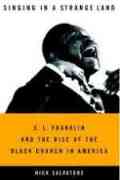 Salvatore’s book is the product of eight years of extensive research and interviews. The result is a biography with the arc and detail of a fine novel. It begins in rural Mississippi, in famous Sunflower County, home to Delta soil and the birthplace of the blues. Franklin’s mother was religious, his father, nowhere to be found, and his stepdad, a man of the plow, not the pulpit. But though needed in the fields, Franklin felt a calling he could not resist. Salvatore writes of his early years as a preacher, to Tennessee and then further north. And in Detroit, the young man becomes the legend.
To know Franklin is to know the story of the rise of activism in the black church, but it is also to know the exhilarating tale of the rise of gospel, blues, and soul music in the twentieth century — including that of C. L. Franklin’s own daughter, a girl with a staggering voice and the name Aretha.#
In a May, 2005 interview with Jerry Jazz Musician publisher Joe Maita, Salvatore talks about the preacher who was at the centerpiece of change for a people and a nation.
______________________________
photo Walter P. Reuther Library
Reverend C.L. Franklin, from the pulpit of New Bethel Baptist Church, 1977
_____
“What am I saying? I’m saying that sometimes in the midst of our own crises, in the midst of our own life-problems, in the midst of the things that we find ourselves involved in, sometimes the power of our deliverance is in our own power and in our own possession. What you need, my brothers and sisters, is within you. First of all, it’s faith in God, and second, faith in yourself, and thirdly, the will and determination to put these into practice. The man who stands and simply cries will never go over his Red Seas. The man who stands or the woman who simply stands and complains, stands before your Red Seas or your own problems, and simply cries, will never find the way out.”
– C.L. Franklin
______________________
JJM What is in your own background that would contribute to a decision to write a biography as challenging as this?
NS I originally went to graduate school at U.C. Berkeley to study African American History because I had a sense that race was really the central divide in American life, yet it seemed that everybody else was talking about class. While they were not wrong, I felt they were missing an even larger story that I have since attempted to tell in my three books.
My first book was a biography of Eugene Debs, the white American labor leader and socialist. My second book was called We All Got History, a biography of an unknown nineteenth century black janitor named Amos Weber, who left a two-thousand page hand-written chronicle behind, from which I wrote his biography.
The glue that holds all three of these subjects together is the alternative perspective they share on the meaning of being an American. They did not simply accept the dominant image that being an American means being an uncritical patriot, or means an acceptance of certain kinds of social relations, whether it be economic, racial, etc. And that is the theme. Gene Debs questioned the meaning of Democracy as America transitioned into an industrial, capitalist society within an entirely different bureaucratic order. Weber, who was a black soldier during the Civil War, questioned the meaning of a political democracy he fought for and his brothers died for as America looked toward reconstruction and the reconfiguring of the American world. C.L. Franklin asked a similar question, adapted to the mid-twentieth century. These are issues and people I find intriguing — people who revere the part of the Declaration of Independence that reads, “We hold these truths to be self-evident that all men are created equal, and endowed by their creator with unalienable rights,” and who question the way those values are applied in modern society.
JJM You wrote, “To know [Reverend C.L. Franklin] is to understand more fully the complex experiences central to modern American life.” Why?
NS Well, for a couple of reasons. One of the things that transformed twentieth century America was the large migration of African Americans out of the rural South, which began in 1915 and continued into the sixties. The South was transformed enormously as a consequence. At first, white southerners were furious about it because they were losing their labor force, but by World War II, technology had transformed the process of picking cotton and they were more than happy to help African Americans move on. This migration fundamentally transformed the cities of the North in terms of social composition, politics and the coming to maturity of a black political voice and a black political presence. In cities like Detroit, Cleveland, and Chicago, enormous tensions built around this transition that eventually broke out into violence over jobs and residences — especially throughout the thirties, forties and fifties, but also into the sixties. In 1966, after Martin Luther King marched in Cicero, Illinois for fair and open housing laws, he commented that the violent reaction he and the marchers experienced there was the worst he had ever seen, including Selma and Birmingham.
At the same time this is going on, a music of different tones emerges that fundamentally transforms the way Americans listen to music — Motown, Soul, R&B — so, culturally, a generational transformation takes place. When I use the term “transformation of America” or the phrase that you read from the book’s preface, some readers may assume that I am talking only about civil rights, but the underlying processes that ultimately led to civil rights are equally profound.
JJM The civil rights movement wouldn’t have happened if people didn’t have the courage to speak out. You argue that one of the significant ways they grew courageous enough to speak out was through singing — especially in church. The courage gained through this experience began showing up in popular music as well.
NS That’s right. When a group of people is living in an oppressive and dangerous culture, how do they speak out against it? If you are African American, how do you speak out against an oppressive culture like that found in the Mississippi Delta of 1947? It was very dangerous, and plenty of people were killed trying to do so. So when black people came to a city like Detroit from a state like Mississippi or Arkansas, while they discovered a freedom that didn’t exist for them in the Delta, they weren’t sure how to express themselves after being raised in a culture that threatened them for speaking out. In the process of finding one’s voice, church hymns and sermons became critically important. Through his sermons, C.L. Franklin encouraged people to find their voice.
JJM How did his childhood experiences lead to an interest in preaching?
NS At the time, structurally or sociologically there were really only three things a young black man could do other than farm someone else’s land. One would be to preach, a second would be a blues musician, and the third was to become a funeral director, provided he had economic resources. These were the only three occupations in the segregated South that whites had very little control over. A Baptist preacher is called by the congregation, and paid by the congregation. I don’t mean to suggest that there were not efforts by whites in the southern Baptist convention to influence black preachers, because there were, but the point is that the minister ultimately had to report to the congregation. Similarly, if a blues musician was good, and if people enjoyed them and went to listen to them on Saturday night, they made a living of sorts. The reason there was a market for black funeral directors is because no white funeral director would take a dead black body.
So, the choices beyond picking cotton were very limited, and Franklin understood very early that he was not going to spend his life picking cotton. It wasn’t just because he hated agricultural work that made him want to do something else. He talked of an experience of working a plot of land on a plantation outside of Cleveland, Mississippi, that ran up to the railroad tracks parallel to Highway 61, where he saw the cars and trains in movement, all traveling elsewhere. In later years he identified this as the moment he experienced what he called “the deep longing” to know where the people in those cars and trains were going. This ignited the first conscious stirrings within him that he was not going to allow the limitations imposed by Mississippi define his sense of the possible. He also talked about how his mother had a tremendously powerful and positive influence on his decision to preach, but he just knew he was not going to spend his life in agriculture if he could, in any way, have anything to say about it.
JJM How did music inspire him as a young adult?
NS He listened to all sorts of music. Even though his family was very poor, they owned a stand up Victrola. He loved listening to Roosevelt Sykes, and he listened to other blues singers. He also listened to a preacher out of Atlanta, J. M. Gates, who ultimately recorded an enormous number of three minute sermons in the twenties and thirties. That is all I am sure he listened to.
The social pattern surrounding the use of the Victrola was very interesting. It was not unusual for the people who didn’t own a Victrola to buy the records and bring them to the home of a friend who did. It became another way of socializing. Even in very strict religious households, children were allowed to listen to music as long as they didn’t dance or cross their legs. They listened to the blues as well as recorded hymns and sermons. B.B. King tells the story about how, as a child, there was no distinction between Saturday night and Sunday morning — that the same people who were at the juke joints were in church pews on Sunday morning.
JJM Of a religious experience King attended as a young boy, he explained, “[The minister] says one thing and the congregations says it back, back and forth, back and forth, until we’re rocking together in a rhythm that won’t stop. His voice is low and rough and his guitar high and sweet, they seem to sing to each other, conversing in some heavenly language I need to learn. No room for fear here; no room for doubt; it’s a celebration of love.”
NS Yes. He is referring to the call and response pattern so central to African American as well as African music, which is as prominent in secular as in sacred music. King said that whenever he was in Detroit, no matter how late he was up on Saturday night playing a gig, he was in the first row at New Bethel Baptist — C.L. Franklin’s church — at 10:45 Sunday morning. He called Reverend Franklin “my main preacher.”
One of the things Franklin did that was so important was insist people rethink the divide between the sacred and the secular so many people before him felt was inviolable, and music and politics were central to this. He was once being criticized for opening up his church to prostitutes and pimps and responded to the critics by telling them their problem was that they had too much religion and didn’t understand their relationship between their faith and the world they lived. That is what was really important to him.
JJM What were sermons like before Franklin?
NS There were many variations, but there at least two major traditions. One was what became known as the manuscript preachers, who literally wrote out their sermon. They viewed sermons as a kind of learned discourse, or learned essays, and they would not give in to or encourage emotional responses. They would often quote from authorities and theologians or whomever they felt were pertinent to the sermon. These could be wonderful, powerful sermons, but they were certainly not meant to appeal to the congregation in any kind of an emotive way regarding the their faith or secular issues of the day.
Some of Franklin’s good friends were manuscript preachers, but Franklin wasn’t. He was what they called the “whooper,” a minister who chanted at least a part of his sermon. He might work on a sermon in his head for four or five months in advance of delivering it. During this time he would discuss with other Detroit ministers the meanings of scripture, and perhaps get suggestions for readings to use within the sermon. After this preparation time, he would go into the pulpit with just a small piece of paper with only a couple of phrases on it — not even an outline — and in a narrative voice, begin telling a story. He always began with the biblical text, which was a way of evoking his connections to the divine authority. The story always had a moral lesson of some sort, and it almost always was one that had the interplay between the sacred and the secular, because even in his most secular moments, he retained the core sense of his faith vision. During the sermon, every now and then he would tune a word, giving it a musical intonation which in part was to begin the process of encouraging the call and response pattern that let the congregation know he knew where they also wanted to go. By doing this, he was working toward a moment where the congregation would come close to experiencing their god on that Sunday rather than just hearing the message. By the final one-third of the sermon, his tuning of words transformed his preaching into a rhythmic and chanting presentation while retaining the pertinent message at its core.
One minister put it to me very vividly, saying that many other ministers tried to whoop or chant when they had run out of ideas, and it ultimately just became noise. But for C.L. Franklin, it was never just noise — even as he chanted and raised the emotive level, he remained focused on the message he was trying to communicate to the congregation.
JJM Concerning that, you wrote, “What made C.L. such an extraordinary preacher was that even as he brought the congregation to this peak, he continued to address contemporary issues. As the caged eagle had been touched by the flock above, so too might individuals constrained by segregation find within community self-identity, group cohesiveness, and, ultimately, freedom.”
NS Absolutely. A very powerful sermon where he does that is in “Dry Bones in the Valley,” which is out of the Book of Ezekial. It is the famous story of how the bones are interconnected — the ankle bone is connected to the leg bone, etc. — and he tells it in a way that, as he reaches an emotional peak, has you realizing it is you he is rescuing from human fracture; and he is saying that there is a wholeness here, something that is complete here. It was an absolutely stunning performance.
JJM In 1939, the black political scientist Ralph J. Bunche wrote, “The Negro preachers of Memphis as a whole have avoided social questions. They have preached thunder and lightening, fire and brimstone, and Moses out of the bulrushes, but about the economic and political exploitation of local blacks they have remained silent.” How much influence did this essay have on Franklin and other black preachers?
NS I don’t know if Franklin ever read this essay, he may have just talked about it. It is pretty ironic because Bunche — a brilliant guy who went on to win a Nobel Prize — was one of a group of highly secular, intellectual black activists in the thirties who held pretty disdainful attitudes, for the most part, toward religion, especially in the black communities. He felt there were too many examples of preachers doing exactly what he said in the remark you quoted from, which was to talk about “pie in the sky,” the joy of life after death, and how blacks had to bear with the pain of contemporary life. There is no question that there is truth to this. C.L. Franklin even understood this because early on, when he left Mississippi in 1939, he was a self-described fundamentalist who preached only about the after-life, but he came to understand that finding one’s voice meant one had to make that broader connection between the sacred and the secular.
Ironically, it was a group of older ministers in Memphis who were instrumental in bringing Franklin toward that line of thinking, just two years after Bunche wrote the essay. So, in a sense, Bunche worked off an image that had some real basis in life and experience, but it became a stereotype. If he had spent more time in Memphis, Bunche would have found, as Franklin himself did, ministers who didn’t share that stereotyped approach he wrote about in the essay.
JJM What was Franklin’s core political vision?
NS In political terms he was a liberal Democrat, which means he believed that government had a role to play in making certain that economic and social inequalities did not remain permanent. He was an integrationist throughout his life, and at times during the sixties he intentionally argued in public with black nationalists. He was also a strong supporter of the trade union movement up until the point the union broke its commitment to equality. The national office of the United Auto Workers was there, and while they were good in their public statements and presentation, they rarely worked inside their own locals to break down the strong resistance of white members toward working with blacks, and to allow them to be promoted within the local union. Franklin would, at times, be critical of these kinds of actions, but he was also known as a labor preacher, which meant he supported the ideals of the trade union movement. Those were the three major areas he was involved with politically.
He was a strong supporter and good friend of Martin Luther King, Jr., and a strong supporter of the civil rights movement — although while he was tactically non-violent, he was not philosophically non-violent. One of the burdens he carried throughout his life was that he never fully left Mississippi emotionally — what he experienced there was very harsh, and the scars he carried from them were really deep.
JJM He was obviously an incredible marketer, because he had a great understanding about how to project his message using the technology available to him at the time, particularly radio and records.
NS Yes, he had a radio show in Memphis in the early forties called “The Shadow of the Cross.” When he moved to Buffalo for two years, he had a radio show there, as he did in Detroit as well, where his Sunday evening service was broadcast live. He began to achieve fame when his recordings were distributed nationally by Chess Records, and when WLAC of Gallatin, Tennessee — a 50,000 clear watt channel — began broadcasting a recorded sermon every Sunday evening. This broadcast reached people all over the country.
JJM How did his show affect the way people viewed him, and more importantly, how they viewed themselves?
NS The broadcast made him a star, and long before his daughter Aretha was the “Queen of Soul,” C.L. Franklin was the one in the family with the reputation. The way people saw themselves as a result of Franklin’s preaching was reflected in two ways; one is that they looked to him as a leader, and hoped that by identifying with him they could absorb some of the qualities he projected; and the other is that they were deeply touched by him, and heard in him a voice that moved their souls. Consequently, they began to understand new dimensions in their own spiritual lives.
People were profoundly affected by Franklin’s sermons. I interviewed many who wanted to share something about their own conversion experiences and C.L. Franklin’s role in it, even though they never met him. The qualities he possessed were immensely powerful. People understood his complexities, that he was anything but a perfect man, and that he sometimes lost his way in navigating the divide of the sacred and the secular. But, he had a core faith message that was central to who he was, and which touched people deeply.
JJM As he became famous, how was he able to balance a life between faith and fortune, and how was he able to deal with the demands of his family and career?
NS He clearly had trouble with fame. As you pointed out, his artful use of technology was a great way to market himself, but, as much as he desired recognition, it also took him by storm. Every mistake he made was now magnified and made much larger. He was always a very human man, and he made a variety of human mistakes. For instance, he was not always celibate when he was married, and, in 1940, when his wife was pregnant with their second child, he had another child by a very young congregate in his own church in Memphis. Had that happened twenty years later, Franklin may have been destroyed as a public figure.
A lot of people felt that he was losing his grip on that play between the sacred and the secular, and between fame and faith. He enjoyed going to the clubs in Detroit to hear jazz and blues musicians who came through town, and he made no bones about that, never hiding this from his own parishioners — he would even tell some of them to attend another church if they had a problem with that. He truly believed there was nothing wrong with his interests outside the church, and this very clearly was not the normal pattern for most ministers at that time.
I believe he may have been confused in some ways. While his intellectual position distinguishing the sacred from the secular was clear, at the same time he found himself moved or motivated by forces within him that he really didn’t understand very well. His stepson told me something that I keep coming back to over and over again in my head, that Franklin carried emotional scars out of Mississippi that were with him all of his life, and he was immensely reticent to talk about them. The scars remained very difficult for a biographer or members of his family to identify because he never talked about them. The only people he may have shared this with were a few very close male friends — two of whom are now dead and the other repeatedly refused to be drawn into a discussion about that dimension of Franklin’s character.
JJM You interviewed many people for this book, but one you were unable to was Aretha Franklin. Did she choose not to be interviewed because she also didn’t want this part of her fathers life to remain private?
NS In a sense, yes, and there is some background around her choice. In 1968, Time magazine did a cover story on Aretha, and she took profound exception to the reporter’s comment that in essence said her mother deserted the family in 1948. Well, her mother, Barbara Siggers Franklin, did not desert the family, and since that time, Aretha has had a sharp-edged suspicion of journalists asking about her family life. I fit into that category, because I am an outsider who showed up asking questions. The other thing at work with Aretha’s refusal to be interviewed is that, as I began working on this project, she was completing her own autobiography that appeared in 1999, Aretha: From These Roots.
If you read her book and mine, you will see that they are very different. I am eternally grateful to my friend Erma Franklin, Aretha’s sister, because she understood the need for an honest and full study of her dad as long as it was not a sensational one, and one that didn’t simply focus on the moments her father was all too human. She did not want his life to be reduced to that. While I assured her that was not my intent, I also told her this was not going to be a sponsored biography, and that I would not write a sanitized version of his life. She got comfortable with this, and we actually became very good friends as we grew to understand and respect each other.
One of the things I insisted on was that I would not show the book’s manuscript to anyone in the family until it was in bound in galleys two months prior to its publication, and, to Erma’s eternal credit, she agreed. Erma didn’t live long enough to read the manuscript, but when Aretha did, she was wonderful. Her response to the book came in three different moments; one was when she had her publicity agent send out a press release announcing and welcoming the book; the second is when she gave an interview to the Detroit Free Press, in which she talked about how delighted she was with the book; and the third is when she came to my book signing at New Bethel Baptist Church in Detroit, where her father preached. That was a remarkable experience, because before I spoke, she sang ““Amazing Grace”.”
JJM What a great experience for you…
NS Very incredible, yes.
JJM Did she model her singing style at all after her father’s singing style?
NS No, because they had different voices. The biggest influences on her were the great gospel singers Clara Ward and James Cleveland, and to a lesser extent Mahalia Jackson. Cleveland lived with the Franklin’s for a period of time while he was associate director of music at New Bethel Baptist church. The people who came through the Franklin home in Detroit were astounding, and they represented the crossroads of post World War II black culture jazz, rhythm and blues, gospel, you name it. Erma Franklin described her father’s relationship with Mahalia as that of brother and sister. They may have talked two and three times a day, no matter where they were.
JJM He had a long relationship with Clara Ward that must have had an impact on Aretha…
NS Very much so, yes. Clara Ward was there a lot. She and C.L. Franklin had a long relationship, but it did not prevent him from having relationships with other women simultaneously.
JJM I couldn’t help but feel a little bad for Clara, because the love she felt for him was not reciprocated. It made me wonder why he put her through such heartache.
NS The information we have about those relationships come either from the women involved with him themselves, or, in the case of Clara, from her sister. C.L. never committed to that relationship, and we will never know why not.
JJM Concerning his commitment toward relationships with women, you wrote, “In his head he understood the weight of abandonment, but in his heart he felt a fear of entanglement.” Maybe Clara drew him a little too close to his heart and he felt the threat of entanglement.
NS That is very possible, and in a sense it may be the best guess because he was so elusive on those issues — and his friends honor that elusiveness, which is in some ways admirable, but it is frustrating for the biographer.
JJM Upon reflecting on his work in 1977, Franklin said, “My church is not as narrow minded as it was, when I became its pastor. It’s gratifying to look back at the way things were and to see how far we’ve come and to know my leadership had an impact on the revolution.” He died tragically, and before his time, so it may be difficult to ever know the answer to this question, but his biographer may have as good an idea about this as anyone; was he totally satisfied with his life’s work?
NS I think he had hopes that the progress of change within the congregation and within black America would be faster. I do believe he wished that. He would get frustrated at times with the pace of progress, particularly because he put a lot of his own power and energy into the process. Every now and then he actually reflected on this in a sermon, and he would speak about how people didn’t listen to what he preached, and how frustrating it was that people didn’t take his message to heart. But I also think he meant it when he said that “revolution” — a broad way of talking about social change — takes time. He had great pride in his role of pushing along the pace of change.
JJM You talk about him having a bit of an inside/outside sense regarding this issue…
NS Yes, inside of him, he would have liked to have erased his memory of what he experienced in Mississippi, and part of the way he could do that was to find his voice and to help others find theirs — especially after he got out of Mississippi and into Memphis, Buffalo and Detroit. And outside of him was the slowness of change in society, which reflected for him a realization of just how slow his own change was, and of what he still carried within him from his youth. This inside/outside sense allowed him to have a tremendous amount of sympathy for the people he was trying to help transform themselves, yet at the same time it was a constant, meddlesome feeling for him. That he probably felt both sides of that is my best understanding of him.
_____________________
“Perhaps it was simply hard to explain in only a few words what he had done. For decades, C.L. Franklin had preached to raise self-consciousness, to compel his audiences to shed a ‘slave psychology,’ to find the courage to stretch out their hands and allow their God to act in and through them. At the center of that struggle he stressed the necessity to sing because of the pain; to nurture one’s voice in a strange land was in fact to develop a vision of the possible that countered debilitating limits others imposed.”
– Nick Salvatore
*
Singing in a Strange Land:
C. L. Franklin, the Black Church, and the Transformation of America
by
Nick Salvatore
__________
About Nick Salvatore
JJM Who was your childhood hero?
NS My childhood hero was Roy Campanella, the catcher for the Brooklyn Dodgers, who was part African American and part Italian. I grew up in Brooklyn, and when I was a kid of nine or ten, I used to walk to games at Ebbetts Field with my mom and my brothers, and Campanella was a guy I just simply fell in love with. He was an incredibly good ball player, but even though he wasn’t particularly fast or handsome, he and “Pee Wee” Reese became the backbones of the Dodger team. I could identify with his Italian side, and I just adored him. I became a catcher because of him.
JJM Oh, really?
NS Well, I was never very good and don’t mean to suggest I had his skills. My wife has a funny quip about American men; she says that you have to treat them kindly because they all share the same experience of discovering at age fourteen that they are not going to achieve their dream of being a major league ball player. And, in a sense, that was me.
Campanella was a central figure along with Jackie Robinson, of course, in another important process during my childhood, and that was becoming aware of race in American society. I didn’t understand a lot of this at the time, but now I realize that when people went to Ebbetts Field, they went to cheer the team, but it was also one of the few places where a white kid like me encountered large groups of African Americans. We rooted for the same players and interacted with each other in the stands. New York City is like a series of villages, and when you are a kid it takes a while before you realize that you actually can walk outside your village. Ebbetts Field played an important role for my brother and me in understanding that you didn’t have to live within the boundaries of your own neighborhood. Ebbetts Field helped open up a new world to me, and Roy Campanella, “Campy,” as we fondly called him, was a central part of that experience.
*
Nick Salvatore is the Maurice and Hinda Neufeld Founders Professor of Industrial and Labor Relations and Professor of American Studies at Cornell University. He is the author of Eugene V. Debs: Citizen and Socialist (1982), which received the Bancroft Prize in History and the John H. Dunning Prize, and We All Got History: The Memory Books of Amos Webber(1996), which received the New England History Association’s Outstanding Book Prize. Singing in a Strange Land: Rev. C. L. Franklin, the Black Church, and the Transformation of America is his third book. He has twice received fellowships from the National Endowment for the Humanities and was a Senior Fellow in Residence at the Institute for the Advanced Study of Religion at Yale University.
Salvatore was born in Brooklyn, New York. After high school he worked as a trucker’s helper in New York and was an active member of his Teamsters’ local. He then attended Hunter College in the Bronx (now Lehman College), a division of the City University of New York, and received his B. A. in history in 1968. His M.A. and Ph. D. degrees, also in history, he received from the University of California, Berkeley, where he studied with Leon F. Litwack. He has taught American history at the College of the Holy Cross in Worcester, MA and, since 1981, at the School of Industrial and Labor Relations, Cornell University; from 1997, he has held a joint appointment in American Studies at Cornell as well. Besides history, Nick enjoys long walks, music, and conversation. He has two daughters, Gabriella and Nora, and a grandson, Joseph. He and his wife, Ann Sullivan, live in Ithaca, New York.
Reverend C.L. Franklin products at Amazon.com
Aretha Franklin products at Amazon.com
Nick Salvatore products at Amazon.com
Nick Salvatore’s web site
_______________________________
This interview took place on May 23, 2005
*
If you enjoyed this interview, you may want to read our interview with Boogaloo author Arthur Kempton, and Dixie Hummingbirds biographer Jerry Zolten.
_______________________________
Other Jerry Jazz Musician interviews
# Text from publisher.


