
____________________________________________
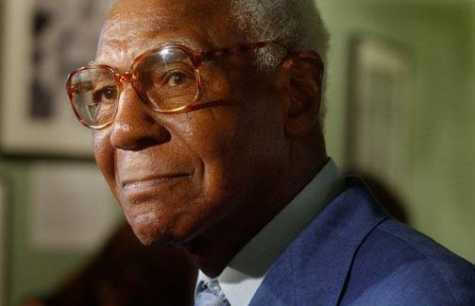
The charismatic Buck O’Neil is truly an American hero. His eloquence, grace and genuine love for people have captured the hearts and imaginations of kindred spirits worldwide. His illustrious baseball career spans seven decades and has helped make him a foremost authority and the game’s greatest ambassador.
O’Neil was born November 13, 1911 in Carrabelle, Florida. His father, who played for local teams, introduced him to baseball at an early age. He was nicknamed “Buck” after the co-owner of the Miami Giants, Buck O’Neil. A segregated America denied O’Neil the chance to play Major League baseball so he showcased his skills with the Kansas City Monarchs of the Negro Leagues. He joined the Monarchs in 1938, was named player/manager for the club in 1948 and continued his association with the team through the end of the 1955 season.
O’Neil had a career batting average of .288 including four .300-plus seasons at the plate. In 1946 the talented first baseman led the league in hitting with a 353 average and followed that in 1947 with a career best .358 mark. He posted averages of .345 and .330 in 1940 and ’49 respectively.
He played in three Negro American League All-Star games and in two Negro American League World Series. In addition to his career with the Monarchs, O’Neil teamed with the legendary Satchel Paige during the height of Negro League barnstorming in 1930’s and 40’s to play countless exhibition games.
Following his Monarch career, O’Neil moved on to Major League Baseball as a scout with the Chicago Cubs. He was named the Major’s first black coach by the Cubs in 1962 and is credited with signing Hall of Fame baseball players Ernie Banks and Lou Brock to their first pro contracts. He has worked as Kansas City Royals scout since 1988 and was named “Midwest Scout of the Year” in 1998.
O’Neil rose to national prominence with his compelling narration of the Negro Leagues as part of Ken Burns’ PBS baseball documentary. Since then, he has been the source of countless national interviews including appearances on “Late Night with David Letterman,” and “Late, Late Show with Tom Snyder.”
Today, O’Neil serves as Board Chairman of the Negro Leagues Baseball Museum (NLBM) in Kansas City, Missouri. He is a member of the 18-person Baseball Hall of Fame Veterans Committee (Cooperstown, New York) and continues to lead the charge for deserving Negro Leaguers to be inducted. Through his tireless crusade, America is awakening to the incredible story of the Negro Leagues and the NLBM as the world’s only museum dedicated to preserving Negro Leagues history.*
We are honored by Mr. O’Neil’s participation in a January, 2003 Jerry Jazz Musician interview, conducted by Paul Hallaman.
photo courtesy Negro League Museum
The Kansas City Monarchs, 1945
____________________________________________
JJM Tell us a little about your early life in Florida, and how you got into baseball?
BO’N I played with the Miami Giants, a semi pro team. At the time I played with them we had five guys who could have played with the Kansas City Monarchs, but they wanted a first baseman. Since that was my position, that is why I got the job.
JJM The Miami Giants were a traveling team?
BO’N Yes, semi-pro.
JJM At the time of your leaving Edward Waters College to play for the Miami Giants, black baseball was quite a bit different than white baseball. Could you talk a little about that?
BO’N We played a different style of baseball in the Negro Leagues than the major leaguers did. In the majors, Babe Ruth, Jimmie Foxx and those guys would come in and hit the home run. It was the type of baseball where you could go out and get a bottle of pop or peanuts until the big guys came to the plate. You couldn’t do that if you were watching a Negro League baseball game. Negro League baseball was so fast and quick, if you go out for something to eat you might miss something you had never seen before. It was actually that quick. A good way to explain it is that Jackie Robinson brought Negro League baseball to the majors.
JJM It was a lot faster brand of baseball, where runs were not just the result of the three run home run?
BO’N Yes, it was very quick. These players would routinely take the extra base, stretch a single into a double, a double into a triple, and if you weren’t smart they would steal home too.
JJM After the Miami Giants, you played with some traveling teams. In 1935, you went to the National Baseball Congress tournament with a team called the New York Tigers, where you met Satchel Paige.
BO’N Yes, and not a soul of us was from New York, but we called ourselves the New York Tigers because everybody on the team figured that with the black population in Harlem we could draw them to every park we played if we had a New York name. We played in the Denver Post tournament and from there went to Wichita, Kansas, which was the site of the first National Baseball Congress tournament in 1935. That is when I met Satchel Paige, Double Duty Radcliffe, Quincy Trouppe
JJM Paige was pitching for an integrated team from Bismarck, North Dakota.
BO’N Yes, and they won the tournament. They were an outstanding ball club. Paige pitched in every ball game, and set a record for strikeouts down there.
JJM Tell us a little about how you came to join the Kansas City Monarchs, probably the greatest of all Negro League teams.
BO’N I was playing with the Shreveport Acme Giants in 1936, during which time we played all over the country, even up into the Dakotas. When we came back to Shreveport, I decided to stay there during the winter. We were like a farm club for the Monarchs, and when they came to Shreveport to train that spring I trained right along with them. The manager of the Monarchs, Andy Cooper, and the owner, J.L Wilkinson, liked the way I played, and told me they would like me to play on their team. The one catch there was that Mayweather, their first baseman from the year before, broke his leg and they said they had to give him a chance to keep his job. So, because of this circumstance and since they felt I was too good to be playing semi pro ball, they sent me to Memphis to play with the Memphis Red Sox of the Negro Leagues. I played with the Red Sox for one season, 1937. In 1938, they traded Mayweather to St. Louis and I came to Kansas City to replace him. I have been here ever since.
JJM At that time Kansas City was not only a center for great baseball. The clubs in the neighborhoods between 12th and 18th Streets were centers for much of the country’s best jazz scene. You got a chance to visit those clubs in your off hours, didn’t you?
BO’N Yes. Tom Pendergast was the city boss during that time, and Kansas City was “wide open.” All of the hotels, bars and theaters had live music, so there was a lot of work for musicians here at that time. A jazz player could find a gig in Kansas City, and they flocked here during that time. And because of Kansas City’s blue laws, the town didn’t close down at midnight. I particularly remember a club called the Subway, which was underground. The jazz players would come down to the Subway and jam all night long.
JJM So you had a chance to see Andy Kirk and Count Basie
BO’N Yes. I recall one night I went to the Subway after playing ball that day, and Basie, who was a friend of mine, invited me to sit down with him in the audience. A kid came in to the club with a horn, and Basie said to let him play. He started blowing, and none of us knew what he was blowing, but you had to listen to him because he was making some sounds that you never heard before. The kid turned out to be Charlie Parker.
JJM You were a close personal friend of Lionel Hampton.
BO’N Yes, Lionel was a very good friend of mine. I gave him a uniform and he coached first base for me.
JJM Could he play ball at all?
BO’N No, we didn’t want him to play! He just wanted to be on the field.
JJM Just leave him on the vibraphone where he belonged, huh?
BO’N Yes!
JJM Satchel Paige left the Pittsburgh Crawfords in the early thirties for the Bismarck team, then he went down to the Dominican Republic to pitch. He subsequently signed with the Monarchs, but his arm was hurt
BO’N Yes, he hurt his arm and was looking for a job. J.L.Wilkinson recognized Pagie’s appeal, and brought him to Kansas City in 1939. He didn’t put him on the Monarchs, but he formed a team for him, and called it the Satchel Paige All Stars, also known as the Little Monarchs. The team included Cool Papa Bell and some other players from the Monarchs, and was managed by Newt Joseph. They played exhibition games with Satchel pitching where they would carry Satchel. Nobody would hit the ball out of the ballpark and they would let Satchel strike them out with nothing. They would do this for three innings. During this time, Wilkerson sent our trainer, Jewbaby Floyd, out to work on Satchel’s arm, and after about three months Satchel told Winfield Welch, the Acme Giants manager, to turn him loose. As soon as he was turned loose, he struck out 17 and they felt Satchel was ready to join the Monarchs. That was history, really, because his arm was back, and, oh man, he could really pitch!
JJM You have talked quite a bit about J.L. Wilkinson, or “Wilkie” as you call him. He was the owner of the Monarchs and quite an influential person in the history of Negro League baseball, but he was not a Negro himself.
BO’N No. When the Negro Leagues started in 1920, he was the only white owner. The League wanted all black owners, but he had a franchise with the baseball park here, and he had a good club who called themselves the All Nations Team at the time. That is why they put Wilkie in. He had quite an influence on the Negro Leagues. When the depression came, Wilkie started night baseball.
JJM Yes, and the Monarchs traveled on a bus and trailers and they had their own generator, so wherever they went, throughout the continental United States and Canada, they had the ability to play games in any small town, day or night. They were not confined to the railroad lines.
BO’N That’s right.
JJM You served in the Navy during WWII, and while you were there Jackie Robinson signed with Montreal. Can you talk a little about that?
BO’N I was in Subic Bay, running a stevedore battalion. One night, while everyone is in bed, the commanding officer got on the horn and asked me to come see him at once. I thought I may have been in trouble because this was unusual. I went to his office and asked me if I heard what had happened. I replied, “No, Sir,” and he informed me that Branch Rickey just signed Jackie Robinson to an organized baseball contract. I said, “Thank God it finally happened!” I got on the horn and announced, “Hear this! Hear this! Hear this!” over the loudspeaker, waking everyone up. “Branch Rickey just signed Jackie Robinson to an organized baseball contract.” We whooped, we hollered, we shot our guns. We didn’t sleep that much that night.
JJM In your opinion, should Jackie have been first? You talk about the greatness of Paige in your book, “I Was Right on Time.” Should Satchel have been first instead of Jackie Robinson?
BO’N Not necessarily so. I think Jackie was the right guy — that he was the best ballplayer — he was the right guy, because he knew just what it meant to be first. He had a whole race of people on his back. His playing in the majors happened before the civil rights movement, and when he signed his baseball contract, it was really the beginning of the civil rights movement. This was before the Brown vs. Board of Education decision, before Sister Rosa Parks refused to go to the back of the bus, and while Martin Luther King was a sophomore at Morehouse College. Branch Rickey started that ball on the road.
JJM The integration of the major leagues, when first Robinson and then Larry Doby and others began playing alongside white players for the first time had a profound change on the Negro Leagues. Can you tell us a little about that?
BO’N When they signed Jackie to that contract, it was really the death knell for the Negro Leagues. Actually, that is what we wanted all the time, to have just the major leagues. When Rube Foster started the Negro Leagues, his vision was that if he organized the black ballplayers, the National League would take a black team, and the American League would take a black team. That was his thinking. He was that far ahead of his time.
JJM Rube Foster was quite an influential person in the history of baseball. He really was the father of Negro League baseball.
BO’N That’s right, he was.
JJM Buck, can you tell us about some of the players you scouted and signed in your capacity as scout with the Chicago Cubs?
BO’N While I was here with the Monarchs, I signed Ernie Banks to a contract in 1950. Following the signing, he went into the service for two years. When he returned in 1953, he played with the Monarchs, which is when the Cubs saw Ernie. We had our East/West game in Chicago, when the Cubs saw Banks play in it. Tom Baird, the owner of the Monarchs at the time, called me at the hotel after the game and told me to bring Ernie out to the Cubs’ ballpark, Wrigley Field, because they wanted to sign him to a major league contract. He sent Wendell Smith to pick Ernie and me up to come out to Wrigley the very next day. The general manager of the Cubs told me that Negro League baseball is just about over, and said that when Baird sells the Monarchs he wanted me to come and work for them, to scout for the Cubs. I told him that sounded good to me. He told me that since I signed Banks to a contract with the Monarchs, he wanted me to sign Banks to the contract with the Cubs. That was my first duty as a member of the Cubs. So, I signed Ernie Banks twice. Later, I signed Lou Brock. I also signed the relief pitcher Lee Smith and outfielder Joe Carter, both of whom I believe will one day go into the Hall of Fame. So, I had some success with it.
JJM Tell us a little about your career as a coach with the Cubs?
BO’N At the time, Mr. Wrigley, the owner of the Cubs, thought that since the papers were always on the manager’s seat because the Cubs never won, he would have more than one manager. He had different managers, what we called the “coaches council.” So, he had a board of guys managing that ball club during the time I was there, in 1962. But, it wasn’t a good idea because different managers had different ideas about how they wanted to run the ball club. It was actually confusing to the ballplayers, because one coach wanted a player to do this, and when he was through managing and it became the next coach’s turn, he wanted to do that. It couldn’t last under those circumstances. But I was there as a coach on that team.
During that time, I remember Jim Enright of the Chicago Tribune remarking that I must be very happy to be the first black coach in the major leagues. I told him that it is kind of bittersweet to me because now I don’t have to travel all over the country in my automobile, and because I am making a little more money as a coach, but that is the sweet part. The bitter part for me was that baseball was over 75 years old, and I was the first black coach! I knew Rube Foster, C.I. Taylor, Frank Duncan, Jim Taylor, all guys who were qualified for this job way before me, and I am the first black coach? That doesn’t speak too well for baseball.
JJM Speaking of Rube Foster and black ownership, is that a change we are likely to see on the horizon in major league baseball?
BO’N I don’t know. The first thing about it is that it takes a lot of money to be the owner of a baseball team — a lot of money. All of the men who own baseball teams now, made their money someplace else. Sure, they are millionaires, but they made their money somewhere other than baseball. I remember the days when the whole family of the owner earned a living in baseball. That doesn’t happen anymore. To answer your question, I don’t know if we might one day have a black owner in baseball, but it has to be somebody with a whole lot of money, who is also willing to invest it in the team. There are certainly wealthy blacks who can afford a baseball team, but they aren’t necessarily going to invest their money in baseball. It has got to be somebody in the corporate structure that is black with a whole lot of money.
JJM A number of your contemporaries are now enshrined in the Baseball Hall of Fame in Cooperstown. We talked about Satchel Paige, and we know Cool Papa Bell, Josh Gibson, Hilton Smith and other Negro League greats are in Cooperstown. Which Negro Leaguers do think will be enshrined in Cooperstown in the future?
BO’N There are seven or eight guys who should be in the Hall of Fame. I don’t know if they are being considered, but I know they should be in there. We had them on the list when we were on the veterans committee. The committee now is run by the Hall of Famers, and I don’t know just yet what they are going to do about the Negro League baseball players. We have some players that should be in Cooperstown. I am going to start with Newt Allen from the Kansas City Monarchs, who played second base and was an outstanding ballplayer here. The Monarchs also had Boojum Wilson, who was a great hitter, and Mule Suttles, a great home run hitter just like Josh Gibson. Biz Mackey, the guy who taught Roy Campanella how to catch, was a great catcher and a great baseball man. They should all be in the Hall of Fame.
JJM Buck, can tell us a little about the Negro League Museum in Kansas City?
BO’N We are very proud of the Museum. In 1990, Horace Peterson, who was the head of the black archives in Kansas City, asked me to meet with him. He brought up the idea of starting a Negro League Hall of Fame. I told him I didn’t think we needed a Negro League Hall of Fame, because the people who are qualified to be in the Negro League Hall of Fame should go into the Hall of Fame in Cooperstown. I felt that instead of having a Hall of Fame, we should create a Negro League Museum. That is where it started. We had a very small office in the vacant building right across the street from this building now. I paid the rent on it one month, Connie Johnson paid the rent another month, Jesse Rodgers paid it a month, Alfred “Slick” Surratt paid it another, and this is the way we survived. All these guys were former Monarch ballplayers. Reverend Cleaver, who was on the city council at the time, helped the city make the decision to allocate twenty million dollars for the 18th and Vine street area, and that is why they built this building for us here. It is nice, you should see it. Everybody should come and see the Negro League Museum because it is really the history of black baseball in this country, and it is a history of this country during the segregation era.
__________________________________
I Was Right on Time
by
Buck O’Neil
_______________________________
Buck O’Neil products at Amazon.com
Negro League Museum
_______________________________
This interview took place on January 22, 2003
*
If you enjoyed this interview, you may want to read our interview with Jackie Robinson biographer Scott Simon.
* Text from the Negro League Museum