
.
.
“Ken Namura’s Long, Strange Trip” was a short-listed entry in our recently concluded 72nd Short Fiction Contest, and is published with the consent of the author.
.
.
___
.
.
photo of Kyoto by Tom Lorber/via pexels.com

.
Ken Namura’s Long, Strange Trip
by Peter Newall
.
That year, I was living in a small rented apartment on the western side of Kyoto, not far from Omiya railway station. It’s a part of Kyoto not so much frequented by Westerners; there are no famous temples or gardens in the area, no foreigners’ bars or restaurants advertising English menus, which was exactly why I chose to stay there. I wanted to immerse myself in Japanese life, not mix with expatriates. I avoided Gion and the other guidebook spots, too. I didn’t want to be taken for a tourist, although I knew that to the Japanese mind, all Westerners are tourists, just of longer or shorter duration.
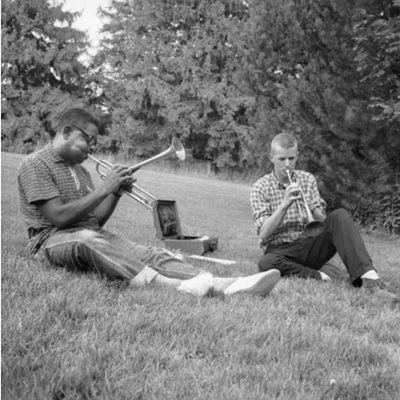
…..Ostensibly I was in Japan to teach English; that was how I’d obtained my visa. I did just enough of that work to keep my residential status, but mostly I spent my time wandering around the lesser-known parts of the city, delighted by its bland Japanese-ness, and playing trumpet with local jazz musicians. There are plenty of music clubs in Kyoto, mostly small bars seating only twenty or thirty people, but always crowded. You could play two nights a week easily, and two more if you were willing to take the express forty minutes to Osaka. I did that train journey frequently, and I’m sure I was better known in the Kansai area as a musician than as a language teacher. There was no money in it, of course, but I enjoyed myself, and it was a good way to mix with Japanese people.
…..That western part of Kyoto is low-rise and monotonously flat. It’s a patchwork of irregular blocks of the cramped old wooden houses called machiyas, punctuated in odd places by dusty beauty salons unchanged from the 1960s, tiny bakeries, barber shops still with striped poles outside, little hole-in-the-wall joints selling pickled vegetables and cooked fish. Tiny devotional shrines stick out awkwardly onto the footpath; they’ve always been there, and it’s impossible, or at best the worst of bad luck, to move them. On the wider streets you find octopus ball stands, ramen restaurants with their black curtains, opticians, camera shops, and of course kombinis, the ubiquitous and invaluable Japanese corner stores. Near the station are rows of brightly-lit izakayas, drinking-houses, raucous in the evening, even noisier pachinko halls, and little stand-up bars – sometimes behind just a plastic sheet – expressly for the locals, which I still didn’t feel confident to enter on my own.
…..The railway line from Nijo station, which runs along a giant concrete overpass, ugly but neat in a very Japanese way, cuts right through this area. At night the sky is purple, with thick skeins of electrical wires criss-crossing it above your head. In the back streets you can always smell miso soup cooking, mixed with the incense from shrines. If you had insomnia, as I had not infrequently, you could walk around the streets at three or four in the morning, see almost nobody, hear only silence. I was very happy there.
…..It was during that time I met Ken Namura. Ken was a very good pianist. He was classically trained, he told me, but preferred to play jazz, in a McCoy Tyner kind of style, strong, rhythmic left hand, very gospelly. We were put together in someone’s makeshift band one night, and hit it off musically straight away. After that, we played together regularly round the Kansai area, with whoever we could find to make up a group.
…..Ken was quite unusual for a Japanese. First, he was tall, taller than me, and I stand a full head above most Japanese men. I wasn’t sure of his age, although I took him to be well past sixty. Bald on top, he tied his remaining hair in a straggly grey ponytail. He had a domed forehead, big eyes behind thick round tinted glasses, a hooked nose, and a very prominent Adam’s apple. He looked rather like an elongated tortoise. And his gestures, and particularly his walk, like a gunfighter, were very un-Japanese. When I met him I assumed he’d learned these from Western films.
…..He dressed in an American style, cowboy boots, jeans, checked shirts, although he was not alone in Kyoto doing that; there were shops peddling second-hand American clothes everywhere. And he spoke good English, accented, of course, but accurate, made odd only by his use of fragments of 1970s American slang, phrases you’d hear on an old Frank Zappa record. Eiichiro Higuchi, the bass player, whom I’d got to know pretty well, mentioned to me once that Ken was rich, and owned a lot of property, but Ken didn’t talk about himself or his life at all, and I never found out if it was true or not.
…..From time to time we’d go out and eat ramen together, at Ken’s invitation; he knew every good ramen shop in Kyoto. It was clear that one reason he chose to hang around with me was to show off his English; to me, to his friends, or to anyone listening, even in the street. I always spoke to him in Japanese, trying to improve my limited fluency, and he’d always answer in English. He’d even go to the – again very un-Japanese – extent of calling out to me across a crowded bar in English, to attract attention to his use of the language. But I put up with these quirks of Ken’s, because he played piano so well. I felt lucky to be on stage with him, to be honest, he was that good.
…..One evening we’d played at Verso, a cellar club on Takatsuji dori. We had a quartet, with Higuchi on bass and a drummer whom I didn’t know. We were just covering standards, but we were all in form, we instinctively understood each other, it went over well with the small crowd; it was a particularly good night. Afterwards, when the patrons had left, we sat around in the empty bar over a couple of beers. I don’t drink before a show, but one or two afterwards is enjoyable, and the camaraderie of the people you’ve just played a good gig with is special. I suppose it’s the same as the winning side’s dressing room after a football match.
…..Ken usually didn’t drink; he smoked a lot of weed, and the two don’t go together. But this night he drank a bit, and it loosened him up enough to talk about himself, which as I say he usually avoided.
…..‘You know,’ he said, leaning towards me on his long neck, peering through his glasses, ‘acid was legal in Japan right up to 1970. And the acid we got then was laboratory-made, like Owsley’s stuff. I took quite a few trips at that time. I would have been about twenty.
…..‘One night I dropped a trip with two other guys, and we started climbing up Mount Higashiyama. There are paths going up, and even though there was no light, we could see our way easily, as you do on acid, you know? As we got more and more out of it, I got separated from the others, but I could see the summit above me, black against the sky, and I went on climbing. When I got to the top, the acid really came on. I was peaking, man, and all I could do was sit there, looking out over Kyoto below.
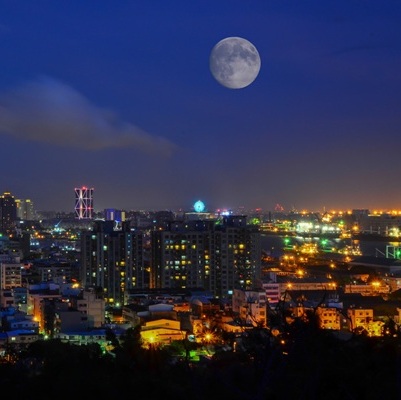
…..‘The lights of the city weren’t so bright in those days, but to me, they were amazing, the mirror image of the Milky Way, you know? Except that they moved, they writhed like a great lit-up serpent, stretched across the whole valley. Unreal, insanely beautiful. But then the serpent reared its head and came up towards me, right up to my face, this huge creature made out of light. It had a single giant red eye, absolutely huge, and looking into this red eye I saw hell, wide open in front of me. Hell like Bosch saw it, you know? And it was trying to draw me in. I was right on the edge of this hell, completely freaked out, fighting not to lose my grip and be sucked into it. Fear, big time, I can tell you.
…..‘That went on maybe all night; it seemed like forever. I know it was only when it began to get light that I started to straighten out. I remember I was soaking wet with dew. Eventually I could get up and go home, but the memory of that fear didn’t leave me for a long time. That’s the only trip I wish I hadn’t dropped. It was a while before I dropped another one, you know?
…..‘I went up the mountain at night again, later that year. Without the acid, the lights down below were just ordinary, of course. Except I realised that the red eye of the serpent, that I’d stared into for so long, that had come from deep in the cosmos to try and drag me into hell, was the red light on top of the Kyoto station tower.’ He laughed.
…..I waited to hear if there was more, but just at that point there was some kind of disturbance at the door. A woman, standing in the entrance, was saying the same few words over and over again, loudly, in a harsh, coarse voice, and the bar-owner was trying to tell her he was closed, and she couldn’t come in. Ken had his back to the door, but as soon as we heard this woman’s voice he broke off his story, and shifted in his seat.
…..The woman succeeded in getting past the bar owner, and came toward our table. Staggered, almost; she was unsteady on her feet. She was clearly drunk, and from her blurred, coarse features, she got drunk a lot. She was wearing a straw hat, like a boater, with turned-up edges and a ribbon round the crown; girlish, and quite strange, as she must have been well past fifty.
…..By this time Ken had got up, and turned to her. She was saying something I didn’t understand, grinning broadly, and waving around an unlit cigarette. Ken took her by the arm, and led her over to a small table to one side, where he sat down opposite her, talking to her, in a low voice, calmly, smiling.
…..‘His wife,’ Higuchi told me, speaking softly. ‘She usually stays home.’ He inclined his head sideways, as if there were more that could be said, but it would not be proper to say it, especially to a foreigner. Perhaps he was embarrassed to have divulged even that much, because he went through his pockets to find a pack of Lucky Strikes. He offered me one, which I refused, much as the sight of the familiar red circle – in Japan then, they still sold Luckies and Camels in the original packaging, without warnings all over it – tempted me. Having lit up, he asked me something about Lee Morgan. The change in subject was so abrupt that I couldn’t follow him at first, but then I understood his intention, and went along with it.
…..After a few minutes Ken came back to our table, and collected his coat and cigarettes. ‘Hasta la vista,’ he said, smiling, a little apologetically I thought, but saying nothing more. He escorted his wife out; the door closed quietly behind them. The bar owner looked over at our group anxiously, but once he was satisfied I wasn’t going to talk about the incident, he went back to clearing up.
…..I played a number of gigs with Ken after that, but he didn’t again speak about his life, and of course I asked him no questions.
…..But a month or two later I was in a second-hand vinyl shop, up at the far end of Teramachi dori. I was searching for 70s Japanese jazz-funk records, a particular passion of mine. Usually, proprietors of such shops ignore Westerners. But perhaps because I’d spoken to him in reasonable Japanese when I came in, the fellow who ran the place, who obviously sat there all day with nothing but records to think about, asked me what I was looking for. Japanese artists, I told him, Masaru Imada, Jiro Ingaki, maybe, that kind of thing.
…..Putting down his cigarette, he shuffled over to the record bins, all immaculately arranged, the discs in plastic sleeves as clean as new satellite dishes. He pulled out a record, by the cover obviously American, early 70’s. I didn’t want American jazz, but to be polite I took it from him and inspected it. I can’t remember the title. But on the back was a photo of the band, a five-piece outfit; he jabbed a finger at this picture, so I dutifully looked more closely. The usual suspects; Oscar Brashear, yes, and Joe Henderson, and then there was Ken, a very much younger Ken, in white flares and a shirt open almost to his waist. There was no doubt about it; his name was written underneath, along with the others.
…..‘Japanese musician,’ said the proprietor. I was going to say, yes I know, but I shut up.
…..‘He was in LA in the 70’s, played with all the big guys, but he got busted for selling acid, and deported back to Japan,’ he told me. ‘Is he still around?’ I ventured. The guy shrugged. ‘I don’t know, maybe.’ I got the impression records were his world, and he didn’t care to go out and listen to live music. I bought the disc; I felt I had to.
…..At first I intended to tell Ken about this remarkable find as soon as I saw him, but the next day I decided I wouldn’t. He’d have told me about it if he wanted to. In Japan, you let people tell you, you don’t ask. Still, now I understood where Ken got his stylized walk, his liking for American clothes, his idiosyncratic but practiced English. I was sure he held his own with those well-known American musicians, too; he really could play, Ken.
…..If he’d stayed in LA – well, what a different life altogether. Sunshine, cocaine, palm trees, freeways, condominiums, money, all that. And maybe he’d have gone on playing with ‘all the big guys’, as the record store man had it, right through the 70’s, and become famous, like Joe Farrell or Tom Scott, or at least ended up in the band on one of the television Tonight shows so popular back then.
…..When I thought about it, I guessed that was Ken’s dream. He must have been in heaven, playing jazz in LA, in America. And yet when the dream had failed him, or been taken from him, he’d accepted a different life, a smaller life, you might say, back in Japan, and accepted too everything else he was dealt, his unhappy, drunken wife, his anonymity, his playing for small money in front of a handful of people who didn’t really know what they were hearing. I say accepted, because nothing about him suggested frustration or bitterness; his manner was really quite gentle, almost Zen. Perhaps he’d learned that, at least, from the acid.
…..Yet Ken hadn’t let the dream die completely; he still clung to a part of it. He still asserted – through his American style, his deliberate use of English – his history, his experience, his difference from the conventional Japanese, even from other Japanese musicians. He may never have talked about it, but some element of everything he’d desired when he was young still burned inside him, I was sure. There are some dreams, like some trips, that stay with you for a very long time.
…..I knew I had absolutely no right to feel sorry for Ken Namura, none at all. He was secure in life, if what Higuchi told me was true, he was well liked, and was a better musician than the rest of us there; better than me, by a good distance. But I did feel a kind of sadness for him, all the same. He’d fallen short of his dream. But some dreams, like some trips, don’t work out as you’d like; they just go in the wrong direction, they carry you down a strange, unwanted path, and there’s absolutely nothing you can do about it, you just have to ride it out to the end, you know?
.
.
___
.
.

Peter Newall has worked in a Navy dockyard, as a lawyer and as a musician. He has lived in Australia, Germany, Japan and now in Odesa, Ukraine, where he leads a local blues band.
.
.
___
.
.
Click here to help support the continuing publication of Jerry Jazz Musician, and to keep it ad and commercial-free (thank you!)
.
Click here to read “La Fontaine,” Ashlee Trahan’s winning story in the 72nd Jerry Jazz Musician Short Fiction Contest
Click here to read more short fiction published on Jerry Jazz Musician
Click here to read The Sunday Poem
A Letter From the Editor: On “The Weary Blues: Celebrating Langston Hughes and the Harlem Renaissance”
Click here for information about how to submit your poetry or short fiction
Click here for details about the upcoming 73rd Jerry Jazz Musician Short Fiction Contest
Click here to subscribe to the Jerry Jazz Musician quarterly newsletter (it’s free)
.
.
.
___
.
.

Jerry Jazz Musician…human produced since 1999
.
.
.