
.
.
.
.
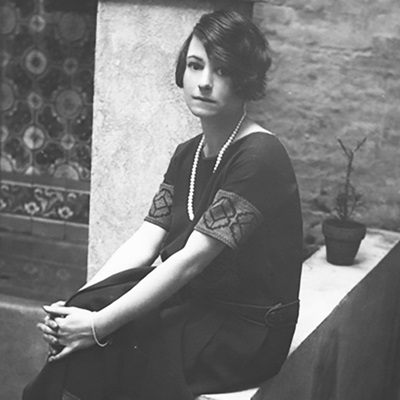
Dorothy Parker, an Icon of the Jazz Age
.
I. The Entrance: Allegro
She enters the room like a rimshot,
sharp enough to wake the drunks
dozing at the back table.
A quicksilver crack across the silence.
The Algonquin waits with nervous chords,
cigarette smoke trembling above cocktails,
ink-stained men rehearsing their cleverness like scales.
Women wrapping their doubt in pearls,
daring each other not to flinch.
Dorothy Parker never flinches.
She sits,
a short glass raised,
her wit already unbuttoned.
Refrain:
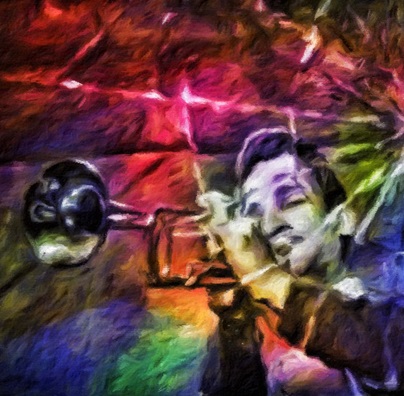
Her tongue is a trumpet in the smoke,
her laugh the cymbal’s kiss,
her pain tucked quiet in the bassline.
The table leans toward her,
as if she were the melody.
.
II. The Round Table: Swing
The Algonquin Round Table,
they call it a lunch,
but it feels like a jam session.
Quips fly faster than sheet music,
barbs braided into improvisations.
Men arrive certain of their brilliance.
Dorothy makes them solos cut short.
Her rejoinders arrive on the offbeat,
unexpected,
perfect,
leaving their orchestration in ruins.
Her tongue is a horn section,
her quips syncopated against the pomp of men
who believe they conduct the room.
They call her cruel,
but cruelty is just honesty
delivered on the offbeat.
Really it’s survival,
syncopation against a world
that would hush her if it could.
Refrain:
Her tongue is a trumpet in the smoke,
her laugh the cymbal’s kiss,
her ache tucked quiet in the bassline.
Listen closer:
beneath the bright brass of her laughter,
there’s a muted trumpet moan,
a slow drag of yearning
slipping under the tablecloth.
Dorothy knows the joke is armor,
and every armor carries its chink.
.
III. Interlude on Love: Lento, Blue
And yet,
when the stage clears,
when applause is memory,
she writes love poems with trembling hands.
She writes of men the way
jazz writes of midnight,
with smoke curling the vowels,
with rhythm aching for resolve
that never comes.
Her sonnets are trapdoors,
her couplets bite, then bleed.
Even the rhyme schemes
carry broken bottles in their pockets.
Love, for her,
was always a forgotten lyric:
sweet in rehearsal,
sour onstage,
cut short by the drummer’s impatient roll.
She marries, divorces, returns,
as if rehearsing a song
that refuses to resolve.
A refrain played too often,
a record needle wearing down the groove.
For Dorothy,
love is a ballad always played in minor,
a chorus cut short,
a tune forgotten halfway through the night.
Still, the audience leans in.
We hear her mask slip
in the quiet measures between epigrams:
her poems whispering of sleep
that won’t come,
of bottles emptied against the hour,
of a body tired of outliving desire.
.
IV. Politics: Forte, Brassy
Do not mistake her for mere entertainment.
The same tongue that skewered her friends
tore at injustice.
She marched, petitioned, wrote,
her words unfurling beyond the cocktail lounge.
The FBI kept files.
She kept her conscience.
Even when blacklists spread like mildew,
Dorothy signed her name,
ink as sharp as her voice at lunch.
Jazz-age frivolity?
Yes. But beneath the clinking glasses,
she laid down chords of resistance.
Refrain:
Her tongue is a trumpet in the smoke,
her laugh the cymbal’s kiss,
her sorrow still standing in the bassline.
.
V. Coda: Diminuendo
What remains is not just the quip.
Not just the woman who could halt
a man mid-monologue.
What remains is the hush between measures,
the tired hand lowering the pen,
the poems where longing breathes
through clenched teeth.
She turned loneliness into cabaret,
turned despair and self-doubt into swing,
made the ache sparkle
long enough for us to forget
what it cost her.
Dorothy Parker,
patron saint of the after-hours,
turned her own breaking
into something that glittered briefly
beneath the spotlight.
And when the house lights rose,
when the last martini glass was cleared,
she went home alone,
her silence louder than any joke.
So let us remember her not only
for the sting of her retort,
but for the hush inside the chord,
the way her wit kept time with her wound,
the way jazz kept time with an age
that wanted to laugh through the ache.
Dorothy in a minor key,
always sharp,
always blue,
always half a step ahead,
always half a step away.
Final Refrain:
Her tongue was a trumpet in the smoke,
her laugh the cymbal’s kiss,
her heart, forever,
the unfinished bassline.
.
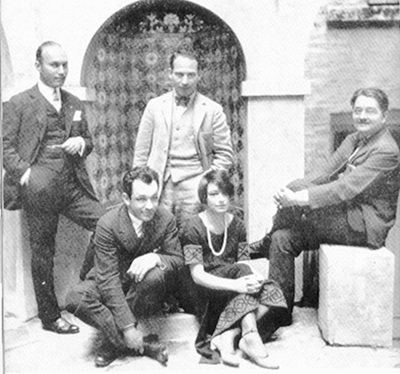
Members and associates of the Algonquin Round Table c. 1931: (standing, left to right) Art Samuels, Harpo Marx (sitting), Charlie MacArthur, Dorothy Parker and Alexander Woollcott.
.
.
___
.
.

Jane McCarthy recently wrapped five years as a co-founder of a deep-tech company, wrangling ideas, words, and the occasional engineer, in her role leading communications and marketing. Originally from the UK and now based in Portugal, she’s pursuing ghostwriting and voice-over work while writing her debut novel. Her storytelling blends speculative curiosity with themes of identity, memory, and the weird ways consciousness misbehaves. Jane loves to listen to emotional jazz while she writes.
Click here to learn more
.
.
Dorothy Parker’s association with jazz music is multifaceted, stemming from her work as a lyricist for popular songs that became jazz standards, the use of her poetry as lyrics in contemporary jazz compositions, and various artistic references to her life and work.
One example is “I Wished on the Moon”, whose music was composed by Ralph Rainger, with lyrics by Parker. It was first introduced by Bing Crosby in the 1935 film The Big Broadcast of 1936 and has since been recorded by many jazz artists, including Billie Holiday.
.
Here is the Crosby recording…[Danmark Music Group]
.
.
And here is the 1935 recording by Billie Holiday….[Columbia/Legacy]
.
.
___
.
.
Click for:
More poetry on Jerry Jazz Musician
War. Remembrance. Walls. The High Price of Authoritarianism – by editor/publisher Joe Maita
“My Vertical Landscape,” Felicia A. Rivers’ winning story in the 69th Jerry Jazz Musician Short Fiction Contest
More short fiction on Jerry Jazz Musician
Information about how to submit your poetry or short fiction
Subscribe to the (free) Jerry Jazz Musician quarterly newsletter
Helping to support the ongoing publication of Jerry Jazz Musician, and to keep it commercial-free (thank you!)
.
___
.
.

Jerry Jazz Musician…human produced since 1999
.
.
.